Page 2 of 3
Re: Why isn't playing a move you want a bot to analyze obvio
Posted: Tue Oct 08, 2019 2:17 am
by ez4u
Uberdude wrote:Knotwilg wrote:
Now that we're here, what frustrates me when analyzing with LZ is, in order of priority:
1. That White starts out with 55%, suggesting komi is too large, but we don't seem to think that part of her assessment is true.
We don't? I think it's true, and I thought most people did too. So long as it's understood in the correct context, i.e. LZ thinks that in games between itself white has a slight advantage with the 7.5 komi. That such an advantage exists in games of a superhuman player doesn't mean a weaker player can make significant use of that advantage.
P.S Title is obvious to me too
P.P.S I think Bill really should install Lizzie.
People should also have this in perspective, which is much easier with the new version 0.7 of Lizzie. Start with an empty board. Switch engines for LZ to katago (under
engines at the top of the window). Katago likes White with a winrate of about 55.3%. Now go into the
Game menu at the top, click on
Set gameinfo and set the komi to 6.5 instead of 7.5. Now katago likes Black with a winrate about 54.3%. So we are talking about nearly a 10% difference due to one point of komi.
Re: Why isn't playing a move you want a bot to analyze obvio
Posted: Tue Oct 08, 2019 2:20 am
by xela
I think there's three things going on here:
- UI design
- The "width" of go compared with chess
- The nature of Monte Carlo tree search
To my mind, go is a much more inherently visual game than chess. The idea that a diagram with numbered moves can show not just a board position, but also the history of a game -- you just can't do that in chess. Chess players are moving pieces around, not adding them, so it's much more natural to think in coordinates or in text.
Another factor is that the chess board is so much smaller, and involves six different types of pieces in an asymmetric starting position (no need to think about mirrored or rotated positions), so coordinates each have their own individual character. H7 is that square where white wants to sacrifice a bishop. C5 is where black tries to undermine white's pawn centre in hypermodern openings. And so on. You don't have the cognitive overhead of: "N12, now is that a knights move away from the stone I played 20 moves earlier, or is it a large knight's move?"
This feeds into the UI design. When I used to analyse chess positions using
SCID, you have a window with the board position, then a separate text window with moves, evaluations and variations. All text. Drawing things on the board doesn't help. But with Lizzie, you can light up the board to show how the engine is "thinking". The immediacy of it is great, but it can also be misleading. A "missed" move sticks out in a way it wouldn't in a text list.
Width: in chess there are rarely more than 20 legal moves in a position, and often only two or three moves that are worth considering in the sense that they don't lose the game obviously and rapidly. If a move isn't near the top of the engine's list then it's generally not worth considering. Exceptions are rare and pretty obvious (e.g. where one player has such a large advantage that nearly any move will be a winning move). In go ... well, I don't need to spell it out in this forum!
And tree searching. Chess engines will evaluate every legal move (although they'll explore some more deeply than others), so nothing is completely overlooked (although once in a while an evaluation will be in error). MCTS guided by a neural net is just weird. The fact that it's possible to ignore very good moves and still play at a superhuman level is hard to understand, but we have plenty of empirical evidence that it's possible! With modern computing power, there should be no problem rewiring an engine to give, say, 10 playouts to every legal move before going into the usual search strategy. You'd lose a bit of strength, especially in fast games, but it might improve things as an analysis tool?
Re: Why isn't playing a move you want a bot to analyze obvio
Posted: Tue Oct 08, 2019 2:23 am
by John Fairbairn
there hasn't actually been a generation of strong Go players who have grown up with the bots from the start.
Obviously true, but there are already indications...
I was intrigued by the following fuseki, played in an exhibition game at a festival for the Nihon Ki-in to thank fans for their support. It was between two new pros. Both are just 13 and so in virtually their entire go careers Zen and later AI bots have been available. From their styles of play we can safely assume they have been using them.
I can only talk in terms of impressions, but FWIW it is normal now for even the more established players to adopt the AI style for the first few moves. They then revert to human type but throw in a few AI-type shoulder hits later on, if they remember. These young players, in contrast, seem to continue the AI style throughout the entire long fuseki.
As to what is characteristic about that style - and again I stress I am giving only my own impressions - I think it is that there is a strong emphasis on the seriai (running battle) style but with the modern difference that the fighting is at more at a distance. Whereas seriai fights in go used to be galleons pounding each other at close quarters, clashing, and being boarded with hand-to-hand fighting ensuing, now a seriai fight is battleships taking pot-shots at each other a couple of miles apart.
A few other changes result from that. For example, extraneous things like reconnaissance (probes) becomes more important. But a more fascinating one, to me, is that the concept of good shape seems also to be changing. Prophylactic shapes are becoming more flexible (in crude terms: wider). We might even say shapes are becoming more adventurous. If this right, I assume it is all part of the drive to achieve maximum efficiency and overconcentration.
Obviously I'm too weak to say the players in the above game have achieved naximum efficiency, but I think most of us here are strong enough to say there is extraordinarily little overconcentration (a couple of examples of potential heaviness that cancel each other out, perhaps?).
There is, incidentally a very early potential ladder in what is considered an AI joseki. Does that not confuse the bots?
Re: Why isn't playing a move you want a bot to analyze obvio
Posted: Tue Oct 08, 2019 2:34 am
by Bill Spight
Knotwilg wrote:Now that we're here, what frustrates me when analyzing with LZ is, in order of priority:
1. That White starts out with 55%, suggesting komi is too large, but we don't seem to think that part of her assessment is true.
Well, AlphaGoTeach gives White only about a 3% advantage, and the Elf commentaries give White about a 1% advantage. Both use a huge number of playouts.

Uberdude wrote:We don't? I think it's true, and I thought most people did too. So long as it's understood in the correct context, i.e. LZ thinks that in games between itself white has a slight advantage with the 7.5 komi. That such an advantage exists in games of a superhuman player doesn't mean a weaker player can make significant use of that advantage.
It's the first player, Black, who has the possible advantage as the skill level increases. So if anything, as bots get better we should see the estimated advantage for White decrease with the 7½ pt. komi. But, for human players, anyway, statistics for over 40 years have indicated that the modal result on the board in an even game has been 7 pts.
Knotwilg wrote:2. Ladders. They are not rare and can play a big role in a local evaluation. Then you see the ladder forming and facepalm ...
You've come to the right place. Dealing with ladders is right up lightvector's alley.
Knotwilg wrote:3. When you play out a suggested sequence with winning percentage x% on the first move, on any move (i) in that sequence the winning percentage x_i can vary by a lot.
The number of playouts is a factor there. That's why the Elf commentaries do not continue such sequences when the number of playouts drops to 1500. Even with a bot as strong as Elf, the Elf team did not trust its winrate estimates with so few playouts.
Re: Why isn't playing a move you want a bot to analyze obvio
Posted: Tue Oct 08, 2019 3:20 am
by Knotwilg
ez4u wrote:
People should also have this in perspective, which is much easier with the new version 0.7 of Lizzie. Start with an empty board. Switch engines for LZ to katago (under engines at the top of the window). Katago likes White with a winrate of about 55.3%. Now go into the Game menu at the top, click on Set gameinfo and set the komi to 6.5 instead of 7.5. Now katago likes Black with a winrate about 54.3%. So we are talking about nearly a 10% difference due to one point of komi.
Really (rushes to LZ's download page) ?!
and
Really (now not so sure anymore what to think of bot based analysis) ?!
Re: Why isn't playing a move you want a bot to analyze obvio
Posted: Tue Oct 08, 2019 4:15 am
by Kirby
About the komi advantage at the start of the game...
Usually, my goal in using LZ is not to see who is leading - it’s to see where I made mistakes in my game, and to see other strong options.
From this perspective, it is irrelevant who is leading at the start of the game, because it doesn’t give information about a mistake I have made - I haven’t played any moves, yet! What matters to me is interpreting later parts of the game where I can potentially find mistakes.
Re: Why isn't playing a move you want a bot to analyze obvio
Posted: Tue Oct 08, 2019 5:34 am
by Gomoto
(You can always change the komi in the sgf file before analyzing if you like to.)
Re: Why isn't playing a move you want a bot to analyze obvio
Posted: Tue Oct 08, 2019 6:24 am
by Knotwilg
Kirby wrote:About the komi advantage at the start of the game...
Usually, my goal in using LZ is not to see who is leading - it’s to see where I made mistakes in my game, and to see other strong options.
From this perspective, it is irrelevant who is leading at the start of the game, because it doesn’t give information about a mistake I have made - I haven’t played any moves, yet! What matters to me is interpreting later parts of the game where I can potentially find mistakes.
Sure, but I would find it pleasing if the game started with a 50-50 chance. It would increase my confidence in the differential analysis.
Re: Why isn't playing a move you want a bot to analyze obvio
Posted: Tue Oct 08, 2019 7:00 am
by yoyoma
Knotwilg wrote:Kirby wrote:About the komi advantage at the start of the game...
Usually, my goal in using LZ is not to see who is leading - it’s to see where I made mistakes in my game, and to see other strong options.
From this perspective, it is irrelevant who is leading at the start of the game, because it doesn’t give information about a mistake I have made - I haven’t played any moves, yet! What matters to me is interpreting later parts of the game where I can potentially find mistakes.
Sure, but I would find it pleasing if the game started with a 50-50 chance. It would increase my confidence in the differential analysis.
With KataGo (easy using LZ 0.7) set komi to 7.0, and it will say the game starts at close to 50-50.
Re: Why isn't playing a move you want a bot to analyze obvio
Posted: Tue Oct 08, 2019 7:54 am
by Kirby
Knotwilg wrote:Kirby wrote:About the komi advantage at the start of the game...
Usually, my goal in using LZ is not to see who is leading - it’s to see where I made mistakes in my game, and to see other strong options.
From this perspective, it is irrelevant who is leading at the start of the game, because it doesn’t give information about a mistake I have made - I haven’t played any moves, yet! What matters to me is interpreting later parts of the game where I can potentially find mistakes.
Sure, but I would find it pleasing if the game started with a 50-50 chance. It would increase my confidence in the differential analysis.
i think of it like a game theory problem where the expected payoff is negative.
for example, let's say you are going to play tic-tac-toe with your friend. if you win, you have to pay him $5. if you tie, you have to pay him $10, and if you lose you have to pay him $20. all situations are bad for you, but there is still an optimal way to play - if your goal is to end up with the most amount of money, you should aim to have minimal loss. (unless you say that the optimal strategy is to not play the game - in that case, just don't play go as black :-p)
i suppose that go is a zero-sum game, so you can argue that if it's a losing position, it doesn't matter what you play. but from that perspective, we don't really need win rates - we just need a binary value from LZ that says, "black is winning" or "white is winning". i think it's useful to have a more descriptive quantification of the amount of gain/loss.
i guess my conclusion is that if we accept that non-binary evaluation of board state in the form of percentages to be a useful form of analysis, looking for move recommendations that minimize loss, even from a losing position, is useful for identifying mistakes.
Re: Why isn't playing a move you want a bot to analyze obvio
Posted: Tue Oct 08, 2019 9:59 am
by jann
Bill Spight wrote:It's the first player, Black, who has the possible advantage as the skill level increases. So if anything, as bots get better we should see the estimated advantage for White decrease with the 7½ pt. komi.
Could you explain this? If 7.5 is too much (very likely) then W winrate will approach 100% as the level increase, won't it?
Re: Why isn't playing a move you want a bot to analyze obvio
Posted: Tue Oct 08, 2019 11:22 am
by Bill Spight
jann wrote:Bill Spight wrote:It's the first player, Black, who has the possible advantage as the skill level increases. So if anything, as bots get better we should see the estimated advantage for White decrease with the 7½ pt. komi.
Could you explain this? If 7.5 is too much (very likely) then W winrate will approach 100% as the level increase, won't it?
I was not assuming that 7.5 komi is too much. If that is given, then indeed the White winrate will equal 100% with perfect play with 7.5 komi.
Uberdude wrote:That such an advantage exists in games of a superhuman player doesn't mean a weaker player can make significant use of that advantage.
Assuming that both players are evenly matched, in general it is Black who is better able to make use of the advantage of the first move, so that the statistical komi generally increases with their skill level. Statistical komi might be 3.5 for DDKs, for instance. For Black to give 5.5 komi at that level may favor White. But 5.5 komi favors Black at the pro level. And if 7.5 komi favors White at the level of today's top bots, it surely favors White at the human level. That's what I should have said, instead of predicting what will happen as bots get stronger. That was speculation.
But there is no guarantee that, as bots get stronger, 7.5 komi will continue to favor White.
Re: Why isn't playing a move you want a bot to analyze obvio
Posted: Tue Oct 08, 2019 3:20 pm
by xela
ez4u wrote:Uberdude wrote:Katago likes White with a winrate of about 55.3%. Now go into the Game menu at the top, click on Set gameinfo and set the komi to 6.5 instead of 7.5. Now katago likes Black with a winrate about 54.3%. So we are talking about nearly a 10% difference due to one point of komi.
These numbers are pretty much what I'd expect if seven points is the "correct" komi:
- 44.7% of playouts end up with black 8 or more points ahead on the board, so a win for black with either komi.
- 45.7% of playouts end up with black no more than 6 points ahead on the board, so a win for white with either komi.
- 9.6% of playouts end up with black exactly 7 points ahead on the board, so could go either way depending on komi.
The third number being so small tells us that perfect play is still some way off.
Re: Why isn't playing a move you want a bot to analyze obvio
Posted: Tue Oct 08, 2019 7:16 pm
by EricBackus
xela wrote:With modern computing power, there should be no problem rewiring an engine to give, say, 10 playouts to every legal move before going into the usual search strategy. You'd lose a bit of strength, especially in fast games, but it might improve things as an analysis tool?
I'm skeptical.
Does it really help to analyze every legal top-level move but not every legal response to those moves? You clearly don't want to force analysis of every response to every move at every level of the tree, because then you're just doing a brute-force search and you don't have anywhere close to the computing power you would need for that. But with only 10 playouts for each legal move, do you really get any kind of accurate estimate of the value of those moves?
But, of course, it is worth trying anyway just to see what happens.
Re: Why isn't playing a move you want a bot to analyze obvio
Posted: Tue Oct 08, 2019 11:56 pm
by Uberdude
Here is a screenshot of LZ 247 network with the normal LZ engine pondering on the Takemiya reduction position form John's original thread after 100k playouts. Note that in Lizzie 0.7 I changed the default setting to show stats on all moves considered rather than the default threshold of only showing if they have at least 0.1 of the total playouts (n which case you get just a dull red circle). It is very single-minded and focuses almost all of its resources on further exploring the shoulder hit.
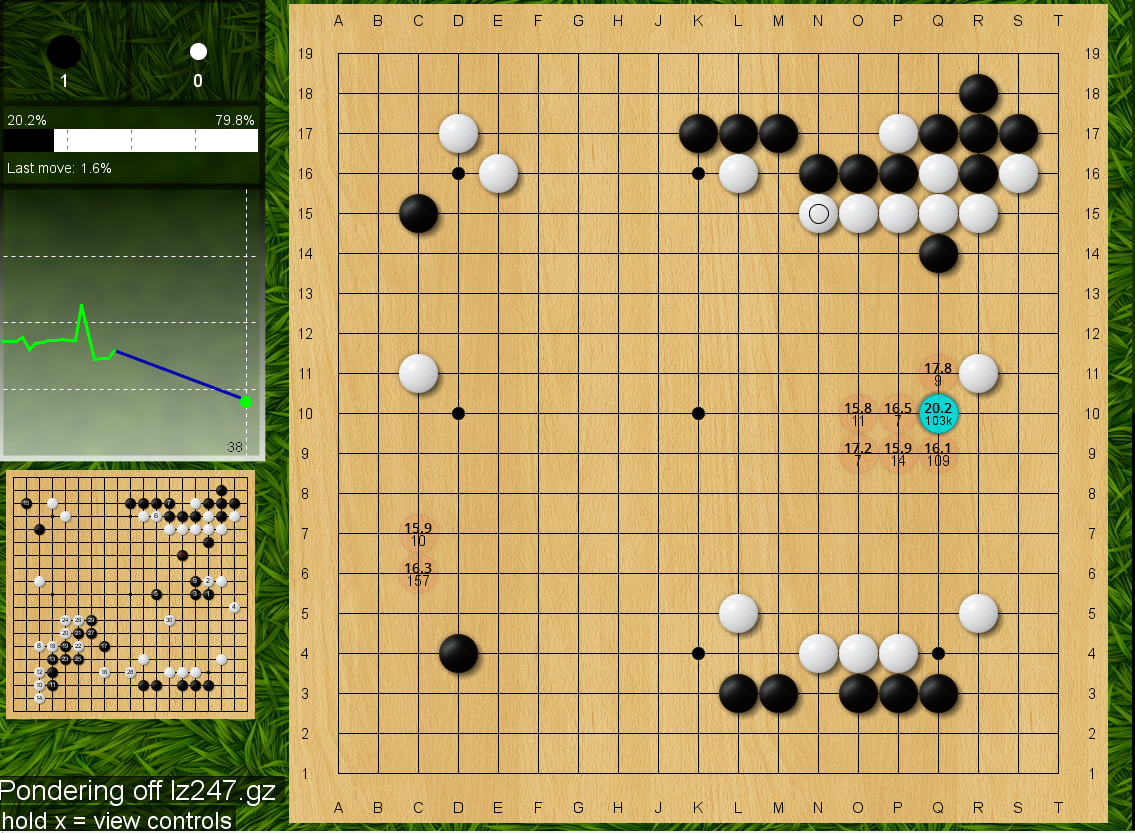
- JF Takemiya reduce LZ.PNG (1.33 MiB) Viewed 8538 times
And here is the same position using the LZ review mode engine which is modified to force LZ to consider more moves (from
https://github.com/AncalagonX/leela-zer ... v0.16-next)
First, 800 visits of unmodified search are performed like normal. Beyond 800 visits, LZ is only allowed to spend 25% of its total visits per second drilling down onto its standard preferred "most optimal" move(s). The remaining 75% of total visits are then split equally among a large number of other top move candidates.
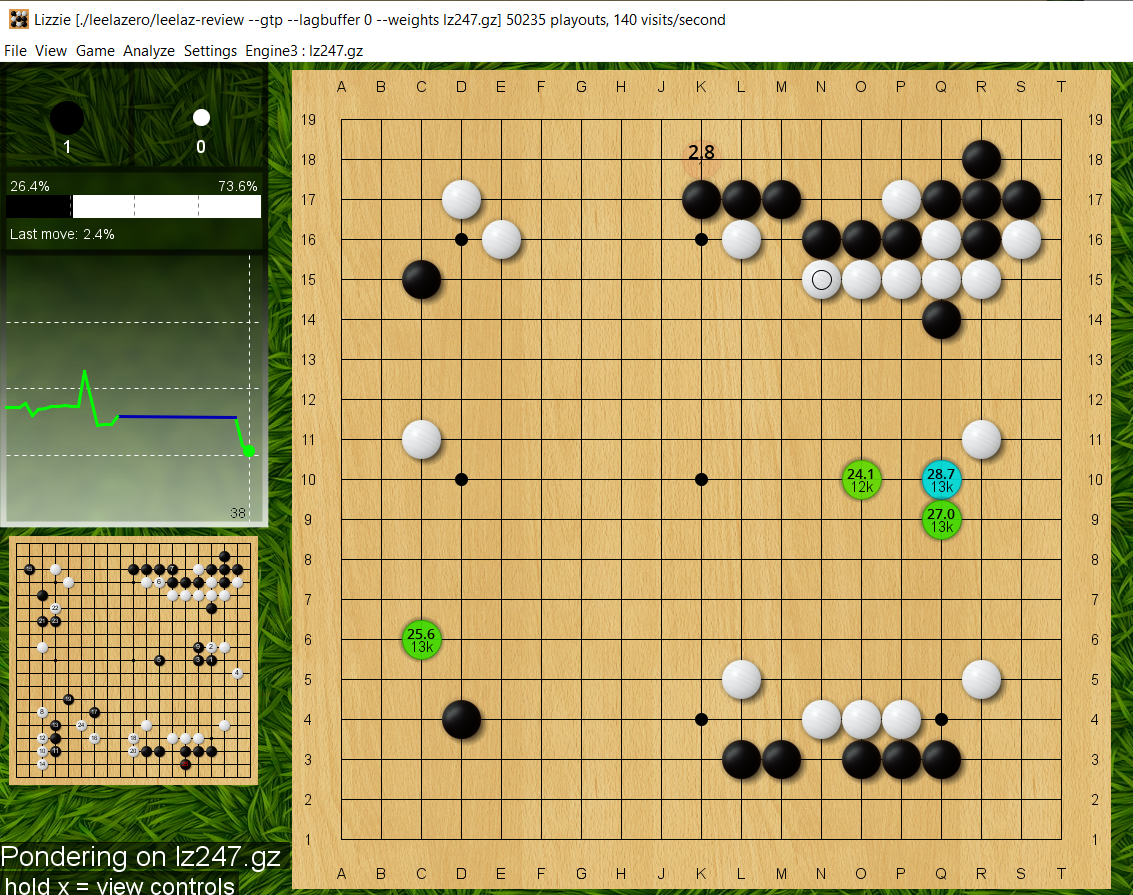
- JF Takemiya reduce LZ review.PNG (1.32 MiB) Viewed 8538 times
It didn't actually look at as many alternatives as I'd hoped: it worked better with older weaker networks that weren't so single minded. The 4 options reflects a hardcoded parameter of the modified engine, that could be increased if desired. But at least they have more playouts so have a better winrate estimate.
Also for completeness here is LZ247's view after I play Takemiya's gentler reduction, -6% over the shoulder hit. Interesting to note that even after the gentle reduction, it still ends up wanting to go in deep as black when white clamps the attachment of 2 in the principal variation (which only happens because it thinks white's knight response at o10 is a little better than Takemiya's opponent's block at o9, that seems to be because it thinks o10 has a good follow up at n8 if black tenuki, whilst o11 is easier to tenuki and leaves n11 as a good forcing move before Takemiya's m7).
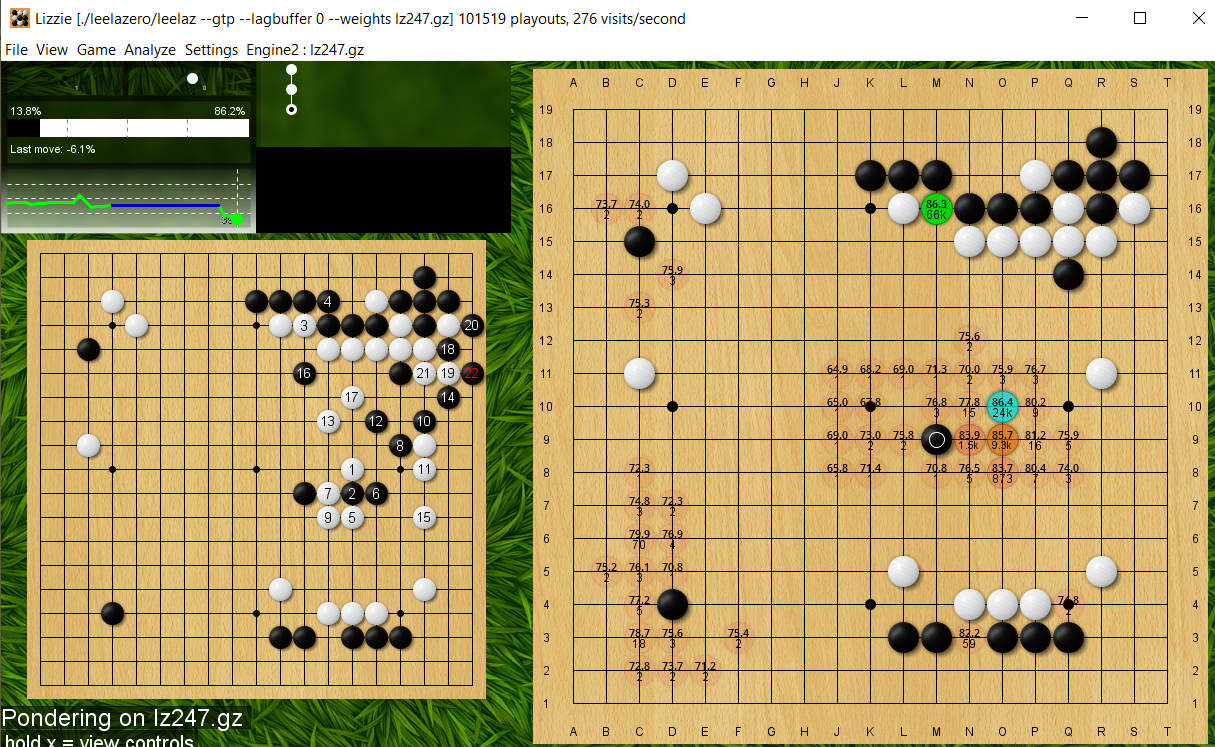
- JF Takemiya reduce LZ on Takemiya.PNG (1.22 MiB) Viewed 8538 times