Well, I'm not a physics major, but I just attempted it and
the shaken up one was slower.
I really don't have a good idea why.
Re: Physics puzzles
Posted: Wed Nov 24, 2010 1:47 am
by shapenaji
SpongeBob wrote:cyclops, I liked your reasoning with the pressure, nice.
Well, it seems my first puzzle was not difficult enough for a smart croud like the one here on L19. Watch out: this one is REALLY cool, but also hard to figure out:
You have a ramp and you have two identical cans of soda. If you let both cans roll down the ramp, they will arive at the bottom of the ramp at the same time. Now if you shake one of the cans directly before the experiment, one of them will be faster than the other. Which one is it and why?
And if you do not believe that: try it out!
Well, here's my thought process.
What does shaking a can of soda do? It separates the carbonated bubbles from the solution. The liquid zone may loose a little volume and the "air zone" may gain a little volume along with a lot of increased pressure (The increased pressure shouldn't change the volume of the fluid additionally though,since the fluid is incompressible)
What effect does this have? It results in a change in the moment of inertia of the can, A transfer of mass takes place (an evening out if you will) between the top and the bottom of the can. This will result in a decrease. Which means that the shaken-up can should spin faster when given an equivalent amount of energy (in this case, gravitational potential energy)
Re: Physics puzzles
Posted: Wed Nov 24, 2010 2:38 am
by entropi
Made a try but deleted afterwards because it did not make much sense.
Here is another try:
What happens by shaking is that the mass inside the can is shifted from liquid to gas. The question is why it should make the can slower or faster?
While the can is rolling, the liquid moves inside, which creates friction. Since this requires some energy, it takes some portion of the potential energy that should normally turn into cinetic energy. Thus, the can with less liquid mass should be faster (assuming the friction depends on mass).
But, otoh I would guess that an empty can would roll slower than a full one, which is a contradiction to my reasoning.
Therefore my conclusion is: It is an inexplicable twilight zone phenomenon.
Re: Physics puzzles
Posted: Wed Nov 24, 2010 2:55 am
by HermanHiddema
The title "Physics puzzles" reminded me of this one:
O.k.,
here comes my attempt for a nice contribution to this thread:
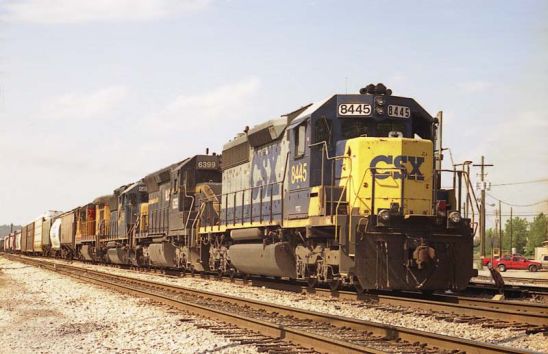
Late in the evening of a warm summer night, into the setting sun,
a very heavy freight train is pulled by a strong and heavy locomotive
onto its way to destination.
A tiny mosquito - may be it was an ephemerid ('one-day-fly' in German) - happened to hoover above the rails - when,
its honeycomb eyes blinded by the evening sun, it turns around and WANG- its short life found an end.
There was a moment that the train (and perhaps insect?) stood still (had speed zero). True or not?
_______________________________________________________________________________________________________________________ You know the 'Impulserhaltungssatz' (German for momentum conservation law (theorem) in physics)
momentum (SI unit kg·m/s, or, equivalently, N·s) is the product of the mass and velocity of an object (p = mv).
p = mv = constant,
resp. p1 x m1 = p2 x m2
The law of conservation of momentum states that if a body A of mass m1 and initial velocity u1 collides with a body B of mass m2 and initial velocity u2 , then after collision their final velocities will be v1 and v2 respectively:
(m1 x u1) + (m2 x u2) = (m1 x v1) + (m2 x v2) = constant
The question:
As i) the law is an axiom, hence must be true,
ii) the weight of neither heavy freight train nor tiny insect did change,
iii) speed of insect, above ground was initially about zero,
iv) speed of insect afterwards is = speed of train,
v) there was a time that insect had the speed zero
vi) then momentum = m(insect) x (speed = 0) = 0 =? momentum(train) is zero too?
vii) there is a first moment that insect & train have the same speed,
viii) hence speed v of both train and insect must have been zero at one moment?.
________________________________________________________________________________________________________________
EDITED: insect flies a tiny bit into the direction of the train
Re: Physics puzzles - mosquito meets train
Posted: Wed Nov 24, 2010 5:19 am
by cyclops
Tommie wrote:
viii) hence speed v of both train and insect must have been zero at one moment?.
why hence?
I don't understand the meaning of =? in (vi)
Re: Physics puzzles - mosquito meets train
Posted: Wed Nov 24, 2010 5:47 am
by flOvermind
mosquito meets train:
Tommie wrote:
The question:
As i) the law is an axiom, hence must be true,
It's not an axiom in the mathematical sense, so no, that argument alone is not a reason to just state it is true.
It's a physical law, and as such it's just a theory. But it has been confirmed by a lot of experiments, so lets assume for the moment it's true
Tommie wrote:
ii) the weight of neither heavy freight train nor tiny insect did change,
iii) speed of insect, above ground was initially about zero,
iv) speed of insect afterwards is = speed of train,
Afterwards, the speed of the insect = the *new* speed of the train = the former speed of the train - some tiny value (ignoring friction and engine forces).
Tommie wrote:
v) there was a time that insect had the speed zero
vi) then momentum = m(insect) x (speed = 0) = 0 =? momentum(train) is zero too?
The momentum of the insect is zero, yes. But you always have to look at the momentum of the whole system. Momentum must be preserved, but it can be transferred from one object to another.
momentum_before = m(insect) x (speed(insect)=0) + m(train) x speed(train) = m(train) x speed(train)
That's the initial momentum of the whole system.
Tommie wrote:
vii) there is a first moment that insect & train have the same speed,
viii) hence speed v of both train and insect must have been zero at one moment?.
momentum_afterwards = m(insect) x speed(after) + m(train) x speed(after) = (m(insect)+m(train)) x speed(after) = m(train) x speed(train)
speed(after) = speed(train) x m(train) / (m(insect)+m(train))
So speed(after) is lower than speed(train) and higher than speed(insect)=0 (assuming m(insect) is finite and >0). The speed of any object must be continuous, because only finite acceleration is possible. And there is no force present that accelerates the train, so the curve of speed over time is monotonous. That means the speed of the train at any time is between speed(train) and speed(insect). Therefore, it is at no time equal 0.
Re: Physics puzzles
Posted: Wed Nov 24, 2010 6:20 am
by cyclops
SpongeBob wrote:cyclops, I liked your reasoning with the pressure, nice.
thx
SpongeBob wrote:
You have a ramp and you have two identical cans of soda. If you let both cans roll down the ramp, they will arive at the bottom of the ramp at the same time. Now if you shake one of the cans directly before the experiment, one of them will be faster than the other. Which one is it and why?
And if you do not believe that: try it out!
Lets assume only frictional loss from the inside. Because the fluid surface tries to remain horizontal the shaken can will have internal friction all the time resulting in a maximum speed.
In the unshaken can the fluid's rotation follows the can's rotation and the acceleration goes on forever. So the unshaken can wins in the end.
Another point of view: In the shaken can, because of the drag the gas will get concentrated in the forward direction pushing the center of gravity backwards thus reducing gravity's torque around the turning point/line ( the point/line where ramp and can touch ). Hence less acceleration.
Re: Physics puzzles - mosquito meets train
Posted: Wed Nov 24, 2010 6:24 am
by Tommie
cyclops wrote:
Tommie wrote:
viii) hence speed v of both train and insect must have been zero at one moment?.
why hence?
I don't understand the meaning of =? in (vi)
The meaning of the question mark ? is its basic one,
e.g. transforming an affirmative statement into a question of the type: This statement, is it true?
I do not know how else to express this in a mathematical formula.
If speed = zero,
then the product of anything times zero must also be = zero
Re: Physics puzzles - mosquito meets train
Posted: Wed Nov 24, 2010 6:54 am
by ethanb
Tommie wrote:
cyclops wrote:
Tommie wrote:
viii) hence speed v of both train and insect must have been zero at one moment?.
why hence?
I don't understand the meaning of =? in (vi)
If speed = zero,
then the product of anything times zero must also be = zero
Shouldn't this be in the "Trolling in field of study" thread?
Even disregarding flOvermind's (correct, I believe) argument from conservation of momentum, there is also the point that the collision with the insect is partly elastic. I didn't see you mention "a spherical mosquito of uniform density" but you did say that it squished. Therefore the transfer of kinetic energy actually took place over time, not in a single instant. So zero wasn't a factor anyway.
Re: Physics puzzles
Posted: Wed Nov 24, 2010 7:05 am
by Harleqin
SpongeBob wrote:cyclops, I liked your reasoning with the pressure, nice.
Well, it seems my first puzzle was not difficult enough for a smart croud like the one here on L19. Watch out: this one is REALLY cool, but also hard to figure out:
You have a ramp and you have two identical cans of soda. If you let both cans roll down the ramp, they will arive at the bottom of the ramp at the same time. Now if you shake one of the cans directly before the experiment, one of them will be faster than the other. Which one is it and why?
And if you do not believe that: try it out!
The increased pressure inside the can blows it up a bit. In order to change the turning speed, which is required for rolling down a ramp, you need to apply torque, and that is proportional to the radius. You thus need more force to get the bigger can turning, which means that less force is available for acceleration downwards. The blown-up can therefore is slower in accelerating and arrives later at the bottom.
Re: Physics puzzles - mosquito meets train
Posted: Wed Nov 24, 2010 7:10 am
by Tommie
flOvermind wrote:mosquito meets train:
flOvermind wrote:
Tommie wrote:
The question:
As i) the law is an axiom, hence must be true,
It's not an axiom in the mathematical sense, so no, that argument alone is not a reason to just state it is true.
It's a physical law, and as such it's just a theory. But it has been confirmed by a lot of experiments, so lets assume for the moment it's true
I am not a physicist and just wanted to provide the formula of the law.
A bit of the introduction is to mislead non-physicist like myself.
(...)
flOvermind wrote:
Tommie wrote:
v) there was a time that insect had the speed zero
vi) then momentum = m(insect) x (speed = 0) = 0 =? momentum(train) is zero too?
flOvermind wrote:
The momentum of the insect is zero, yes. But you always have to look at the momentum of the whole system. Momentum must be preserved, but it can be transferred from one object to another.
momentum_before = m(insect) x (speed(insect)=0) + m(train) x speed(train) = m(train) x speed(train)
That's the initial momentum of the whole system.
Tommie wrote:
vii) there is a first moment that insect & train have the same speed,
viii) hence speed v of both train and insect must have been zero at one moment?.
flOvermind wrote:
momentum_afterwards = m(insect) x speed(after) + m(train) x speed(after) = (m(insect)+m(train)) x speed(after) = m(train) x speed(train)
speed(after) = speed(train) x m(train) / (m(insect)+m(train))
So speed(after) is lower than speed(train) and higher than speed(insect)=0 (assuming m(insect) is finite and >0). The speed of any object must be continuous, because only finite acceleration is possible. i) And there is no force present that accelerates the train, so the curve of speed over time is monotonous.
ii) That means the speed of the train at any time is between speed(train) and speed(insect).
iii) Therefore, it is at no time equal 0.
i) If the train is becoming slower (perhaps to zero?) as I and you suggest,
then the train undergoes negative acceleration. What does the 'monotonus' mean & imply?
ii) Is it, can it be zero, e.g. for the tiniest moment?
iii) Why Therefore,? If speed of insect = zero before contact,
then it can be zero because of ii), thus iii) is not true , thus no validity for Therefore,.[/hide]
Gosh, the hide & quote level labels are difficult to postion!
EDITed problem a tiny bit, insofar that insect flies into the direction of the train
Re: Physics puzzles - mosquito meets train
Posted: Wed Nov 24, 2010 7:28 am
by flOvermind
Tommie wrote:Gosh, the hide & quote level labels are difficult to postion!
EDITed problem a tiny bit, insofar that insect flies into the direction of the train
Hehe... I think I know where you're getting at.
Starting out from my equations, we get that the insect accelerates from a negative velocity to a positive velocity, so obviously at some point after the collision it has to have velocity 0. The train decelerates from a large positive velocity to a slightly smaller positive velocity, so at no point it reaches zero. That's a direct consequence of the law of conservation of momentum.
The apparent paradox is that from the point on when they collide, they should have the same velocity. So how can it be that the insect will have 0 velocity at some point after the collision, but the train not?
The problem here is that it's not really correct that both have the same velocity. Their velocities will approach each other, but not instantly, because of deformation of the colliding bodies.
Re: Physics puzzles - mosquito meets train
Posted: Wed Nov 24, 2010 7:42 am
by Tommie
ethanb wrote:
Shouldn't this be in the "Trolling in field of study" thread?
Even disregarding flOvermind's (correct, I believe) argument from conservation of momentum, there is also the point that the collision with the insect is partly elastic. I didn't see you mention "a spherical mosquito of uniform density" but you did say that it squished. Therefore the transfer of kinetic energy actually took place over time, not in a single instant. So zero wasn't a factor anyway.
Providing a puzzle implies that some know the answer beforehand, others afterwards.
Being invited to provide and to solve puzzles is thus voluntarily 'trolling' from both sides, active and passive, yes.
It is thus an action enjoyed by all participants, I hope.
If we were physicists and knew all the answers ... but we are not.
From your statement I guess that you want to answers my question with 'No' , is that correct?
Flowovermind is the first one to state
That's the initial momentum of the whole system.
.
You are the first one to mention
partly elastic
.
Now also flowovermind mentioned 'deformation'.
The bold terms in your comment above 'spherical', 'uniform density' - what do they have to do with the answer?
Why 'Therefore'?
Therefore the transfer of kinetic energy actually took place over time, not in a single instant.
If it could have happened in a single instant, would then the train stand still?
Re: Physics puzzles - mosquito meets train
Posted: Wed Nov 24, 2010 7:50 am
by Tommie
flOvermind wrote:
Starting out from my equations, we get that the insect accelerates from a negative velocity to a positive velocity, so obviously at some point after the collision it has to have velocity 0. The train decelerates from a large positive velocity to a slightly smaller positive velocity, so at no point it reaches zero. That's a direct consequence of the law of conservation of momentum.
The apparent paradox is that from the point on when they collide, they should have the same velocity. So how can it be that the insect will have 0 velocity at some point after the collision, but the train not?
The problem here is that it's not really correct that both have the same velocity. Their velocities will approach each other, but not instantly, because of deformation of the colliding bodies.
At the time when they are approaching zero speed difference,
the energy transfer by the momentum of the insect will also be approaching zero.
I think that's the answer. I'm not a physicist myself and heard this problem from a informatician 10 years ago, hence for me it was quite an honest puzzle.
It could be called Zeno and the Mosquito but this would probably give something away already.