I've never actually heard anyone refer to a moyo as a territorial framework; it's either moyo or framework.)
So, you've never read my stuff!!! Shame on you!
There is a lot of sense in what you say, but one also has to guard against being a frog in a well. There's moyo, jimoyo and omoyo, and kakoi. One major problem with adopting Japanese terms in the west is that they are badly misused (e.g. yose for endgame), so we end up with different meanings floating around, depending on how well the user knows Japanese.
Another problem with adopting Japanese is that the grammar gets lost, so we end up with made-up grammar such as "to make sabaki" or the somewhat nonsensical "to tenuki". We also get made-up and varying pronunciations.
Yet another problem in the past, and maybe still to a degree today, is that some people with long memories don't like the Japanese. Using Japanese terms offends them.
That's not much of a problem nowadays but it's been replaced by another one. The Koreans are very chippy about people in the west using Japanese terms, and would much prefer us to use Korean. My sense is that they've realised that is a futile exercise, but the problem still rears its head.
One benefit of saying things in English is that while they may mean little to a novice they at least sound welcoming. For every putative negative association with chess you can probably adduce several positive ones such as "this guy is trying to communicate with me" or "he's not a nerd". Jargon is offputting, but it's possibly twice as offputting if it's foreign as well.
There are several other aspects to consider, such as choosing a lingua franca for westerners who do not have a native command of Englsh, but the upshot is that the whole business is a mess and will probably remain so for a long time, and each writer or teacher has to try to make a judgement on how much jargon to use, and in what form, depending on his audience. He will probably fail a good percentage of the time.
This is actually not a problem exclusive to us. The Japanese have been down this road. We may usefully refer to the very long article 術語をいかにすべきか? (What should we do with technicaal terms?) in
Kido, Vol. 37, No. 12 (1961). This was the transcription of a round-table discussion led by the Kido editor. It involved all the top go writers of the time, plus a couple of top pros. It was essentially this meeting that determined that go terms came to be written mostly in katakana.
To give a flavour of what they were talking about, here is part of Hayashi's introductory remarks.
"Voices were raised several years ago saying we must somehow standardise technical terms. Recently, new people have started writing game commentaries and the problems of technical terms have again come back to the boil. Almost 500 books have been published since the end of the war, and although some may feel it is too late, I thought that if we could form a research group again, as you all are deeply versed in technical terms it would be a group that has some authority. Today’s meeting is the first step and I would like to hear your various opinions. Takagawa sensei was also meant to be here today, but circumstances meant he could not come. He will give us the benefit of his opinions on another occasion.
"The problems of technical terms can broadly be divided into two: the problem of standardisation of terms and then the problem of the characters used. At present there is also the problem of whether or not technical terms are being used inaccurately, but I think the most thoroughly confusing issue is the use of characters. There are people who use old-style kanji and there are others who use hiragana, and there are also some people who use katakana. Also, even among those who use katakana, there are complexities to do with declensions and at what point you put the katakana. I believe it would be a step towards reaching the ideal state if a grammar, as it were, could be standardised and if all writers would follow it as much as possible.
"One further thing where we must think about the future is how to handle the case of translating the terms into foreign languages, but, for the time being, of these three problems I would like to hear your opinions of the first two, fundamental, problems."
One speaker, Mihori Sho, who will be known as the reporter who covered many famous games, also showed some foresight as regards the international audience. He said:
"I am the one who knows least among those here, and I have come expecting to learn a great deal today. But if I were to state my general view to get things started, ultimately one kind of technical term is, first of all, those where they give a name to the meaning of the stone just played. A second type is those named according to their shape. These can be understood from the situation. I also believe that, as regards the problem of characters Mr Hayashi has just mentioned, using katakana is best, since the [government] restriction of kanji is now being welcomed everywhere. To take the characters for osaeru [to block], there are as many as four proper ones: . 約、押、抑and 捺. I have some sympathy for using the old characters, from before the restrictions, as Inoue Takuji [a famous pre-war go writer] often did in order to convey a meaning or a nuance, but we have a mission to think internationally and so I think it is surely better not to use the old characters."
Before the war, the typical amateur go fan who bought books and magazines was pretty strong. He was at home with technical words, although, as the above discussion also showed, pros and amateurs had (and still have) rather different vocabularies and usages. After the war, there was a new audience who were much weaker, and often couldn't read the old characters (or properly understand the old grammar used before the war). This meant a big change and the introduction of quite a few terms that were of little use to strong players but were necessary for beginners. Under this pressure, too, some terms such as joseki and tesuji and hane became fuzzy, at least among amateurs.
Then foreigners came along and just made the situation worse, not just by being even fuzzier, but fussier as well.
What to do about such a to-do? There is wisdom in the old rhyme (seek and ye shall find):
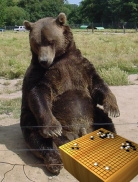
Fuzzy wuzzy was a bear,
Fuzzy wuzzy had no hair,
Fuzzy wuzzy didn't care.
Fuzzy wuzzy wasn't fussy, wuz 'e?