Hey guys, sorry I haven't updated this journal more. I've been busy and whatnot, but I figured I should share stuff here since some go related things have happened in my life.
(It has
been way too long since a post here. An internal critic needs to be able to vent every now and then. 
Moyo has been neglecting his studies to some extent. Sure, he still reads on occasion, and every now and then he'll do a go problem, but he hasn't been playing games like he should. Even his club visits are lacking in games. I know he's got a life, but I feel I need to give him a push every now and then.
In my own way I do support him. I want him to become a dan level player, too.
The guy's a kyu, he makes lots of mistakes in his games. I like pointing these out because, let's face it, making fun of him is my job. And it's fun. He's made it too easy, though. 
So I do want him to become a dan. That way his problems will be harder to see and it will actually give me a challenge.  )
)
For my birthday I received 3 go books. All of them were from Hinoki Press. Up to this point, all of my books are Kiseido, so it is probably good to mix things up a bit.
(Because a different publishing company is going to give you that much diversity. All the books are about go, how different can they truly be?) The books are: "The Art of Positional Analysis," "Shuko: The Only Move - Vol. 1," and "The Theory and Practice of Shapes."
(You're about a 4 kyu currently... Aren't those books for dan players? )
These books are higher level than anything I've read before.
(  )
) The only book I've read that comes close to this level is "The Direction of Play," which was quite a challenge for me at 9 kyu. I have the book on extended loan to a friend of mine, but would like to get it back to see if I can take a second stab at it.
"Shapes" seems the easiest of the three, but the first chapter was very introductory. The first problem set was moderately difficult for me, we'll see if it gets harder.
"The Only Move" is an interesting book. I like the author's style so it will probably be a fun read, but it has been difficult for a kyu like me. My favorite problem so far is the third one. The answer is something that would have fit perfectly into "Lessons in the Fundamentals of Go." I remember reading the problem and thinking "Okay, Kageyama would probably say to play this, but the answer is probably this instead." Of course the right answer was exactly what I thought Kageyama would have played.
(Is Kageyama your version of Sai or something?  )
)
"The Art of Positional Analysis" is fascinating so far. I feel that I had a breakthrough moment when looking at the first game.
(Oh, this ought to be good...)
The following position is one where Kobayashi said he spent about one hour trying to find an alternative to

. That astonished me and made me realize just how important good reading is when you get into a tight spot. Don't just settle for letting your opponent do something bad to you, try to find another move even if, in the end, none appears. That, however, was not my breakthrough. I then looked at the board and wondered "Where will black play

?" While "Positional Analysis" is not a problem book, I did want to spend time on that move.
$$Bm47 Kobayashi Koichi 9p (B) vs. Sonoda Yuichi 9p (W) - Oct. 1984
$$ ---------------------------------------
$$ | . . . . . . . . . . . . . . . . . . . |
$$ | . . . . . . . . . . . . . . . . . . . |
$$ | . . . O . . . . . O . X . . X . . . . |
$$ | . . O , . . . . . c . . . b . , X . . |
$$ | . . X O . . . . . . . . . . . . . . . |
$$ | . . X O . . . . . . . . . . . . . . . |
$$ | . X O O . . . . . . . . . . . . X . . |
$$ | . X . . . . . . . . . . . . . . . . . |
$$ | . . X . . . . . . . . . . . O . O . . |
$$ | . . . , . . . . . , . . . . . X O . . |
$$ | . . . . . . . . . . . . . O O O X . . |
$$ | . . X . . . . . . . . . 2 1 X X . X . |
$$ | . . . . . . . . . . . . 4 . . . . . . |
$$ | . . . . . . . . . . . . . O . O O 3 . |
$$ | . . . O . . a . . . . . O X . O X . . |
$$ | . . O , X . . O . , . . . X . , X . . |
$$ | . . . O X . . . . . . . . X . X . . . |
$$ | . . . O . . . . . . . . . . . . . . . |
$$ | . . . . . . . . . . . . . . . . . . . |
$$ ---------------------------------------
- Click Here To Show Diagram Code
[go]$$Bm47 Kobayashi Koichi 9p (B) vs. Sonoda Yuichi 9p (W) - Oct. 1984

$$ ---------------------------------------

$$ | . . . . . . . . . . . . . . . . . . . |

$$ | . . . . . . . . . . . . . . . . . . . |

$$ | . . . O . . . . . O . X . . X . . . . |

$$ | . . O , . . . . . c . . . b . , X . . |

$$ | . . X O . . . . . . . . . . . . . . . |

$$ | . . X O . . . . . . . . . . . . . . . |

$$ | . X O O . . . . . . . . . . . . X . . |

$$ | . X . . . . . . . . . . . . . . . . . |

$$ | . . X . . . . . . . . . . . O . O . . |

$$ | . . . , . . . . . , . . . . . X O . . |

$$ | . . . . . . . . . . . . . O O O X . . |

$$ | . . X . . . . . . . . . 2 1 X X . X . |

$$ | . . . . . . . . . . . . 4 . . . . . . |

$$ | . . . . . . . . . . . . . O . O O 3 . |

$$ | . . . O . . a . . . . . O X . O X . . |

$$ | . . O , X . . O . , . . . X . , X . . |

$$ | . . . O X . . . . . . . . X . X . . . |

$$ | . . . O . . . . . . . . . . . . . . . |

$$ | . . . . . . . . . . . . . . . . . . . |

$$ ---------------------------------------[/go]
After about a minute, I figured that the shoulder hit at 'a' would be a good move as it helps the only weak group on the board. It was then that I asked a new question. "Assuming white comes away with sente, where would he play?" The answer seemed obvious to me. White would play at 'b'. If black defends, white will block on the outside facing the center and he will have a massive box. This idea was presented earlier in the chapter.
(Of course it was, you'd never be able to see a move like that...)
So I looked at that result and realized that white's move would be too good for white. So I changed my answer to 'c' and that, it turned out on the next page, was the move Kobayashi chose. In fact, he said it was the only move. "If Black allows white to play [the standard moves] then Black's access to the center is blocked, making White's moyo in the center quite large. White's advantage would grow greatly."
(I thought you were reading "The Art of Positional Analysis" not "The Only Move" )
Sometimes sente feels like the enemy of every kyu player, because mishandling sente is how a kyu loses the game. I must remember to read beyond my opponent's local responses, because if I suddenly lose sente with an exchange, even if it is a good exchange, I might be giving my opponent a chance to do something even larger. That sounds stupidly obvious when I say it
(Because it is stupidly obvious...  )
), but until reading for my opponent comes naturally to me I must keep reminding myself.
I want to build too much. I prefer to enclose a corner rather than approach. I prefer to defend before attacking. This is not always correct and I need to know when playing defensively is a mistake.
There is an idea in the opening: When you have more potential than your opponent, you build. When your opponent has more potential than you, you destroy. This would seem to also apply in the middle game. Black can help his stones, or maybe make a few points on the bottom, but it will not compare to white's result of playing on the top side first. Even though these moves do not build anything for black they are necessary.
(So you're saying you like good moyo aji better than bad moyo aji?  )
)
All in all, I look forward to reading each of these books. They are above my level, but if I want to reach above my level then I can't just read books meant for kyus.
(You probably should also spend less time with the books and more times at the board.  )
)
Also, speaking of books, my review of The Chinese Opening will be coming soon to the Book Reviews sub-forum. I just need to finish reading the end of the last chapter and then consolidate my final opinions.
(Did you just acknowledge me?  )
)
In other news, I updated my signature to a new Kageyama quote from "Lessons."
(And now you're back to ignoring me...)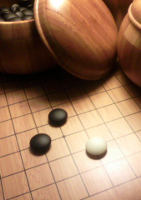
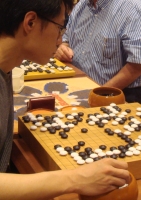
 ) I played another KGS match, as I said I would try to do more of over break, and I was unable to win against an opponent who played the "live everywhere" strategy I won against last time. I believe I made two key mistakes that cost me the game.
 should have been at F3 so I could turn around and successfully attack black's 2 stones on the right. I got greedy and tried to both seal him into the corner and attack his stones. Too much.
  at D5 may have also been something to consider. (You complain that this opponent is playing an unreasonable strategy and then you go around and make an unreasonable move. You're just as bad as him. And he's better at this than you.
  )
)
 ?
?
 was a good move or not. I wanted to activate options for my E16 stone, but P3 or something else on the bottom may have been bigger.
 as I did. The issue, though, is that at
  black can use O6 to get a few forcing moves by atariing at M5 and M6, and then use sente to kill the two white stones or make them live really low while black gets the corner. Certainly having only two stones instead of three makes the later side/corner fight much more difficult for white than in the game.
 is roughly what I was expecting as the outcome, or white playing Q2 in sente and then taking care of the aji of the weak black stones. I don't think it's a spectacular result for white, when black can keep white's upper right stones low, and a white play there induces black to fix his side up.
 )
) I paused for a full minute, analyzing all 6 groups hanging in the balance of this conflict. (You sure it's only six? I'd count 9 groups, but I guess you didn't take time to read their fate.)
 is a tesuji or not, but it looked good to me and my opponent had to back off. The bamboo joint formed by this forcing move ended up being game winning for me. (You think you came up with an original tesuji without having it printed in a book for you? Yeah, right. If you came up with a tesuji then I'm the real Batman.
  )
) . Black has no less than 4 empty triangles and 0 eye shape. I, on the other hand, have plenty of shape. (Well, I guess maybe those books are helping you on the board after all...
  . From
  on the game was a one-way path to black's resignation. He tried too hard to kill my stones and it cost him the game.