
Visualization

If you're new to the game and have questions, post them here.
User avatar
daal
Oza
Posts: 2508
Joined: Wed Apr 21, 2010 1:30 am
GD Posts: 0
Has thanked: 1304 times
Been thanked: 1128 times

Re: Visualization

Post by daal »

kasai wrote:I'm still unclear on how you're supposed to read if you can't or have trouble seeing images at all in your brain (I don't quite have aphantasia, but the first time I was able to make an image in my head was when I was twelve and I thought that was what hallucination was :lol: ). If you're not reading by placing stones in your head, what are you actually doing? I understand reading out general stuff with "hane, then jump, then" etc etc, but how do you hold the previous moves in your head while you're reading further ahead, especially in something like a complicated fight? Is it like having a list in front of you that you read from? But if you can't see at all, do you have to repeat the list over and over to "see" the previous moves?
I can't really see stones in my mind, it's more that my mind creates an image of what seems pertinent. Here is an example of what I'm talking about:

Instead of "seeing" this:
Click Here To Show Diagram Code
[go]$$B
$$ +-----------+
$$ | . . . . . |
$$ | . O O O . |
$$ | . O X X . |
$$ | O . O X . |
$$ | . . O O . |
$$ +-----------+[/go]
I see something like this:
Click Here To Show Diagram Code
[go]$$B
$$ +-----------+
$$ | . . . . . |
$$ | . ? ? ? . |
$$ | . ? , X T |
$$ | . ? ? X T |
$$ | . . ? ? . |
$$ +-----------+[/go]
I am a fairly weak player, but I do know a few things about go, so to some certain extent, I can make sense of a position. As with the examples of the strong chess players who can recreate a whole board position because it makes sense to them, certain elements of a go position make sense to me, and these are the things that I can "see." One thing that helps me see what might happen (read) is to simply count the liberties of the stones involved. This way, when I imagine a play in that area, knowing how the liberty count is affected substitutes for having to see it happen visually.
Patience, grasshopper.
Bill Spight
Honinbo
Posts: 10905
Joined: Wed Apr 21, 2010 1:24 pm
Has thanked: 3651 times
Been thanked: 3373 times

Re: Visualization

Post by Bill Spight »

kasai wrote:I'm still unclear on how you're supposed to read if you can't or have trouble seeing images at all in your brain (I don't quite have aphantasia, but the first time I was able to make an image in my head was when I was twelve and I thought that was what hallucination was :lol: ). If you're not reading by placing stones in your head, what are you actually doing? I understand reading out general stuff with "hane, then jump, then" etc etc, but how do you hold the previous moves in your head while you're reading further ahead, especially in something like a complicated fight? Is it like having a list in front of you that you read from? But if you can't see at all, do you have to repeat the list over and over to "see" the previous moves?
Don't worry, be happy! :D

Conscious visualization may help, but it is not particularly important to reading. One reason that I mentioned the exercise with imagining the starting and ending positions is that I found such an approach helpful in bridge. In bridge, the cards do not move from hand to hand, but are removed as they are played. In go, stones are added, unless they are captured. The necessary visualizations are similar. In neither exercise are the intermediate stages visualized. :)

In forming the conscious visual image of our surroundings that we perceive, the brain forms at least 18 separate images, none of which we are conscious. (When I was studying this kind of thing, 18 had been identified. Maybe more have been found since then.) Most of what the brain does is unconscious. Thank goodness! Otherwise things might be quite confusing. ;) Just because you don't consciously visualize intermediate positions in reading does not mean that they have no representations (images) in your brain, or that you do not make use of them. Just because you don't see yourself placing stones in your head ( ;)) does not mean that your brain is not doing that. Your brain is quite capable of doing parallel processing of go positions, even if you can only be conscious of one line of play at a time. :) Do not imagine that your conscious reading is doing most of the work.
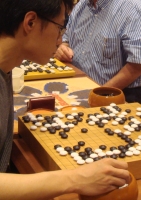
As for consciously reading each line of play from the beginning, Kotov says don't do it, but research indicates that chess grandmasters do that, at least some of the time. Doing so may be helpful in a complicated fight. :)
The Adkins Principle:
At some point, doesn't thinking have to go on?
— Winona Adkins

Visualize whirled peas.

Everything with love. Stay safe.
John Fairbairn
Oza
Posts: 3724
Joined: Wed Apr 21, 2010 3:09 am
Has thanked: 20 times
Been thanked: 4672 times

Re: Visualization

Post by John Fairbairn »

Conscious visualization may help, but it is not particularly important to reading. One reason that I mentioned the exercise with imagining the starting and ending positions is that I found such an approach helpful in bridge
I'd like to hear some detail on that, please. I think Ialso mentioned that someone recommended to me that a way of learning a piece of music was to start at the end. It doesn't work for me, but I suspect that's because I'm lazy or sloppy - and I also suspect that that is the same problem most amateurs have with reading.

We all agree that pure calculation is hard. We all agree that "tricks" are needed to cut the workload. Chunking is one trick we all use (though it's not much of a trick if we don't do the grunt work).

But using the final position is very probably, in my estimation, also a major trick we could make use of. The problem with reading in go - at least superficially - is that we don't know what the final position is.

However, we can override the process by using strategy. We look at the position first in purely strategic terms and decide what we want or need to do. That becomes the final position, and so we tailor (i.e. prune) our reading to reach that goal.

That's ridiculously obvious, isn't it? Except that most of us can be sloppy and lazy and we can behave ridiculously in two self-defeating ways.

One is that we play too many fast games and so have no time to make the relevant strategic decisions. We are flying blind.

The other is that we do too many tsumego problems. With these (unless you make use of hints) there is no very often clear way of determining the final position (we do learn to spot likely ishinoshitas but for the most part tsumegos are just a jumbled mass of stones). In contrast, tesuji problems usually do have a definable final position, on top of which these are much more likely than tsumegos to cater to solutions called for by strategic analysis. And of course many tsumegos use tesujis.

I have an inkling that the hegemony of tsumego is due partly to the emotive words "life" and "death" but also to the fact that in the past so many newspapers offered them not as a way to train go players but as a recreation in lieu of crosswords or sudokus. (Would you really study crosswords if you want to be a writer, or sudokus if you want to be a mathematician?)

If that line of reasoning makes sense, the recipe for success is (1) to play slower games, using the extra time for strategic thinking before calculating, and (2) to practise the specifics of calculation by doing tesuji problems in (much greater) preference to tsumego problems.
User avatar
EdLee
Honinbo
Posts: 8859
Joined: Sat Apr 24, 2010 6:49 pm
GD Posts: 312
Location: Santa Barbara, CA
Has thanked: 349 times
Been thanked: 2070 times

Post by EdLee »

Hi Dan, Gomoto,

Thanks. Still fascinating to me. :study:

Dan, that you can see ( and hear and feel all the usual sensations ) in your dreams seems to mean you can subconsciously see, but cannot consciously see, in your mind's eye ? That the neural circuitry to visualize is there, but you cannot access it consciously, but only ( at least ) in your dreams... ?

Gomoto, I still don't quite understand your reading process.
The "invisible" representations remain a mystery, to me.

Curiosity questions:
Dan, at what age did you start Go ( and chess ) ?
Gomoto, at what age did you start Go ? ( Can you see in your dreams ? )

Thanks.
User avatar
EdLee
Honinbo
Posts: 8859
Joined: Sat Apr 24, 2010 6:49 pm
GD Posts: 312
Location: Santa Barbara, CA
Has thanked: 349 times
Been thanked: 2070 times

Post by EdLee »

In forming the conscious visual image of our surroundings that we perceive, the brain forms at least 18 separate images, none of which we are conscious.
Hi Bill, how did they ( the neurobiologists ? ) figure out that there are these separate subconscious images ? By MRI ? Do they also know what they look like ?
dfan
Gosei
Posts: 1598
Joined: Wed Apr 21, 2010 8:49 am
Rank: AGA 2k Fox 3d
GD Posts: 61
KGS: dfan
Has thanked: 891 times
Been thanked: 534 times
Contact:

Re: Visualization

Post by dfan »

John Fairbairn wrote:I'd like to hear some detail on that, please. I think I also mentioned that someone recommended to me that a way of learning a piece of music was to start at the end. It doesn't work for me, but I suspect that's because I'm lazy or sloppy - and I also suspect that that is the same problem most amateurs have with reading.
I am a big fan of starting at the end when memorizing a piece of music, although I'm not sure if the reason is transferable to go. The big advantage in my opinion is that you can always play the amount of the piece that you have learned to a definitive conclusion, rather than petering out as your recollection fades, so you always play with confidence.
The other is that we do too many tsumego problems. With these (unless you make use of hints) there is no very often clear way of determining the final position (we do learn to spot likely ishinoshitas but for the most part tsumegos are just a jumbled mass of stones). In contrast, tesuji problems usually do have a definable final position, on top of which these are much more likely than tsumegos to cater to solutions called for by strategic analysis. And of course many tsumegos use tesujis.
I heartily agree. I didn't get around to saying in an earlier response that I think there are two very different types of reading, the tesuji-ish situations where moves tend to have real semantic meaning and the tsumego-ish situations where it's pure calculation and you just have to confirm by brute force that every variation leads to a good result. The latter are very difficult for me.

Of course, as you learn more about go, some tsumego techniques turn into chunks and you learn to consider them more semantically. But at that point you start doing more difficult tsumego problems, and the situation continues. :)

In general I feel that my over-the-board strength has been improved more from doing tesuji problems and easy tsumego problems than from doing hard tsumego problems.
dfan
Gosei
Posts: 1598
Joined: Wed Apr 21, 2010 8:49 am
Rank: AGA 2k Fox 3d
GD Posts: 61
KGS: dfan
Has thanked: 891 times
Been thanked: 534 times
Contact:

Re:

Post by dfan »

EdLee wrote:Dan, that you can see ( and hear and feel all the usual sensations ) in your dreams seems to mean you can subconsciously see, but cannot consciously see, in your mind's eye ? That the neural circuitry to visualize is there, but you cannot access it consciously, but only ( at least ) in your dreams... ?
I guess? Once I figured out that other people could visualize, I spent a while trying to "exercise" my mind's eye, thinking that maybe I could build up my conscious visualization, but nothing worked.
Dan, at what age did you start Go ( and chess ) ?
I started playing chess when I was 3, and was pretty serious about it until about the age of 8, at which time I mostly put it aside until I was in my 20s.

I read a book about go when I was a kid, and had a set I did a little experimenting on, but didn't start seriously playing or studying until college.
denizen
Beginner
Posts: 15
Joined: Sat Jul 23, 2016 2:54 pm
GD Posts: 0
Been thanked: 1 time

Re: Visualization

Post by denizen »

I started playing go again after a pretty long break. I realized how much trouble I have reading and happened to read this thread. After thinking about it, researching things, and talking to people, I realized that I think differently than do most people: I have no capacity to visualize anything. I now understand for the first time (in adulthood) that I'm "aphantasic" and that other people are capable of mental visualization. I can "hear" an imaginary conversation but cannot "see" or interact with an imaginary image. I can't "see" my family members, for instance, and could describe them only based on whatever abstract ideas I remember about them.

Among other things, I'm trying to figure out what's possible for me with go as a result of this. When I "read," I look at the board state as it actually exists. If I play a hypothetical move, I have to think consciously about whether the empty intersection on the board is a black stone or a white stone. With each subsequent move, I have to reevaluate each intersection and remember what is or is not a stone. "Reading" a multiple-move sequence requires mechanistic assessment of each relevant—actually empty—intersection of the board. It seems that this type of reading is not viable for real improvement (I'm 9k-10k or so).

I enjoy playing go and like figuring things out. I'm attracted to the (hopeless) quest of understanding and to the mathematical beauty of the game. But my reading limitations concern me. While I could just play games and not worry about it, what makes me enjoy go is the process of understanding at least some small part of what's going on. My level of reading seems to make that impossible in real games.

My question is this: have other people been able to develop and improve the kind of mechanistic reading that I'm talking about here? Or do you need to have some ability to activate the "visual" circuitry in your brain to be able to play at a competent level?
User avatar
EdLee
Honinbo
Posts: 8859
Joined: Sat Apr 24, 2010 6:49 pm
GD Posts: 312
Location: Santa Barbara, CA
Has thanked: 349 times
Been thanked: 2070 times

Post by EdLee »

Hi denizen, Thanks for sharing.
I'm curious about your dreams: are they in complete darkness ?
That is, zero visual elements in your dreams, but other senses OK: audio, smell, touch, gravity, acceleration, sense of direction, location ( heights), happiness, and other emotions, etc.

Like Dan...
denizen
Beginner
Posts: 15
Joined: Sat Jul 23, 2016 2:54 pm
GD Posts: 0
Been thanked: 1 time

Re: Visualization

Post by denizen »

I never remember any visual sensation of my dreams at all. I might wake up with some emotion based on thinking that the dream was real, but I can't remember what I "saw" during the dream.

From my research about aphanthasia, some of us see images during dreams. The ability to see an image during a dream is different than the conscious ability to activate the visual circuitry (apparently). I'm sure I also "see" things during dreams but I have no recollection of that.
denizen
Beginner
Posts: 15
Joined: Sat Jul 23, 2016 2:54 pm
GD Posts: 0
Been thanked: 1 time

Re: Visualization

Post by denizen »

For more explanation, I really don't remember dreams except for maybe once a month.The most common time when I remember is waking up in a panic with some nightmare that I had. In those cases, I can conceive of some pattern of events, but nothing more than some imagined horror.
dfan
Gosei
Posts: 1598
Joined: Wed Apr 21, 2010 8:49 am
Rank: AGA 2k Fox 3d
GD Posts: 61
KGS: dfan
Has thanked: 891 times
Been thanked: 534 times
Contact:

Re: Visualization

Post by dfan »

I have aphantasia and am about 3k KGS/AGA, and have a chess rating of over 2000 (probably about equivalent to 1d). So you can definitely get that far without being able to visualize. I'm currently trying to prove that one can get even farther. :)
denizen
Beginner
Posts: 15
Joined: Sat Jul 23, 2016 2:54 pm
GD Posts: 0
Been thanked: 1 time

Re: Visualization

Post by denizen »

dfan wrote:I have aphantasia and am about 3k KGS/AGA, and have a chess rating of over 2000 (probably about equivalent to 1d). So you can definitely get that far without being able to visualize. I'm currently trying to prove that one can get even farther. :)
Does it feel like you can "figure anything out" or are we just pattern-recognition monkeys trying to do better than our peers who can't quite manage the same pattern-recognition skills?
dfan
Gosei
Posts: 1598
Joined: Wed Apr 21, 2010 8:49 am
Rank: AGA 2k Fox 3d
GD Posts: 61
KGS: dfan
Has thanked: 891 times
Been thanked: 534 times
Contact:

Re: Visualization

Post by dfan »

I'm not sure what you mean by figure anything out. I certainly read out variations, it's just difficult. But I think almost everyone finds reading out variations difficult in some way.
denizen
Beginner
Posts: 15
Joined: Sat Jul 23, 2016 2:54 pm
GD Posts: 0
Been thanked: 1 time

Re: Visualization

Post by denizen »

dfan, that wasn't a very good explanation of my question (a little too much bourbon last night). For more detail, at my current level of reading, a lot of my decisions are based on instinct and hope that it's going to turn out well. I want to have some ability to make harder decisions based on reading. Have you gotten to that point in playing a real game that you're making important decisions that require reading more than a few moves based on reading (e.g., "I could cut here and I know it works, but I can read out the result and it's bad"), or are you making these decisions instinctually, with hopefully an improving instinct?
Post Reply