Page 3 of 4
Re: status
Posted: Fri Sep 10, 2010 1:07 pm
by HermanHiddema
willemien wrote:I would not list any of them
But that is mostly because in the first example White is dead and better abandoned (as far as i can see)
The second I would not list it because there is already a white stone inside Blacks area.
Also Black is alive (with territory)
$$W
$$ +----------------
$$ | 8 4 6 . . 7. . .
$$ | 5 1 2 X X X O .
$$ | 0 3 O X O O . O
$$ | . X X O . . . .
$$ | . X O . O . . .
$$ | 9 X O . . . . .
$$ | . O . . . . . .
$$ | . . O . . . . .
- Click Here To Show Diagram Code
[go]$$W

$$ +----------------

$$ | 8 4 6 . . 7. . .

$$ | 5 1 2 X X X O .

$$ | 0 3 O X O O . O

$$ | . X X O . . . .

$$ | . X O . O . . .

$$ | 9 X O . . . . .

$$ | . O . . . . . .

$$ | . . O . . . . .[/go]
But if you really want I won't stop you.
But if you have really add a lot of them i would make a seperate page of "Other open formations "
My point wasn't about these specific formations, my point was that you have to draw the line somewhere.
Again, there are literally thousands of corner shapes. Closed formations, open formations, formations with and without defects (such as cutting points), with and without outside liberties, with and without hane/descent on the outside/inside. The only reasonable criterion for inclusion, IMO, is whether it is a common shape. Whether it is useful for player to
know their status.
It is useful for players to know that the L-shape is dead, that the hovercraft shape can be attacked with a descent, that the choice between the J-group and the straight J-group exists, and leads to ko, and that hanes on the first line matter to many corner shapes. Because they will encounter them in games regularly.
It is not useful for player to know the status of the staircase ten, because they will not encounter it in games. The staircase ten is interesting as a reading exercise, as a tsumego. But it provides no benefit to learn its status anymore than learning that of the above two examples does (both of which are existing tsumego).
Re: status
Posted: Fri Sep 10, 2010 1:14 pm
by willemien
It is not useful for player to know the status of the staircase ten, because they will not encounter it in games. The staircase ten is interesting as a reading exercise, as a tsumego. But it provides no benefit to learn its status anymore than learning that of the above two examples does (both of which are existing tsumego).
I guess you will find it unbelievable but I did encounter this shape in actual play.
Re: status
Posted: Fri Sep 10, 2010 1:29 pm
by HermanHiddema
willemien wrote:It is not useful for player to know the status of the staircase ten, because they will not encounter it in games. The staircase ten is interesting as a reading exercise, as a tsumego. But it provides no benefit to learn its status anymore than learning that of the above two examples does (both of which are existing tsumego).
I guess you will find it unbelievable but I did encounter this shape in actual play.
I do not find it unbelievable, it is certainly possible for such a shape to happen. And the same is true for the thousand other shapes I mentioned. With the millions of games being played each day at all sorts of playing levels, the most unlikely groups will appear on the board.
But it isn't common. It is not the result of known joseki or invasion. There is no point in learning by heart the status of this shape, or any of the other thousand, because it is exceedingly unlikely that you will need that knowledge.
Again, the question remains: Why include this unlikely but possible shape, and not the other thousands of shapes that are equally unlikely, but equally possible?
Re: status
Posted: Fri Sep 10, 2010 2:53 pm
by willemien
HermanHiddema wrote:Again, the question remains: Why include this unlikely but possible shape, and not the other thousands of shapes that are equally unlikely, but equally possible?

I am not convinced of those 1000 of shapes.
Please show me some (say 10) of those shapes so that:
1. Black is completely surrounding an area in the corner.
2. The black formation has no cutting points
3. The status does change if a black stone is removed (this is just to prevent superfluous stones)
4. The area that black surrounds does not contain white stones
5. The area contains more than 3 empty points (preferably more than 7)
6. The status of the group depends on who's turn it is. (for this living in seki differs from living with territory)
7. The shape is not on the
CornerShapes page
Deal?
Re: status
Posted: Fri Sep 10, 2010 3:37 pm
by Shaddy
HermanHiddema wrote:
But it isn't common. It is not the result of known joseki or invasion. There is no point in learning by heart the status of this shape, or any of the other thousand, because it is exceedingly unlikely that you will need that knowledge.
Again, the question remains: Why include this unlikely but possible shape?
I shaved the question down. What is the point of including such an unlikely shape? I have never seen it in any of my games (nor, i believe, any games that I have observed). It is interesting as a tsumego, but not as a standard corner shape, like most of the rest of the shapes on the Sensei's page.
Re: status
Posted: Fri Sep 10, 2010 4:54 pm
by Numsgil
willemien wrote:HermanHiddema wrote:Again, the question remains: Why include this unlikely but possible shape, and not the other thousands of shapes that are equally unlikely, but equally possible?
I am not convinced of those 1000 of shapes.
Please show me some (say 10) of those shapes so that:
1. Black is completely surrounding an area in the corner.
2. The black formation has no cutting points
3. The status does change if a black stone is removed (this is just to prevent superfluous stones)
4. The area that black surrounds does not contain white stones
5. The area contains more than 3 empty points (preferably more than 7)
6. The status of the group depends on who's turn it is. (for this living in seki differs from living with territory)
7. The shape is not on the
CornerShapes page
Deal?
Actually, black groups in the corner with no external liberties are almost always (quite often? More than occassionally) in danger of a seki invasion to rob points late in the end game. If it's just a single large eye shape, and the eye shape isn't a killing shape, and the number of empty intersections of the eye shape is below some surprisingly large number (I'm going to arbitrarily guess and say 13), the chance of an invasion living in seki is very real. The more blobby the eye shape the greater the chance. The lack of external liberties means all sorts of shortage of liberty tesujis can work, and since it's in the corner you run in to some interesting seki shapes that involve false eyes even.
It almost never turns up in DDK play because the players aren't strong enough to see it. In SDK play players tend to place moves inside the eye shape because they're aware of the danger.
Re: status
Posted: Sat Sep 11, 2010 2:58 am
by willemien
Joaz Banbeck wrote:As promised, I looked at my copy of 'Go Proverbs Illustrated'.

The part on five stone in a row on the third line in a corner is, alas, only one page.
It has two diagrams:
$$Bc
$$+-------------------
$$|. 4 . . . . . . .
$$|. . . 2 1 3 . . .
$$|O O O O O X . . .
$$|X X X X X X . . .
$$|. . . . . . . . .
- Click Here To Show Diagram Code
[go]$$Bc

$$+-------------------

$$|. 4 . . . . . . .

$$|. . . 2 1 3 . . .

$$|O O O O O X . . .

$$|X X X X X X . . .

$$|. . . . . . . . .[/go]
..and:
$$Bc
$$+-------------------
$$|. . . . . . . . .
$$|. . . . 2 1 3 . . .
$$|. O O O O O X . . .
$$|4 X X X X X X . . .
$$|. . . . . . . . . .
- Click Here To Show Diagram Code
[go]$$Bc

$$+-------------------

$$|. . . . . . . . .

$$|. . . . 2 1 3 . . .

$$|. O O O O O X . . .

$$|4 X X X X X X . . .

$$|. . . . . . . . . .[/go]
And it has a few small paragraphs explaining how they live.
It does not discuss the possibility of the attacker starting with the 1-2 point.
Thanks I added your first diagram to
Five stones on the third line in the corner
Will try to make it a nice page later (but feel free to add to the page yourself if you wish)
Re: status
Posted: Sat Sep 11, 2010 3:14 am
by willemien
Numsgil wrote:willemien wrote:HermanHiddema wrote:Again, the question remains: Why include this unlikely but possible shape, and not the other thousands of shapes that are equally unlikely, but equally possible?
I am not convinced of those 1000 of shapes.
Please show me some (say 10) of those shapes so that:
1. Black is completely surrounding an area in the corner.
2. The black formation has no cutting points
3. The status does change if a black stone is removed (this is just to prevent superfluous stones)
4. The area that black surrounds does not contain white stones
5. The area contains more than 3 empty points (preferably more than 7)
6. The status of the group depends on who's turn it is. (for this living in seki differs from living with territory)
7. The shape is not on the
CornerShapes page
Deal?
Actually, black groups in the corner with no external liberties are almost always (quite often? More than occassionally) in danger of a seki invasion to rob points late in the end game. If it's just a single large eye shape, and the eye shape isn't a killing shape, and the number of empty intersections of the eye shape is below some surprisingly large number (I'm going to arbitrarily guess and say 13), the chance of an invasion living in seki is very real. The more blobby the eye shape the greater the chance. The lack of external liberties means all sorts of shortage of liberty tesujis can work, and since it's in the corner you run in to some interesting seki shapes that involve false eyes even.
It almost never turns up in DDK play because the players aren't strong enough to see it. In SDK play players tend to place moves inside the eye shape because they're aware of the danger.
This is just handwaving. Give an example.(say with 12 or more empty points)
Ps it is about black not able to live or only life in seki, It is not the question of white can live inside black terretory, so answers like
10x10CornerGame1, are no good because even if white lives black lives(with territory) as well.
I did make a page
CommonCornerShapes what was the same page as
CornerShapes only some uncommen shapes are removed. (feel free to edit)
Re: status
Posted: Sat Sep 11, 2010 5:45 am
by HermanHiddema
willemien wrote:HermanHiddema wrote:Again, the question remains: Why include this unlikely but possible shape, and not the other thousands of shapes that are equally unlikely, but equally possible?
2. The black formation has no cutting points
So you feel that the tripod groups, J groups, weak carpenters square, comb formation, hovercraft and walkie-talkie eight should not be on the corner shapes page then?

Re: status
Posted: Sat Sep 11, 2010 6:31 am
by Sverre
HermanHiddema wrote:
So you feel that the tripod groups, J groups, weak carpenters square, comb formation, hovercraft and walkie-talkie eight should not be on the corner shapes page then?
Perhaps it would be helpful to have a separate "closed corner shapes" page for this sort of information. After all, the enclosed shapes in the middle and sides are very well known to most players, but a similar shape in the corner can have very different characteristics.
Re: status
Posted: Sat Sep 11, 2010 6:55 am
by willemien
HermanHiddema wrote:willemien wrote:HermanHiddema wrote:Again, the question remains: Why include this unlikely but possible shape, and not the other thousands of shapes that are equally unlikely, but equally possible?
2. The black formation has no cutting points
So you feel that the tripod groups, J groups, weak carpenters square, comb formation, hovercraft and walkie-talkie eight should not be on the corner shapes page then?

I did remove the comb formation and walkie-talkie eight from the
Common Corner Shapes page.
(as i did all closed shapes with more than 8 spaces.)
Do you really find the others uncommon as well? (they are chapters in Davies "life and death")
If you really think so you may remove them from the
Common Corner Shapes page.
But please do leave the Corner Shapes page as a full index. (It is a bit a child of me, I started this page about a year ago)
You are all welcome to edit sensei's library but just removing shapes from the full index is not helpful for anybody.
Sorry but I am starting to think that i am waisting my time here a bid.
Was hoping that somebody would find a bigger closed group that also could revert to s seki.
But all i get is handwaving. So i think i am going to do something more usefull. like editing the
Five stones on the third line in the corner page
And you all may wonder if it is a commmon or an uncommon corner shape.
Re: status
Posted: Sat Sep 11, 2010 8:09 am
by HermanHiddema
willemien wrote:HermanHiddema wrote:willemien wrote:
2. The black formation has no cutting points
So you feel that the tripod groups, J groups, weak carpenters square, comb formation, hovercraft and walkie-talkie eight should not be on the corner shapes page then?
I did remove the comb formation and walkie-talkie eight from the
Common Corner Shapes page.
(as i did all closed shapes with more than 8 spaces.)
Do you really find the others uncommon as well? (they are chapters in Davies "life and death")
No, I do not.

I have been arguing, for quite some time now, that the corner shapes pages should include only common corner shapes. You gave an entirely different list of criteria, which included "no cutting points". If you think that "no cutting points" is a reasonable criterion for the corner shapes page, then apparently you feel that all of those common shapes with cutting points should be removed. If you don't think it is a reasonable criterion, then why did you give it?
Re: status
Posted: Sat Sep 11, 2010 9:33 am
by willemien
It is that i just finished a big edit of five stones on the third line in the corner.
Hope that the page is a bit more useful now.
Okay you may have 1 cutting point per shape.
But:

- the stone or connected stones at each side of the cutting point have at least 3 liberties. (so cutting doesn't put them in atari and the cutting stone can be put in atari)
Guess you now also want open formations
- Okay but the gap between the nearest black stone and the side is at most 1 space.
(I know tha gap with five stones on the third line in the corner is two stones but that is the only one. (and follows from the name of the shape)
But can i now have 20 diagrams? (is still less than 10% of all those positions
Re: status
Posted: Sat Sep 11, 2010 9:52 am
by LocoRon
Wow, it's a good thing we have an official "corner shape" judge here, letting all of us uneducated plebes know the criteria for what constitutes a corner shape. And here I was, thinking that a corner shape was any shape that occurred in the corner. Boy was I wrong! Good thing I've been schooled before making a fool of myself at a sophisticated cocktail party.

Re: status
Posted: Sun Sep 12, 2010 11:13 am
by xed_over
willemien, I think you are missing the point
if we were studying knots, for example, there are some very basic and important knots to learn
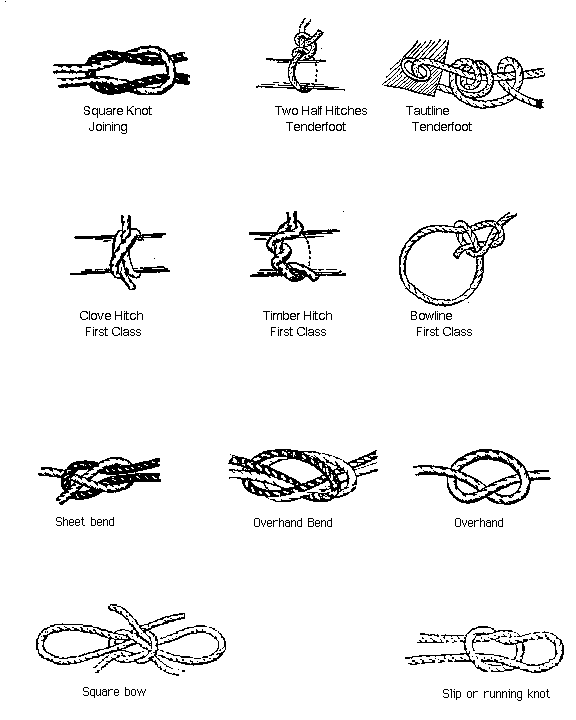
but there are also knots that are nothing more than an interesting puzzle
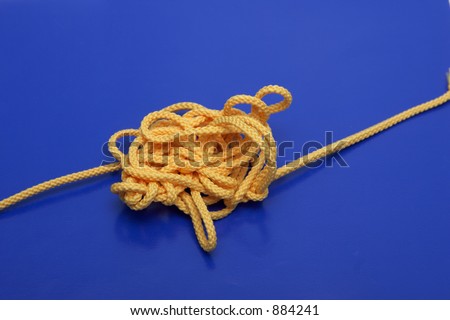
the corner page was very helpful and useful when it contained, what is considered, very basic and important corner shapes to learn. but some of the shapes you are adding now are not considered basic and important shapes to learn. they are nothing more than perhaps interesting puzzles -- that just happen to be of some "shape" in the corner.