I mentioned earlier the word "perception" as a word that came to me after being reminded of Gestalt psychology and that seemed apposite to go. I have pursued the word a little further and it now seems even more fecund in its applications to go.
It seems that one of the key elements of perception is the human ability to infer: to fill in information that is not there. Apparently the experts are not yet sure why we do this, but their best guess is that it's an evolutionary adaptation brought about by the fact that so much of what we see or hear comes to us as incomplete information. Certainly, what most of us see on the go board is a potage of incomplete information! We'd love to adapt!
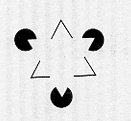
A classic example of perception seems to be Kanizsa's illusion:
- img081.jpg (7.28 KiB) Viewed 13460 times
We "see" a white triangle imposed on a black one, but in reality there are no triangles in the figure.
My guess is that this resembles what is going on on the go board with this importance difference: pros see the triangles, we amateurs see only the Pacmen. My starting point for this guess is something I realised about go quite a long time ago, and for me it was the most important insight I've ever had into go. It didn't make me stronger (and as to why I'll mention that later) but it allowed me to
appreciate the game at a much higher level. The insight was this: go is supposed to be the surrounding game; pros play the surrounding game; amateurs play the counting game. Or, to repeat the comments on the figure: pros see the triangles spanning the whole board, we see the Pacmen territories in the corners and on the side.
Or, to belabour the point a little, amateurs think surrounding applies just to countable territories whereas pros realise that you can surround abstract things like influence.
Always assuming my insight was on the right lines, why didn't it make me stronger? I think it's because you only learn to "see" (infer) the
ley lines if you put in the notorious 10,000 hours.
That then raises the question as to what benefit the ley lines give the pros. I think the answer lies in the very important remark Bill made earlier on: reading (calculation) is best used for confirmation of ideas we come up with first.
No-one can read out everything. We approximate by using tricks to prune the tree. Every player beyond a Day 1 beginner has experienced this. You look at a tsumego problem and if you try to work out every move on a "if he plays there I play here" basis, you soon run into the sand. But if you recognise a shape (e.g. a space where you can play a nakade) you can choose the right move instantly, just performing one or two lines of analysis to make sure there's nothing hidden there, such as a possible seki.
In other words, if you have a specific goal in mind you can read ahead much further and more easily. My guess is that pros can do this for areas way beyond the scope of tsumego and also beyond the scope of josekis and middle game josekis. They can do it for the whole board because they can see the invisible ley lines there. AI bots are effectively doing the same, but even more reliably.
I believe that counting - the be all and end all for many amateurs - is likewise just another confirmation tool for a pro, and again they can use it in the centre of the board in ways amateurs can't.
Obviously I've no personal experience of how to become really strong at go, but everything I read (or infer!) points to building up perception or something like it by playing over countless pro games. That's certainly what the pros have done. Some amateurs I know have tried this and often claim it doesn't work. Some desperately try to memorise pro games and even more say that doesn't work. I believe that's because they think it will work by osmosis.
The way to make it work is by effortful practice. T Mark Hall's now famous experience of improving two grades just by playing over the games of Go Seigen was an example of that. The point is that he was transcribing the games into sgf files from densely packed diagrams. He had to be "effortful" to find the next move on the diagram without scanning every line. He learned to look in the right area of the diagram to find the next move. That alone made him stronger. He was, if you like, laying down ley lines.
Not everyone wants to transcribe games as a way of becoming stronger, but they can't avoid putting some effort into playing over games. Just thinking about what is really being surrounded, how that little defect on one side of the board can have a tsunami effect on the other side, and things like that, may be a way of learning where the invisible ley lines should be. Details aside, that seems the real rational choice for amateurs here.

 Of course YMMV.
 .
.