Page 3 of 5
Re: 10 year old Japanese pro
Posted: Fri Jan 11, 2019 9:02 pm
by TheCannyOnion
OK, but does anyone know Sumire's actual strength? Is she already of professional strength, or is she really a strong amateur at this point but is expected to grow quickly?
Re: 10 year old Japanese pro
Posted: Mon Jan 14, 2019 4:36 am
by Uberdude
FYI I added some more analysis to my
LZ analysis of the s12 peep exchange, to find the same peep loses over 20% when in a position it's more clearly going to become an unconditional loss of 2 points.
Re: 10 year old Japanese pro
Posted: Mon Jan 14, 2019 9:26 am
by John Fairbairn
to find the same peep loses over 20% when in a position it's more clearly going to become an unconditional loss of 2 points.
Are you also saying this is possible evidence for saying a 10 percentage point change in AI winrate corresponds to about 1 point? That seems to equate to my sense of what other threads have already concluded about winrates.
Re: 10 year old Japanese pro
Posted: Mon Jan 14, 2019 9:55 am
by Uberdude
John Fairbairn wrote:to find the same peep loses over 20% when in a position it's more clearly going to become an unconditional loss of 2 points.
Are you also saying this is possible evidence for saying a 10 percentage point change in AI winrate corresponds to about 1 point? That seems to equate to my sense of what other threads have already concluded about winrates.
Yes, of the same ballpark, though bear in mind different bots can give quite different winrate changes for the same moves. The 10% ~= 1 point in the opening was something I saw Nikola Mitic (who studied as insei in Japan) reported as being the thoughts of pros for Elf (I'm guessing the newer v1) which generally has bigger swings in the opening than LZ. Interestingly Elfv1 thought Iyama's peep in this game was barely a mistake, I've not tried running it against the sequences I got out of LZ 198 to explain why LZ 198 thinks it is bad. Also something I think I've noticed (but unscientifically) is the newer 40-block LZ networks are giving bigger winrate swings than their older and weaker brethren (which is expected, a perfect player would shoot to 100% as soon as you make that 1 point mistake that loses the game on move 5).
Re: 10 year old Japanese pro
Posted: Tue Jan 15, 2019 4:00 pm
by London Go Centre
The latest video on the London Go Centre's video channel is Daniel Hu's analysis of Nakamura Sumire's game against Iyama Yuta
It looks like the the world's youngest pro missed a chance to deliver a shock to Japan's #1 on move 93 though as Daniel Hu says it's a complicated 14 move read.
https://www.youtube.com/channel/UCBGI3t ... H8IAsr6Ucw
Re: 10 year old Japanese pro
Posted: Tue Jan 22, 2019 6:03 am
by trout

1/23/19, Nakamura Sumire will be playing a game with Choi Jeong.
She will play with Black with no Komi.
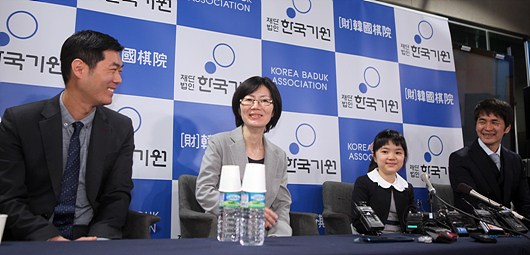
Interviewed by Korean and Japanese media. From left Han Jongjin 9p(Teacher), Miyuki(Mother), Sumire and Shinya(Father)
Han Jongjin said that Sumire hate losing more than anyone else and plays hide and seek, and other board game like any other children during break.
Re: 10 year old Japanese pro
Posted: Wed Jan 23, 2019 1:21 am
by Uberdude
She lost pretty badly, was something like 30 points behind even if her big group didn't die. The o6 atari resistance spectacularly backfired. Winrates are from no komi LZ 157.
Hopefully she can normally play better than this and the pressure/nerves got to her (she is only 9!), plus Choi is really strong (occasionally beats top men). Gotta be tough for a little kid in the limelight...
Re: 10 year old Japanese pro
Posted: Thu Jan 24, 2019 10:10 pm
by TheCannyOnion
Does anyone know Sumire's actual strength? Is she already of professional strength, or is she really a strong amateur at this point?
Re: 10 year old Japanese pro
Posted: Fri Jan 25, 2019 3:14 am
by Uberdude
TheCannyOnion wrote:Does anyone know Sumire's actual strength?
I expect her teachers have a decent idea. We here are just guessing from very little data.
TheCannyOnion wrote:Is she already of professional strength, or is she really a strong amateur at this point?
Where do you draw the line? I suppose she's stronger than EGF 6d (though less certain after Choi game, probably most EGF 6d have more experience and mental fortitude, she is only 9 after all) but weaker than a top Chinese amateur like Bai Baoxiang or Wang Chen, who are basically mid-level pro strength and probably stronger than more than half the pros in the world (including plenty of old 9ps and most female pros).
Seeing as Han Jongjin says she hates losing, IMO having these exhibition games against top pros might not be the best idea for a little kid's wellbeing, why not play some weaker players that she might beat to gain confidence?
Re: 10 year old Japanese pro
Posted: Fri Jan 25, 2019 4:13 am
by Bill Spight
Uberdude wrote:Seeing as Han Jongjin says she hates losing, IMO having these exhibition games against top pros might not be the best idea for a little kid's wellbeing, why not play some weaker players that she might beat to gain confidence?
Maybe so, maybe not.

When I was coming along in bridge, my favorite opponents were world and national champions. I was older than 9, but you rise to the challenge. As Billie Jean King puts it, you raise the level of your game.
Re: 10 year old Japanese pro
Posted: Fri Jan 25, 2019 5:04 am
by TheCannyOnion
Uberdude wrote:TheCannyOnion wrote:Is she already of professional strength, or is she really a strong amateur at this point?
Where do you draw the line? I suppose she's stronger than EGF 6d (though less certain after Choi game, probably most EGF 6d have more experience and mental fortitude, she is only 9 after all) but weaker than a top Chinese amateur like Bai Baoxiang or Wang Chen, who are basically mid-level pro strength and probably stronger than more than half the pros in the world (including plenty of old 9ps and most female pros).
Seeing as Han Jongjin says she hates losing, IMO having these exhibition games against top pros might not be the best idea for a little kid's wellbeing, why not play some weaker players that she might beat to gain confidence?
Where do you draw the line when it comes to certifying new professionals in Japan? I understand that Sumire's promotion is by recommendation, rather than going through the insei leagues. Still, I wonder if this was a wise move after all. It just doesn't feel right...
To me, her promotion – for lack of a better word – desecrates the normal certification process. Dozens of inseis run the gauntlet every year to qualify for a few precious spots. Just imagine the fierce competition they have to endure, the sacrifice they have to make... Then along came our little Sumire who, sweetly cherubic and undoubtedly not without talent, helicoptered right past the inseis, all the while being feted and basked in media spotlight. Love the buzz and headlines, but I wonder if hers is at least partially a case of publicity stunt, or an attempt to drum up flagging state of Go in Japan by way of generating public interest, perhaps to inspire little children to take up the game. Whatever the motivation or justification, I find her 'promotion' a wee bit sacrilegious, but then again, I'm just a decrepit traditionalist.
Mind you, I don't doubt her strength as being on par with or better than decent Japanese amateurs, and I'm in no position to judge her 'potential'... But, as you pointed out, all the media circus and pressure might not be good for her, which makes me wonder if the powers that be have thought this through. I sincerely hope that direct promotion of Sumire's type never happens again. The professional shodan certificate (in modern times) should be regarded as a sacred object that has to be earned on merit, not given.
Re: 10 year old Japanese pro
Posted: Fri Jan 25, 2019 6:28 am
by tchan001
She's the pioneer of the new additional way of promotion to pro. There will be many other kids to follow in her path later on so she will only be in the limelight for now. It shouldn't be too much pressure for her as both her parents are part of the go scene as well.
Re: 10 year old Japanese pro
Posted: Fri Jan 25, 2019 9:21 am
by Elom
Cho Chikun 9p became a pro at eleven. Fujisawa Rina 4p became a pro a littler younger, and Nakamura Sumire 1p a little younger still, although she reminds me much of Cho 9p (even with Japan-Korea element, except with the roles reversed). Hopefully, she won't have to lose too often. I believe all of the nihonkiins new shodans have exhibition matches (against pros of about the same level as Choi Jeong 9p, although perhaps it's true if she plays future games they would best be nearer to her level). Fujisawa 4p has gone on to break another record so Nakamura Sumire can take the one for youngest pro
.
Apart from training in professional norms, the three main tests for professionals seem to be firstly on the ability to win matches in a single competitive situation (the pro exam), secondly on actual overall strength of the player (promotion based on average nihinokiin insei ranking across Jan-Feb-Mar or thereabouts) and thirdly on potential or merit. So strength is one of three or four elements; I don't think her promotion is too fanciful through that consideration. Perhaps the female pro exam is like a combination of one and two, whereas what I think the Kansai Kiin system to be of promotion after winning one game against a professional seems an extreme version of one, although I might be getting a bit of topic here; anyway, unless I've been mistaken, there have been quite a few special promotions from the Nihon Kiin...
If strength is the most important element, then a year from now may be the best time to make comparisons (in terms of age and having played enough pro games).
Re: 10 year old Japanese pro
Posted: Fri Jan 25, 2019 9:46 am
by TheCannyOnion
Elom wrote:Cho Chikun 9p became a pro at eleven. Fujisawa Rina 4p became a pro a littler younger, and Nakamura Sumire 1p a little younger still, although she reminds me much of Cho 9p (even with Japan-Korea element, except with the roles reversed). Hopefully, she won't have to lose too often. I believe all of the nihonkiins new shodans have exhibition matches (against pros of about the same level as Choi Jeong 9p, although perhaps it's true if she plays future games they would best be nearer to her level). Fujisawa 4p has gone on to break another record so Nakamura Sumire can take the one for youngest pro
.
Apart from training in professional norms, the three main tests for professionals seem to be firstly on the ability to win matches in a single competitive situation (the pro exam), secondly on actual overall strength of the player (promotion based on average nihinokiin insei ranking across Jan-Feb-Mar or thereabouts) and thirdly on potential or merit. So strength is one of three or four elements; I don't think her promotion is too fanciful through that consideration. Perhaps the female pro exam is like a combination of one and two, whereas what I think the Kansai Kiin system to be of promotion after winning one game against a professional seems an extreme version of one, although I might be getting a bit of topic here; anyway, unless I've been mistaken, there have been quite a few special promotions from the Nihon Kiin...
If strength is the most important element, then a year from now may be the best time to make comparisons (in terms of age and having played enough pro games).
Ah, my dear Elom, but Sumire was
never an insei, she never took the 'pro exam', and she has never participated in the insei league. As far as I know, she was plucked from obscurity by a panel and promoted directly to professional status. Meanwhile, outside the fawning spotlight, dozens of inseis are toiling mightily against each other for a precious few openings. If strength is the most important element for promotion, as it should, then let Sumire participate in the insei league to prove her merit.
I understand Sumire was deemed to have some talent and upside to merit this special promotion, but I find this entire affair rather distasteful. Mind you, I'm not criticizing Sumire in any way; she's cute as a button. I'm simply miffed by the adults behind this 'special promotion' malarkey, which cheapens the Shodan diploma and trivializes competition, not to mention is unfair to the current as well as aspiring inseis who must earn their promotion the hard way.
Re: 10 year old Japanese pro
Posted: Sat Jan 26, 2019 1:11 pm
by John Fairbairn
Ah, my dear Elom, but Sumire was never an insei, she never took the 'pro exam', and she has never participated in the insei league. As far as I know, she was plucked from obscurity by a panel and promoted directly to professional status. Meanwhile, outside the fawning spotlight, dozens of inseis are toiling mightily against each other for a precious few openings. If strength is the most important element for promotion, as it should, then let Sumire participate in the insei league to prove her merit.
I understand Sumire was deemed to have some talent and upside to merit this special promotion, but I find this entire affair rather distasteful. Mind you, I'm not criticizing Sumire in any way; she's cute as a button. I'm simply miffed by the adults behind this 'special promotion' malarkey, which cheapens the Shodan diploma and trivializes competition, not to mention is unfair to the current as well as aspiring inseis who must earn their promotion the hard way.
I think you need to raise your eyes from the floor and look at the big picture.
The current system is not really working. Japanese parents are now reluctant to pay professionals for tuition, and even more reluctant to go down the old live-in pupil road. The result is that keen aspirants are now playing in a sort of part-time insei system or studying alone for the pro exams. That means they are taking longer and longer to reach pro strength. In the latest crop of four new pros in the Nihon Ki-in, the youngest is 13. Not too long ago that would have caused a stir of hope. Now it's time to buy a Zimmer frame. The other three new pros were 22, 19 and 17.
The 17-year-old, Ikemoto Ryota, scored an incredible 157-9 in his inseiship. With apparent talent like that, why is he starting prodom at 17? Does it tell us something about the level of competition in the insei ranks?
The Nihon Ki-in is not a government body. It is a self-perpetuating guild. It does not have to make its ranks open to just anybody. It "owes" nothing to the public as a potential employer. It
has made its entry system more or less open in recent years but more out of desperation than choice. Those who have succeeded (domestically) have generally been older than in the past and/or are foreign-born. Internationally, their collective accomplishments have been disappointing. The Nihon Ki-in is just not getting the right clay to make bricks. And it can't change Japan or the world. But what it can do is spot an opportunity and grasp it. So kudos to them for that.
You can have a separate debate about putting too much on the shoulders of a very young player (recall Tracy Austin in tennis), but that's not the Nihon Ki-in's responsibility. Its responsibility is to its own existing members (other pros).