MrBackpack wrote:Right now, I'm leaning toward buying because the prices, as compared to building,
are still going to be quite similar and the floor goban comes with stones.
That summer of 2003 consisted of endless sanding and staining the wood with nasty chemicals --
if the pine was untreated, the ink would bleed terribly.
For this purpose, I used hare glue. Just dilute it with water and apply. Then sand lightly and reapply.
Not a nasty chemical at all, unless you start thinking about the source of it
MrBackpack wrote:Right now, I'm leaning toward buying because the prices, as compared to building,
are still going to be quite similar and the floor goban comes with stones.
That summer of 2003 consisted of endless sanding and staining the wood with nasty chemicals --
if the pine was untreated, the ink would bleed terribly.
For this purpose, I used hare glue. Just dilute it with water and apply. Then sand lightly and reapply.
Not a nasty chemical at all, unless you start thinking about the source of it
Did you mean "hair" or "hare?"
Not trying to be a jerk, but wondering what kind of glue you used.
If you search woodworking sites and ancient usenet woodworking groups you will find many helpful pages on how to build a traditional, Japanese floor board. Pine will be good practice but it tis too soft for a playing surface.
The cutout on the bottom surface remains a mystery. As a woodworker, I promise you, removing less than 1% of the mass of a huge block of maple, spruce or cedar has absolutely zero effect on the resonance or drying of the remaining 99% of the wood.
A huge block of wood, even if laminated from dozens of slabs or sticks, requires total seasoning. There are only two ways to prevent movement in wood: your let all moisture naturally migrate out of the cellular structure (10-15 years) or you replace the water at a molecular level with another substance like a polymer.
You really do not want to use any abrasives on your board, you should learn how to use planes to shape and finish all surfaces. Planes are wonderful tools, not to be taken lightly.
Strongly urge you to locate a local woodcraft club.
David Boise id
David Bogie, Boise ID
I play go, I ride a recumbent, of course I use Macintosh.
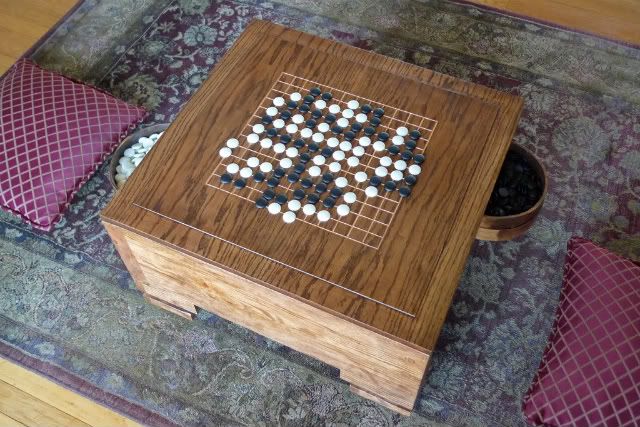
I'd be glad to answer any questions you have, and help any way I can. This was my first attempt at a goban, but I've got some experience with wood working. I tried to keep a traditional feel to it with the proportions and solidity, I used great big chunks of wood as much as I was able. I also fixed things together with wooden pegs and only gave in to metal hardware in one place where I was overcome by a fit of lazyness :p I intentionally went for a darker non-traditional color though simply because I like the way it looks with the dark board and lighter lines. (it is quite a bit darker in person)
I love the way it turned out, and I love all the little imperfections of the wood and the way I made and stained the drawers. It really has personality to it. The only real problem is that I don't know anyone to play with :( The grid is a standard-ish 50x47cm on one side and a smaller 13x13 on the other side and those are regular sized Yunzi stones in the pictures. The overall length of the long side is about 66cm, it stands about 50cm tall, and weighs even more than your mother.
I made it using only a table saw, drill, some hand tools, and a whole lot of clamps. As far as cost, aside from the tools and a piece of wood it didn't cost me anything beyond some sandpaper, stain, and polyurethane. What it mainly cost was time, lots and lots and lots and lots of time, but it was a labor of love :) If you're wanting to buy one I could make a custom one for you, shoot me an email if you're interested
Just need to say: You'all are awesome... pretty darn friendly forum here. I'm considering making my own goban as well; although, I may just find a big enough hunk of older wood and cut the board out of this. I don't have the a machine for engraving the lines, but I imaging a straight piece of steel and wood burner would get the job done.
The bigger questions for me are how to find an appropriately aged and dried hunk of wood to start with. I will be moving to Adelaide Australia in a year, which is very dry, and I'm a little concerned about cracking, etc.
Just my random thoughts, but a fun project to consider. I'm currently living in Japan, so I will probably pick up a used goban here either way, they are relatively affordable and plentiful here.
I love the way it turned out, and I love all the little imperfections of the wood and the way I made and stained the drawers. It really has personality to it. The only real problem is that I don't know anyone to play with
You can play via the web... when I lived in the US, I would set up my board and then start a web game on dragongoserver.net. Then I would follow along on my goban at home, so when I walked pass, I could look at the board and think about my next move(s). Worked better than looking at the computer screen all the time for me ˆ.ˆ
Suitable woods
It makes sense that the woods traditionally used for making gobans are the best for that purpose in the lands where go was traditionally played. That does not mean that when we consider all the different woods of the planet there might not be some from distant parts of the world that might not be quite suitable. I believe that board makers have begun considering closely related species from relatively nearby. But there are a lot of tree species.
For example, somebody said "pine too soft" but was probably thinking just of "white pine". I rather suspect that a species like "yellow pine" would be too hard. If the rather hard yellow pine or eastern hemlock aren't too hard, well they both would be available in large diameter trees. In other words, the harder "softwoods" and the softer "hardwoods" might be worth experimenting with. Cut a board and see what impact with go stones does.
Drying
If there is some common forest species that would be suitable (right hardness, grows to large diameter) and especially if a common species it might be possible to find some "standing dead". Those often have good portions which is why standing dead trees are sought by wood sculptors who also don't want to have to wait decades for large chunks of wood to season.
For example, suppose hemlock were a suitable wood. Well in much of its range being killed by wooley angelid so not impossible to find a 3+' diameter tree standing dead for some years.
I used to have CAD files of various goban grids of international standard (Japanese, Chinese, Miniature). I probably lost them in an install, but once I get some time I'll redo them. They were rasters of an accurate grid overlay, so they're suitable for use with a laser engraver (although I'm told raster gets you lower resolution, it should be fine for this use).
csobod wrote:I used to have CAD files of various goban grids of international standard (Japanese, Chinese, Miniature). I probably lost them in an install, but once I get some time I'll redo them. They were rasters of an accurate grid overlay, so they're suitable for use with a laser engraver (although I'm told raster gets you lower resolution, it should be fine for this use).
Here’s a Web site with goban grid files in diverse formats (GIF, PDF, EPS) and also with a script to make your own:
csobod wrote:I used to have CAD files of various goban grids of international standard (Japanese, Chinese, Miniature). I probably lost them in an install, but once I get some time I'll redo them. They were rasters of an accurate grid overlay, so they're suitable for use with a laser engraver (although I'm told raster gets you lower resolution, it should be fine for this use).
Here’s a Web site with goban grid files in diverse formats (GIF, PDF, EPS) and also with a script to make your own:






 You. Are. Awesome.