Samurai Gourmet - a retired salaryman has a meal each episode, intercut with scenes of a ronin in 18th century. Season 1, episode 3 begins with the main character playing go at a friends house.
Re: Mainstream Go Sightings
Posted: Sat Sep 29, 2018 7:07 am
by Aidoneus
I was re-watching Altered Carbon, episode 7, when a Go game appeared a bit past the 40 minute mark. It struck me that the players were using the same silicone board that I bought recently. Which reminded me that the coordinates were different than any I have seen. With the numbers ascending from the bottom, the letters ascend from right to left instead of left to right. Where would this be standard notation?
Re: Mainstream Go Sightings
Posted: Sat Sep 29, 2018 1:14 pm
by Marathon
Aidoneus wrote:I was re-watching Altered Carbon, episode 7, when a Go game appeared a bit past the 40 minute mark. It struck me that the players were using the same silicone board that I bought recently. Which reminded me that the coordinates were different than any I have seen. With the numbers ascending from the bottom, the letters ascend from right to left instead of left to right. Where would this be standard notation?
I've never seen coordinates on a board in real life. I've only seen coordinates on demo boards in videos and when using software. The board in that picture seems odd because the letters are oriented to be read from someone standing between the two players, off to the top side, while the letters are most easily read by the player on the left.
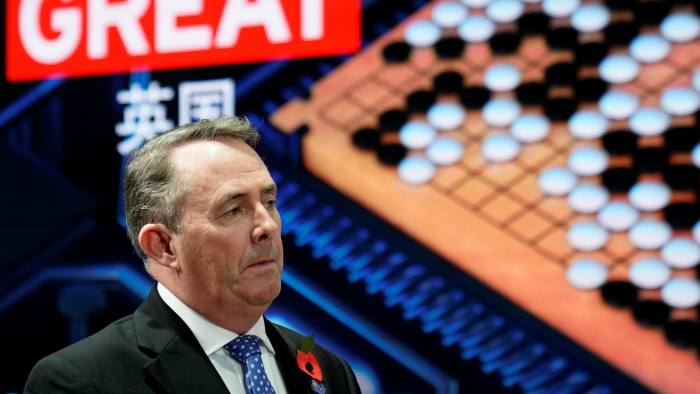
The FT had a giant photo of Go board on its front page today. It may be behind a pay wall - it's a photo of Liam Fox, a UK politician. The article is about UK/US trade, and the Go board's presence is not explained.
That's part of the front cover of Nature when the first AlphaGo paper was published (plus some Chinese text on top, with the white on red GREAT being part of a UK gov export campaign, see https://www.great.gov.uk/), so my guess it was illustrating tech/trade with an international angle seeing as that's what Fox is minister of; "UK software company makes clever AI thingy and gets on Chinese tech magazine cover" type of deal -- and please don't mention how most of DeepMind's staff is foreign so Brexit will make such successes in the future less likely. https://www.google.co.uk/search?q=natur ... o&tbm=isch
He asks if I play Go. Go, he says, is a good metaphor, although that is a vast understatement of its beauty. Go is not a simulation of anything. Go is Go. It possesses – he hesitates – atsumi. He waves his hands. Atsumi, like the walls of a castle. Thickness and dominion. Mass, like with gravity again: the power to move things by being what it is. English and Japanese are both good languages for saying these things. Good, but not great. I ask if he is himself Japanese.
The interesting fella says that he is not.
When he does not say anything else, I admit that I have never played Go and ask him to show me how it works.
We play Go. It turns out that my ignorance of the game does not make me a tedious opponent because one of the ways in which Go is not like chess is that there are no prescribed openings as such. There are familiar patterns that quickly yield to uniquenesses, and what appears to be a mistake may become a fulcrum whose existence and position enables something remarkable. It is about identity as much as strategy. It is also profoundly difficult for computers to understand. Even a smallish chess machine can beat most players – but until very recently the very best Go simulator still struggled with an average human opponent. Now that has changed, but it happened by making a different kind of step altogether. Effectively, the digital Go master is not a machine at all, but a simulated person whose consciousness only extends to Go.
It's woven in and out of the story, for at least a few pages.