Page 1 of 3
unsolvable (math) problem for a whole year, help me!
Posted: Fri May 23, 2014 3:29 pm
by MJK
Everything is in the hide tag below.
[hide][attachment=0]qqewew.PNG[/attachment][/hide]This situation occurred while trying to solve a messed up inequality problem. I soon realized it never works this way and somehow found another way, but after a year I still cannot find an error in that definitely non-sense..... expression of thought(?).
After seeing the thread insisting that a right triangle can at the same time be an equilateral triangle on a 2 dimensional Euclidean plain, I again realized that this website has quite a lot of math people by whom I can probably get some help.
[edit] minor fix of notation error caused by a badly coded sequenceformula writer [/edit]
Better presentation of the problem below.
What is the error of generalizing that,
given,
{a, b, c, d, X} ⊂ {x|x is a real number}
a<X<b <=> c<X<d
then,
a=c and b=d
?
Code: Select all
Prove that below is not true.

when,
{a, b, c, d, X} ⊂ {x|x is a real number}
a<X<b <=> c<X<d

then,
a=c and b=d
Re: unsolvable (math) problem for a whole year, help me!
Posted: Fri May 23, 2014 3:53 pm
by RBerenguel
I can't follow it. What's the assumption beside them being reals? What's P? A clause? And A? And B?
Re: unsolvable (math) problem for a whole year, help me!
Posted: Fri May 23, 2014 4:06 pm
by MJK
RBerenguel wrote:I can't follow it. What's the assumption beside them being reals? What's P? A clause? And A? And B?
Oops, I'm sorry. I just almost copied directly my handnotes... so.
A, B, and P are all conditions of (alpha, beta). They basically mean the same thing. The diagram below shows the points that meet the condition on an R^2 plane. Alpha to the x-axis and beta to the y-axis.
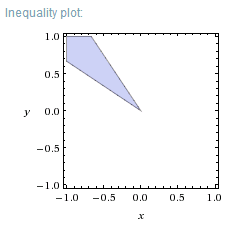
- dgdgd.PNG (5.16 KiB) Viewed 11858 times
Therefore, all the coloured points on the diagram above are the elements of the set {(alpha, beta)|P)}.
I hope my explanation was sufficient.
Re: unsolvable (math) problem for a whole year, help me!
Posted: Fri May 23, 2014 4:24 pm
by RBerenguel
MJK wrote:RBerenguel wrote:I can't follow it. What's the assumption beside them being reals? What's P? A clause? And A? And B?
Oops, I'm sorry. I just almost copied directly my handnotes... so.
A, B, and P are all conditions of (alpha, beta). They basically mean the same thing. The diagram below shows the points that meet the condition on an R^2 plane. Alpha to the x-axis and beta to the y-axis.
dgdgd.PNG
Therefore, all the coloured points on the diagram above are the elements of the set {(alpha, beta)|P)}.
I hope my explanation was sufficient.
Makes a little more sense now.
A (or P) is redundant, they are the same inequality. Aside from that, what are you trying to prove/see from the inequalities A & B, then?
Re: unsolvable (math) problem for a whole year, help me!
Posted: Fri May 23, 2014 4:27 pm
by MJK
RBerenguel wrote:Makes a little more sense now.
A (or P) is redundant, they are the same inequality. Aside from that, what are you trying to prove/see from the inequalities A & B, then?
In the last few lines. Why do I get the result that alpha and beta equals zero? There must be my fundamental misunderstanding which I cannot find.
Re: unsolvable (math) problem for a whole year, help me!
Posted: Fri May 23, 2014 4:34 pm
by DrStraw
How does -b/2 = a/3 and b/3=-a/2 follow from the previous line?
a=-1 and b=1 make the previous line true, but not this line.
Re: unsolvable (math) problem for a whole year, help me!
Posted: Fri May 23, 2014 4:42 pm
by MJK
DrStraw wrote:How does -b/2 = a/3 and b/3=-a/2 follow from the previous line?
a=-1 and b=1 make the previous line true, but not this line.
But isn't it
a<X<b <=> c<X<d
a=c and b=d?
Because both inequalities have the same range.
Re: unsolvable (math) problem for a whole year, help me!
Posted: Fri May 23, 2014 4:43 pm
by RBerenguel
The thing is, inequalities don't work like this. Even though a+b (alpha+beta) satisfy these two inequalities, it doesn't mean the extremes have to coincide. You wouldn't say:
5<d<7
2<d<9
And conclude that 5=2 and 7=9.
From the last line you could deduce:
-0.5b+0.5a<0<1/3b-1/3a
Which is then, just
a<b.
The best way to study 3-way inequalities is do them by pieces, and always study the boundaries. So the important thing is the lines
-3/2b=a
a=-2/3b
b=1/2a
Etc
And their intersections (the first one is b=0 a=0, but from the other pair you get a=-3/4, b=-3/8). You need all four points from here.
Does this help? It's a little tricky typing this now, since I'm on my iPad

Re: unsolvable (math) problem for a whole year, help me!
Posted: Fri May 23, 2014 4:52 pm
by MJK
RBerenguel wrote:The thing is, inequalities don't work like this. Even though a+b (alpha+beta) satisfy these two inequalities, it doesn't mean the extremes have to coincide. You wouldn't say:
5<d<7
2<d<9
And conclude that 5=2 and 7=9.
Thank you for your such long reply with iPad.
But in your example
5<d<7 <!=> 2<d<9 (not necessary and sufficient condition of d)
5<d<7 => 2<d<9 would be true though
if
1<d<3 <=> a<d<b
a=1 and 3=b
this was what I meant.
Re: unsolvable (math) problem for a whole year, help me!
Posted: Fri May 23, 2014 4:59 pm
by RBerenguel
MJK wrote:RBerenguel wrote:The thing is, inequalities don't work like this. Even though a+b (alpha+beta) satisfy these two inequalities, it doesn't mean the extremes have to coincide. You wouldn't say:
5<d<7
2<d<9
And conclude that 5=2 and 7=9.
Thank you for your such long reply with iPad.
But in your example
5<d<7 <!=> 2<d<9 (not necessary and sufficient condition of d)
5<d<7 => 2<d<9 would be true though
if
1<d<3 <=> a<d<b
a=1 and 3=b
this was what I meant.
In this case it is true, but only because this is one inequality with just one variable (the "solution" is an interval) but in the problem above, it is not.
Re: unsolvable (math) problem for a whole year, help me!
Posted: Fri May 23, 2014 5:05 pm
by MJK
My question can be summarized as,
Code: Select all
What is the error of generalizing that,

given,
{a, b, c, d, X} ⊂ {x|x is a real number}
a<X<b <=> c<X<d

then,
a=c and b=d

?
Re: unsolvable (math) problem for a whole year, help me!
Posted: Fri May 23, 2014 5:06 pm
by DrStraw
MJK wrote:DrStraw wrote:How does -b/2 = a/3 and b/3=-a/2 follow from the previous line?
a=-1 and b=1 make the previous line true, but not this line.
But isn't it
a<X<b <=> c<X<d
a=c and b=d?
Because both inequalities have the same range.
You are trying to create an equivalence where there is none.
Posted: Fri May 23, 2014 5:11 pm
by EdLee
MJK, just curious: what's the background of this question ? Are you trying to understand it for fun ?
Or, is it a homework assignment ?
If it's homework, which school level ? Which subject ? (Mathematics, or physics, or something else, like economics ? )
Re:
Posted: Fri May 23, 2014 5:27 pm
by MJK
EdLee wrote:MJK, just curious: what's the background of this question ? Are you trying to understand it for fun ?
Or, is it a homework assignment ?
If it's homework, which school level ? Which subject ? (Mathematics, or physics, or something else, like economics ? )
Background is a situation I faced during my trying to solve a horrible inequality problem. The original problem is quite far away from this and is already solved by a very different way. So everything is for fun, or because it feels very 'caught' due to 'unknowing'
On which level? I can currently deal with some basic analysis (or actually in the process studying it). The level of the answer is not much important. Best if I can understand everything, but even if not so I will essentially have dealt with more math years later, and most importantly I do want to know the answer.
I will re-state my question below. I already changed my original post with the newer version of my problem.
Code: Select all
What is the error of generalizing that,

given,
{a, b, c, d, X} ⊂ {x|x is a real number}
a<X<b <=> c<X<d

then,
a=c and b=d

?
Re: Re:
Posted: Fri May 23, 2014 5:56 pm
by DrStraw
MJK wrote:
Code: Select all
What is the error of generalizing that,

given,
{a, b, c, d, X} ⊂ {x|x is a real number}
a<X<b <=> c<X<d

then,
a=c and b=d

?
As I stated above, the error is in "a<X<b
<=> c<X<d"
That simply is not true.