Page 1 of 2
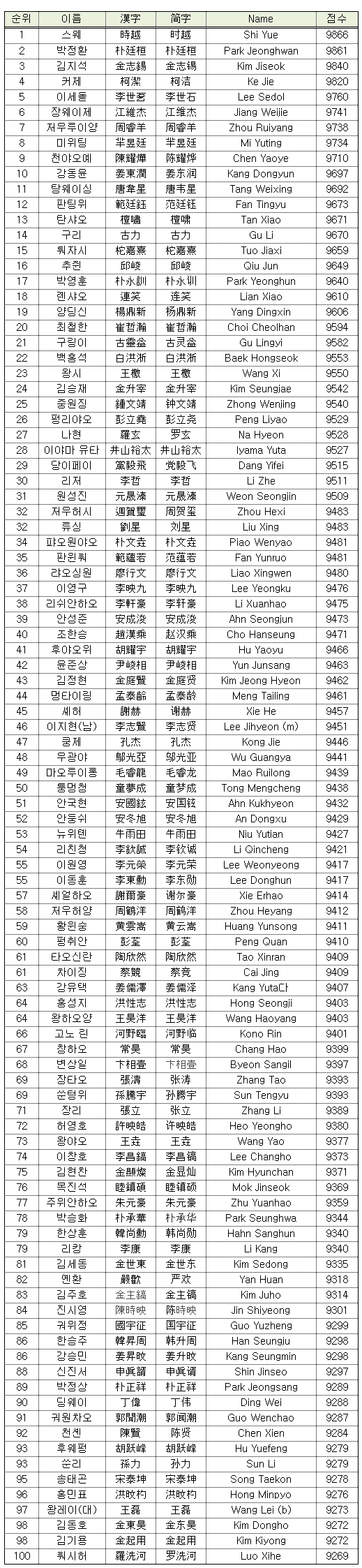
World ranking as of end of September by Dr Bae Taeil
Posted: Mon Nov 03, 2014 9:05 pm
by trout
Re: World ranking as of end of September by Dr Bae Yaeil
Posted: Mon Nov 03, 2014 10:37 pm
by emerus
Don't even recognize #6 and #7.
Chen Yaoye has been on a huge decline and wow Iyama has basically vanished. What happened there?
Re: World ranking as of end of September by Dr Bae Yaeil
Posted: Mon Nov 03, 2014 11:38 pm
by cdybeijing
emerus wrote:Don't even recognize #6 and #7.
Chen Yaoye has been on a huge decline and wow Iyama has basically vanished. What happened there?
Jiang Weijie and Zhou Ruiyang have been elite players for several years now. I would expect more people to know them than, say, Ke Jie or Mi Yuting.
Re: World ranking as of end of September by Dr Bae Yaeil
Posted: Tue Nov 04, 2014 2:13 am
by wineandgolover
...and the ascent of Ke Jie continues.

Re: World ranking as of end of September by Dr Bae Yaeil
Posted: Tue Nov 04, 2014 3:47 am
by Knotwilg
Japanese players at 28 & 66
Top 20: 6 Koreans.
Dearly missing: Na Hyun.
The 10 game match to decide the best player of our times was between #5 and #14. Perhaps Shi Yue and Park Jung Hwan should go next?
Re: World ranking as of end of September by Dr Bae Yaeil
Posted: Tue Nov 04, 2014 4:32 am
by Jingliu
The 10 game match to decide the best player of our times was between #5 and #14.
No buddy, they played jubango because Lee Sedol has 14 major international titles and Gu Li has 7, far exceeding other players. It's still a long way for Shi Yue and Park Junghwan to catch up with titles, and only then there will be enough interest among sponsors and fans to have another jubango.
Re: World ranking as of end of September by Dr Bae Yaeil
Posted: Tue Nov 04, 2014 4:48 am
by John Fairbairn
People in chess often say that Elo type systems have built-in inflation over time. It may even be necessary, in the same way that a measure of inflation is necessary for an economy. The only real drawback is that it makes historical comparisons difficult or meaningless.
But if that is so, does "over time" mean just over years and months, or can it mean over number of games? If it can, it seems to me that it might matter that the typical Korean is playing sometimes around twice as many games as a Japanese player, a huge difference.
As I (mis?)understand it in chess, if, a player scores 50-50 in one year and gets a certain grading, and then scores 50-50 in the following year against roughly the same level of opposition, he can usually expect a higher grading.
If that's right, does it not also mean that a player who scores 50-50 over 100 games can expect a higher rating than one who scores 50-50 over 50 games?
Re: World ranking as of end of September by Dr Bae Yaeil
Posted: Tue Nov 04, 2014 5:01 am
by RobertJasiek
OC, #22 is not 3 ranks weaker than #1. Quite like on KGS, top ratings run away more than one would wish.
Re: World ranking as of end of September by Dr Bae Yaeil
Posted: Tue Nov 04, 2014 12:45 pm
by yoyoma
RobertJasiek wrote:OC, #22 is not 3 ranks weaker than #1. Quite like on KGS, top ratings run away more than one would wish.
Robert, you can see the math here:
http://english.baduk.or.kr/sub03_04-1.htm
It is not supposed to be 100 points = 1 rank.
Re: World ranking as of end of September by Dr Bae Taeil
Posted: Tue Nov 04, 2014 10:43 pm
by RobertJasiek
Thanks. What I like most about this is the quote "value has been chosen adequately to reflect rapid variations of performance of baduk players" and the illustration that this is so.
Re: World ranking as of end of September by Dr Bae Taeil
Posted: Wed Nov 05, 2014 2:29 am
by leichtloeslich
John Fairbairn wrote:As I (mis?)understand it in chess, if, a player scores 50-50 in one year and gets a certain grading, and then scores 50-50 in the following year against roughly the same level of opposition, he can usually expect a higher grading.
If that's right, does it not also mean that a player who scores 50-50 over 100 games can expect a higher rating than one who scores 50-50 over 50 games?
I don't think so.
From what little I understand by having skimmed
this, inflation is a function of time, not of games played.
You need rating points injected into the system, which happens gradually over time.
Also, from my limited understanding, inflation means everyone's rating gets higher over time, but the gaps between the players stay roughly the same.
Re: World ranking as of end of September by Dr Bae Taeil
Posted: Wed Nov 05, 2014 7:02 am
by pwaldron
leichtloeslich wrote:
From what little I understand by having skimmed
this, inflation is a function of time, not of games played.
You need rating points injected into the system, which happens gradually over time.
Also, from my limited understanding, inflation means everyone's rating gets higher over time, but the gaps between the players stay roughly the same.
The basic Elo system is
deflationary, not inflationary. The total number of rating points in the system is conserved, so that if you play in a tournament and gain 10 rating points then your opponents will lose the same amount. In general, players enter the system as beginners at a low rating and eventually retire later with a higher rating, which the net effect of removing rating points from circulation.
There are various ways to try and combat the inherent deflation in the system. The EGF injects extra rating points, and the UCSF puts a floor in place for various players (e.g. established life masters) so that their ratings don't drop below certain thresholds. The USCF actually tracks the average ratings of a cohort of players (active players in their twenties and thirties, if I remember) to monitor how the system is doing.
In general the inflation/deflation doesn't matter provided that all players are moderately active. The rating differences should reasonably reflect the difference in skill. Problems do arise, however, if an inactive player returns to play. For their first games they will be under/over rated and will have results that would be unexpected given their entry rating.
Re: World ranking as of end of September by Dr Bae Taeil
Posted: Wed Nov 05, 2014 8:45 am
by leichtloeslich
pwaldron wrote:...
To put it politely: you didn't tell me anything I didn't already know, and, furthermore, whilst quoting (almost) my entire post, you didn't address anything I said.
As far as I'm aware, JF suggested that the
observed inflation in FIDE ratings for the top chess-players could explain why the Japanese go-players seem to rank poorly when compared to the Korean go-players, because
maybe playing more games causes you to have a more inflated rating.
This, in my humble understanding of the subject matter, is factually wrong. (Please feel free to correct me on this one, as you probably know more about ELO rating math than I do.)
This is what my post was about. If it was really that ambivalent that it caused you to think anything you said was relevant to my post, I apologize for not being more verbose. (I usually aim at keeping my posts succinct.)
Re: World ranking as of end of September by Dr Bae Taeil
Posted: Wed Nov 05, 2014 12:41 pm
by hyperpape
If inflation is happening, then not playing competitively while your strength is constant will leave you behind (to the tune of 7 points a year in chess). If that happens, then playing games will have a slightly positive expected value in rating, and the more games you play, the smaller the probability that your resulting change in rating is zero or lower.
So I'd guess that John's mechanism is theoretically possible. But 1) rating in the Chess ELO system that we best understand is still only .3% of a player's rating per year, so this effect is pretty small, and 2) I bet that 40 games a year is more than enough to combat the effect (note also that there's a catchup effect. The further "behind" you are, the greater the expected value of playing games is, so there's an effective upper limit on how far you can realistically fall behind if you play at all).
So I share the scepticism that this could be an important effect.
I'd be more worried that I haven't seen discussion of Dr. Bae Taeil's methods. There are weird aspects to it, like the international weighting factors I believe he was using and the tournament weighting factors. These may be necessary for good international comparisons, but I haven't ever read why.
We could also compare:
http://sports.geocities.jp/mamumamu0413/total.html.
Re: World ranking as of end of September by Dr Bae Taeil
Posted: Thu Nov 13, 2014 8:01 pm
by Abyssinica
So apparently Ke Jie > Lee Sedol.