Page 1 of 4
What is the theoretical value of the first move of a game?
Posted: Mon Aug 24, 2020 1:35 pm
by Gérard TAILLE
During yose or in a tsume-go problem the value of a move may be quite simple.
$$W
$$ -------------------
$$ | . . . X O . . . .
$$ | . . . X O . . . .
$$ | X X X X O . . . .
$$ | O O O O O . . . .
$$ | . . . . . . . . .
$$ | . . . . . . . . .
$$ | . . . . . . . . .
$$ | . . . . . . . . .
$$ | . . . . . . . . .
- Click Here To Show Diagram Code
[go]$$W

$$ -------------------

$$ | . . . X O . . . .

$$ | . . . X O . . . .

$$ | X X X X O . . . .

$$ | O O O O O . . . .

$$ | . . . . . . . . .

$$ | . . . . . . . . .

$$ | . . . . . . . . .

$$ | . . . . . . . . .

$$ | . . . . . . . . .[/go]
In the above diagram the value of a move in the upper left corner is 22 points.
From a theoretical point of view is it possible to give the value of the very first move of a game?
My calculation is the following: assuming a parfait game will end with an advantage of exactly 7 points for black the value of the first move must be 4 x 7 = 28 points.
Do you agree with such evaluation ?
Re: What is the theoritical value of the first move of a gam
Posted: Mon Aug 24, 2020 2:49 pm
by bogiesan
Value of first move in an even game between evenly matched has been debated for many centuries. Did you not find the answer?
Re: What is the theoritical value of the first move of a gam
Posted: Mon Aug 24, 2020 2:56 pm
by Uberdude
Why did you multiply by 4?
If you model the game as each player taking a gote move of some clear number of points in a non interacting way (like the cards of environmental Go) then there's many ways you can end up with black having 7 more at the end (I'm using a short game to illustrate the point):
28, 27, 26, 25, 24, 23, 22, 21, 20, 19, 18, 17, 16, 15
100, 100, 100, 100, 100, 93
7, 7, 7, 7, 7, 7, 7
24, 23, 22, 21, 20, 19, 18, 17, 16, 15, 14, 13, 12, 11
12, 12, 12, 12, 11, 10, 45, 43, 30, 28, 2, 2, 2, 1, 1, 1, 1
28, 21, 12, 12, 10, 10, 5, 5, 3, 3, 2, 2, 2, 2, 1, 1, 1, 1, 1, 1
Does it make sense to talk about the value of the first move as the gote number of points it grabs (which could be e.g 7 or 100 in the examples), or is "the value of sente" more useful, which is something closer to the difference between the first 2 numbers. Of course Go isn't so simple as grabbing a bunch of non interacting gote moves in decreasing order, but it'll do for starters.
Re: What is the theoritical value of the first move of a gam
Posted: Mon Aug 24, 2020 4:18 pm
by Bill Spight
A reasonable estimate for how much an opening move, if gote, gains is twice komi. So with a 7 pt. komi we can estimate the gain for the first play as 14 pts. There is a great deal of uncertainty about that estimate, however.
KataGo provides an estimate for the value of each position, or position with a certain player to play, so we can use that as a way of estimating how much a play gains. I expect that it will be close to 14 pts.

(Years ago I estimated it as 13.75 pts.

)
Re: What is the theoritical value of the first move of a gam
Posted: Mon Aug 24, 2020 4:23 pm
by ez4u
Gérard TAILLE wrote:...
From a theorical point of view is it possible to give the value of the very first move of a game?
My calculation is the following: assuming a parfait game will end with an advantage of exactly 7 points for black the value of the first move must be 4 x 7 = 28 points.
Do you agree with such evaluation ?
Is this a "theoretical" value? What does that even mean? Notice that if we change 7 to 11, the first move value changes to 44. If we change the 4 to 3, it changes to 21. Is there a "theory" behind either the 7 or the 4?
Re: What is the theoretical value of the first move of a gam
Posted: Mon Aug 24, 2020 6:50 pm
by Kirby
In the above diagram the value of a move in the upper left corner is 22 points.
Just a side note... I agree with the assessment of 22 points for playing a move in that corner. But the position made me wonder about ko threats. Specifically, is a 22 point corner that has fewer ko threats that can be used against it different in "value" from a 22 point corner with many ko threats that can be used against it?
I don't think so in terms of the way we count value of a position. But I wonder if it'd ever be useful to distinguish when counting. It's hard to predict how many kos might arise in the course of a game anyway, so maybe it's not really that practical to differentiate.
Re: What is the theoretical value of the first move of a gam
Posted: Mon Aug 24, 2020 8:16 pm
by Bill Spight
Kirby wrote:
In the above diagram the value of a move in the upper left corner is 22 points.
Just a side note... I agree with the assessment of 22 points for playing a move in that corner. But the position made me wonder about ko threats. Specifically, is a 22 point corner that has fewer ko threats that can be used against it different in "value" from a 22 point corner with many ko threats that can be used against it?
One way of dealing with the value of a ko threat when there is only a potential ko of unknown type and size on the board is to assign the threat a small positive value, ε, negative if it is your opponent's threat. Back in the '90s Yonghoan Kim, one of Berlekamp's students, tackled the idea of the value of ko threats in his dissertation, in what he called perturbation theory. OC, if you know the specifics you can work things out.
As for the value of 22 pts. for a move in the corner, I know you guys understand these things, but for the readers, the value of 22 pts. does not mean what a lot of people think it means.
Assuming that the White stones are immortal, the average value of the corner is 6 pts. for White. If Black plays first, Black lives and gets 5 pts., an average gain of 11 pts. If White plays first, White kills and gets 17 pts., also an average gain of 11 pts. 22 pts. is the sum of the two average gains. It is equal to the difference between 5 pts. for Black and 17 pts. for White, which is a little easier to calculate than the average gain.
Re: What is the theoritical value of the first move of a gam
Posted: Mon Aug 24, 2020 8:40 pm
by Bill Spight
Uberdude wrote:Why did you multiply by 4?
If you model the game as each player taking a gote move of some clear number of points in a non interacting way (like the cards of environmental Go) then there's many ways you can end up with black having 7 more at the end (I'm using a short game to illustrate the point):
28, 27, 26, 25, 24, 23, 22, 21, 20, 19, 18, 17, 16, 15
100, 100, 100, 100, 100, 93
7, 7, 7, 7, 7, 7, 7
24, 23, 22, 21, 20, 19, 18, 17, 16, 15, 14, 13, 12, 11
12, 12, 12, 12, 11, 10, 45, 43, 30, 28, 2, 2, 2, 1, 1, 1, 1
28, 21, 12, 12, 10, 10, 5, 5, 3, 3, 2, 2, 2, 2, 1, 1, 1, 1, 1, 1
Does it make sense to talk about the value of the first move as the gote number of points it grabs (which could be e.g 7 or 100 in the examples), or is "the value of sente" more useful, which is something closer to the difference between the first 2 numbers. Of course Go isn't so simple as grabbing a bunch of non interacting gote moves in decreasing order, but it'll do for starters.
Suppose that the stack of cards model is appropriate for go in general when you don't know the specifics of the position, but you do know how much the most valuable card (the
top card) gains. Also suppose that at each turn each player takes the top card. Also, as in your example, there could be any number of cards of the same size, and suppose that there is a 50:50 chance that the number of cards of a given size is odd or even.
Then the expected result of the stack of cards with a top card that gains T pts. is T/2 pts.
Let S(v) be the expected value of having the move when the top card gains
v pts.
Let the gain of the top card be T and the gain of the second to top card be R.
Half the time the number of cards that gain T pts. will be odd and the player with the move (the first player) will take the last one for a gain of T pts. Then the second player will take one of the second to top cards, for an expected gain of S(R). The expected result will be T - S(R).
Half the time the number of top cards will be even and the players will split them, for net 0 pts. Then the first player will have an expected gain of S(R).
The expected result will then be ((T - S(R)) + S(R))/2 = T/2. QED.
Edit: T/2 will also be the expected komi because for N cards you will have 2
N-1 pairs of equiprobable results that add to T. Half of the addends will be less than or equal to T/2 and half of them will be greater than or equal to T/2.
Re: What is the theoretical value of the first move of a gam
Posted: Mon Aug 24, 2020 11:17 pm
by lightvector
Echoing what I think Bill has tried to teach on these forums.
The "swing value" - the total swing in points between white playing first and black playing first - of the upper left is 22 points.
But it's weird to call that the "value of the move". For example, the phrase "value of the move" suggests some other possible intuitions: that maybe 22 should be the amount that you'd have to make a card worth in a model like Uberdude's model to be indifferent between moving there and taking the car. Or that if you were forced to pass rather than to make a move in the upper left, 22 points would be the amount of extra komi you'd need in compensation to make it fair. Or that if you were to blunder and to play a useless dame move somewhere else when the upper left was the biggest move, the amount you'd lose on average would be 22 points.
But none of these is the case, in all cases 11 is generally closer to the right answer, not 22. We can see 22 points is too high as follows:
1. Suppose it's white's turn, and white plays in the upper left. White has 17 points, with black to move next.
2. Suppose white is instead forced to pass and is awarded 22 points in compensation for this forced pass. Black plays in the upper left and has 5 points. So net, white has 17 points matching situation 1 in points. But now *white* is to move next.
So generally, situation 2 is better for white than situation 1. Therefore 22 points is too large, white preferred to receive the 22 points and forego the move than to play the move.
Okay, what about 11 points?
3. Suppose white is instead forced to pass and is awarded 11 points in compensation for this forced pass. Black plays in the upper left and has 5 points. But now white is to move next instead of black, so to match things up we need to force white to pass again. Let's award another 11 points for this pass. Now white has 22 points, while black has 5 points, so net white has 17 points, and black is to move next.
In situation 3, we've achieved equivalence with situation 1. We had to force white to pass twice though. But there's still a clear sense in which we can say that the average value of each move here was 11 points.
Per move we forced white to give up, we needed to give 11 points of compensation to white to make it equivalent to if white was never forced.
If you still find "swing values" easier to think about, just call them "swing values" or some other phrasing less ambiguous than "value of a move" when you talk about them.
Re: What is the theoretical value of the first move of a gam
Posted: Mon Aug 24, 2020 11:33 pm
by RobertJasiek
Re: What is the theoretical value of the first move of a gam
Posted: Tue Aug 25, 2020 12:09 am
by Gomoto
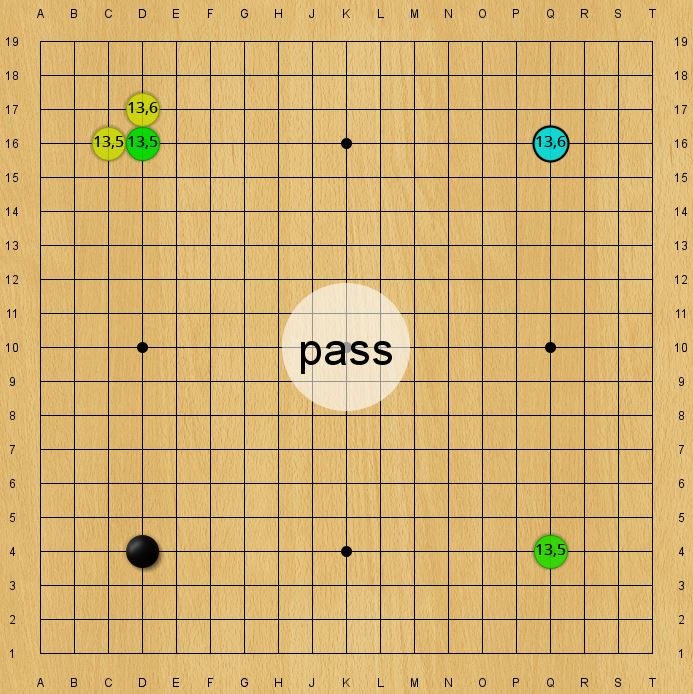
- moveval1.JPG (116.31 KiB) Viewed 16644 times
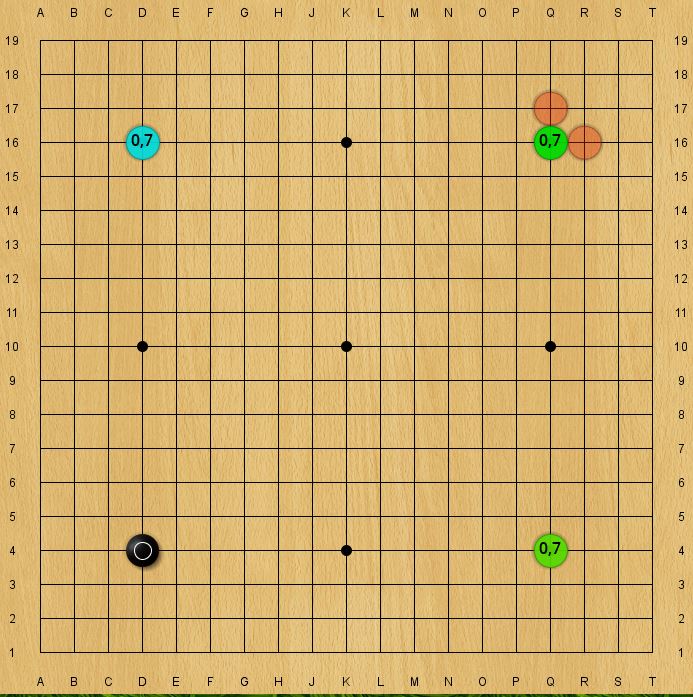
- moveval2.JPG (117.49 KiB) Viewed 16644 times
Re: What is the theoretical value of the first move of a gam
Posted: Tue Aug 25, 2020 2:49 am
by Gérard TAILLE
Thank you for your answers and let me try to understand these answers to my question.
We have to distinguish beetween
1) the swing value in a given area of the board
2) the value of a move
Taking my example with 22 points. It is clearly a swing value but the value of a move here is only 11 points : whitout knowing who will play first one can estimate that, on average, white will have 6 points in this area (17 points if he plays first and -5 points if black plays first) and a player can add 11 points to this value if plays first.
One sees that a swing value is twice the value of the corresponding move.
In other words:
the "value of a move" consists of comparing the move to a pass move
and the swing value consists of comparing the move to an opponent move.
With this in mind I understand that the value of the first move is 14 points.
If now you want to compare such move with a swing value (e.g. 22 points) then you have to consider that such move is equivalent to a move in an area of 28 points (swing value).
It seems to me that computers use only "value of move" but I am not sure what strong human players use. It seems to me that they can switch easily from one count (value of moves) to the other (swing values) depending of the situation (fuseki, middle game, yose) and that is a little upsetting.
Re: What is the theoretical value of the first move of a gam
Posted: Tue Aug 25, 2020 4:02 am
by RobertJasiek
Computers do not use move values.
Per-move value and swing value are both move values, although the latter has restricted scope of application.
That players can use both and other values should come to no surprise. They are just values, which can be calculated:)
Re: What is the theoretical value of the first move of a gam
Posted: Tue Aug 25, 2020 6:31 am
by Gérard TAILLE
Oops, I have to clarify my point concerning computer vs human play.
Taking aside the deep analysis made by a computer or a human through a vast tree of variants, my understanding is the following.
Let's suppose it is black to play.
A computer evaluates all the positions reached by a black move and chooses the best move according to these evaluations. If you substract to these evluations the evaluation of the currtent position you can see that the choice made by the computer can be seen as based on the value of each black move (but of course the computer has not to do explicitly these substractions).
Humans may act strictly as a computer but in order to choose their move they also can take into account another approach to gather some more information: they imagine they pass and they find the best white move. Using such information they can return to the computer method in order to definitely chosose their move. In that case, beside the move evaluation made by the computer the human add something like a swing evaluation in order to have a better understanding of the position.
To my knowledge I don't think a computer improve its analysis by finding the best white move when the pass move looks completetly stupid.
So my conclusion is the following:
Computer use basically "move values" though humans may add some swing values to improve their analysis.
Re: What is the theoretical value of the first move of a gam
Posted: Tue Aug 25, 2020 7:14 am
by Bill Spight
Gérard TAILLE wrote:Thank you for your answers and let me try to understand these answers to my question.
We have to distinguish beetween
1) the swing value in a given area of the board
2) the value of a move
Taking my example with 22 points. It is clearly a swing value but the value of a move here is only 11 points : whitout knowing who will play first one can estimate that, on average, white will have 6 points in this area (17 points if he plays first and -5 points if black plays first) and a player can add 11 points to this value if plays first.
One sees that a swing value is twice the value of the corresponding move.
In other words:
the "value of a move" consists of comparing the move to a pass move
and the swing value consists of comparing the move to an opponent move.
That's one way to think about it.
Another way is to think of the value of a move as like the distance between two points on a map. We start at point A and go to point B. How far have we gone? In go we start at position A and make a move to position B. How much have we gained?
With this in mind I understand that the value of the first move is 14 points.
If now you want to compare such move with a swing value (e.g. 22 points) then you have to consider that such move is equivalent to a move in an area of 28 points (swing value).
I see what you are saying, but it seems to me to unnecessarily complicated. What does this hypothetical 28 point area look like? Swing values aren't really made for this kind of thing.
It seems to me that computers use only "value of move" but I am not sure what strong human players use.
As Robert pointed out, modern computer go players do not use the value of a move as described here. They could be trained to do so, and before the virus hit that was something I was thinking about working on. Aaron Siegel has written a program that does calculate such values, called CGSuite. See
http://cgsuite.sourceforge.net/ . KataGo does make use of evaluations in terms of points on the board, which the author, lightvector, can explain.
It seems to me that they can switch easily from one count (value of moves) to the other (swing values) depending of the situation (fuseki, middle game, yose) and that is a little upsetting.
Strong players of previous generations were mostly confused. Swing values were devised to compare plays, as you indicate above. Good enough.
But swing values don't work for comparing sente and gote. Despite that fact, well into the late 20th century the Nihon Kiin's
Small Yose Dictionary included several pages of plays ordered by move values which lumped sente and gote together. Finally they stopped doing so, but instead of correcting the move values, simply dropped that feature.

The rule of thumb for comparison was to double the value of sente. That is already misleading, as what were called the value of sente moves were actually the average gains of reverse sente moves. Early in this century O Meien wrote a popular book in Japanese about endgame evaluation that explained that. His book does not refer to the value of sente at all.
And he does not use swing values.
When you try to do more sophisticated things than just compare two plays, swing values usually make things more difficult and confusing than average gains. Best, IMO, to ground your understanding on the value of positions; starting, OC, with scores, and then the average value of positions. Then think of the average value of a move as the difference between the average value of the position before the move and the average value of the position after the move.