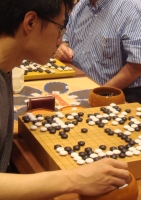
Life and death in go do not have single, unambiguous meanings. Stones may be capturable, even killable, but capturing them or killing them may be costly.
Under area scoring, dead stones at the end of the game may be captured without cost. So we may define live stones under area scoring as stones remaining on the board at the end of play. If that is our definition, then the players will capture dead stones at the end of play. But why force them to do so? Why not let the players agree which stones are alive or dead, and only force them to capture dead stones if they disagree? In that case our definition is that stones are alive or dead if the players agree that they are.


Anyway, the White stones in Diagram 4 are alive because if Black attempts to capture them she must add one stone to the three inside stones, and then White can capture the four stones and make 8 pts. of territory instead of 0. It is costly for Black to try to capture the White stones. Note the assumptions of alternating local play. Those assumptions are practical during a game, but do not guarantee that the White stones will remain on the board at the end of play. So that's another definition of life. It is possible to construct a board where correct play is for Black to put the White stones in atari and for White to ignore that atari and play elsewhere, and then Black captures the White stones. OC, that would involve a humungous ko. Formally, we might say that the White stones are alive with probability 1 - ε, where ε is small. To put it informally, the White stones are alive, except when the aren't.