Chinese, Korean, and Japanese player name issues.
-
Alberich
- Dies with sente
- Posts: 92
- Joined: Sun Jun 17, 2012 11:05 am
- GD Posts: 0
- IGS: Alberich
- Online playing schedule: IGS most weekdays
- Been thanked: 1 time
Chinese, Korean, and Japanese player name issues.
I'm very new at this but I'm wondering about this issue on names. In regular chess...you can immediately tell whether the player is male or female by the designation "GM" and "WGM". However I haven't seen a method on allowing viewers to know if the player in question is male or female. It may not be an issue for people who are already familiar with the names but what about people just learning about the game? Is there an official way of determining whether the person in question is male or female?
-
Uberdude
- Judan
- Posts: 6727
- Joined: Thu Nov 24, 2011 11:35 am
- Rank: UK 4 dan
- GD Posts: 0
- KGS: Uberdude 4d
- OGS: Uberdude 7d
- Location: Cambridge, UK
- Has thanked: 436 times
- Been thanked: 3720 times
Re: Chinese, Korean, and Japanese player name issues.
Most professional players are male so that's a reasonably safe assumption. In the GoGoD database females have a "(f)" suffix. On Mr Kin's webpages their names are in red.
-
jts

- Oza
- Posts: 2672
- Joined: Sat Sep 18, 2010 4:17 pm
- Rank: kgs 6k
- GD Posts: 0
- Has thanked: 310 times
- Been thanked: 637 times
Re: Chinese, Korean, and Japanese player name issues.
It's also fairly easy to tell based on the tournament, if that is marked on the sgf. Professional women are usually playing in their own tournaments.
By the way, I've noticed you frequently contrast go to "regular chess", Alberich. I don't know exactly what to make of this, but I wonder if you have heard people talk about "Chinese chess" or "Japanese chess" and assumed that was a go reference. In fact, there are completely different games called xiangqi and shogi in china and Japan, respectively. Shogi, xiangqi, and shatranj are all descendants of the same Indian parcheesi variant. Go has a completely separate history.
By the way, I've noticed you frequently contrast go to "regular chess", Alberich. I don't know exactly what to make of this, but I wonder if you have heard people talk about "Chinese chess" or "Japanese chess" and assumed that was a go reference. In fact, there are completely different games called xiangqi and shogi in china and Japan, respectively. Shogi, xiangqi, and shatranj are all descendants of the same Indian parcheesi variant. Go has a completely separate history.
-
John Fairbairn
- Oza
- Posts: 3725
- Joined: Wed Apr 21, 2010 3:09 am
- Has thanked: 20 times
- Been thanked: 4739 times
Re: Chinese, Korean, and Japanese player name issues.
We only use (f) - and (m) - to distinguish players with the same name (as it appears in English). Sr. and Jr. are likewise used.In the GoGoD database females have a "(f)" suffix.
GoGoD users have access to the enormous biographical lexicon of just about every go player or go personage who ever mattered - reference to that is how we expect users to distinguish between the sexes.
-
Alberich
- Dies with sente
- Posts: 92
- Joined: Sun Jun 17, 2012 11:05 am
- GD Posts: 0
- IGS: Alberich
- Online playing schedule: IGS most weekdays
- Been thanked: 1 time
Re: Chinese, Korean, and Japanese player name issues.
I know but I prefer Go to all those variants.jts wrote:It's also fairly easy to tell based on the tournament, if that is marked on the sgf. Professional women are usually playing in their own tournaments.
By the way, I've noticed you frequently contrast go to "regular chess", Alberich. I don't know exactly what to make of this, but I wonder if you have heard people talk about "Chinese chess" or "Japanese chess" and assumed that was a go reference. In fact, there are completely different games called xiangqi and shogi in china and Japan, respectively. Shogi, xiangqi, and shatranj are all descendants of the same Indian parcheesi variant. Go has a completely separate history.
-
hirohiigo

- Dies in gote
- Posts: 40
- Joined: Thu Aug 26, 2010 10:14 am
- Rank: KGS 13-kyu
- GD Posts: 0
- KGS: hirohiigo
- Has thanked: 1 time
- Been thanked: 5 times
Re: Chinese, Korean, and Japanese player name issues.
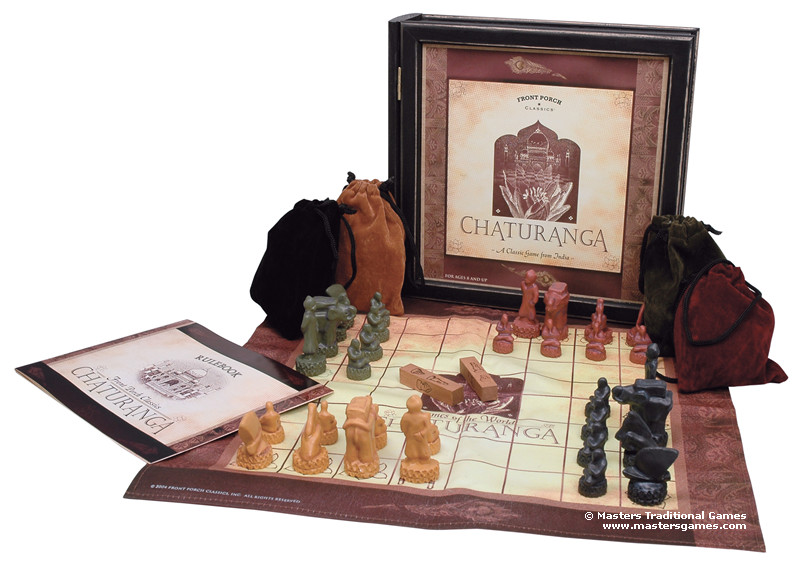
Chaturanga isn't a parcheesi variant. You may be thinking of chaturaji, which, despite the name given in the picture I just linked, is not chaturanga, but is a spin-off game that has similarities with parcheesi. Chaturanga was an abstract strategy game very similar to chess.In fact, there are completely different games called xiangqi and shogi in china and Japan, respectively. Shogi, xiangqi, and shatranj are all descendants of the same Indian parcheesi variant.

-
jts
- Oza
- Posts: 2672
- Joined: Sat Sep 18, 2010 4:17 pm
- Rank: kgs 6k
- GD Posts: 0
- Has thanked: 310 times
- Been thanked: 637 times
Re: Chinese, Korean, and Japanese player name issues.
The history is quite fascinating. We're all familiar with parcheesi, I think; four players, dice, race game. It may have started in Manchuria and spread as far as Burma. In India, it was first modified by differentiating the four pieces along a military theme, and changing the rule from rolling the dice to determining how many spaces a man moves, to rolling the dice to select a man to move. Then, this four player parcheesi variant developed its own two player variant (each player took control of the pieces for two sides, so he had two copies of each piece). Under a period of restrictions on gambling, the dice were dropped, and each player could move whichever piece he wanted. Voila.hirohiigo wrote:Chaturanga isn't a parcheesi variant. You may be thinking of chaturaji, which, despite the name given in the picture I just linked, is not chaturanga, but is a spin-off game that has similarities with parcheesi. Chaturanga was an abstract strategy game very similar to chess.In fact, there are completely different games called xiangqi and shogi in china and Japan, respectively. Shogi, xiangqi, and shatranj are all descendants of the same Indian parcheesi variant.
-
hirohiigo
- Dies in gote
- Posts: 40
- Joined: Thu Aug 26, 2010 10:14 am
- Rank: KGS 13-kyu
- GD Posts: 0
- KGS: hirohiigo
- Has thanked: 1 time
- Been thanked: 5 times
Re: Chinese, Korean, and Japanese player name issues.
The problem with this theory is that chaturaji, the "parcheesi variant" you're describing, doesn't exist in written history until around the 1000s AD, which is actually well after the creation of shogi in Japan, whereas the first descriptions of chaturanga and its variants (namely shatranj) exist as early as the 600s AD. If chaturaji was the parent of chaturanga, you'd expect to find evidence of chaturaji earlier than chaturanga, as well as more variants of chaturaji along the Silk Road. On the other hand, we see shatranj show up in written history nearly half a millenium before chaturaji, as well as many, many variants spawning across the world (shatranj, chess, makruk, sittuyin, xiangqi, shatar, shogi, janggi, etc.).jts wrote:The history is quite fascinating. We're all familiar with parcheesi, I think; four players, dice, race game. It may have started in Manchuria and spread as far as Burma. In India, it was first modified by differentiating the four pieces along a military theme, and changing the rule from rolling the dice to determining how many spaces a man moves, to rolling the dice to select a man to move. Then, this four player parcheesi variant developed its own two player variant (each player took control of the pieces for two sides, so he had two copies of each piece). Under a period of restrictions on gambling, the dice were dropped, and each player could move whichever piece he wanted. Voila.hirohiigo wrote:Chaturanga isn't a parcheesi variant. You may be thinking of chaturaji, which, despite the name given in the picture I just linked, is not chaturanga, but is a spin-off game that has similarities with parcheesi. Chaturanga was an abstract strategy game very similar to chess.In fact, there are completely different games called xiangqi and shogi in china and Japan, respectively. Shogi, xiangqi, and shatranj are all descendants of the same Indian parcheesi variant.
It's more likely that chaturaji was a parcheesi spin-off of chaturanga than chaturanga being a... weird abstract spin-off of a parcheesi game.
Your explanation (each player getting 2 of each piece) also doesn't explain the existence of the Mantri piece (queen in chess, minister in xiangqi, gold general in shogi, etc.). It also doesn't explain why the boat inexplicably became a chariot in its 2 player form in every part of the world except Thailand.
-
jts
- Oza
- Posts: 2672
- Joined: Sat Sep 18, 2010 4:17 pm
- Rank: kgs 6k
- GD Posts: 0
- Has thanked: 310 times
- Been thanked: 637 times
Re: Chinese, Korean, and Japanese player name issues.
So, if you want to know more about the history of shatranj ans parcheesi you should hit up the university library nearest to you, since I'm just regurgitating things I read years ago, and the books will be more interesting and have more footnotes than this post.
I will mention one point that is important in historical work, the idea of the "more difficult reading". In textual criticism, the idea is that if you have two manuscripts and aren't sure which one gives the original reading and which one is the result of sloppy copying and/or revision, the more difficult reading is older. People don't take a perfectly comprehensible story and add something illogical or nonsensical to it. In a game, this means that you don't start with a game that mimics a field battle, and then say, "you know what would make this game better? BOATS."
I will mention one point that is important in historical work, the idea of the "more difficult reading". In textual criticism, the idea is that if you have two manuscripts and aren't sure which one gives the original reading and which one is the result of sloppy copying and/or revision, the more difficult reading is older. People don't take a perfectly comprehensible story and add something illogical or nonsensical to it. In a game, this means that you don't start with a game that mimics a field battle, and then say, "you know what would make this game better? BOATS."
-
Kung-Fu Joe
- Beginner
- Posts: 11
- Joined: Fri Sep 16, 2011 11:59 am
- Rank: KGS 6k
- GD Posts: 0
- KGS: KungFuJoe
- Tygem: KungFuJoe
- Location: NJ, USA
Re: Chinese, Korean, and Japanese player name issues.
It's nitpicking, but I'll note that WGM and GM are actually entirely different, and unequivocal, titles. WGM titles are given to women at the top of the field, who still lack the necessary ratings or requirements for a regular GM title. There are female players-- such as Grandmaster Judit Polgar-- who have achieved those requirements and are known by the simple GM title, rather than WGM.Alberich wrote:I'm very new at this but I'm wondering about this issue on names. In regular chess...you can immediately tell whether the player is male or female by the designation "GM" and "WGM". However I haven't seen a method on allowing viewers to know if the player in question is male or female. It may not be an issue for people who are already familiar with the names but what about people just learning about the game? Is there an official way of determining whether the person in question is male or female?
-
ez4u

- Oza
- Posts: 2419
- Joined: Wed Feb 23, 2011 10:15 pm
- Rank: Jp 6 dan
- GD Posts: 0
- KGS: ez4u
- Location: Tokyo, Japan
- Has thanked: 2354 times
- Been thanked: 1337 times
Re: Chinese, Korean, and Japanese player name issues.
Whatever the validity of the more difficult reading in textual criticism, I think that trying it on with games is wildly optimistic. Saying, "you know what would make this game better? BOATS." is exactly what game designers do, isn't it?jts wrote:...
I will mention one point that is important in historical work, the idea of the "more difficult reading". In textual criticism, the idea is that if you have two manuscripts and aren't sure which one gives the original reading and which one is the result of sloppy copying and/or revision, the more difficult reading is older. People don't take a perfectly comprehensible story and add something illogical or nonsensical to it. In a game, this means that you don't start with a game that mimics a field battle, and then say, "you know what would make this game better? BOATS."
Dave Sigaty
"Short-lived are both the praiser and the praised, and rememberer and the remembered..."
- Marcus Aurelius; Meditations, VIII 21
"Short-lived are both the praiser and the praised, and rememberer and the remembered..."
- Marcus Aurelius; Meditations, VIII 21
-
hyperpape
- Tengen
- Posts: 4382
- Joined: Thu May 06, 2010 3:24 pm
- Rank: AGA 3k
- GD Posts: 65
- OGS: Hyperpape 4k
- Location: Caldas da Rainha, Portugal
- Has thanked: 499 times
- Been thanked: 727 times
Re: Chinese, Korean, and Japanese player name issues.
The game of game design: argue incessantly about which rules make the best game. Under no circumstances should you either play the games being discussed or appeal to real evidence concerning factors that make games good. The game is played forever, and no one ever wins, which makes sense, because game designers really hate games that can have draws.ez4u wrote:Whatever the validity of the more difficult reading in textual criticism, I think that trying it on with games is wildly optimistic. Saying, "you know what would make this game better? BOATS." is exactly what game designers do, isn't it?
-
jts
- Oza
- Posts: 2672
- Joined: Sat Sep 18, 2010 4:17 pm
- Rank: kgs 6k
- GD Posts: 0
- Has thanked: 310 times
- Been thanked: 637 times
Re: Chinese, Korean, and Japanese player name issues.
Hmm.ez4u wrote: Whatever the validity of the more difficult reading in textual criticism, I think that trying it on with games is wildly optimistic. Saying, "you know what would make this game better? BOATS." is exactly what game designers do, isn't it?
 I guess I'm happy to make fun of game designers. But the whole gist of accepting the more difficult reading is that - even though, as dues-paying members of our culture, it seems to us that weirdos are always trying to corrupt our obvious, natural practices with their weirdo innovations - empirically, when innovations become widespread, it happens the other way around.
 Imagine you were an anthropologist studying American chess, and wondered why the corner piece was called both a castle and a rook. The naive explanation is that since the piece resembles a castle, it must have originally been called that, and later the absurd whims of fashion, game design, and slang led the cool kids to call the castle a "rook". The more difficult reading is that since the name rook is apparently incomprehensible, that name came first, after which people started to call it a castle because of its appearance. (Now, I wonder which hypothesis the historical record backs....)
As for the blog you link to... 1. It's about the bible! Jeepers, no one wants to be told what to believe about their favorite middle eastern myth cycle. These principles of textual criticism were developed back when people were preparing critical editions of the iliad, Plato, and various other Greek and roman literary works. If you want the your sacred texts to be exempted from the rules that you apply to Homer, fine; but don't take it out on poor old lectior difficilior.
2. That blogger makes it sound like textual criticism is based on deductive principles of logic (and maybe that's how I made it sound, too...), but it's actually purely empirical. classicists went through endless rounds of dismissing certain readings as "nonsense" or "barbaric", only to subsequently find proof that the weird reading was the older one, before finally admitting that (all else equal) the difficult reading is usually right.
3. That blogger doesn't seem to understand that "difficult reading" is a rule for when you don't have more conclusive evidence. If you have hundreds of early mss with an attested reading and one late mss with a strange reading, there is no need to get flustered about difficult readings. With the bible, for example, you might wonder whether the Septuagint-derived mss or the massoretic derived mss represent the original document.
-
ez4u
- Oza
- Posts: 2419
- Joined: Wed Feb 23, 2011 10:15 pm
- Rank: Jp 6 dan
- GD Posts: 0
- KGS: ez4u
- Location: Tokyo, Japan
- Has thanked: 2354 times
- Been thanked: 1337 times
Re: Chinese, Korean, and Japanese player name issues.
Since I know nothing about textual criticism, I would perhaps bow to your greater knowledge if 5 minutes with Google had not taken me to both of these pages on Wikipedia (italics added):jts wrote:Hmm.ez4u wrote: Whatever the validity of the more difficult reading in textual criticism, I think that trying it on with games is wildly optimistic. Saying, "you know what would make this game better? BOATS." is exactly what game designers do, isn't it?
Imagine you were an anthropologist studying American chess, and wondered why the corner piece was called both a castle and a rook. The naive explanation is that since the piece resembles a castle, it must have originally been called that, and later the absurd whims of fashion, game design, and slang led the cool kids to call the castle a "rook". The more difficult reading is that since the name rook is apparently incomprehensible, that name came first, after which people started to call it a castle because of its appearance. (Now, I wonder which hypothesis the historical record backs....)
As for the blog you link to... 1. It's about the bible! Jeepers, no one wants to be told what to believe about their favorite middle eastern myth cycle. These principles of textual criticism were developed back when people were preparing critical editions of the iliad, Plato, and various other Greek and roman literary works. If you want the your sacred texts to be exempted from the rules that you apply to Homer, fine; but don't take it out on poor old lectior difficilior.
2. That blogger makes it sound like textual criticism is based on deductive principles of logic (and maybe that's how I made it sound, too...), but it's actually purely empirical. classicists went through endless rounds of dismissing certain readings as "nonsense" or "barbaric", only to subsequently find proof that the weird reading was the older one, before finally admitting that (all else equal) the difficult reading is usually right.
3. That blogger doesn't seem to understand that "difficult reading" is a rule for when you don't have more conclusive evidence. If you have hundreds of early mss with an attested reading and one late mss with a strange reading, there is no need to get flustered about difficult readings. With the bible, for example, you might wonder whether the Septuagint-derived mss or the massoretic derived mss represent the original document.
"Lectio difficilior potior (Latin for "the more difficult reading is the stronger") is a main principle of textual criticism. Where different manuscripts conflict on a particular word, the principle suggests that the more unusual one is more likely the original. The presupposition is that scribes would more often replace odd words and hard sayings with more familiar and less controversial ones, than vice versa (Carson 1991)..."
"Lectio brevior (Latin for "shorter reading") is one of the key principles in textual criticism, especially biblical textual criticism. The principle is based on the widely accepted view that scribes showed more tendency to embellish and harmonise by additions and inclusions than by deletions. Hence, when comparing two or more manuscripts of the same text, the shorter readings are more likely to be closer to the original..."
Pretty obviously you get to pick whichever fits the argument you would like to make. BTW, just Google on "textual criticism" and peruse the results. Obviously this field is dominated by biblical studies, so it is no surprise that the blog noted above deals with it as well. As always YMMV.

Dave Sigaty
"Short-lived are both the praiser and the praised, and rememberer and the remembered..."
- Marcus Aurelius; Meditations, VIII 21
"Short-lived are both the praiser and the praised, and rememberer and the remembered..."
- Marcus Aurelius; Meditations, VIII 21