
Introduction to fighting

If you're new to the game and have questions, post them here.
User avatar
PeterPeter
Lives with ko
Posts: 285
Joined: Wed Oct 03, 2012 1:11 am
GD Posts: 0
Location: UK
Has thanked: 42 times
Been thanked: 52 times

Introduction to fighting

Post by PeterPeter »

At the moment, as soon as 1 or 2 my stones come into direct contact with enemy stones and a fight breaks out, I feel lost. I can usually see about 8 possible moves which look reasonable to me, but I have no method for judging how they compare.

Trying to read out sequences is difficult, since for each of my 8 options I see 8 reasonable replies, and so on, and the number of combinations rapidly becomes unmanageable in my head.

I have tried to learn from studying various sources, but I have not found anything that fills the gap between:
- Re-wordings of the fundamentals: what is a liberty, what is an eye, what is ko, what is a ladder, that sort of thing; and
- Series of numbered moves which have little commentary other than a conclusion at the end that ‘black is better’, and I don’t see why (and I usually think the opposite :sad: ).

There seem to be so many conflicting objectives for each move: create liberties, reduce enemy liberties, connect your stones, cut the enemy stones, don’t allow yourself to be cut, leave eye-space. For every reason I can see for a move being good, I can see an equally persuasive reason why it might be bad. I often end up blindly playing a nobi or a hane, simply because I get the impression they are usually safe choices.

So, how to get started on this? Is there a guide out there that explains every move in a sequence, fully and using quite basic ideas? What are the main guiding principles? Are there any rules that work 90% of the time (if this..., do this...)? Is there a method that players use for each move, such as analysing liberties or aiming for one of the ‘good shapes’?

Regards,

Peter
Mef
Lives in sente
Posts: 852
Joined: Fri Apr 23, 2010 8:34 am
Rank: KGS [-]
GD Posts: 428
Location: Central Coast
Has thanked: 201 times
Been thanked: 333 times

Re: Introduction to fighting

Post by Mef »

The basic rule of fighting is this: The person with the weakest group loses.

If you have the weakest group, that usually means you either must yield first, or get captured. If you aim to strengthen your weak groups, this will indirectly weaken your opponent's nearby groups. You can profit by pressuring your opponent's weak groups (and likewise they will try to profit from pressuring yours). If you have many groups, it is hard to strengthen them all and that is where it is easy to run into trouble.
p2501
Lives in gote
Posts: 598
Joined: Tue Jul 26, 2011 8:25 am
Rank: 4 kyu
GD Posts: 0
Universal go server handle: p2501
Location: Germany, Berlin
Has thanked: 331 times
Been thanked: 101 times

Re: Introduction to fighting

Post by p2501 »

http://senseis.xmp.net/?LoseYourFirst50 ... AsPossible

Only experience will help. Try stuff.
User avatar
oren
Oza
Posts: 2777
Joined: Sun Apr 18, 2010 5:54 pm
GD Posts: 0
KGS: oren
Tygem: oren740, orenl
IGS: oren
Wbaduk: oren
Location: Seattle, WA
Has thanked: 251 times
Been thanked: 549 times

Re: Introduction to fighting

Post by oren »

I think Yilun Yang on KGS Plus does a lot of good lectures covering basic techniques in games.
snorri
Lives in sente
Posts: 706
Joined: Fri Jul 02, 2010 8:15 am
GD Posts: 846
Has thanked: 252 times
Been thanked: 251 times

Re: Introduction to fighting

Post by snorri »

It's a big topic.

I'd recommend learning a little bit about important stones first, just to get your head in the right place. A lot of problems with fighting come from trying to save everything or trying to save the wrong things.

Jennie Shen 2p has 5 audio lectures on this topic on www.intenetgoschool.com. Unfortunately, they aren't the free ones, but they are only 1 euro each.
User avatar
EdLee
Honinbo
Posts: 8859
Joined: Sat Apr 24, 2010 6:49 pm
GD Posts: 312
Location: Santa Barbara, CA
Has thanked: 349 times
Been thanked: 2070 times

Post by EdLee »

Peter, some ideas:

- find a good teacher
- Bruce Wilcox's 'Contact Fight' lessons (used to come on a CD; maybe now you can download it from him?)
- continue to play games, post them for review
rlaalswo
Dies with sente
Posts: 106
Joined: Tue Jul 17, 2012 11:41 am
GD Posts: 0
Has thanked: 11 times
Been thanked: 3 times

Re: Introduction to fighting

Post by rlaalswo »

PeterPeter wrote:At the moment, as soon as 1 or 2 my stones come into direct contact with enemy stones and a fight breaks out, I feel lost. I can usually see about 8 possible moves which look reasonable to me, but I have no method for judging how they compare.

Trying to read out sequences is difficult, since for each of my 8 options I see 8 reasonable replies, and so on, and the number of combinations rapidly becomes unmanageable in my head.

I have tried to learn from studying various sources, but I have not found anything that fills the gap between:
- Re-wordings of the fundamentals: what is a liberty, what is an eye, what is ko, what is a ladder, that sort of thing; and
- Series of numbered moves which have little commentary other than a conclusion at the end that ‘black is better’, and I don’t see why (and I usually think the opposite :sad: ).

There seem to be so many conflicting objectives for each move: create liberties, reduce enemy liberties, connect your stones, cut the enemy stones, don’t allow yourself to be cut, leave eye-space. For every reason I can see for a move being good, I can see an equally persuasive reason why it might be bad. I often end up blindly playing a nobi or a hane, simply because I get the impression they are usually safe choices.

So, how to get started on this? Is there a guide out there that explains every move in a sequence, fully and using quite basic ideas? What are the main guiding principles? Are there any rules that work 90% of the time (if this..., do this...)? Is there a method that players use for each move, such as analysing liberties or aiming for one of the ‘good shapes’?

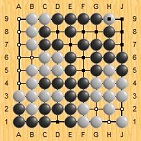
I think you don't have enough reading skills. If you have good reading, problems you wrote above doesn't make sense. I suggest you to solve many life and death, which is the best for improving reading skills.
peppernut
Dies in gote
Posts: 63
Joined: Tue Oct 09, 2012 4:51 am
Rank: 5k
GD Posts: 0
KGS: peppernut
Has thanked: 12 times
Been thanked: 21 times

Re: Introduction to fighting

Post by peppernut »

PeterPeter wrote:
I have tried to learn from studying various sources, but I have not found anything that fills the gap between:
- Re-wordings of the fundamentals: what is a liberty, what is an eye, what is ko, what is a ladder, that sort of thing; and
- Series of numbered moves which have little commentary other than a conclusion at the end that ‘black is better’, and I don’t see why (and I usually think the opposite :sad: ).


I remember a similar feeling when I started playing, especially against the computer. What worked for me was when I was unsure what was going on, I would just fallback to extending my stones. When my opponent attached I would just nobi. Soon you learn that if you can hane instead, you should ... But "Can I hane?" is sometimes a difficult question for players at all levels.

Extending when stones are touching is like the most basic of basic shapes. Get a feel for that first. Afterwards, cutting points, ladders, and the rest will start to make more sense.
User avatar
Loons
Gosei
Posts: 1378
Joined: Tue Apr 20, 2010 4:17 am
GD Posts: 0
Location: wHam!lton, Aotearoa
Has thanked: 253 times
Been thanked: 105 times

Idle speculation

Post by Loons »

"How do you fight" is a crazy broad question.

I imagine the secret is probably in those arcane sequences with the vaguery; "black is better".


There are normal ways (joseki, I guess) of invading, normal ways of settling those invasions, normal ways of attacking those invasions. Subtly adapting/choosing the usual technique for your board is skill at fighting I guess.


Recently, it was highlighted to me that I virtually never play side attachments against (stronger) enemy third line stones to help settle my own lonely third line stones, even though it's a usual way in many cases.


Much of the advice given I guess relates to easing you into recognising what "looks normal here".
Revisiting Go - Study Journal
My Programming Blog - About the evolution of my go bot.
Alguien
Lives in gote
Posts: 628
Joined: Tue Aug 07, 2012 11:50 pm
Rank: KGS 3k
GD Posts: 0
Universal go server handle: Alguien
Has thanked: 44 times
Been thanked: 93 times

Re: Introduction to fighting

Post by Alguien »

If you're really looking for the basics, pick any free 9x9 AI and play. You'll be able to have a hundred fights against a stronger opponent in the time you'd play a single 19x19 human game.
User avatar
karaklis
Lives in sente
Posts: 797
Joined: Tue Apr 20, 2010 2:14 pm
GD Posts: 600
Has thanked: 93 times
Been thanked: 105 times

Re: Idle speculation

Post by karaklis »

Loons wrote:"How do you fight" is a crazy broad question.

I think you can boil it down to just play a bit beyond your own horizon. You may lose big, but that doesn't matter.
Lamp
Dies with sente
Posts: 123
Joined: Mon May 07, 2012 10:20 pm
Rank: 7k
GD Posts: 0
Has thanked: 3 times
Been thanked: 11 times

Re: Introduction to fighting

Post by Lamp »

Play on Tygem. Every game is just a huge massive fight. Practice makes perfect, I guess?
Falcord
Dies in gote
Posts: 38
Joined: Thu Jul 21, 2011 6:12 am
Rank: KGS 5 kyu
GD Posts: 0
KGS: Neuron
Has thanked: 2 times
Been thanked: 6 times

Re: Introduction to fighting

Post by Falcord »

I think (from my limited experience) that learning how to fight comes in two parallel ways:

1) Reducing the number of moves you consider, by applying general principles. This means you know where to start reading, to the point where your 8 reasonable responses boil down to two or three of which you can read a satisfactory conclusion. Obviously this isn't infallible, but it helps reduce the load from your mind. For instance, after a relatively isolated crosscut, I would read the extension before the atari. This doesn't mean the atari is always wrong, but by putting it second in my "reading list" it's much easier to arrive to the correct line of play faster. This wasn't evident when I begun.

2) Learn to read deeper. Combined with the previous, developing the ability to read more moves ahead helps you understand and perceive the fight much better.


You will need to develop both sides equally, as one is useless without the other. Even if you know every single fight-related proverb and every tesuji, there is no avoiding to actually read the fight, since nothing works 100% of the time in Go. Top pros often challenge the very basic assumptions of Go for some genius strategy (check out Lee Sedol's broken ladder game, in which he played out a ladder that didn't work halfway across the board and won because of it). Also, learning to read without having an order of priorities for your moves is going to make it extremely hard for you to read every single path and it's not advisable either.

To address points 1 and 2, I'd read the James Davies' books and do a lot of fighting tsumego, respectively. That's what I've been doing lately and it helped.
User avatar
PeterPeter
Lives with ko
Posts: 285
Joined: Wed Oct 03, 2012 1:11 am
GD Posts: 0
Location: UK
Has thanked: 42 times
Been thanked: 52 times

Re: Introduction to fighting

Post by PeterPeter »

Thanks everyone.

It seems the main advice is just to keep bashing away at it.

I have played loads of 9x9, and feel comfortable on that board size - the edge is never far away. It is when a fight breaks out on the fourth line of a 19x19 board that I get lost.

I also regularly do tsumego, but they seem to deal with positions that are almost settled, rather than the start of the fighting.

peppernut wrote:What worked for me was when I was unsure what was going on, I would just fallback to extending my stones. When my opponent attached I would just nobi. Soon you learn that if you can hane instead, you should ... But "Can I hane?" is sometimes a difficult question for players at all levels.

Falcord wrote:1) Reducing the number of moves you consider, by applying general principles. This means you know where to start reading, to the point where your 8 reasonable responses boil down to two or three of which you can read a satisfactory conclusion.

I sort of understand this. After an opponent attaches, my first thought is to extend; there are probably 2 directions worth considering. Then there is probably a hane or 2 to look at. A one-point jump is also often a good option. Then there is a tenuki... that might give 6 moves to consider. If the opponent then has a similar 6 replies to each, that is 36 lines to read out... I guess I just need more practice.

Falcord wrote:To address points 1 and 2, I'd read the James Davies' books and do a lot of fighting tsumego, respectively. That's what I've been doing lately and it helped.

Falcord, James Davies seems quite a prolific author, is there any particular book of his you would recommend to start with?

EdLee wrote:- continue to play games, post them for review

I will pick out an interesting game to post, but I don't want to overload the forum :) .
Regards,

Peter
User avatar
jts
Oza
Posts: 2662
Joined: Sat Sep 18, 2010 4:17 pm
Rank: kgs 6k
GD Posts: 0
Has thanked: 310 times
Been thanked: 632 times

Re: Introduction to fighting

Post by jts »

Keep playing! Remember the 100 games rule. If you can't prune the tree at all when reading, you'll benefit more from practice than from anything else. Easy tsumego will help too; try the beginner collection on sensei's library.

It may seem insulting when people go on about what a liberty is and what a ladder is, but do you count the liberties on your stones while you wait for your opponent to move? Have you ever read out a ladder that wasn't on the board yet, and played a ladder breaker for it? If you try to do these things, even if it seems hard at first, it will be good practice.

Davies tesuji book is his best, IMHO, but all of them are good (if not necessarily at the level that you want yet).
Post Reply