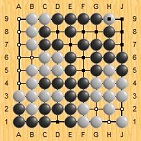
Lines of Play That are Especially Difficult to Read

Talk about improving your game, resources you like, games you played, etc.
illluck
Lives in sente
Posts: 1223
Joined: Sun Apr 25, 2010 5:07 am
Rank: OGS 2d
GD Posts: 0
KGS: illluck
Tygem: Trickprey
OGS: illluck
Has thanked: 736 times
Been thanked: 239 times

Re: Lines of Play That are Especially Difficult to Read

Post by illluck »

Reading: not just for Go...

Click Here To Show Diagram Code
[go]$$Bc
$$ ---------------------------------------
$$ | . . . . . . . . . . . . . . . 3 . . . |
$$ | . . . . . . . . . . . . . 2 X . . . . |
$$ | . . . . . . . . . . . . . O O X X X . |
$$ | . . . , . . . . . , . . . . 1 O O X . |
$$ | . . . . . . . . . . . . . 4 . . . O . |
$$ | . . . . . . . . . . . . . . . . O . . |
$$ | . . . . . . . . . . . . . . . . . . . |
$$ | . . . . . . . . . . . . . . . . . . . |
$$ | . . . . . . . . . . . . . . . . . . . |
$$ | . . . , . . . . . X . . . . . , . . . |
$$ | . . . . . . . . . . . . . . . . . . . |
$$ | . . . . . . . . . . . . . . . . . . . |
$$ | . . . . . . . . . . . . . . . . . . . |
$$ | . . . . . . . . . . . . . . . . . . . |
$$ | . . . . . . . . . . . . . . . . . . . |
$$ | . . . , . . . . . , . . . . . , . . . |
$$ | . . . . . . . . . . . . . . . . . . . |
$$ | . . . . . . . . . . . . . . . . . . . |
$$ | . . . . . . . . . . . . . . . . . . . |
$$ ---------------------------------------[/go]
User avatar
Shaddy
Lives in sente
Posts: 1206
Joined: Sat Apr 24, 2010 2:44 pm
Rank: KGS 5d
GD Posts: 0
KGS: Str1fe, Midorisuke
Has thanked: 51 times
Been thanked: 192 times

Re: Lines of Play That are Especially Difficult to Read

Post by Shaddy »

And if Black resists..

Click Here To Show Diagram Code
[go]$$Bc
$$ ---------------------------------------
$$ | . . . . . . . . . . . . . . 6 . . . . |
$$ | . . . . . . . . . . . . . 2 X 4 5 . . |
$$ | . . . . . . . . . . . . . O O X X X . |
$$ | . . . , . . . . . , . . . . 1 O O X . |
$$ | . . . . . . . . . . . . . . 3 . 8 O . |
$$ | . . . . . . . . . . . . . . . 7 O . . |
$$ | . . . . . . . . . . . . . . . . . . . |
$$ | . . . . . . . . . . . . . . . . 9 . . |
$$ | . . . . . . . . . . . . . . . . . . . |
$$ | . . . , . . . . . X . . . . . , . . . |
$$ | . . . . . . . . . . . . . . . . . . . |
$$ | . . . . . . . . . . . . . . . . . . . |
$$ | . . . . . . . . . . . . . . . . . . . |
$$ | . . . . . . . . . . . . . . . . . . . |
$$ | . . . . . . . . . . . . . . . . . . . |
$$ | . . . , . . . . . , . . . . . , . . . |
$$ | . . . . . . . . . . . . . . . . . . . |
$$ | . . . . . . . . . . . . . . . . . . . |
$$ | . . . . . . . . . . . . . . . . . . . |
$$ ---------------------------------------[/go]


Well, I've posted this problem before. If you want to have a crack at it before reading the answer, go for it - White to escape or live, not just win capturing race.

The answer:
S11
Uberdude
Judan
Posts: 6727
Joined: Thu Nov 24, 2011 11:35 am
Rank: UK 4 dan
GD Posts: 0
KGS: Uberdude 4d
OGS: Uberdude 7d
Location: Cambridge, UK
Has thanked: 436 times
Been thanked: 3718 times

Re: Lines of Play That are Especially Difficult to Read

Post by Uberdude »

@Shaddy: I was expecting someone to suggest that resistance, thanks for saving me having to show how to answer. :)

@illluck: Nitpicking, but I think black should live with solid connection so that white's descent to the first line on the right (rather than top) is sente as that looks likely to be less useful.
SmoothOper
Lives in sente
Posts: 946
Joined: Thu Apr 19, 2012 9:38 am
Rank: IGS 5kyu
GD Posts: 0
KGS: KoDream
IGS: SmoothOper
Has thanked: 1 time
Been thanked: 41 times

Re: Lines of Play That are Especially Difficult to Read

Post by SmoothOper »

Uberdude wrote:@Shaddy: I was expecting someone to suggest that resistance, thanks for saving me having to show how to answer. :)

@illluck: Nitpicking, but I think black should live with solid connection so that white's descent to the first line on the right (rather than top) is sente as that looks likely to be less useful.


OK I am convinced. However, I still don't see a sharp joseki that would work with tengen against the 4-4. Maybe it is the zen strategy for confusion having its effect, but it looks like white is able to read out exactly what they want to do.
Uberdude
Judan
Posts: 6727
Joined: Thu Nov 24, 2011 11:35 am
Rank: UK 4 dan
GD Posts: 0
KGS: Uberdude 4d
OGS: Uberdude 7d
Location: Cambridge, UK
Has thanked: 436 times
Been thanked: 3718 times

Re: Lines of Play That are Especially Difficult to Read

Post by Uberdude »

SmoothOper wrote:OK I am convinced. However, I still don't see a sharp joseki that would work with tengen against the 4-4. Maybe it is the zen strategy for confusion having its effect, but it looks like white is able to read out exactly what they want to do.


Or maybe it is because there isn't one. Just because you have some strange hatred of 4-4 points doesn't mean that after playing tengen and they reply with 4-4 that there is some move to make the 4-4 collapse in heap.
SmoothOper
Lives in sente
Posts: 946
Joined: Thu Apr 19, 2012 9:38 am
Rank: IGS 5kyu
GD Posts: 0
KGS: KoDream
IGS: SmoothOper
Has thanked: 1 time
Been thanked: 41 times

Re: Lines of Play That are Especially Difficult to Read

Post by SmoothOper »

Uberdude wrote:
SmoothOper wrote:OK I am convinced. However, I still don't see a sharp joseki that would work with tengen against the 4-4. Maybe it is the zen strategy for confusion having its effect, but it looks like white is able to read out exactly what they want to do.


Or maybe it is because there isn't one. Just because you have some strange hatred of 4-4 points doesn't mean that after playing tengen and they reply with 4-4 that there is some move to make the 4-4 collapse in heap.


Doesn't have anything to do with that as much as I am willing to see how tengen works, and 4-4 is one answer I would be just about be guaranteed of seeing. Though in theory 4-4 is supposed to be about center oriented influence, but with a black stone sitting there on tengen. I am thinking one way to go about it would be to have some ladder related joseki that would force the issue, but I am not coming up with any.
User avatar
oren
Oza
Posts: 2777
Joined: Sun Apr 18, 2010 5:54 pm
GD Posts: 0
KGS: oren
Tygem: oren740, orenl
IGS: oren
Wbaduk: oren
Location: Seattle, WA
Has thanked: 251 times
Been thanked: 549 times

Re: Lines of Play That are Especially Difficult to Read

Post by oren »

SmoothOper wrote:Doesn't have anything to do with that as much as I am willing to see how tengen works, and 4-4 is one answer I would be just about be guaranteed of seeing. Though in theory 4-4 is supposed to be about center oriented influence, but with a black stone sitting there on tengen. I am thinking one way to go about it would be to have some ladder related joseki that would force the issue, but I am not coming up with any.


If there was a move that immediately gave a better result due to tengen being played, I think you would see more professionals playing tengen.
SmoothOper
Lives in sente
Posts: 946
Joined: Thu Apr 19, 2012 9:38 am
Rank: IGS 5kyu
GD Posts: 0
KGS: KoDream
IGS: SmoothOper
Has thanked: 1 time
Been thanked: 41 times

Re: Lines of Play That are Especially Difficult to Read

Post by SmoothOper »

oren wrote:
SmoothOper wrote:Doesn't have anything to do with that as much as I am willing to see how tengen works, and 4-4 is one answer I would be just about be guaranteed of seeing. Though in theory 4-4 is supposed to be about center oriented influence, but with a black stone sitting there on tengen. I am thinking one way to go about it would be to have some ladder related joseki that would force the issue, but I am not coming up with any.


If there was a move that immediately gave a better result due to tengen being played, I think you would see more professionals playing tengen.


I would settle for playable in this instance.

It seems there are a list of ladder joseki. I think the strength of tengen, is that ladder breaker approaches to tengen wouldn't have sente like approaches to the corners
http://senseis.xmp.net/?LadderJoseki
SmoothOper
Lives in sente
Posts: 946
Joined: Thu Apr 19, 2012 9:38 am
Rank: IGS 5kyu
GD Posts: 0
KGS: KoDream
IGS: SmoothOper
Has thanked: 1 time
Been thanked: 41 times

Re: Lines of Play That are Especially Difficult to Read

Post by SmoothOper »

http://en.wikipedia.org/wiki/Katsukiyo_Kubomatsu

The Great Amateur opened at tengen. I guess consistency/predictability is the primary reason pros don't play especially difficult sequences to read.
hyperpape
Tengen
Posts: 4382
Joined: Thu May 06, 2010 3:24 pm
Rank: AGA 3k
GD Posts: 65
OGS: Hyperpape 4k
Location: Caldas da Rainha, Portugal
Has thanked: 499 times
Been thanked: 727 times

Re: Lines of Play That are Especially Difficult to Read

Post by hyperpape »

I feel like there's some big assumption underlying your question that makes it so there's no real communication happening on this thread.

There's such a thing as a prepared move--some pro sits in his study and works on a particular joseki or whole opening and finds a new move that's interesting. It might be either a) a brilliant refutation of some way that people have been playing, or b) a complex move that has a lot of variations, but where that pro can benefit from his greater study. More often than not, we're not talking about a huge do or die thing--New In Go just featured a Go Seigen innovation in the large avalance. It potentially gave him two points in the opening, and it was considered a huge deal.

Now, all professionals do this--some are more creative than others, but they all try to find new moves. It's not a tactic for particular opponents, it's just something they do. You might save such a move for a tough opponent, or a title match, since you don't find these moves every day (and once you play a move, people start studying it, and then your advantage is gone). But it's not a strategy for opponents who are particularly good at reading.

Read New In Go, or the commentaries in GoGameGuru. I seem to remember you can find some examples of prepared moves/research in Charles Matthews' On Your Side series.

The other thing is that prepared moves can happen in almost any joseki. Except for a limited number of very simple josekis, they were all innovations at some point in time. It's not just the magic sword and avalanche that have new variations. And any new variation is a potential trap for an opponent who doesn't know about it.

Now, let's say you're facing Lee Sedol, and you plunk down the avalanche (or whatever else), and you don't have a prepared move in mind. How is that supposed to help you? Either you stick to the paths that both of you are familiar with, in which case you're playing joseki*. How does that help you? Maybe it means it takes more moves for Lee to kill you, but you're not gaining any advantage. Alternately, maybe you go down some path that's unfamiliar to you both. That's even worse, since now you're pitting your reading against Lee's. Sure, there are too many variations for either of you to read, but how does that help you? You'll both read part of the tree, not the whole thing, and odds are that Lee's reading will be sharper than yours, and you'll end up at a disadvantage.

Now, does that answer your question, or were you imagining something else?

* Pros almost always read even while playing joseki. They will look for places where one side might want to deviate from the joseki. My point here is that if they're playing a familiar line, they're not going to get trapped.
SmoothOper
Lives in sente
Posts: 946
Joined: Thu Apr 19, 2012 9:38 am
Rank: IGS 5kyu
GD Posts: 0
KGS: KoDream
IGS: SmoothOper
Has thanked: 1 time
Been thanked: 41 times

Re: Lines of Play That are Especially Difficult to Read

Post by SmoothOper »

hyperpape wrote:I feel like there's some big assumption underlying your question that makes it so there's no real communication happening on this thread.

There's such a thing as a prepared move--some pro sits in his study and works on a particular joseki or whole opening and finds a new move that's interesting. It might be either a) a brilliant refutation of some way that people have been playing, or b) a complex move that has a lot of variations, but where that pro can benefit from his greater study. More often than not, we're not talking about a huge do or die thing--New In Go just featured a Go Seigen innovation in the large avalance. It potentially gave him two points in the opening, and it was considered a huge deal.

Now, all professionals do this--some are more creative than others, but they all try to find new moves. It's not a tactic for particular opponents, it's just something they do. You might save such a move for a tough opponent, or a title match, since you don't find these moves every day (and once you play a move, people start studying it, and then your advantage is gone). But it's not a strategy for opponents who are particularly good at reading.

Read New In Go, or the commentaries in GoGameGuru. I seem to remember you can find some examples of prepared moves/research in Charles Matthews' On Your Side series.

The other thing is that prepared moves can happen in almost any joseki. Except for a limited number of very simple josekis, they were all innovations at some point in time. It's not just the magic sword and avalanche that have new variations. And any new variation is a potential trap for an opponent who doesn't know about it.

Now, let's say you're facing Lee Sedol, and you plunk down the avalanche (or whatever else), and you don't have a prepared move in mind. How is that supposed to help you? Either you stick to the paths that both of you are familiar with, in which case you're playing joseki*. How does that help you? Maybe it means it takes more moves for Lee to kill you, but you're not gaining any advantage. Alternately, maybe you go down some path that's unfamiliar to you both. That's even worse, since now you're pitting your reading against Lee's. Sure, there are too many variations for either of you to read, but how does that help you? You'll both read part of the tree, not the whole thing, and odds are that Lee's reading will be sharper than yours, and you'll end up at a disadvantage.

Now, does that answer your question, or were you imagining something else?

* Pros almost always read even while playing joseki. They will look for places where one side might want to deviate from the joseki. My point here is that if they're playing a familiar line, they're not going to get trapped.


Those are all good points. What I am interested about with this thread are playing styles that are difficult to read because there are a large number of miai, but also as a corollary resilient to prepared plays. IE it isn't good enough to simply let the opponent choose their favorite joseki. The theory is that with with large number of miai, the combinations of plays will be difficult to read. Generally I wouldn't think that these styles would be necessarily complicated as much as ambiguous.
hyperpape
Tengen
Posts: 4382
Joined: Thu May 06, 2010 3:24 pm
Rank: AGA 3k
GD Posts: 65
OGS: Hyperpape 4k
Location: Caldas da Rainha, Portugal
Has thanked: 499 times
Been thanked: 727 times

Re: Lines of Play That are Especially Difficult to Read

Post by hyperpape »

Shuei was known for a miai style--you could look at John Faibairn's books on him. Whether that would be what you were looking for, I don't know.
User avatar
Loons
Gosei
Posts: 1378
Joined: Tue Apr 20, 2010 4:17 am
GD Posts: 0
Location: wHam!lton, Aotearoa
Has thanked: 253 times
Been thanked: 105 times

Re: Lines of Play That are Especially Difficult to Read

Post by Loons »

Two space pincer, press, cut, avalanche sounds like something you might be interested in.
Revisiting Go - Study Journal
My Programming Blog - About the evolution of my go bot.
lemmata
Lives in gote
Posts: 370
Joined: Thu Feb 23, 2012 12:38 pm
Rank: Weak
GD Posts: 0
Has thanked: 91 times
Been thanked: 254 times

Re: Lines of Play That are Especially Difficult to Read

Post by lemmata »

SmoothOper wrote:I wonder if there are any lines of play that just have so many variations that they are impossible to read, the magic sword and large avalanche are a couple examples.

Also are there any examples of pros that were known for successful deployment of these in defense against strong reading?

You are asking if Pro A, who is weaker at reading that Pro B, has employed complicated lines of play that are "impossible" to read as a defense against the strong reading abilities of Pro B.

If the variations are numerous and complicated then Pro B would be the one who is at an advantage since he can read more variations and deeper variations. Pro B would be taking steps forward with greater vision of the future than Pro A.

This is like asking whether a lightweight boxer could compensate for the weight difference against a heavyweight by getting into a slugging match.

One might try compensating for a weakness in reading by trying to obtain settled positions whenever it is possible to do so without falling behind by too much. For example, amateur players who fear the complications of the avalanche joseki are often advised to just connect at the 3-3 point if the joseki occurs early in the opening.

Click Here To Show Diagram Code
[go]$$ ---------------------------------------
$$ | . . . O . . .
$$ | . . O . . . .
$$ | . . X O O O .
$$ | . . X X X . X
$$ | . . . . . . .
$$ | . . . . . . .
$$ -------------[/go]


Another idea is to make corner enclosures. There are fewer variations that arise from a finished corner. That said, for the pros, such tactics are probably a matter of style rather than to compensate for any perceived weakness. The gap b/t top pros and the new 1Ps is razor thin.
SmoothOper
Lives in sente
Posts: 946
Joined: Thu Apr 19, 2012 9:38 am
Rank: IGS 5kyu
GD Posts: 0
KGS: KoDream
IGS: SmoothOper
Has thanked: 1 time
Been thanked: 41 times

Re: Lines of Play That are Especially Difficult to Read

Post by SmoothOper »

lemmata wrote:
SmoothOper wrote:I wonder if there are any lines of play that just have so many variations that they are impossible to read, the magic sword and large avalanche are a couple examples.

Also are there any examples of pros that were known for successful deployment of these in defense against strong reading?

You are asking if Pro A, who is weaker at reading that Pro B, has employed complicated lines of play that are "impossible" to read as a defense against the strong reading abilities of Pro B.

If the variations are numerous and complicated then Pro B would be the one who is at an advantage since he can read more variations and deeper variations. Pro B would be taking steps forward with greater vision of the future than Pro A.

I don't think that lines of play with many variations are necessarily complicated.

lemmata wrote:
This is like asking whether a lightweight boxer could compensate for the weight difference against a heavyweight by getting into a slugging match.


I am thinking of it more like Texas' holdem where one of the strategies is to increase the bids early on before the flop so that people don't get as much information to work with and can't predict the odds as well.

lemmata wrote:
Click Here To Show Diagram Code
[go]$$ ---------------------------------------
$$ | . . . O . . .
$$ | . . O . . . .
$$ | . . X O O O .
$$ | . . X X X . X
$$ | . . . . . . .
$$ | . . . . . . .
$$ -------------[/go]


Another idea is to make corner enclosures. There are fewer variations that arise from a finished corner. That said, for the pros, such tactics are probably a matter of style rather than to compensate for any perceived weakness. The gap b/t top pros and the new 1Ps is razor thin.


As an amateur I used to prefer the simple enclosures, but if someone can read it out better you are in trouble.
Post Reply