Carbon trading policies are awkward and full of holes. The cleanest answer to the externality is a carbon tax. Don't put it on greens, not in America anyway, that it hasn't be implemented or even championed.p2501 wrote:Its not only about alternative energies. Its a good start but just half of the rent so to speak. Because Co2 emission is regulated/limited already (in germany at least). Companies buy permissions to be able to blow Co2 in the air, which are limited. So if energy producing companies switch to alternative energies, the interest and value in those permissions falls a lot. In the end Co2 emission will only be redistributed, other companies not related with power production have interest in those permissions too.
So even if more and more people switch to green energy, that alone won't effect Co2 emission much.
Climate change / global warming
-
aokun
- Dies with sente
- Posts: 120
- Joined: Tue Aug 03, 2010 1:50 pm
- Rank: AGA 1D
- GD Posts: 150
- KGS: aokun
- Has thanked: 4 times
- Been thanked: 63 times
Re: Climate change / global warming
-
Javaness2
- Gosei
- Posts: 1548
- Joined: Tue Jul 19, 2011 10:48 am
- GD Posts: 0
- Has thanked: 111 times
- Been thanked: 326 times
- Contact:
Re: Climate change / global warming
Historically, the simulations to model climate change (global warming) have performed very poorly. They are hopefully better now. I do not really trust them, I just rely on the obvious scientific fundamentals, observational evidence, and the money people put in to trying to disprove the theories. It amazed me the amount that was spent on trying to prove that Carbon Dioxide was not a greenhouse gas.
-
Bantari

- Gosei
- Posts: 1639
- Joined: Sun Dec 06, 2009 6:34 pm
- GD Posts: 0
- Universal go server handle: Bantari
- Location: Ponte Vedra
- Has thanked: 642 times
- Been thanked: 490 times
Re: Climate change / global warming
Hmm... Not sure I ever claimed that both sides are equal in the sense you try to exploit here. What I mean is that there are ulterior motives and propaganda on both sides, without quantifying how much on each side and from which corner.HermanHiddema wrote: Yes, I'm asking that in the context of Bantari's post, which basically claims that both sides of the debate are equal in this matter. So the question I am asking is twofold: When the idea of global warming first emerged, what powerful vested interests were there that would pump millions into advancing CO2 reductions in order to promote their own short term profits? And furthermore, today, what percentage of companies would profit from reducing carbon emissions? Are the vested interests on both sides anywhere near equal at the moment?
So I'm not looking for examples, that's just anecdotal evidence. I'm looking for evidence that both sides are equal in this matter. That both have equal vested interests, have equal amounts of power, have invested equally in pure propaganda (as opposed to investing in neutral research).
The point of my post(s) is this:
The right thing is to protect the environment and spend effort (and money) to support that goal.
From this perspective it does not matter which side pours more money into what, or which side has more scientists supporting its agenda. To me, arguments about the scientific validity of this or that buzzword and/or question of which side is more corrupt than the other is just waste of effort and energy. What's more - in only confuses issue and gets people bogged down in arguing over that rather than trying to figure out what to do to make things better.
Like you do here. Does it really matter which side uses more propaganda or pays its lobbyists more? Or which side has more companies supporting it and what are sizes of those companies? What influence does the answer have on the question of weather to generally protect the environment or not? Lets say - the pro-global-warming side uses more silly scare tactics, while the other sides spends more money. So?... Does it tell you ANYTHING about what is the right thing to do? I think not.
This is all I am trying to say here.
PS>
Personally, I consider people who see such issues in black and white only and being vocal about it to be doing everybody a disservice. Why? Because life is seldom like that, and when it comes out that the apparently 'only good and pure and holy' side does have some bad apples, the whole idea gets discredited and suffers. So I rather concentrate on what is to be done rather than who says what and why.
- Bantari
______________________________________________
WARNING: This post might contain Opinions!!
______________________________________________
WARNING: This post might contain Opinions!!
-
HermanHiddema

- Gosei
- Posts: 2011
- Joined: Tue Apr 20, 2010 10:08 am
- Rank: Dutch 4D
- GD Posts: 645
- Universal go server handle: herminator
- Location: Groningen, NL
- Has thanked: 202 times
- Been thanked: 1086 times
Re: Climate change / global warming
I realize that your post does not strictly say that. It does only say that both sides invest in propaganda without quantifying how much each side spends. But the formulation very much suggests equality, which is what I objected against.Bantari wrote: Hmm... Not sure I ever claimed that both sides are equal in the sense you try to exploit here. What I mean is that there are ulterior motives and propaganda on both sides, without quantifying how much on each side and from which corner.
I think there are too many people who think that the moderate course of action is to choose the middle road. To consider both points of view and sort of take the average. Too many people think that the moderate opinion is something like "there is probably some global warming, man may have had something to do with it, and we don't know the consequences". And that is because the climate denial side of the story gets a disproportionate amount of time and attention with respect to the amount of evidence that supports it. Which is in part because there is so much more money supporting climate denial. In my opinion, the moderate opinion is something more like "global warming is definitely happening, man was complicit in making it happen, and there will be bad consequences". That's just a basic neutral representation of what the scientific consensus is at the moment. That is the truth as far as we know it. The opinion "global warming is not real" is just as wrong as "the Earth will turn into Waterworld within the century".
This I fully agree with.The point of my post(s) is this:
The right thing is to protect the environment and spend effort (and money) to support that goal.
As they say:
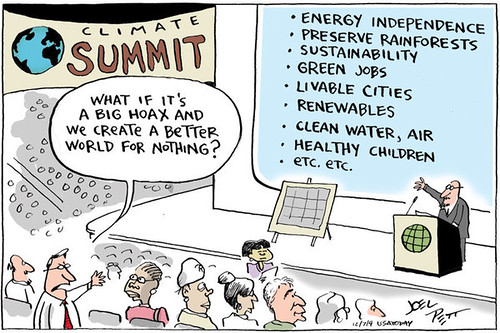
-
Uberdude
- Judan
- Posts: 6727
- Joined: Thu Nov 24, 2011 11:35 am
- Rank: UK 4 dan
- GD Posts: 0
- KGS: Uberdude 4d
- OGS: Uberdude 7d
- Location: Cambridge, UK
- Has thanked: 436 times
- Been thanked: 3720 times
Re: Climate change / global warming
Just a drive-by cautionary comment raised by that cartoon:
"Renewables" != making the world a better place.
Here in the UK we have this scheme to encourage private citizens to generate electricity with renewable sources: putting solar panels or wind turbines on the roof of their house. They are paid for the electricity they generate and use themselves, and paid even more if they don't use it and export it to the grid (at several times the market rate). The people who can afford the capital costs of such schemes are the fairly well-off middle classes. The people who pay are everyone, and hence mostly the poor, through higher energy bills. Taxing the poor to subsidise the rich in the name of "green energy" is not my idea of making the world a better place.
"Renewables" != making the world a better place.
Here in the UK we have this scheme to encourage private citizens to generate electricity with renewable sources: putting solar panels or wind turbines on the roof of their house. They are paid for the electricity they generate and use themselves, and paid even more if they don't use it and export it to the grid (at several times the market rate). The people who can afford the capital costs of such schemes are the fairly well-off middle classes. The people who pay are everyone, and hence mostly the poor, through higher energy bills. Taxing the poor to subsidise the rich in the name of "green energy" is not my idea of making the world a better place.
-
shapenaji
- Lives in sente
- Posts: 1103
- Joined: Tue Apr 20, 2010 10:58 pm
- Rank: EGF 4d
- GD Posts: 952
- Location: Netherlands
- Has thanked: 407 times
- Been thanked: 422 times
Re: Climate change / global warming
Uberdude wrote:Just a drive-by cautionary comment raised by that cartoon:
"Renewables" != making the world a better place.
Here in the UK we have this scheme to encourage private citizens to generate electricity with renewable sources: putting solar panels or wind turbines on the roof of their house. They are paid for the electricity they generate and use themselves, and paid even more if they don't use it and export it to the grid (at several times the market rate). The people who can afford the capital costs of such schemes are the fairly well-off middle classes. The people who pay are everyone, and hence mostly the poor, through higher energy bills. Taxing the poor to subsidise the rich in the name of "green energy" is not my idea of making the world a better place.
Yeah, but this issue is sort've unrelated to renewable energy, it would be just as bad for any infrastructure development in which one section of society benefited more than another.
Tactics yes, Tact no...
-
Bill Spight
- Honinbo
- Posts: 10905
- Joined: Wed Apr 21, 2010 1:24 pm
- Has thanked: 3651 times
- Been thanked: 3374 times
Re: Climate change / global warming
I am unfamiliar with the UK situation, and cannot comment on it. However, I do know a little about the question of the small scale generation of electricity, having lived in northern New Mexico in the 1970s. Power from our electric cooperative was unreliable. When our well pump went on the lights would often dim.shapenaji wrote:Uberdude wrote:Just a drive-by cautionary comment raised by that cartoon:
"Renewables" != making the world a better place.
Here in the UK we have this scheme to encourage private citizens to generate electricity with renewable sources: putting solar panels or wind turbines on the roof of their house. They are paid for the electricity they generate and use themselves, and paid even more if they don't use it and export it to the grid (at several times the market rate). The people who can afford the capital costs of such schemes are the fairly well-off middle classes. The people who pay are everyone, and hence mostly the poor, through higher energy bills. Taxing the poor to subsidise the rich in the name of "green energy" is not my idea of making the world a better place.
Yeah, but this issue is sort've unrelated to renewable energy, it would be just as bad for any infrastructure development in which one section of society benefited more than another.
 I looked into solar panels, but back then they were quite expensive. The only thing that would have been feasible, it seemed, was to fill the attic with rechargeable batteries and switch to DC appliances. A non-starter. What might also have worked would have been if I could have sold power to the coop, but the coop was not buying.
 Nowadays solar panels are better and cheaper, but still expensive, and the coop, I have heard, now buys power from members. As I understand it now, solar panels generate power cheaply, but their initial cost is high, so that they are economical over time, but you have to be rich enough to install them in the first place. There are obstacles to large solar farms, even in the deserts of the Southwest. If you want to increase the share of solar power on your electrical grid, it makes sense to buy it from users. It also makes sense to subsidize the initial installation of solar panels. The only reason I can think of that the cost of electricity would go up is politics.
The Adkins Principle:
At some point, doesn't thinking have to go on?
— Winona Adkins
Visualize whirled peas.
Everything with love. Stay safe.
At some point, doesn't thinking have to go on?
— Winona Adkins
Visualize whirled peas.
Everything with love. Stay safe.
-
aokun
- Dies with sente
- Posts: 120
- Joined: Tue Aug 03, 2010 1:50 pm
- Rank: AGA 1D
- GD Posts: 150
- KGS: aokun
- Has thanked: 4 times
- Been thanked: 63 times
Re: Climate change / global warming
If what you're saying is that renewables are not a good in their own right, but a policy with unintended as well as intended consequences, it is an interesting point. Renewables do have good consequences, but they would seem to be accounted for in the other items on the list, namely air and water quality, sustainability, energy independence and so on. The one thing that might be a separate item is that renewables, well, don't run out. That might fit under sustainability.Uberdude wrote:Just a drive-by cautionary comment raised by that cartoon:
"Renewables" != making the world a better place.
Here in the UK we have this scheme to encourage private citizens to generate electricity with renewable sources: putting solar panels or wind turbines on the roof of their house. They are paid for the electricity they generate and use themselves, and paid even more if they don't use it and export it to the grid (at several times the market rate). The people who can afford the capital costs of such schemes are the fairly well-off middle classes. The people who pay are everyone, and hence mostly the poor, through higher energy bills. Taxing the poor to subsidise the rich in the name of "green energy" is not my idea of making the world a better place.
Meanwhile, that renewable subsidies only help the upper middle class or make life dearer for the poor is not the whole story of "renewables." It is certainly not a necessary part of renewable policy. Certainly if tax subsidies, rather than higher bills, are used to subsidize energy that involves less local pollution, high cost imports, foreign policy distortion and climate change, those who pay taxes, particularly the upper middle class, may be subsidizing their own poor and everyone else's, since the poor disproportionately breath bad air, suffer from high imported energy prices, fight the wars and live in the low muddy bits that will flood first in future.
There are lots of bad policies involved in every line of that cartoon, so criticize away, but don't forget the original externalities involved. The rewards of fossil fuel use are widespread, but accrue disproportionately by wealth. The US and Europe get more than poorer areas, rich people get more than poor people, oil magnates get more than anyone, and the poorest will get hungry, homeless and wet.
-
topazg

- Tengen
- Posts: 4511
- Joined: Wed Apr 21, 2010 3:08 am
- Rank: Nebulous
- GD Posts: 918
- KGS: topazg
- Location: Chatteris, UK
- Has thanked: 1579 times
- Been thanked: 650 times
- Contact:
Re: Climate change / global warming
As a drive by comment, I've spent about 5 of the last 8 years of my professional career working alongside very senior members of National Grid Transco (_the_ high voltage transmission company in the UK - distribution has a lot of local NGOs, but transmission at 275 kV and 400 kV doesn't). I can promise you that generation by users is an integral part of their plans and the hope is to have most homes capable of generating some energy into the grid by 2025.
-
jts
- Oza
- Posts: 2672
- Joined: Sat Sep 18, 2010 4:17 pm
- Rank: kgs 6k
- GD Posts: 0
- Has thanked: 310 times
- Been thanked: 637 times
Re: Climate change / global warming
When you hear that a certain environmental regulation is bad for the poor, make sure to check that it is actually bad for the poor, as opposed to the-poor-as-imagined-by-wealthy-energy-industry-lobbyists. In America, we encounter this most frequently with protests agains the burden that gas taxes would impose on "the poor". In fact, while any tax is harder for a poor person to pay, most poor people do not own cars. (They're poor.) Those who do own cars tend to own fewer, and smaller, cars. (Again, this isn't rocket science.) Even poor people with cars often need to use public transportation in order to economize on the daily costs of driving a car. So gas taxes are actually not a very good example of a regressive tax, although I for a long time assumed they were.
The UK already raises a great deal of income from a genuinely regressive tax (VAT), so electricity usage would have to be fairly egalitarian for solar subsidies to be a major factor in the regressivity of the UK tax code.
The UK already raises a great deal of income from a genuinely regressive tax (VAT), so electricity usage would have to be fairly egalitarian for solar subsidies to be a major factor in the regressivity of the UK tax code.
-
Uberdude
- Judan
- Posts: 6727
- Joined: Thu Nov 24, 2011 11:35 am
- Rank: UK 4 dan
- GD Posts: 0
- KGS: Uberdude 4d
- OGS: Uberdude 7d
- Location: Cambridge, UK
- Has thanked: 436 times
- Been thanked: 3720 times
Re: Climate change / global warming
It's sunnier in New Mexico! Solar panels make more economic sense where it is sunny.Bill Spight wrote: I am unfamiliar with the UK situation, and cannot comment on it. However, I do know a little about the question of the small scale generation of electricity, having lived in northern New Mexico in the 1970s.
The cost goes up because the electricity suppliers have to, by law, pay the middle-classes who have installed solar panels / wind turbines on their roofs above the market rate for the electricity they generate even if they use it themselves (and even more if it goes back into the grid). Of course there are other factors raising prices such as wholesale energy costs, wage inflation, greed for profits etc.Bill Spight wrote: The only reason I can think of that the cost of electricity would go up is politics.
-
ez4u

- Oza
- Posts: 2419
- Joined: Wed Feb 23, 2011 10:15 pm
- Rank: Jp 6 dan
- GD Posts: 0
- KGS: ez4u
- Location: Tokyo, Japan
- Has thanked: 2354 times
- Been thanked: 1337 times
Re: Climate change / global warming
I think that aokun hit the nail on the head earlier in this regard. Subsidizing the installation of renewable energy devises is one thing, choosing how to pay for the subsidy is another. Whatever method is chosen, it is a choice. The expenditure and the funding are only linked if that is the choice you make. The choice you do make will have very real economic impacts and will also heavily affect the framing of the discussions around the subject. If the subsidy were paid for from the proceeds of a carbon tax, do you think the perception would be the same as when the electricity bills of the poor are raised instead? The "by law" mentioned above is not a law of nature but rather the very visible hand of politicians and we know what to think about that...Uberdude wrote:...
The cost goes up because the electricity suppliers have to, by law, pay the middle-classes who have installed solar panels / wind turbines on their roofs above the market rate for the electricity they generate even if they use it themselves (and even more if it goes back into the grid). Of course there are other factors raising prices such as wholesale energy costs, wage inflation, greed for profits etc.Bill Spight wrote: The only reason I can think of that the cost of electricity would go up is politics.
Dave Sigaty
"Short-lived are both the praiser and the praised, and rememberer and the remembered..."
- Marcus Aurelius; Meditations, VIII 21
"Short-lived are both the praiser and the praised, and rememberer and the remembered..."
- Marcus Aurelius; Meditations, VIII 21
-
Bill Spight
- Honinbo
- Posts: 10905
- Joined: Wed Apr 21, 2010 1:24 pm
- Has thanked: 3651 times
- Been thanked: 3374 times
Re: Climate change / global warming
Well, as I said, I cannot comment on the UK situation.Uberdude wrote:It's sunnier in New Mexico! Solar panels make more economic sense where it is sunny.Bill Spight wrote: I am unfamiliar with the UK situation, and cannot comment on it. However, I do know a little about the question of the small scale generation of electricity, having lived in northern New Mexico in the 1970s.
 But I hear it's pretty foggy in London. Maybe global warming will clear that up for you.
 Bill Spight wrote: The only reason I can think of that the cost of electricity would go up is politics.
Gee, sounds like politics to me.The cost goes up because the electricity suppliers have to, by law, pay the middle-classes who have installed solar panels / wind turbines on their roofs above the market rate for the electricity they generate even if they use it themselves (and even more if it goes back into the grid). Of course there are other factors raising prices such as wholesale energy costs, wage inflation, greed for profits etc.
The Adkins Principle:
At some point, doesn't thinking have to go on?
— Winona Adkins
Visualize whirled peas.
Everything with love. Stay safe.
At some point, doesn't thinking have to go on?
— Winona Adkins
Visualize whirled peas.
Everything with love. Stay safe.
Re: Climate change / global warming
I find the reasoning behind this argument both impractical and unscientific.HermanHiddema wrote:I realize that your post does not strictly say that. It does only say that both sides invest in propaganda without quantifying how much each side spends. But the formulation very much suggests equality, which is what I objected against.Bantari wrote: Hmm... Not sure I ever claimed that both sides are equal in the sense you try to exploit here. What I mean is that there are ulterior motives and propaganda on both sides, without quantifying how much on each side and from which corner.
I think there are too many people who think that the moderate course of action is to choose the middle road. To consider both points of view and sort of take the average. Too many people think that the moderate opinion is something like "there is probably some global warming, man may have had something to do with it, and we don't know the consequences". And that is because the climate denial side of the story gets a disproportionate amount of time and attention with respect to the amount of evidence that supports it. Which is in part because there is so much more money supporting climate denial. In my opinion, the moderate opinion is something more like "global warming is definitely happening, man was complicit in making it happen, and there will be bad consequences". That's just a basic neutral representation of what the scientific consensus is at the moment. That is the truth as far as we know it. The opinion "global warming is not real" is just as wrong as "the Earth will turn into Waterworld within the century".
This I fully agree with.The point of my post(s) is this:
The right thing is to protect the environment and spend effort (and money) to support that goal.
As they say:
If global warming were a complete hoax it would be a disaster. The amount of funding that goes into solving this problem could alleviate or help other problems that are confirmed, like starvation, housing, slavery, human traffic, cartels, criminal violence,poverty etc.
I have seen several detractor documentaries on global warming, which led me to believe that I don't really know what is going on. I\m certainly being pushed by ads and media constantly to believe the world is going to end and that is an agenda.
I also don't find being played on fear to be a positive thing. And that is regardless of global warming existing, or it being a cause for C02 emissions, which some scientist argue is not the cause of global warming.
C02 is a very profitable agent to attack on this, as car companies and oil companies have deep pockets and those with an agenda have a lot to gain on manipulating a crowd that believes its going to suffer. Weather changes are spectacular because you cant really personally measure it and it affects everyone. I've heard people say many times "global warming is really making summers hot" in Argentina, while global warming speaks about the poles getting a lot warmer, the rest of the world barely changes temperature.(at least that i remember from the awful truth by Al Gore).
The phrase "The right thing is to go green" is as accurate as "the right thing is to solve tsumego 24/7". Of course there is an upside, but it doesnt evaluate on the consequences.
In this light, personally, I find many causes's budgets disagreeable until we can solve the most disastrous and detrimental situations like the ones I mentioned before.
My 2 cents.
-
HermanHiddema
- Gosei
- Posts: 2011
- Joined: Tue Apr 20, 2010 10:08 am
- Rank: Dutch 4D
- GD Posts: 645
- Universal go server handle: herminator
- Location: Groningen, NL
- Has thanked: 202 times
- Been thanked: 1086 times
Re: Climate change / global warming
Of course. It is only a silly cartoon. But the truth is, quite simply, that global warming is not a hoax.Conanbatt wrote: I find the reasoning behind this argument both impractical and unscientific.
If global warming were a complete hoax it would be a disaster. The amount of funding that goes into solving this problem could alleviate or help other problems that are confirmed, like starvation, housing, slavery, human traffic, cartels, criminal violence,poverty etc.
What about these documentaries made you believe they had credibility? Because AFAIK, there really isn't any significant scientific support for the position that global warming is not man-made. Which scientists are you referring to, specifically?I have seen several detractor documentaries on global warming, which led me to believe that I don't really know what is going on.I\m certainly being pushed by ads and media constantly to believe the world is going to end and that is an agenda.
I also don't find being played on fear to be a positive thing. And that is regardless of global warming existing, or it being a cause for C02 emissions, which some scientist argue is not the cause of global warming.