I guess I would expect the selection of most joseki would be left to the student to solve much the way a mathematician would leave certain basic proofs for the student to solve(ie you have book and an Internet look it up), the core expected competency would then be Fuseki and whole board development. Though, I expect the economies of teaching would lead to a teachers to teach the minimum necessary to keep the student coming back for more lessons.RobertJasiek wrote:Which kind of competence do you want to see?
A 1 Dan's Half Understanding of Fundamentals
-
SmoothOper
- Lives in sente
- Posts: 946
- Joined: Thu Apr 19, 2012 9:38 am
- Rank: IGS 5kyu
- GD Posts: 0
- KGS: KoDream
- IGS: SmoothOper
- Has thanked: 1 time
- Been thanked: 41 times
Re: A 1 Dan's Half Understanding of Fundamentals
-
Bantari

- Gosei
- Posts: 1639
- Joined: Sun Dec 06, 2009 6:34 pm
- GD Posts: 0
- Universal go server handle: Bantari
- Location: Ponte Vedra
- Has thanked: 642 times
- Been thanked: 490 times
Re: A 1 Dan's Half Understanding of Fundamentals
Not to nitpick, but I run into that before, and my question is: what does it mean when a joseki is 'old'?often wrote:Bantari wrote:What if you don't have a teacher? Or the teacher does not know?often wrote: Chen Wei: "there are josekis out there that you just have to know and memorize without thinking, and there are josekis out there that you can puzzle over"
Me: "So how do i know which ones i should just know w/o thinking?"
Chen Wei: "ask your teacher"
Me: "And what about ones that fell into disuse?"
Chen Wei: "ask your teacher"
my current go teacher keeps up with the recent go opinions so i would hope that a "professional teacher" would know the recent happenings with go knowledge, considering its their profession
if you don't have a teacher, i have no good answer for you
i've read some joseki dictionaries and they don't really mention if something is "old"
for example this one:
is considered old
senseis.xmp talks about it and references guo juan as the source of the info, but the "21st century dictionary of basic joseki" by takao shinji doesn't reference that its old and its a fairly recent book.
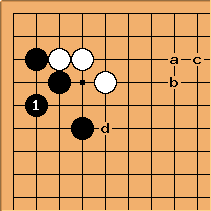
Does it mean its bad? If so, what is the refutation or the reasons behind it being bad?
Or is it merely out of fashion, but still perfectly sound?
And does any of that really matter at our level?
Sorry for all these questions, not trying to be difficult, it really interests me.
I notice people often say 'old' joseki, but not usually 'bad' joseki or not-joseki. So what does 'old' really mean, and why should we care?
- Bantari
______________________________________________
WARNING: This post might contain Opinions!!
______________________________________________
WARNING: This post might contain Opinions!!
-
often
- Lives with ko
- Posts: 197
- Joined: Mon May 13, 2013 8:51 am
- Rank: weak
- GD Posts: 0
- KGS: often
- Been thanked: 81 times
Re: A 1 Dan's Half Understanding of Fundamentals
It's a fine joseki and still works, but the result is not the optimum, the reason is that after white makes he extension he gets a decent amount of territory while black is relatively overconcentrated and w/o much territory. his only saving grace is that he has senteBantari wrote: Not to nitpick, but I run into that before, and my question is: what does it mean when a joseki is 'old'?
Does it mean its bad? If so, what is the refutation or the reasons behind it being bad?
Or is it merely out of fashion, but still perfectly sound?
And does any of that really matter at our level?
Sorry for all these questions, not trying to be difficult, it really interests me.
I notice people often say 'old' joseki, but not usually 'bad' joseki or not-joseki. So what does 'old' really mean, and why should we care?
in a more broad sense, "old" just means there are better more efficent plays than that one
learning josekis can help your fundamentals since they typically are just good efficient shape
whether you should memorize them or not depends on your teacher. both schools of thought that i've heard have good reasons for why you should or shouldn't, but i wouldn't say it is the single roadblock to improving
-
RobertJasiek
- Judan
- Posts: 6283
- Joined: Tue Apr 27, 2010 8:54 pm
- GD Posts: 0
- Been thanked: 800 times
- Contact:
Re: A 1 Dan's Half Understanding of Fundamentals
Speaking about a particular joseki like
means to ignore the fundamentals: what are the amounts of territory, how do the influences compare, why is good connection and eye shape (not) called overconcentrated?often wrote:after white makes he extension he gets a decent amount of territory while black is relatively overconcentrated and w/o much territory.
A teacher can / should be able to provide a selection if the student wants to learn it from the teacher.SmoothOper wrote:I guess I would expect the selection of most joseki would be left to the student to solve
Some teachers like to keep up with every recent fashion. Other teachers improve their knowledge without having to follow every fashion. Either way can be very time-consuming, so every teacher has to make some compromises, because he cannot have enough time to follow both approaches equally exhaustive.often wrote:a "professional teacher" would know the recent happenings with go knowledge
Then you read the wrong dictionaries. (Some dictionaries simply teach mainly the new. If so, they should mention when exceptionally some variation is old.)i've read some joseki dictionaries and they don't really mention if something is "old"
The particular joseki is not "old" in the sense of "outdated", but nowadays also newer, alternative variations and lines of reasoning have been developed. (And there are the territory fundamentalists, who compare only the territory.)doesn't reference that its old
No problem either. The reader must learn to develop his understanding from representative selections. (It is HIS problem if he does not do this, or even fails to acquire knowledge necessary for knowing how to do it. It is not the DICTIONARY'S fault.)oren wrote:The problem being is no book covers all joseki that are played and especially true for newly played joseki.
I would ask for more from the teacher than just opinion. If he doesn't know all josekis by heart, he must be able to explain how to understand by reasons and compare variations.If my teacher doesn't know, he'll give me his best opinion. That's all I ask for.
-
oren

- Oza
- Posts: 2777
- Joined: Sun Apr 18, 2010 5:54 pm
- GD Posts: 0
- KGS: oren
- Tygem: oren740, orenl
- IGS: oren
- Wbaduk: oren
- Location: Seattle, WA
- Has thanked: 251 times
- Been thanked: 549 times
Re: A 1 Dan's Half Understanding of Fundamentals
No, he actually doesn't have to. That's not a must for me.RobertJasiek wrote: I would ask for more from the teacher than just opinion. If he doesn't know all josekis by heart, he must be able to explain how to understand by reasons and compare variations.

-
SpongeBob

- Lives in gote
- Posts: 499
- Joined: Sat Apr 24, 2010 3:18 pm
- Rank: Fox 3D
- GD Posts: 325
- Location: Germany
- Has thanked: 213 times
- Been thanked: 96 times
Re: A 1 Dan's Half Understanding of Fundamentals
It seems that Robert does not distinguish between 'Understanding' and 'Application' of fundamentals.
Having 'Making too many blunders' in a list to indicate 'Half understanding of fundamentals' is equally wrong and ridiculous as having a proverb 'Avoid bad moves!'. Not every error can be labelled under 'Ignoring the fundamentals'. Otherwise, everything would be fundamentals.
I would say nobody gets to 1 Dan without knowing the fundamentals. Even the majority of 5 kyus know the fundamentals.
Playing strength = Knowledge of Fundamentals + Application of Fundamentals + Reading + ?
(? = Avoid blunders, ... )
It seems that Robert has instead defined something like this:
Understanding of Fundamentals = Playing strength - Reading
You ask why? Simple: If someone has a hammer, every problem looks like a nail to him!
Having 'Making too many blunders' in a list to indicate 'Half understanding of fundamentals' is equally wrong and ridiculous as having a proverb 'Avoid bad moves!'. Not every error can be labelled under 'Ignoring the fundamentals'. Otherwise, everything would be fundamentals.
I would say nobody gets to 1 Dan without knowing the fundamentals. Even the majority of 5 kyus know the fundamentals.
Playing strength = Knowledge of Fundamentals + Application of Fundamentals + Reading + ?
(? = Avoid blunders, ... )
It seems that Robert has instead defined something like this:
Understanding of Fundamentals = Playing strength - Reading
You ask why? Simple: If someone has a hammer, every problem looks like a nail to him!
Stay out of my territory! (W. White, aka Heisenberg)
-
RobertJasiek
- Judan
- Posts: 6283
- Joined: Tue Apr 27, 2010 8:54 pm
- GD Posts: 0
- Been thanked: 800 times
- Contact:
Re: A 1 Dan's Half Understanding of Fundamentals
Wrong.SpongeBob wrote:It seems that Robert does not distinguish between 'Understanding' and 'Application' of fundamentals. [...]
It seems that Robert has instead defined something like this:
Understanding of Fundamentals = Playing strength - Reading
Why do you think that it is wrong? Don't you think that avoiding blunders belongs to the fundamentals? It is mostly a fundamental aspect of psychology.Having 'Making too many blunders' in a list to indicate 'Half understanding of fundamentals' is equally wrong [...]
Indeed. Treating a truth only as a proverb misses the importance of this universal principle. (I could agree to something else, if you should mean it: that the principle alone does not specify in detail which are the bad moves.)as having a proverb 'Avoid bad moves!'
It depends on what ARE the fundamentals. If you stop including things at "a single empty intersection is insufficient for independent life", then each 1d knows all the fundamentals. If you include knowledge about choosing three space pincers, then most 1 dans do not know all the fundamentals. Part of them knows these, but then not other fundamentals of a comparable level and relevance.I would say nobody gets to 1 Dan without knowing the fundamentals.
As before.Even the majority of 5 kyus know the fundamentals.
"?" = intermediate and advanced knowledge above the fundamentals etc.Playing strength = Knowledge of Fundamentals + Application of Fundamentals + Reading + ?
(? = Avoid blunders, ... )
-
John Fairbairn
- Oza
- Posts: 3725
- Joined: Wed Apr 21, 2010 3:09 am
- Has thanked: 20 times
- Been thanked: 4739 times
Re: A 1 Dan's Half Understanding of Fundamentals
I think this hits the nail on the head quite nicely! However, RJ is not wrong about dan players lacking some fundamentals.You ask why? Simple: If someone has a hammer, every problem looks like a nail to him
One good example, I think, is the principle I know as Five Alive (in close fighting, if a group has five liberties it can probably be left to fend for itself for the time being; with fewer liberties it needs urgent attention if you want to save it). I've only come across this in Korean (except that Bruce Wilcox discovered it independently, and I don't rule out the possibility it was imported into Korea by him), but there is a range of similar rules of thumb which we appear not to know.
Victor Chow, a very strong player from Guilin, told us once at a London Open that Chinese kids like him were taught these principles and he was astonished that Europeans did not know about them. He demonstrated some, and they were certainly new to all of us there, and different from anything else we'd seen. He promised to write them up for us, but (because he was based in South Africa) it never really came to fruition. I have a recollection that he may have written up a couple for the BGJ or, much more strongly in my memory, someone in our group wrote them up.
I have a feeling that Shikshin père may have learnt or discovered similar techniques.
I share your view that RJ may be trying to clear the jungle with a sledgehammer, but his quest is still worth encouraging: there's gold in them thar hills.
-
SmoothOper
- Lives in sente
- Posts: 946
- Joined: Thu Apr 19, 2012 9:38 am
- Rank: IGS 5kyu
- GD Posts: 0
- KGS: KoDream
- IGS: SmoothOper
- Has thanked: 1 time
- Been thanked: 41 times
Re: A 1 Dan's Half Understanding of Fundamentals
John Fairbairn wrote:... trying to clear the jungle with a sledgehammer...
From the wonderful song "El Condor Pasa", "I would rather be a hammer than a nail yes I would, I really would..."
This discussion reminds me of my last in person playing experience. While I was playing the one of tournament facilitators came up and kibitzed, "what are you doing, don't do that", well I patently ignored his comment, after a while he said something like "Ah a strong fundamental player.", then walked off. I won the game by a substantial margin.
Its been my experience that 1 dan's just don't get enough beat downs, since they tend to accumulate at the top of the local club circuit without much competition. The lack of downward pressure leading to a situation where they don't get schooled in certain fundamentals, and sort of assume that they have mastered all the basics, at the same time they tend to discourage styles of play that are unfamiliar or uncomfortable for them in their subordinate ranks. For example strongly insisting on traditionally placed handicaps, based on their "strength", of opinion, about knowing what it is the best most interesting game.
-
wineandgolover

- Lives in sente
- Posts: 867
- Joined: Sun Jul 25, 2010 6:05 am
- GD Posts: 0
- Has thanked: 318 times
- Been thanked: 346 times
Re: A 1 Dan's Half Understanding of Fundamentals
It's okay, it was a 1d.Boidhre wrote:Someone kibitzed during a tournament game??
- Brady
-
SmoothOper
- Lives in sente
- Posts: 946
- Joined: Thu Apr 19, 2012 9:38 am
- Rank: IGS 5kyu
- GD Posts: 0
- KGS: KoDream
- IGS: SmoothOper
- Has thanked: 1 time
- Been thanked: 41 times
Re: A 1 Dan's Half Understanding of Fundamentals
It was OK, it was an informal tournament between two clubs, though it was kind of weird.wineandgolover wrote:It's okay, it was a 1d.Boidhre wrote:Someone kibitzed during a tournament game??
-
Uberdude
- Judan
- Posts: 6727
- Joined: Thu Nov 24, 2011 11:35 am
- Rank: UK 4 dan
- GD Posts: 0
- KGS: Uberdude 4d
- OGS: Uberdude 7d
- Location: Cambridge, UK
- Has thanked: 436 times
- Been thanked: 3720 times
Re: A 1 Dan's Half Understanding of Fundamentals
This reminds me of a story I heard. When Cho Hunhyun visited the UK about ten years ago he played some simultaneous games. One of these was a three-stone game against Matthew Macfadyen 6d. As usual Matthew tried to kill things. He succeeded in making a huge semeai, which he won, but in the process Cho squeezed the outside and ended up dominating the rest of the board and won comfortably.often wrote:
- They are occasionally completely surprised by stronger players' sacrifice strategies, which they overlooked completely.
i'm sure you have the same with players' stronger than you, so i mean...
-
tapir
- Lives in sente
- Posts: 774
- Joined: Fri Apr 23, 2010 5:52 pm
- GD Posts: 0
- Has thanked: 137 times
- Been thanked: 155 times
- Contact:
Re: A 1 Dan's Half Understanding of Fundamentals
This is wrong, bad, annoying, incorrect, not true and false in so many ways!SmoothOper wrote:I think this a prime example of poor teaching, and a poor understanding of fundamentals. Firstly, your teacher expects you to learn all of the joseki before learning Fuseki, even the joseki you won't use. What your teacher is missing is that a selection of fuseki can minimize the number of joseki you need to learn, furthermore many of the Fuseki require non-joseki approaches and invasions, the literature are littered with phrases like "we can't just play joseki because it is one." Thirdly if you are interested in Fuseki why discourage it? I suspect the teacher does not know Fuseki very well.
Yes, the literature is littered with phrases like "we can't just play joseki because it is one" because you always have to choose an appropriate way to play. When you minimized the number of joseki you know, you will be most likely the kind of player, who will repeat the same thing over and over again regardless of circumstances, because due to your "interest in fuseki" also known as subscription to some fashionable whole board sequence, you avoided facing the choices that make up good opening play. That is exactly what studying joseki provides, it gives you a whole repertoire of different moves to think with and makes you realize that you indeed have the choice at every step. I am convinced people are relying too much on (some few) joseki because they know too few of them to begin with and thus never arrive at the point where they realize "I could play completely different moves here and still be perfectly fine."
And finally, who are you to teach professionals fundamentals?
Thanks for reading. I did login just to write this rant.
-
SmoothOper
- Lives in sente
- Posts: 946
- Joined: Thu Apr 19, 2012 9:38 am
- Rank: IGS 5kyu
- GD Posts: 0
- KGS: KoDream
- IGS: SmoothOper
- Has thanked: 1 time
- Been thanked: 41 times
Re: A 1 Dan's Half Understanding of Fundamentals
If you don't understand any Fuseki, you might be inclined to follow fads that you don't understand, thus demonstrating your ignorance of the finer points in whole board development, and joseki selection, and make statements like, "Knowledge of Fuseki are just fads". I personally don't jump on the Fuseki band wagon, and I kind of wish people wouldn't play, Nirensei quite so much, though I get pretty comfortable playing against it.tapir wrote: " also known as subscription to some fashionable whole board sequence,