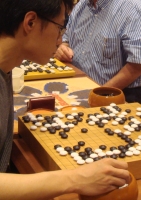
Studying Go in China

Create a study plan, track your progress and hold yourself accountable.
User avatar
Knotwilg
Oza
Posts: 2432
Joined: Fri Jan 14, 2011 6:53 am
Rank: KGS 2d OGS 1d Fox 4d
GD Posts: 0
KGS: Artevelde
OGS: Knotwilg
Online playing schedule: UTC 18:00 - 22:00
Location: Ghent, Belgium
Has thanked: 360 times
Been thanked: 1021 times
Contact:

Re: Studying Go in China

Post by Knotwilg »

The actual art of reading is an undervalued piece of discussion in Go.

The human mind is made for seeing visual patterns. This is the main reason why we still beat computers. (Well, pros still can ...)
We prune instinctively and evaluate positions by visual aids not just raw figure end states.

This comes at the drawback of blind spots. We continue to 'see' familiar patterns and remain oblivious to the awkward moves that crack a problem. Through many tsumego, our pruning becomes better. But before that, we must "unprune", "unsee" and read instead. This is the hard work. Being able to visualize the stones in sequence is one. Doing the exercise in an unrepeated order is two. In regular tsumego there is some guideline: 1) surround 2) cut 3) reduce space 4) vital point. In connection tesuji and capturing cutting stones I still have to find a heuristic and it comes down to painful raw reading.

Game 2 move 150: I think you can ignore the kothreat. White will make seki and you will win the game. More L&D :)
User avatar
SoDesuNe
Gosei
Posts: 1810
Joined: Wed Apr 21, 2010 1:57 am
Rank: KGS 1-dan
GD Posts: 0
Has thanked: 490 times
Been thanked: 365 times

Re: Studying Go in China

Post by SoDesuNe »

Knotwilg wrote:The actual art of reading is an undervalued piece of discussion in Go.


I guess this is closely related to the popular question of how to solve Tsumegos the right way. There isn't one, seems to be the answer after many discussions ^^

Knotwilg wrote:Through many tsumego, our pruning becomes better. But before that, we must "unprune", "unsee" and read instead.


How can you "see" something, which is not familiar to you? Or "unsee" something you have not experienced before?

In my experience "seeing" is a result of constant "reading" (better: experiencing) shapes (and its weaknesses). Your brain recognise the shape and thus knows the moves to solve it, you don't need to use brute-force all over again. Of course checking is requiered, which is where actual reading comes handy again, I guess. But just checking already reduces the workload immensely because you have starting points.
User avatar
Knotwilg
Oza
Posts: 2432
Joined: Fri Jan 14, 2011 6:53 am
Rank: KGS 2d OGS 1d Fox 4d
GD Posts: 0
KGS: Artevelde
OGS: Knotwilg
Online playing schedule: UTC 18:00 - 22:00
Location: Ghent, Belgium
Has thanked: 360 times
Been thanked: 1021 times
Contact:

Re: Studying Go in China

Post by Knotwilg »

What I mean with "unseeing" is when you "see" familiar patterns which however don't appear to solve the problem at hand. It's then tempting to give up or think you cannot solve. At that point you need to reconsider other "raw" possibilities without considering *every* move.

BTW, I disagree that there wouldn't be a structured approach to tsumego. For L&D, "surround, cut, reduce, vital point" is the proper approach, unless of course you "see" the solution.

The main reason is that
- by surrounding you get a favorable position in the game, even if you don't kill
- cutting is the most basic way to put chains in trouble
- reducing the eyespace reveals the vital points and it also reduces the depth of the reading
- finally vital points

If you start an unfamiliar problem with the vital points, then it ramifies quickly into escape, connect and expand variations.
In most problems the surrounding is already done, cutting is a rare possibility, so it boils down to reducing eyespace before playing the vital point. In the end, the vital point may still be the solution, but it is more easily found the other way round.

Another instructive tool is to look for miai moves. This can reduce the complexity by a great amount.
Bill Spight
Honinbo
Posts: 10905
Joined: Wed Apr 21, 2010 1:24 pm
Has thanked: 3651 times
Been thanked: 3373 times

Re: Studying Go in China

Post by Bill Spight »

I agree that there are good approaches to solving tsumego. I also think that there is a theory of life and death waiting to be written. The knowledge is out there, but it is not very well organized.

I have seen some of Segoe's tsumego problems grouped around a particular shape play. That is a help, I think, to learning to recognize that play, but the problems were difficult enough that the problems did not obviously form a coherent theory of that play.

Maybe constructing a theory is more of a Western thing, but why not?
The Adkins Principle:
At some point, doesn't thinking have to go on?
— Winona Adkins

Visualize whirled peas.

Everything with love. Stay safe.
User avatar
Hushfield
Lives in gote
Posts: 359
Joined: Sat Jun 05, 2010 3:17 pm
GD Posts: 11
KGS: Hushfield
Location: Ghent, Belgium
Has thanked: 72 times
Been thanked: 199 times

Re: Studying Go in China

Post by Hushfield »

Bill Spight wrote:Maybe constructing a theory is more of a Western thing, but why not?
Bill, I could not agree more. If I look at where my theoretical knowledge is at when compared to even some of the 3-4 dan level kids here, there's a big gap (in my favour, for once). Almost all of the lectures we've had so far were things I'd heard many times before, and usually already try to apply in my games. I think we tend to emphasize theory and theories far too much. But then again, we spend time on a Western go forum. We are the people that like to theorycraft.
User avatar
Hushfield
Lives in gote
Posts: 359
Joined: Sat Jun 05, 2010 3:17 pm
GD Posts: 11
KGS: Hushfield
Location: Ghent, Belgium
Has thanked: 72 times
Been thanked: 199 times

Re: Studying Go in China

Post by Hushfield »

Today I played two more games. One against my regular opponent, Zhong Feng, and one against one of the youngest kids in the class.

The game against Zhong Feng was another instance of getting to a won position and then not finishing it off. I'm really starting to like playing against him, because I feel I'm learning something. In class, he is well-known for his sloppy play and many overplays. The teacher also singles him out quite a bit in using some of his moves as the start of lectures. I often manage to punish his overplays but then I also have to have the reading to carry the game home. If I can beat him consistently, I think that could be one marker of my play having improved a bit. Unfortunately, we're going to the other go school tomorrow, so I'll have to wait until next week for a rematch.


The second game didn't feel very good but, somewhat to my surprise, Yan Laoshi didn't point out too many mistakes. Afterwards, he seemed pleased with black's play.


We got actual homework this time around. We need to finish 210 tesuji problems for next class, which is next thursday. For once, I'm not postponing my homework. I'm doing these right away.

A new student arrived two days ago. He's an Austrian player, ranked around EGF 1-kyu, so he makes a good match for the other two students already here. I'm working really hard, but it might not be realistic to expect to catch up, especially with all of them also working hard.

Today is Yan Laoshi's birthday and we're going out for dinner, so there will be a bit less time for go problems tonight.
User avatar
SoDesuNe
Gosei
Posts: 1810
Joined: Wed Apr 21, 2010 1:57 am
Rank: KGS 1-dan
GD Posts: 0
Has thanked: 490 times
Been thanked: 365 times

Re: Studying Go in China

Post by SoDesuNe »

Knotwilg wrote:BTW, I disagree that there wouldn't be a structured approach to tsumego. For L&D, "surround, cut, reduce, vital point" is the proper approach, unless of course you "see" the solution.

The main reason is that
- by surrounding you get a favorable position in the game, even if you don't kill
- cutting is the most basic way to put chains in trouble
- reducing the eyespace reveals the vital points and it also reduces the depth of the reading
- finally vital points


I can't say whether there is a proper approach, I already heard so many approaches and all seem - in the end - hinge on personal taste.

For instance, I'm not a fan of a rule of thumb like "surround, cut, reduce, vital point" because why should I consider surrounding a living group? Check the status should come first, in my opinion.
If a group can locally be killed, there is the question whether my stones around are a sufficient surround already, which needs a lot of experience and careful planning.
If I'm behind and can only aim for the kill to gain the upper hand (even when it's unlikely that I succeed) then surrounding is not the right move - again.
If I can chase the opponent and build up something while attacking or run through his Moyo then maybe surrounding is also not the best play.
And lastly, a surround does not always lead to a favourable position. This stone can very well just end up on a Dame, too. Or turn out to be a wasted Ko-threat when played without the proper timing.

Cutting, a delicate matter.
I don't want to cut where my opponent can use the cutting stone to make shape.
I don't want to cut where my opponent can gain sufficient counter-play to capture or threaten to capture my cutting stone (reversing attacker and defender).
I don't want to cut the tail, when I could have killed the whole group.
I don't want to cut unimportant stones, that my opponent gladly sacrfices for the moment.
So much experience and reading involved...

In the end there are so many exceptions, each depending on how the board looks like. I always tell beginners, when in doubt, try to kill everything. They learn sooner or later (at last when they don't skip reading practice) whether to attack from the outside or the inside.

I pretty much agree with the last two points, but my phrasing would be "When you can't spot a vital point (or when it doesn't work yet), reduce the group's eyespace" to cover the cases where something like Hane on the first line is not correct.

Then again, I also agree with Bill Spight and Hushfield. Forming a theory is probably nice for teaching and computer Go but it really does not make grinding those problems any less neccessary. And as far as I know the big difference between western and eastern players is still the reading skill.
When I look back, I could theorise a good deal about the Mini-Chinese-Fuseki when I was like 5-kyu (thanks Battousai : D), had no practical impact at all.
User avatar
Knotwilg
Oza
Posts: 2432
Joined: Fri Jan 14, 2011 6:53 am
Rank: KGS 2d OGS 1d Fox 4d
GD Posts: 0
KGS: Artevelde
OGS: Knotwilg
Online playing schedule: UTC 18:00 - 22:00
Location: Ghent, Belgium
Has thanked: 360 times
Been thanked: 1021 times
Contact:

Re: Studying Go in China

Post by Knotwilg »

Firstly, The heuristics are not for playing order but for thinking order. When in doubt, they become plating order.

I also agree with Bill, especially with the "why not?"

And there is a difference between theorizing and believing the micro Chinese malse any difference to a 5k (or 4d) game. I'm with you on the latter.
User avatar
EdLee
Honinbo
Posts: 8859
Joined: Sat Apr 24, 2010 6:49 pm
GD Posts: 312
Location: Santa Barbara, CA
Has thanked: 349 times
Been thanked: 2070 times

Post by EdLee »

SoDesuNe wrote:When I look back, I could theorise a good deal about the Mini-Chinese-Fuseki when I was like 5-kyu (thanks Battousai : D), had no practical impact at all.
Hmm, posts 132 and 133, this thread
Rules, or rules of thumb, are part of the reasons some (many?) are stuck at their levels. They may be OK for beginners, or when we are at certain "beginning stages" (which can happen repeatedly over time);
but eventually we have to ditch them, lest they become a hindrance.
Bill Spight
Honinbo
Posts: 10905
Joined: Wed Apr 21, 2010 1:24 pm
Has thanked: 3651 times
Been thanked: 3373 times

Re: Studying Go in China

Post by Bill Spight »

Hushfield wrote:We got actual homework this time around. We need to finish 210 tesuji problems for next class, which is next thursday.


Wow!

Until I bought the Segoe-Go Seigen Tesuji Dictionary I didn't have 210 tesuji problems.

And, OC, I had to solve the few problems I had while trudging barefoot through the snow to the go club. ;)
The Adkins Principle:
At some point, doesn't thinking have to go on?
— Winona Adkins

Visualize whirled peas.

Everything with love. Stay safe.
User avatar
SoDesuNe
Gosei
Posts: 1810
Joined: Wed Apr 21, 2010 1:57 am
Rank: KGS 1-dan
GD Posts: 0
Has thanked: 490 times
Been thanked: 365 times

Re:

Post by SoDesuNe »

EdLee wrote:
SoDesuNe wrote:When I look back, I could theorise a good deal about the Mini-Chinese-Fuseki when I was like 5-kyu (thanks Battousai : D), had no practical impact at all.
Hmm, posts 132 and 133, this thread
Rules, or rules of thumb, are part of the reasons some (many?) are stuck at their levels. They may be OK for beginners, or when we are at certain "beginning stages" (which can happen repeatedly over time);
but eventually we have to ditch them, lest they become a hindrance.


I completely agree.
User avatar
SoDesuNe
Gosei
Posts: 1810
Joined: Wed Apr 21, 2010 1:57 am
Rank: KGS 1-dan
GD Posts: 0
Has thanked: 490 times
Been thanked: 365 times

Re: Studying Go in China

Post by SoDesuNe »

Bill Spight wrote:
Hushfield wrote:We got actual homework this time around. We need to finish 210 tesuji problems for next class, which is next thursday.


Wow!

Until I bought the Segoe-Go Seigen Tesuji Dictionary I didn't have 210 tesuji problems.

And, OC, I had to solve the few problems I had while trudging barefoot through the snow to the go club. ;)


A player in my Go-club recently started Shogi and so did I.
The first thing I did was browsing the internet to get to know the rules, the pieces and how they move. Then I started collecting 101 one-move tsume and solved them all in 5 days (with Anki, so I did repeat them at the same time), while also watching videos about opening principles and reading several articles about etiquette, the pro-system and so on.
The said player crushes me and another friend, who started a couple of months earlier, while doing nothing ^^

There's always a bigger fish ; )
(Seriously, his way of approaching such strategic board games is amazing!)
User avatar
Hushfield
Lives in gote
Posts: 359
Joined: Sat Jun 05, 2010 3:17 pm
GD Posts: 11
KGS: Hushfield
Location: Ghent, Belgium
Has thanked: 72 times
Been thanked: 199 times

Re: Studying Go in China

Post by Hushfield »

Bill Spight wrote:Until I bought the Segoe-Go Seigen Tesuji Dictionary I didn't have 210 tesuji problems.
The book we are using is 阶梯围棋综合棋力测试:手筋分册
User avatar
Hushfield
Lives in gote
Posts: 359
Joined: Sat Jun 05, 2010 3:17 pm
GD Posts: 11
KGS: Hushfield
Location: Ghent, Belgium
Has thanked: 72 times
Been thanked: 199 times

Re: Studying Go in China

Post by Hushfield »

Today I played two games. The first was with our new housemate and fellow western student Michael:


I also played a two stone handicap game (as white) with one of the newest kids to join the go school. It was an uneventful game in which he followed every move I made. I basically had sente from the opening until the end of endgame and won by 25,5 points. Afterwards I could not remember much from the game, especially as it was played rather fast.

Today I'll finish my tesuji homework, and work my way through an easy-intermediate chinese book with 1000 problems. After I'm done with it (should take around 7-10 days), I'll have solidified my basic life and death and tesuji, and be ready to take on more difficult problems. There's 4 books in the series, and I hope to work my way through the first 3 volumes (so 3000 problems) while I'm here. Then hopefully I'll have improved enough to take on the last 2 volumes of the Lee Changho life and death. As those were simply unsolvable for me when I left for China, they are a good benchmark to see if my reading has become a bit more accurate (and creative).
Last edited by Hushfield on Tue Jul 15, 2014 4:40 am, edited 1 time in total.
User avatar
SoDesuNe
Gosei
Posts: 1810
Joined: Wed Apr 21, 2010 1:57 am
Rank: KGS 1-dan
GD Posts: 0
Has thanked: 490 times
Been thanked: 365 times

Re: Studying Go in China

Post by SoDesuNe »

Hushfield wrote:Today I played two games. The first was with our new housemate and fellow western student Michael


Ah, cool, he's in China =D I know him! A lot of fun to both of you! : )

I don't like White's opening in the 2H game. The Keima-Joseki doesn't seem to work well with the top right approach and the Keima-dive into the corner (bottom left) gives Black the super (and in my opinion bigger) checking extension.

Interesting to see which books you use, I'm always interested in new problem books =)

Keep up the good work!
Post Reply