No wonder!
-
Aidoneus
- Lives in gote
- Posts: 603
- Joined: Sat Mar 29, 2014 12:37 pm
- GD Posts: 0
- Location: Indiana
- Has thanked: 114 times
- Been thanked: 176 times
No wonder!
I think that this disturbing video goes a long way to explain the lack of basic arithmetic skills that many of us have observed far too often with recent college students: https://www.youtube.com/watch?v=Tr1qee-bTZI
-
DrStraw
- Oza
- Posts: 2180
- Joined: Tue Apr 27, 2010 4:09 am
- Rank: AGA 5d
- GD Posts: 4312
- Online playing schedule: Every tenth February 29th from 20:00-20:01 (if time permits)
- Location: ʍoquıɐɹ ǝɥʇ ɹǝʌo 'ǝɹǝɥʍǝɯos
- Has thanked: 237 times
- Been thanked: 662 times
- Contact:
Re: No wonder!
I've seen that video before. It is kind of worrisome. The interesting thing is that the first alternative method she showed is the way I actually do it in my head, but I can only do that because I understand the standard method.
Still officially AGA 5d but I play so irregularly these days that I am probably only 3d or 4d over the board (but hopefully still 5d in terms of knowledge, theory and the ability to contribute).
-
daal

- Oza
- Posts: 2508
- Joined: Wed Apr 21, 2010 1:30 am
- GD Posts: 0
- Has thanked: 1304 times
- Been thanked: 1128 times
-
hyperpape
- Tengen
- Posts: 4382
- Joined: Thu May 06, 2010 3:24 pm
- Rank: AGA 3k
- GD Posts: 65
- OGS: Hyperpape 4k
- Location: Caldas da Rainha, Portugal
- Has thanked: 499 times
- Been thanked: 727 times
Re: No wonder!
Like most other educational reforms, what you show in the video is not likely to stick. The teachers who are trying to teach new methods will have received almost no training on them, they won't understand them, and they will undermine the intent of the new methods as they try to assimilate it to what they know: http://www.nytimes.com/2014/07/27/magaz ... -math.html
The first alternate method she showed is close to what I do (26 x 31 = 600 + 180 + 26), but it's been years since I've done the standard algorithm for multiplication. The lattice method looks strange to me, but I won't actually criticize it, because I don't know what they're trying to accomplish.
In any case, none of this is responsible for our mathematical mediocrity, since that substantially predates this reform effort.
The first alternate method she showed is close to what I do (26 x 31 = 600 + 180 + 26), but it's been years since I've done the standard algorithm for multiplication. The lattice method looks strange to me, but I won't actually criticize it, because I don't know what they're trying to accomplish.
In any case, none of this is responsible for our mathematical mediocrity, since that substantially predates this reform effort.
-
Aidoneus
- Lives in gote
- Posts: 603
- Joined: Sat Mar 29, 2014 12:37 pm
- GD Posts: 0
- Location: Indiana
- Has thanked: 114 times
- Been thanked: 176 times
Re: No wonder!
Almost 30 years ago, some parents warned me that my son's new third grade teacher did not like math and rarely worked on it with the children, so I should supplement his math education. I hasten to add that this was at a magnet public school for gifted children. As soon as it became feasible, I turned his education over to nuns, even though I am not Catholic or even Christian. I think that he survived their indoctrination.hyperpape wrote:In any case, none of this is responsible for our mathematical mediocrity, since that substantially predates this reform effort.

-
Bill Spight
- Honinbo
- Posts: 10905
- Joined: Wed Apr 21, 2010 1:24 pm
- Has thanked: 3651 times
- Been thanked: 3374 times
Re: No wonder!
Yes, it is a disturbing video. The woman is out to lunch. Her conclusions are non sequiturs. except for the one about students not having efficient arithmetic skills. She assumed without examination that planning a trip does not involve math skills. What a lala!
I do not share her belief that children should become third best calculators by the fifth grade (behind computers and adding machines). Arithmetic algorithms are formal operations, which most children are not prepared to understand before the 5th grade. (Piaget indicated that many years ago.) BTW, as a child I noticed the waste of time our long division practice was. Teaching formal operations to children before they are ready is not only a waste of time, it generates math anxiety and hinders future mathematical development because of that. If we do want our children to become proficient in arithmetic calculation, better to start them on the soroban in 5th grade. (The soroban provides a bridge between concrete operations and formal operations.)
Technological advances do lead to the loss of cognitive skills, as they are made redundant. Before our time literacy led to poorer memory function, because people could make notes and refer to books. The internet will probably have a similar effect. Why remember something if you can easily and readily look it up online? We no longer have clerks adding up ledgers manually nor is our grocery bill added up manually at checkout. Should we still train our children to do those tasks? What a waste of their potential if we do!
I do not share her belief that children should become third best calculators by the fifth grade (behind computers and adding machines). Arithmetic algorithms are formal operations, which most children are not prepared to understand before the 5th grade. (Piaget indicated that many years ago.) BTW, as a child I noticed the waste of time our long division practice was. Teaching formal operations to children before they are ready is not only a waste of time, it generates math anxiety and hinders future mathematical development because of that. If we do want our children to become proficient in arithmetic calculation, better to start them on the soroban in 5th grade. (The soroban provides a bridge between concrete operations and formal operations.)
Technological advances do lead to the loss of cognitive skills, as they are made redundant. Before our time literacy led to poorer memory function, because people could make notes and refer to books. The internet will probably have a similar effect. Why remember something if you can easily and readily look it up online? We no longer have clerks adding up ledgers manually nor is our grocery bill added up manually at checkout. Should we still train our children to do those tasks? What a waste of their potential if we do!
The Adkins Principle:
At some point, doesn't thinking have to go on?
— Winona Adkins
Visualize whirled peas.
Everything with love. Stay safe.
At some point, doesn't thinking have to go on?
— Winona Adkins
Visualize whirled peas.
Everything with love. Stay safe.
-
Bill Spight
- Honinbo
- Posts: 10905
- Joined: Wed Apr 21, 2010 1:24 pm
- Has thanked: 3651 times
- Been thanked: 3374 times
Re: No wonder!
Good point. Unfortunately, we are unlikely to hire many math savvy elementary school teachers. We won't pay them enough.hyperpape wrote:Like most other educational reforms, what you show in the video is not likely to stick. The teachers who are trying to teach new methods will have received almost no training on them, they won't understand them, and they will undermine the intent of the new methods as they try to assimilate it to what they know: http://www.nytimes.com/2014/07/27/magaz ... -math.html
How absurd of the woman to criticize perfectly good math.The first alternate method she showed is close to what I do (26 x 31 = 600 + 180 + 26), but it's been years since I've done the standard algorithm for multiplication. The lattice method looks strange to me, but I won't actually criticize it, because I don't know what they're trying to accomplish.
Yes. We are an innumerate culture, and if all of this ballyhoo about math education meant that we actually valued math more, then that would be something. If we really valued numeracy, we would be better at math, and so would our kids.In any case, none of this is responsible for our mathematical mediocrity, since that substantially predates this reform effort.
Last edited by Bill Spight on Fri Sep 05, 2014 2:19 pm, edited 1 time in total.
The Adkins Principle:
At some point, doesn't thinking have to go on?
— Winona Adkins
Visualize whirled peas.
Everything with love. Stay safe.
At some point, doesn't thinking have to go on?
— Winona Adkins
Visualize whirled peas.
Everything with love. Stay safe.
-
Bantari

- Gosei
- Posts: 1639
- Joined: Sun Dec 06, 2009 6:34 pm
- GD Posts: 0
- Universal go server handle: Bantari
- Location: Ponte Vedra
- Has thanked: 642 times
- Been thanked: 490 times
Re: No wonder!
This is true, although not sure if really THE problem. I think in most countries teachers are pretty far from the top on the salary scale, and yet things are usually not quite as bad. You don't really need to be a genius and require great salary to teach grade-school math - and this is where it all starts. All it takes is some basic skills and some common sense.Bill Spight wrote:Good point. Unfortunately, we are unlikely to hire many math savvy elementary school teachers. We won't pay them enough.hyperpape wrote:Like most other educational reforms, what you show in the video is not likely to stick. The teachers who are trying to teach new methods will have received almost no training on them, they won't understand them, and they will undermine the intent of the new methods as they try to assimilate it to what they know: http://www.nytimes.com/2014/07/27/magaz ... -math.html
In my opinion, the problem is more related to the culture and to the system, not to the fact that we don't get top-notch people as teachers. In many cases, we do get top-noth teachers, especially at university levels, but they often get trampled by the system and at some point just give up any serious efforts.
The culture is bad because both the parents and the students/kids are allowed to (and often do) deal from the position of entitlement - they expect to get good grades no matter what, and if they don't, it means the teacher/school is to blame. Also, on the more personal level, there is very little support for the education system, just demands and expectations and blame. Yet most education starts at home, and without that support the schools can do little, no matter how good the teachers.
The system is bad because it caters to the culture rather than doing its job - teaching. The task at hand is simple: teach the kids the material, and fail those who do not learn. Period. If too many fail or have problems, the curriculum gets adjusted rather than addressing the problems that caused the issue. The video presented here is a perfect example of how idiotic this can get. There are other problems with the system, like difficulties to terminate bad teachers, and generally no methodology to properly evaluate quality of a teacher, and so on...
In a sense, it all stems from one common issue - the lack of value this society puts on education and the fact that "success" is measured in what you have rather than what you are. In terms of teaching - this translates into judging students by their grade rather then what they actually know. And that often carries over to grading methodology and the way teachers perform.
For example, I know for the fact that some schools/universities decided that in the long run it causes less problem to assign grades according to a bell curve (or some other fixed algorithm) which prescribes a certain percentage of grades to be A+, and a certain to be F, with the rest distributed according to the curve - no matter what the actual merit of the class. So, in extreme example, if you have a class of 200 F students, you still have to give 4 of them A+, 20 will get A, and so on... I would say - it is almost impossible to teach well under such circumstances, not to mention that it creates a whole lot of other issues, when some morons who got A+ think of themselves as "math geniuses".
Personally, I think this state of affairs is consciously perpetuated by certain interest groups who decided that there is more profit to be made out of a dumb consumer than out of a smart consumer. Our laziness and conceit certainly helps it along.
All in all, what is really lacking in both the culture and the system is one simple thing: common sense.
Somehow, common sense has been bred our of the population here, by and large.
Present company excluded, of corse.
Or maybe we just sold out for a white picket fence and a japanese car...
- Bantari
______________________________________________
WARNING: This post might contain Opinions!!
______________________________________________
WARNING: This post might contain Opinions!!
-
Aidoneus
- Lives in gote
- Posts: 603
- Joined: Sat Mar 29, 2014 12:37 pm
- GD Posts: 0
- Location: Indiana
- Has thanked: 114 times
- Been thanked: 176 times
Re: No wonder!
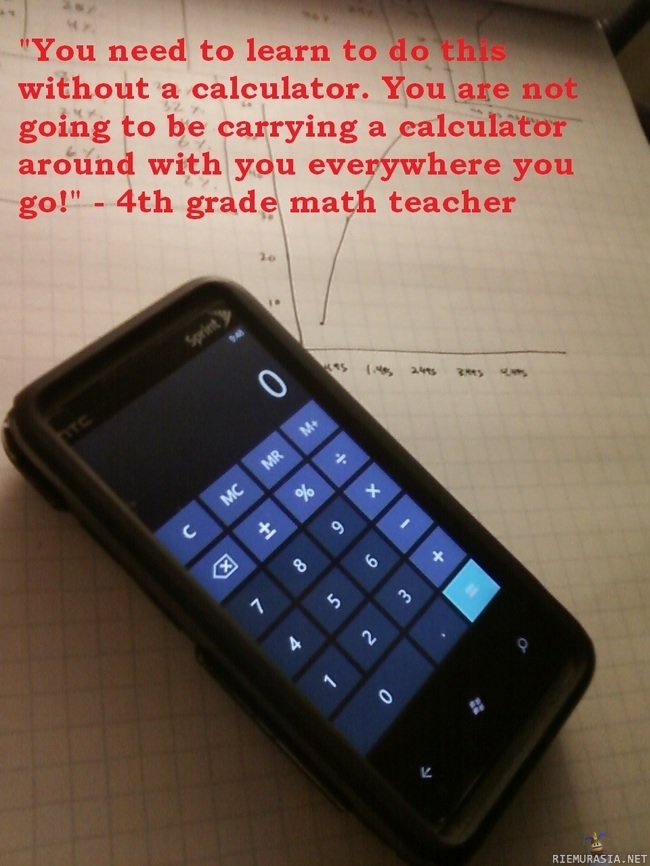
I regularly observe students in college who need to pull out a calculator to multiply two single digit numbers together. I even see a few students who need a calculator to add two single digit numbers. My experience is certainly not unique for college students in Northwest Indiana and Southeast Chicago, where I have taught. Perhaps you have misunderstood exactly what I am appalled by. I will just say this once more and then shut up on the subject.Bill Spight wrote:I do not share her belief that children should become third best calculators by the fifth grade (behind computers and adding machines). Arithmetic algorithms are formal operations, which most children are not prepared to understand before the 5th grade...
Technological advances do lead to the loss of cognitive skills, as they are made redundant. Before our time literacy led to poorer memory function, because people could make notes and refer to books. The internet will probably have a similar effect. Why remember something if you can easily and readily look it up online? We no longer have clerks adding up ledgers manually nor is our grocery bill added up manually at checkout. Should we still train our children to do those tasks? What a waste of their potential if we do!
I believe that trying to teach children elaborate algorithms, of whatever sort, or presenting undirected, inquiry-based learning approaches before having them memorize the addition and multiplication tables has been counter productive. Once children are a bit more mature (at whatever individual age that occurs), a deeper understanding is possible through applications and other means. Of course, simple applications of addition should not wait for the introduction of multiplication! Whatever happened to flash cards? Oh wait, we cannot call on children now because they might lose some self-esteem and collapse!
Flame on.

-
snorri
- Lives in sente
- Posts: 706
- Joined: Fri Jul 02, 2010 8:15 am
- GD Posts: 846
- Has thanked: 252 times
- Been thanked: 251 times
Re: No wonder!
Yes, and kids today cannot even translate simple passages from Latin without using Google. How are they supposed to compete when...oh, right no one cares about that any more.
There are lots of dying skills. Driving a stick shift. Sewing. No one's crying about the decline of these things.
Let's say we revamp the primary education system so that the majority of students are prepared to take, say, the Tripos before they graduate high school. Wonderful. We can congratulate ourselves on our pedagogical genius. The problem is that most of them will just wind up working for the lot that has more charisma despite needing to use a calculator for 6x4. That's a cultural thing, and it may change.
I think the funniest part of the video is her story about how she was better prepared for calculus. Calculus? Who integrates any more? That's what Mathematica is for.
There are lots of dying skills. Driving a stick shift. Sewing. No one's crying about the decline of these things.
Let's say we revamp the primary education system so that the majority of students are prepared to take, say, the Tripos before they graduate high school. Wonderful. We can congratulate ourselves on our pedagogical genius. The problem is that most of them will just wind up working for the lot that has more charisma despite needing to use a calculator for 6x4. That's a cultural thing, and it may change.
I think the funniest part of the video is her story about how she was better prepared for calculus. Calculus? Who integrates any more? That's what Mathematica is for.
-
HermanHiddema

- Gosei
- Posts: 2011
- Joined: Tue Apr 20, 2010 10:08 am
- Rank: Dutch 4D
- GD Posts: 645
- Universal go server handle: herminator
- Location: Groningen, NL
- Has thanked: 202 times
- Been thanked: 1086 times
-
Bill Spight
- Honinbo
- Posts: 10905
- Joined: Wed Apr 21, 2010 1:24 pm
- Has thanked: 3651 times
- Been thanked: 3374 times
Re: No wonder!
As I tried to indicate, I think that THE problem, if there is only one, lies with the culture, something you pretty much agree with.Bantari wrote:This is true, although not sure if really THE problem.Bill Spight wrote:Good point. Unfortunately, we are unlikely to hire many math savvy elementary school teachers. We won't pay them enough.hyperpape wrote:Like most other educational reforms, what you show in the video is not likely to stick. The teachers who are trying to teach new methods will have received almost no training on them, they won't understand them, and they will undermine the intent of the new methods as they try to assimilate it to what they know: http://www.nytimes.com/2014/07/27/magaz ... -math.html
Well, that was not a problem when I was in grade school, but if anything, the teaching of math was worse than it is today.The culture is bad because both the parents and the students/kids are allowed to (and often do) deal from the position of entitlement - they expect to get good grades no matter what, and if they don't, it means the teacher/school is to blame.
The Adkins Principle:
At some point, doesn't thinking have to go on?
— Winona Adkins
Visualize whirled peas.
Everything with love. Stay safe.
At some point, doesn't thinking have to go on?
— Winona Adkins
Visualize whirled peas.
Everything with love. Stay safe.
-
Bill Spight
- Honinbo
- Posts: 10905
- Joined: Wed Apr 21, 2010 1:24 pm
- Has thanked: 3651 times
- Been thanked: 3374 times
Re: No wonder!
From what you had already said, I had a pretty good idea what you were appalled by. I was appalled by different things. Namely, the poor logic of the woman, her attack on math that she didn't even bother to look at, and her attack on perfectly good math that she did look at.Aidoneus wrote:I regularly observe students in college who need to pull out a calculator to multiply two single digit numbers together. I even see a few students who need a calculator to add two single digit numbers. My experience is certainly not unique for college students in Northwest Indiana and Southeast Chicago, where I have taught. Perhaps you have misunderstood exactly what I am appalled by. I will just say this once more and then shut up on the subject.Bill Spight wrote:I do not share her belief that children should become third best calculators by the fifth grade (behind computers and adding machines). Arithmetic algorithms are formal operations, which most children are not prepared to understand before the 5th grade...
Technological advances do lead to the loss of cognitive skills, as they are made redundant. Before our time literacy led to poorer memory function, because people could make notes and refer to books. The internet will probably have a similar effect. Why remember something if you can easily and readily look it up online? We no longer have clerks adding up ledgers manually nor is our grocery bill added up manually at checkout. Should we still train our children to do those tasks? What a waste of their potential if we do!
I quite agree. I think that it is a mistake to teach arithmetic before 5th grade. It is more sophisticated than it appears. Why waste 4 or 5 years on it (and turn children off of math in the process) instead of waiting until they are more ready and then spend 1 or 2 years on it? Recently mathbabe ( http://mathbabe.org/2014/08/15/i-love-m ... lds-medal/ ) mentioned about how she was turned on to math by spirographs. A number of her readers were, too. Spirographs involve concrete operations, not formal operations. Math with concrete operations is appropriate for elementary school.I believe that trying to teach children elaborate algorithms, of whatever sort, or presenting undirected, inquiry-based learning approaches before having them memorize the addition and multiplication tables has been counter productive. Once children are a bit more mature (at whatever individual age that occurs), a deeper understanding is possible through applications and other means.
However, do not underestimate the value of undirected, inquiry based learning in grade school. It is pretty much how children learned before getting to school, and they learned a lot that way.

The Adkins Principle:
At some point, doesn't thinking have to go on?
— Winona Adkins
Visualize whirled peas.
Everything with love. Stay safe.
At some point, doesn't thinking have to go on?
— Winona Adkins
Visualize whirled peas.
Everything with love. Stay safe.
-
Aidoneus
- Lives in gote
- Posts: 603
- Joined: Sat Mar 29, 2014 12:37 pm
- GD Posts: 0
- Location: Indiana
- Has thanked: 114 times
- Been thanked: 176 times
Re: No wonder!
I know that I said I would shut up...but I completely agree with this. With the exception of teaching younger children to count!Bill Spight wrote:I think that it is a mistake to teach arithmetic before 5th grade. It is more sophisticated than it appears. Why waste 4 or 5 years on it (and turn children off of math in the process) instead of waiting until they are more ready and then spend 1 or 2 years on it?
And I implemented the Harvard Calculus Project at Indiana University (1991-93), in which I taught the 3-semester, 13-credit hour sequence in calculus using Mathematica. I stand by the need to know basic addition and multiplication tables, though, before handing over calculators--learning basic arithmetic skills hardly compare to essentially obsolete skills such as using an abacus or slide rule, or nonsense comparisons like sewing.