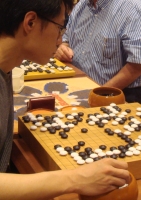
... turned one of the Master's white stones right side up. If the white stones had face and obverse, then the face must be the inner, stripeless side of the clamshell; but few paid attention to such details.
This is yet another of the many infelicities perpetrated by non-go player Seidensticker, but in this case due to sloppy English.
First, the face and obverse are the same thing (Latin
obvertere is to 'face towards').
Second, 'must' does not mean 'has to' here. It means 'presumably is'. The Japanese is 'darou'.
Third, there is no real sense of 'right' way up in the Japanese. It just says he turned the stone over ('uragaeshita' and, in a later sentence, 'hikkurikaesu'), the reference being to an inner face (内側) and an outer face (表) of a shell, not to a right and wrong side.
Fourth, there is no reference in the Japanese to 'few'. In fact it strictly says no-one pays attention to such things (そんなものを気をつける人はない).
It must be borne in mind that Seidensticker was a great admirer of Arthur Waley and often consciously followed Waley's style when translating. Waley was notorious for numerous mis-translations - howlers, even - in
Tale of Genji, but his work is admired (rightly) for its sense of linguistic style and ability to convey the tone of the original. In the case of
Master of Go, Seidensticker was concerned only with conveying Kawabata's observations (in Chapter 10) of Otake/Kitani's nervous tics, which he does in good, idiomatic English. We know from other details that he had little concern about what go players might think about the book. But perhaps that was a great pity, a mistake even, because Kawabata did care, and if the job of the translator is to convey as much of the original author's intentions as possible, Seidensticker ideally ought to have cared too.
There is, incidentally, no evidence that I am aware of that the real Kitani had a stripe compulsion. If anything, a case could be made on evidence available that Kitani was not averse to a mild touch of gamesmanship and may have been trying to irritate his opponent. Although I have seen a couple of players check which way a White stone faces in the bowl before picking it up, and adjusting it if necessary, I am certain they are only either following a personal compulsion for tidiness, like not walking on the cracks in pavements (you also get liner-uppers in shogi), or taking a moment to compose themselves.
Remember also that observers like Kawabata have to sit there for hours, not understanding much of the game but having to find something to write about. The devil makes mischief for idle hands and we know that Kitani was irritated by other things that Kawabata latched onto or made up.

 )
)