This kind of loose pincer by white usually has two responses to think about, either black jumps into the corner, for a standard corner joseki, or does a double approach joseki, because black has handicap stones the result of either is fine really. Though the double approach gives black sente.
Move 16: Nice move, 10 /10
Move 20: Playing low here is not great because it doesn't work well with the other two stones on the fourth line, it would be more normal for this stone to be on the fourth line as well.
Move 22: This attach is a little too much for black, R 5 helps protect the corner, but this attach invites moves like Q7, helping white move out into the board, or a hane at Q or S6.
Move 23: White's move 23 is meaningless, Black's corner is fine, this doesn't attack the corner, or make any territory, it can be ignored and black can play a bigger place.
Move 24: when white doesn't respond to your attach here, black should take advantage and play Q7, this is really bad for white. Playing at O13 is poor, Black's corner is already alive, this doesn't really attack white's two groups which are both alive, and it doesn't gain anything for Black, this is where black should be playing a big move, maybe an approach on the top left?
Move 28: Jumping out to the middle like this isn't great, black can still try and move towards white's corner, perhaps with an attach at D17, if the group is unable to make life on the edge then it can run to the centre. This move doesn't attack anything or make any territory for black and it isn't saving Black's group here, so it isn't very efficient play.
Move 66: A good move, white's shape is bad and is being denied eyes at the edge by this move.
Move 68: Trying to deny the eye
 just pushing at F2 is fine. It won't be easy for white to make a second eye here anyway, so one eye (in gote) is fine to give white.
 is essential to prevent White playing there.


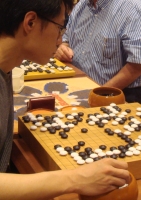
 Can you identify any weak groups or weak spots on the whole board ?
 F3+J3 not settled; if W gets D2 first, it helps W a lot. Conversely, B E3 direction hurts W.
 L3+o3 not settled; if B gets Q2 first, it helps B a lot. Conversely, W P3 direction hurts B.
 Very strange. See
  Slow. H5.
 Slow. H6.
 Strange shape.
 Floater. ( Doesn't really do anything. )
 What's the status of this corner ?
 Same question as above.
 Locally, M2.
 Your note here: a good lesson.
 Your question here: it's a good lesson --
 empty triangle could be suspect right away...