yum list *hfs*
blkid -c /dev/null
mount -t hfsplus -o force,rw /dev/sdc1 /media/external
chown -R myuser:myuser /media/external
let's see if i understand John's points (this is an open reply, not a personal one)
1. "the above diagrams confirm my impression that the bus is heading in the wrong direction"
am i correct to infer that the wrong direction is that of not following in the footsteps of Our Lord Alphago, for She is the Way, the Truth and the Light?
2. John gathers that "the basic idea was to produce a program that can explain moves to humans in a human-like way".
I do not accept any responsibility for whatever false impression anyone has who has not read my paper nor watched any of my videos.
To repeat in this thread for the umpteenth time, No, it wasn't the basic idea. It never was.
When it became clear to me, some way down the track, that Swim could explain itself, i saw that as a bonus, one which could make Swim a useful learning aide, and said so in my blog.
http://lcipm.blogspot.com.au/
Perhaps i confused John by recalling in an earlier post that in 1972, i had started out by setting myself the task of seeing if i could teach a computer how to learn a language. But that was 45 years ago.
Swim is an experimental vehicle for exploring my theories of how an intelligent computational mechanism could deploy hierarchical reasoning, using the toy domain of Go as an experimental testbed. because it is free from the complication of noisy data that complicates matters for robots situated in the real world.
The basic concepts of Swim originate in my 1979 IFCAI paper, which draws upon much prior work in psychology, including and especially Bartlett's theory of Remembering and De Groot's essay on Thought and Choice in Chess. The 34 videos of MiG, one of my retirement hobbies, which i started on once i had discovered where the whole idea of God comes from, describe my current thinking.
3. As for counting, it is glaringly obvious that John has jumped to completely the wrong conclusion about the role it plays in Swim's computational processes. I infer that he has done this because he believes that what Demis says in his recent Royal Society presentation, parts of which feature in my video "Demis and Noam", is correct - namely, that it is impossible to estimate the balance of power in a Go game before its very end, which Demis also says is impossible to detect because it doesn't end like a simple checkmate.
The role of counting in Swim is spelled out as simply as i can spell it out, in my paper, so i will not attempt a simpler explanation here. But, to repeat once more, unlike Alphago and every other Go program ever written, Swim does not use counting to choose a move - instead, it only uses rough estimates of potential territory and influence to form its preliminary perceptions of the state of play to choose a strategy to look for goals to achieve.
4. On the subject of pro commentaries, MiG begins, in episode 2 of what are now about 30 episodes, by observing that pros do not know what they are thinking, because nobody, not even Christoph Koch, one of the world's leading experts on the science of consciousness, knows what they are going to say until they say it. Chritof features in another MiG episode although offhand i can't remeber which. The only difference between Christoph and the rest is that he knows he doesn't know. Antonio Damasio estimates that maybe 80% of our thought processes are subconscious, which by definition we are unaware of. If you are disinclined to google any names of famous scientists that are unfamiliar, i cannot elucidate further.
Pro commentaries are useful, and entertaining, for the audience can delude itself into thinking it understands what the pros are saying, even though the pros themselves don't know why they are saying what they say. Picasso was a rare exception to a general rule when he replied, when asked what his paintings meant, said: "my art speaks for itself". And to me, Michael Redmond is head and shoulders above the rest at attempting to drag himself down to my level.
5. i note that John disparages "amateur" opinion quite a few times in his historical precis. Evidently, in his eyes, unless one is paid by some benefactor or an entrepreneur who can see a way of making money out of one, one's opinion is not worth the paper it is written on, so i have nothing to say, beyond noting that in 1985 i enjoyed listening and watching pro talk every Sunday on NHK TV, and learned that major Japanese newspapers had been carrying pro Go commentaries since before World War I, although quite what world wars have to do with the history of Go theory and popularity, i simply cannot imagine.
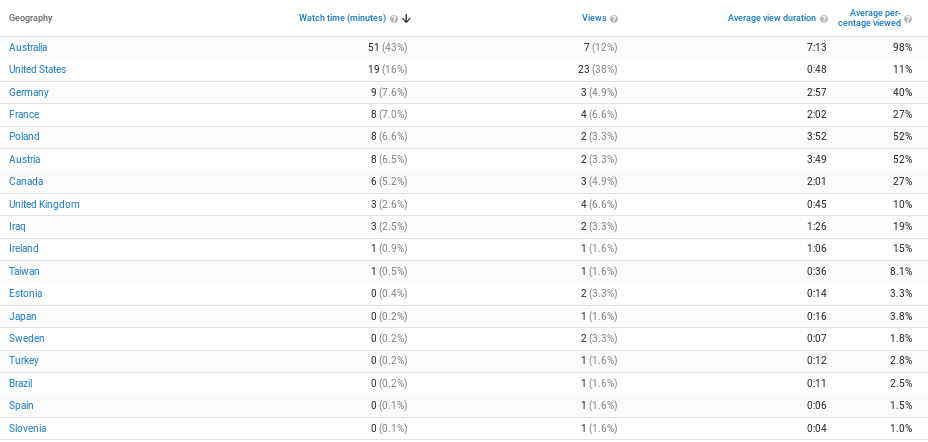
To quote from my latest plagiarised/mashupped video, which Google tells me most Americans didn't watch more than 48 seconds of, presumably jumping to conclusions based on a single frame, well before all the good bits start, It is an ex-policy. It has ceased to be.
If only that were also true of policy makers, who seem hell-bent on starting world war 3. But as Black Adder has just started, i will stop here and post it as it is.
- googleanalytics.png (49.63 KiB) Viewed 13389 times
i didn't do that - you have just provided us with another example of "projection"
- unless you're an old one in disguise, but i can't imagine that, as none of them play Go, except Tony, who kicked the bucket recently so you can't be him unless you're a ghost who can type and i've never seen one of those (i suppose you could be his typist...); but besides, he would have just pulled my leg even further, as he would do when switching colours and beating me again from a position i had resigned from. Hang on a minute, you are pulling my leg even further....oo-er, spooky... but it's nearly 40 years since we both didn't work in the same place! Parallel universes?