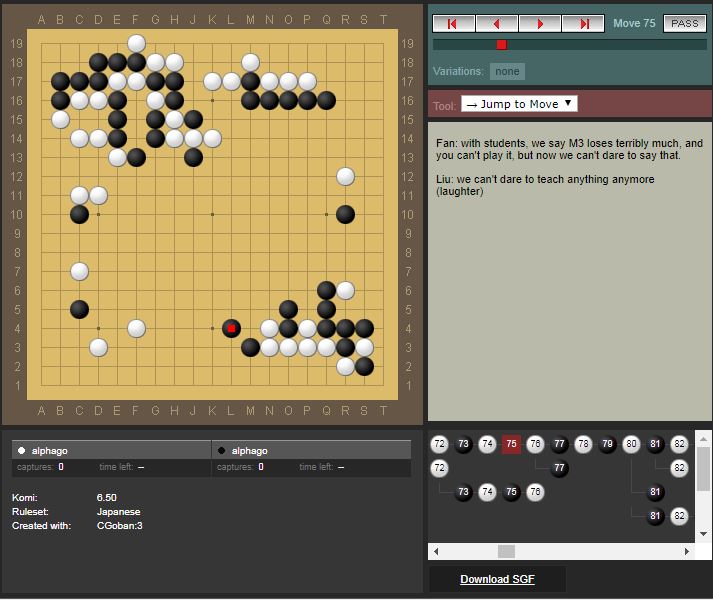
But this is not unique to AI. We do it all the time with human moves (2nd-line probes against a shimari were rare until little more tan a century ago, 5-5 was new, 10-10 was new, josekis go in and out of fashion...). The benefit of using human games as a basis is that we either have or can get a human explanation we have a chance of understanding, however imperfectly. AI has just widened the pool (by pissing in it, in my viewInstead of playing the hane-tsugi White crawled along the second line.I think we have to say that this is joseki, not the hane-tsugi. Having seen it, I have to ask, Why didn't I think of that?
As a human, I can offer an explanation, too. OC, it is post hoc, but so what?
On AI vs human thinking
-
John Fairbairn
- Oza
- Posts: 3724
- Joined: Wed Apr 21, 2010 3:09 am
- Has thanked: 20 times
- Been thanked: 4672 times
Re: On AI vs human thinking
-
Kirby
- Honinbo
- Posts: 9553
- Joined: Wed Feb 24, 2010 6:04 pm
- GD Posts: 0
- KGS: Kirby
- Tygem: 커비라고해
- Has thanked: 1583 times
- Been thanked: 1707 times
Re: On AI vs human thinking
One potential danger of post hoc explanation is that the explanation might have bias. Explanations are often a bit subjective (e.g. "black is good because he gets sufficient influence here"). When you know the "answer" beforehand, you can come up with reasons to support the quality of the move that you might otherwise not buy into, simply because you know that there has to be some reason the AI played that way.Bill Spight wrote: As a human, I can offer an explanation, too. OC, it is post hoc, but so what?
I'd argue that post hoc explanation can still be valuable to make sense of a position, but I can't say that it's very scientific.
be immersed
-
Bill Spight
- Honinbo
- Posts: 10905
- Joined: Wed Apr 21, 2010 1:24 pm
- Has thanked: 3651 times
- Been thanked: 3373 times
Re: On AI vs human thinking
Please note my previous statement that human explanations about their decisions, particularly about intuitive decisions, are typically post hoc. This is clear in experiments involving hypnosis and split brain research.Kirby wrote:One potential danger of post hoc explanation is that the explanation might have bias. Explanations are often a bit subjective (e.g. "black is good because he gets sufficient influence here"). When you know the "answer" beforehand, you can come up with reasons to support the quality of the move that you might otherwise not buy into, simply because you know that there has to be some reason the AI played that way.Bill Spight wrote: As a human, I can offer an explanation, too. OC, it is post hoc, but so what?
I'd argue that post hoc explanation can still be valuable to make sense of a position, but I can't say that it's very scientific.
The Adkins Principle:
At some point, doesn't thinking have to go on?
— Winona Adkins
Visualize whirled peas.
Everything with love. Stay safe.
At some point, doesn't thinking have to go on?
— Winona Adkins
Visualize whirled peas.
Everything with love. Stay safe.
-
Gomoto
- Gosei
- Posts: 1733
- Joined: Sun Nov 06, 2016 6:56 am
- GD Posts: 0
- Location: Earth
- Has thanked: 621 times
- Been thanked: 310 times
Re: On AI vs human thinking
I learned by AI:
How to haengma
How to surround
How to kill
How to live
How to joseki
How to fuseki
How to honte
How to tesuji
How to tenuki
How to surround (intentionally mentioned a 2nd time)
How to count
How to decide
How to compare
How to connect
How to split
How to read
How not to pray and play
(Never forget AI has a nice intuition, but it is also quite competent at reading)
And sometimes I win nowadays ... dont care much about explanations ... i just play the moves I learned by AI
How to haengma
How to surround
How to kill
How to live
How to joseki
How to fuseki
How to honte
How to tesuji
How to tenuki
How to surround (intentionally mentioned a 2nd time)
How to count
How to decide
How to compare
How to connect
How to split
How to read
How not to pray and play
(Never forget AI has a nice intuition, but it is also quite competent at reading)
And sometimes I win nowadays ... dont care much about explanations ... i just play the moves I learned by AI
-
Bill Spight
- Honinbo
- Posts: 10905
- Joined: Wed Apr 21, 2010 1:24 pm
- Has thanked: 3651 times
- Been thanked: 3373 times
Re: On AI vs human thinking
Nectar of the Gods!John Fairbairn wrote:The benefit of using human games as a basis is that we either have or can get a human explanation we have a chance of understanding, however imperfectly. AI has just widened the pool (by pissing in it, in my view)
Let us not sell humans short. We live in the era of Big Data, where programs sift through masses of data and come up with Black Box answers to human questions. (The answers are not necessarily sound, OC.) Not too long ago I was reading about some academic researchers studying the answers of one of these Black Box algorithms and coming up with a simple algorithm using only three parameters that got the same answers to within a small margin of error. Now, nobody had come up with such good answers before the Black Box algorithm, but, once we had those answers, humans were able to come up with good concepts to explain those answers simply. This is not the same thing as learning by imitation, but is a more scientific approach. The top go bots are Black Box algorithms, and I am optimistic that by studying their play humans will come up with new go ideas to help us understand the game and play it better.
The Adkins Principle:
At some point, doesn't thinking have to go on?
— Winona Adkins
Visualize whirled peas.
Everything with love. Stay safe.
At some point, doesn't thinking have to go on?
— Winona Adkins
Visualize whirled peas.
Everything with love. Stay safe.
-
hyperpape
- Tengen
- Posts: 4382
- Joined: Thu May 06, 2010 3:24 pm
- Rank: AGA 3k
- GD Posts: 65
- OGS: Hyperpape 4k
- Location: Caldas da Rainha, Portugal
- Has thanked: 499 times
- Been thanked: 727 times
Re: On AI vs human thinking
One thing that AI has is shock and awe. In 2015, it was a just promising little curiousity, and just two years later it said "I am the teacher now". My sense is that no other shift in the game happened so suddenly, or so unexpectedly. As you've pointed out, Shin Fuseki was a more gradual development than many of us think, and more balanced--the conservatives could maintain with a straight face that their approach would win out in due time.John Fairbairn wrote:But this is not unique to AI. We do it all the time with human moves (2nd-line probes against a shimari were rare until little more tan a century ago, 5-5 was new, 10-10 was new, josekis go in and out of fashion...). The benefit of using human games as a basis is that we either have or can get a human explanation we have a chance of understanding, however imperfectly. AI has just widened the pool (by pissing in it, in my view)
Edit: fixed completely broken syntax of one sentence
-
hyperpape
- Tengen
- Posts: 4382
- Joined: Thu May 06, 2010 3:24 pm
- Rank: AGA 3k
- GD Posts: 65
- OGS: Hyperpape 4k
- Location: Caldas da Rainha, Portugal
- Has thanked: 499 times
- Been thanked: 727 times
Re: On AI vs human thinking
Apparently the old split brain research has recently been called into doubt (though don't ask me any details, I just remembered reading a tweet about this when I saw your post). https://www.ncbi.nlm.nih.gov/pubmed/28122878. The broader point about post-hoc justifications hasn't been repealed, as far as I'm awareBill Spight wrote:Please note my previous statement that human explanations about their decisions, particularly about intuitive decisions, are typically post hoc. This is clear in experiments involving hypnosis and split brain research.
-
John Fairbairn
- Oza
- Posts: 3724
- Joined: Wed Apr 21, 2010 3:09 am
- Has thanked: 20 times
- Been thanked: 4672 times
Re: On AI vs human thinking
This is quite true. There is also the aspect that AI go comes with a shiny new toy that some people think they need to have urgently so their batteries can burst into flames before anyone else's.One thing that AI has is shock and awe. In 2015, it was a promising little curiosity to saying "I am the teacher now". My sense is that no other shift in the game happened so suddenly, or so unexpectedly
But this is precisely what turns AI go into cargo-cult status.
I too expect this to happen. They key phrase is "humans will come up with..." But I also expect that if humans studied, say, Dosaku with the same intensity and passion they study AI games they would likewise play better. After all, that is essentially why present pros are better than present amateurs.I am optimistic that by studying their play humans will come up with new go ideas to help us understand the game and play it better.
I am not knocking AI. I am knocking AI worship.
-
hyperpape
- Tengen
- Posts: 4382
- Joined: Thu May 06, 2010 3:24 pm
- Rank: AGA 3k
- GD Posts: 65
- OGS: Hyperpape 4k
- Location: Caldas da Rainha, Portugal
- Has thanked: 499 times
- Been thanked: 727 times
Re: On AI vs human thinking
I think the proof of a cargo cult is in the results, or lack thereof, so time will tell.John Fairbairn wrote:This is quite true. There is also the aspect that AI go comes with a shiny new toy that some people think they need to have urgently so their batteries can burst into flames before anyone else's.
But this is precisely what turns AI go into cargo-cult status.
-
Bill Spight
- Honinbo
- Posts: 10905
- Joined: Wed Apr 21, 2010 1:24 pm
- Has thanked: 3651 times
- Been thanked: 3373 times
Re: On AI vs human thinking
OK.John Fairbairn wrote:I am not knocking AI. I am knocking AI worship.
Well, Dosaku has already been well studied for a long time. I doubt if studying him now will produce any new go ideas. OC, you never know. Was AlphaGo Master better than Dosaku? I don't know. Maybe Dosaku could give current top pros three stones. But I rather expect that AlphaGo Zero was better than any human who ever lived. And it defeated humans who had absorbed ideas from Dosaku, Go Seigen, and other giants of the game. Now, you and I have recognized echoes of Go Seigen in today's top bots, but the AlphaGo Zero self play games have opened up new territory for exploration. They have an alien feel to them. The dominance of the bots seems to lie much more in the realm of strategy than in tactics. To me that indicates that there are general concepts in their play that are waiting to be discovered and articulated by humans. Humans are good at doing that, so we will.I too expect this to happen. They key phrase is "humans will come up with..." But I also expect that if humans studied, say, Dosaku with the same intensity and passion they study AI games they would likewise play better. After all, that is essentially why present pros are better than present amateurs.I am optimistic that by studying their play humans will come up with new go ideas to help us understand the game and play it better.
The Adkins Principle:
At some point, doesn't thinking have to go on?
— Winona Adkins
Visualize whirled peas.
Everything with love. Stay safe.
At some point, doesn't thinking have to go on?
— Winona Adkins
Visualize whirled peas.
Everything with love. Stay safe.
-
Kirby
- Honinbo
- Posts: 9553
- Joined: Wed Feb 24, 2010 6:04 pm
- GD Posts: 0
- KGS: Kirby
- Tygem: 커비라고해
- Has thanked: 1583 times
- Been thanked: 1707 times
Re: On AI vs human thinking
Even outside of the domain of go, I'm a believer that things are going to get crazy in our lifetime.hyperpape wrote:One thing that AI has is shock and awe. In 2015, it was a just promising little curiousity, and just two years later it said "I am the teacher now". My sense is that no other shift in the game happened so suddenly, or so unexpectedly. As you've pointed out, Shin Fuseki was a more gradual development than many of us think, and more balanced--the conservatives could maintain with a straight face that their approach would win out in due time.
Think about it. Humans have been around for thousands of years, but electricity was just being investigated a few hundred years ago. In my grandfather's lifetime, he had been using a kerosene oil lamp to study. The first airplane was invented just over a hundred years ago, and since then, we've traveled to the moon. They're discovering organic material on Mars, now. The world wide web was invented when - like the 90s? That's just a couple of decades ago.
The rate of advancement in technology isn't happening linearly. It's starting to lift off like crazy.
Here's a funny article along the same lines:
https://waitbutwhy.com/2015/01/artifici ... ion-1.html
Will people be living on Mars in my lifetime? Will AI take over the world? Will there be some new invention that allows people to teleport across the world?
I can only imagine.
be immersed
-
Gomoto
- Gosei
- Posts: 1733
- Joined: Sun Nov 06, 2016 6:56 am
- GD Posts: 0
- Location: Earth
- Has thanked: 621 times
- Been thanked: 310 times
Re: On AI vs human thinking
AI is the new kid on the block. The old blokes don't like the new pretender. But the early adoptors adopt. I for one welcome our new Go overloards.
He, books were dissed too. Which invention wasn't. And I only find the go conservativists mildly amusing, but I prefer to discuss these issues over the go board
I worship the AI because it opens up a fine brave new world!
He, books were dissed too. Which invention wasn't. And I only find the go conservativists mildly amusing, but I prefer to discuss these issues over the go board
I worship the AI because it opens up a fine brave new world!
-
Calvin Clark
- Lives in gote
- Posts: 426
- Joined: Thu Aug 13, 2015 8:43 am
- GD Posts: 0
- Has thanked: 186 times
- Been thanked: 191 times
Re: On AI vs human thinking
When the AlphaGo games came out, there was a lot of amazement and confusion. There was also speculation on what could be learned from the games. I think John noted in another thread that O Meien expressed some skepticism about how much humans can learn from AI.
But things change quickly, and there's a huge difference between just having a handful of self-play records to marvel over and actually being able to play against the AI. The modern AIs can provide evaluation and variations, which is helpful, too. They are an enormous resource, especially for the top players who don't have humans much stronger than themselves to guide them.
But it is still, IMO, highly likely that AI is not close to the truth yet. AlphaGo was still improving when DeepMind reprovisioned it to other goals. Leela Zero is not stuck.
But there are some concerns. For much of May, Leela Zero self-play games mostly looked like this. Some huge percentage of its games started with this exact sequence. I could actually go further, you get the point:
It had all but stopped playing anything but nirensei as black and 4-4 + 3-4 as white. I hear they are tweaking it to explore more, but what if this is the truth? Will human play stagnate from just blindly copying a narrow set of options from impossibly distant intelligences, vast and cool and unsympathetic?
I am more of an optimist on this. I think what we are seeing is a local maximum in a kind of steepest ascent search, akin to being proud that you have reached the top of a hill while simultaneously being oblivious to Everest looming behind your back.
Newer AIs, built in different ways, may not find the Everest for a long time, but maybe they will find a Fuji or Rainier and at least we will have some different scenery.
I also look forward to explainable AI in go as well as in other fields.
But things change quickly, and there's a huge difference between just having a handful of self-play records to marvel over and actually being able to play against the AI. The modern AIs can provide evaluation and variations, which is helpful, too. They are an enormous resource, especially for the top players who don't have humans much stronger than themselves to guide them.
But it is still, IMO, highly likely that AI is not close to the truth yet. AlphaGo was still improving when DeepMind reprovisioned it to other goals. Leela Zero is not stuck.
But there are some concerns. For much of May, Leela Zero self-play games mostly looked like this. Some huge percentage of its games started with this exact sequence. I could actually go further, you get the point:
It had all but stopped playing anything but nirensei as black and 4-4 + 3-4 as white. I hear they are tweaking it to explore more, but what if this is the truth? Will human play stagnate from just blindly copying a narrow set of options from impossibly distant intelligences, vast and cool and unsympathetic?
I am more of an optimist on this. I think what we are seeing is a local maximum in a kind of steepest ascent search, akin to being proud that you have reached the top of a hill while simultaneously being oblivious to Everest looming behind your back.
I also look forward to explainable AI in go as well as in other fields.
- yakcyll
- Dies with sente
- Posts: 77
- Joined: Thu Apr 19, 2018 6:40 am
- Rank: EGF 3k
- GD Posts: 0
- Universal go server handle: yakcyll
- Location: Warsaw, PL
- Has thanked: 165 times
- Been thanked: 18 times
- Contact:
Re: On AI vs human thinking
Hi.
This isn't much, but I wanted to share my perspective too, since the degree to which the new bots are glorified, sometimes personified, irks me greatly (I'm aware it's not healthy, patience will be greatly appreciated).
Imagine a kid shows up - a Westerner, no less - fifteen years of age, well kept, calm and silent, his face betrays no emotion. He starts playing the game, climbing ranks with speed previously unthinkable of humans, first beating top amateurs, then winning tournaments, obtaining a professional rank and proceeding to dominate the world scene in a manner leaving the entirety of Asia scratching their heads. It becomes apparent really quickly, that the kid is a one of a kind prodigy with abilities many consider divine. Remembers every kifu he ever laid his eyes on, can clearly analyze all situations fifty, a hundred moves ahead, plays moves other professionals don't even consider as viable, but they somehow work for him every time. For the next sixty or seventy years he dominates the game, spawning masses of fans and followers who try to decipher his moves through personal analysis as he can offer little to no insight that can be immediately understood and used to adapt the current game theory. No one is able to come close to beating him consistently, as he can adapt to people catching on to his tactics almost instantly.
Would we study his games? Hell yes, we would, I mean, who wouldn't? He's the best, there must be treasure troves of knowledge about the game in his games. He's forming new patterns, presenting rebuttals to attacks previously thought of as clearly advantageous to the attacker and successfully forcing his way into situations thought of as impenetrable. But at some point questions will arise. How much more is there to learn? Aren't we approaching a point where we won't be able to discern what's the right and what's the wrong move on our own? What's the point of competing against this guy if there's no way apparent to touch him? Isn't he hurting the professional scene by claiming every title for himself? Is there no place for originality and character in the game anymore, when everybody and their pets are imitating him?
AlphaGo is this kid. There are a couple of differences of course, namely that it won't leave us, it can be cloned, it doesn't need another person to play and that it is a computer program. I'd argue against claiming it has a distinct style or possesses intuition. What we call the two in regards to humans are just by-products of thorough analysis of game records leading to forming decision trees with winning probabilities, calculated through some sort of value functions, exceeding those attached to paths taken by humans. What we call intuition is a heuristic applied by humans to glue the known with the unknown without using prohibitively high amounts of resources. Computers don't need this, they can just see what a particular path ends with for themselves.
I'm running the risk of sounding like Debbie Downer, but seeing so many people glorifying bots as if they were oracles contributing to the ultimate human enlightenment smells like cargo cult to me too. They're making us reconsider what we know about the game and helping us see the previously unseen, but that was to be expected. We'll be going through similar discussions and problems that the chess community already has a lot of experience with. I'd love to have them solved in Go too already, to avoid seeing laptops running conclusive analysis of live games everywhere or having to argue with other players how a move is not necessarily correct in a given situation just because a bot played something like it. It's fairly clear that machines are (or show potential to eventually become) superior to humans when it comes to problems with bounded solution spaces, no need to beat a dead horse.
This isn't much, but I wanted to share my perspective too, since the degree to which the new bots are glorified, sometimes personified, irks me greatly (I'm aware it's not healthy, patience will be greatly appreciated).
Imagine a kid shows up - a Westerner, no less - fifteen years of age, well kept, calm and silent, his face betrays no emotion. He starts playing the game, climbing ranks with speed previously unthinkable of humans, first beating top amateurs, then winning tournaments, obtaining a professional rank and proceeding to dominate the world scene in a manner leaving the entirety of Asia scratching their heads. It becomes apparent really quickly, that the kid is a one of a kind prodigy with abilities many consider divine. Remembers every kifu he ever laid his eyes on, can clearly analyze all situations fifty, a hundred moves ahead, plays moves other professionals don't even consider as viable, but they somehow work for him every time. For the next sixty or seventy years he dominates the game, spawning masses of fans and followers who try to decipher his moves through personal analysis as he can offer little to no insight that can be immediately understood and used to adapt the current game theory. No one is able to come close to beating him consistently, as he can adapt to people catching on to his tactics almost instantly.
Would we study his games? Hell yes, we would, I mean, who wouldn't? He's the best, there must be treasure troves of knowledge about the game in his games. He's forming new patterns, presenting rebuttals to attacks previously thought of as clearly advantageous to the attacker and successfully forcing his way into situations thought of as impenetrable. But at some point questions will arise. How much more is there to learn? Aren't we approaching a point where we won't be able to discern what's the right and what's the wrong move on our own? What's the point of competing against this guy if there's no way apparent to touch him? Isn't he hurting the professional scene by claiming every title for himself? Is there no place for originality and character in the game anymore, when everybody and their pets are imitating him?
AlphaGo is this kid. There are a couple of differences of course, namely that it won't leave us, it can be cloned, it doesn't need another person to play and that it is a computer program. I'd argue against claiming it has a distinct style or possesses intuition. What we call the two in regards to humans are just by-products of thorough analysis of game records leading to forming decision trees with winning probabilities, calculated through some sort of value functions, exceeding those attached to paths taken by humans. What we call intuition is a heuristic applied by humans to glue the known with the unknown without using prohibitively high amounts of resources. Computers don't need this, they can just see what a particular path ends with for themselves.
I'm running the risk of sounding like Debbie Downer, but seeing so many people glorifying bots as if they were oracles contributing to the ultimate human enlightenment smells like cargo cult to me too. They're making us reconsider what we know about the game and helping us see the previously unseen, but that was to be expected. We'll be going through similar discussions and problems that the chess community already has a lot of experience with. I'd love to have them solved in Go too already, to avoid seeing laptops running conclusive analysis of live games everywhere or having to argue with other players how a move is not necessarily correct in a given situation just because a bot played something like it. It's fairly clear that machines are (or show potential to eventually become) superior to humans when it comes to problems with bounded solution spaces, no need to beat a dead horse.