What I am suggesting is that important, but not well defined terms invite amateurs to use them with incomplete understanding and to revise and improve their understanding over time. Your definition of such terms may have helped improve your play, and another person's definition of them may have helped improve their play, even if the two of you end up with different definitions.RobertJasiek wrote:Bill, please list the important terms you think should be defined and I have not defined yet.
Rational choice by amateurs
-
Bill Spight
- Honinbo
- Posts: 10905
- Joined: Wed Apr 21, 2010 1:24 pm
- Has thanked: 3651 times
- Been thanked: 3373 times
Re: Rational choice by amateurs
Last edited by Bill Spight on Mon Oct 01, 2018 4:28 pm, edited 1 time in total.
The Adkins Principle:
At some point, doesn't thinking have to go on?
— Winona Adkins
Visualize whirled peas.
Everything with love. Stay safe.
At some point, doesn't thinking have to go on?
— Winona Adkins
Visualize whirled peas.
Everything with love. Stay safe.
-
Bill Spight
- Honinbo
- Posts: 10905
- Joined: Wed Apr 21, 2010 1:24 pm
- Has thanked: 3651 times
- Been thanked: 3373 times
Re: Rational choice by amateurs
The explanation for the studies that Gladwell gives relies upon there being no negative effect on experts or only a small effect.Gomoto wrote:There are probably two different possible negative impacts of explaining your play (decisions)
-distraction (I do not want to talk about this, this is trivial)
-formulating explicit grounds for your play may lead to different move selection by your brain, you may select lesser moves (I understand this is true for non experts in the study. I claim this is probably also true for experts, but this is not covered by the study.)
The Adkins Principle:
At some point, doesn't thinking have to go on?
— Winona Adkins
Visualize whirled peas.
Everything with love. Stay safe.
At some point, doesn't thinking have to go on?
— Winona Adkins
Visualize whirled peas.
Everything with love. Stay safe.
- jlt
- Gosei
- Posts: 1786
- Joined: Wed Dec 14, 2016 3:59 am
- GD Posts: 0
- Has thanked: 185 times
- Been thanked: 495 times
Re: Rational choice by amateurs
In the research about jam ranking, amateurs don't know enough concepts, they are like DDKs. It would be interesting to know if the same conclusions still hold for amateurs who know most concepts (SDKs) or who generally use them correctly (dan players).
-
Kirby
- Honinbo
- Posts: 9553
- Joined: Wed Feb 24, 2010 6:04 pm
- GD Posts: 0
- KGS: Kirby
- Tygem: 커비라고해
- Has thanked: 1583 times
- Been thanked: 1707 times
Re: Rational choice by amateurs
I think the OP is kind of true, at least in some cases. When I play beginners, I sometimes don't think as much as I should, and just play the move that I think is right.
Then we review the game, and explain my moves. But I'm kind of just making something up to explain the move for the sake of explaining it. If I'm honest, I played the move because I felt like it was good.
My initial reaction is that maybe conscious thought helps us explore new ideas and to stretch our intuition. If we never utilize the conscious thought process, we probably won't get new ideas and won't improve much. But through experience, our intuition is refined and becomes stronger.
I dunno. Maybe I'm just rambling and coming up with some sort of semi-coherent explanation for my thought process here. I agree with the OP because of my intuition, after all :-p
Then we review the game, and explain my moves. But I'm kind of just making something up to explain the move for the sake of explaining it. If I'm honest, I played the move because I felt like it was good.
My initial reaction is that maybe conscious thought helps us explore new ideas and to stretch our intuition. If we never utilize the conscious thought process, we probably won't get new ideas and won't improve much. But through experience, our intuition is refined and becomes stronger.
I dunno. Maybe I'm just rambling and coming up with some sort of semi-coherent explanation for my thought process here. I agree with the OP because of my intuition, after all :-p
be immersed
- EdLee
- Honinbo
- Posts: 8859
- Joined: Sat Apr 24, 2010 6:49 pm
- GD Posts: 312
- Location: Santa Barbara, CA
- Has thanked: 349 times
- Been thanked: 2070 times
-
RobertJasiek
- Judan
- Posts: 6273
- Joined: Tue Apr 27, 2010 8:54 pm
- GD Posts: 0
- Been thanked: 797 times
- Contact:
Re: Rational choice by amateurs
I have defined some important terms. Usually, others' descriptions of them are not definitions in a (semi-formal) mathematical sense. Therefore, usually, there are not two different definitions. Your problem may be that you confuse 'definition' and 'very ambiguous informal description' in this thread. With the latter, rational choice is difficult, of course. Rational choice must rely on clear, preferably unambiguous definitions. You know because you have provided some definitions of terms, too.Bill Spight wrote:Your definition of such terms [...] another person's definition of them [...] even if the two of you end up with different definitions.
-
John Fairbairn
- Oza
- Posts: 3724
- Joined: Wed Apr 21, 2010 3:09 am
- Has thanked: 20 times
- Been thanked: 4672 times
Re: Rational choice by amateurs
Bill: I think this is the most important insight here (though perhaps the word 'definition' will lead some down the wrong path). At any rate, it gave me a bit of a sleepless night! I realised for the first time that in essence this is a re-statement of the Gestalt principles of grouping. I'm kicking myself for not having made the connection before. In my own defence, Gestalt was in common use when I was a student but it seems to have disappeared down the rabbit hole in recent years. I suspect this may have been when the term was hijacked by people like novelists.What I am suggesting is that important, but not well defined terms invite amateurs to use them with incomplete understanding and to revise and improve their understanding over time. Your definition of such terms may have helped improve your play, and another person's definition of them may have helped improve their play, even if the two of you end up with different definitions.
But it does seem applicable to go. As I understand it, the Gestaltists were concerned with how disparate qualitative elements merge into a whole (a 'configuration') that is recognised by everyone but which cannot be understood in terms of its parts, as these are not measurable. I believe the original prompt for their speculations was music. They were fascinated by the notion that all humans can identify the same melody even when it is played in different key with occasional different wrong notes, irrespective of whether it is played on a trumpet or sung, and whether it is sung to one set of lyrics or another. It's a very human skill, and although there are now apps like Shazam that can attempt to identify tunes, humans seem to do it so much better.
For myself I devised a different configuration, using the old "can't see the wood for the trees" saw. You climb a hill and can instantly see various unmeasurable elements. Sounds obvious, but it's a great skill. One element is a large stand of trees. Aha, a wood, you say. But what do you make of it? That depends on what your plans are. If you are a traveller, you want to know where it is and how to avoid it. You don't care what's inside. If you are a fugitive, however, you still don't care much what's inside but you don't want to avoid it - you want to enter it. But if you are a carpenter looking for oak to build ships, you do care what inside - and you may also care about how much there is (but "lots" will be sufficient description). Then again, you might not see even it as a wood at all. If you are hungry and looking for free food and you spot apples in the trees, you will think of it as an orchard. And yet again, you might just be a tourist who says, "Ooooo" and moves straight onto the next sight.
All these hill climbers are seeing exactly the same unmeasurable, fuzzy thing but interpreting it differently.
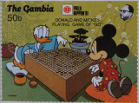
I suspect this is what happening in go. Pros and amateurs see the same thing (so it's irrelevant whether it's measured or not, or defined or not) but interpret (or "understand") it in startlingly different ways. I came across an example myself very recently. It was the position below.
The reader was being asked to choose between Black A and B. Since it was a book on a specific topic (surrounding) there was of course an implication that you had to justify your choice with reasons. So this was an example of the sort of test Gladwell was talking about.
In a real game I would have played A without thinking (i.e. intuitively). But because I knew this was being set as a problem with a theme - and also because I know I play almost every move without thinking and that's a habit I feel I should correct - I gave it some thought. My first thought was to do with the triangled stone. This involved a little reading but I quickly decided that White would make himself heavy by running away, and Black, with a preponderance of stones in the area would chase White and make more territory in doing so, while not being in any danger himself on either side of the fleeing White stones.
So I then turned my attention to the Black group on the lower side and tried to see the merits of B. I could accept that Black was somewhat thinner down there than he was on the right side, and, since White dominates the left side, a move that looks in that direction to erase that dominance could be useful. There was also the point that Black A instead would run the risk of ippoji (one big territory). Note that I did have several reasons, which is perhaps different from the amateurs in the Gladwell experiments. Still, in the end I couldn't convince myself that B was right, and went with A. But it was a close-run thing, and it shouldn't have been.
That uncertainty made me feel bad enough, but I was gobsmacked by the pro's explanation. A was correct, but the main reason was that it covered the weakness around the triangled stone. What weakness????!!!! Like my hill climbers, the pro and I had seen exactly the same thing but perceived something quite different. I am very used to observing that pros very often make early safety plays that I feel are too slow, so I don't find it hard to accept the pro was right here, but to say my understanding is incomplete is being generous to me. (There's a very similar thing in shogi I had trouble with - "Early escape by the king [i.e. castling] is worth nine moves.")
Now in my sleepless state I was trying to work out how this state of affairs (which I think applies to most amateur players) comes about and what can we do about it.
Without going into the inner workings of my thoughts, I came to the conclusion that I already held but now hold even more strongly: that attempts to measure or define strictly the various aspects of go that we can identify (e.g. thickness) are not just doomed to failure but are detrimental. They are trying to teach us to do things algorithmically, which is not something humans do very well, and certainly not when faced with a brand-new problem (i.e. a position we have never seen before).
It may seem glib to say that this is mainly a western problem, but I think it probably is - we see these attempts to measure and define an awful lot in chess. We maybe see this much less in western go (though the "noise" factor may be higher
It can be a subtle difference. Wilcox talked about sector lines. Takagawa talked about boxes and trays. If sector lines have a purpose it is just demarcation - not specially useful because we can see the invisible lines for ourselves already. But boxes and trays have contents and can hold different amounts according to shape and size - don't need to conform to a strict geometric definition of their sides. This seems to offer so much more in getting to grips with perception.
Perception is what the Gestalt grouping principles are concerned with. They try to offer a guide to the way humans perceive, which is important because we have an innate disposition to see patterns, or configurations. I think the most basic elements are proximity, similarity, continuity, closure, and connectedness, though they seem to have several different names. They are all relevant to go positions.
I recall, though maybe wrongly, reading that Gestalt workers failed to come up with a satisfactory theory of how perception works but that they were so convinced that they were on to something that they instead insisted on the word 'principles' rather than 'theory.' I find that a useful distinction. It has been common to translate Japanese kiri as 'go theory', and I've done that myself, but it's bit sloppy. 'Go principles' (plural) would be more accurate. Apart from the etymology of the -ri part and the typical definitions (as genri - basic principles of go), I think it is telling that the usual way to say someone is good at kiri is 'kiri ni akarui' where the etymology of akarui, suggesting brightness and seeing clearly, is really all about perception.
Since I am effectively suggesting perception as a new buzz word (possibly more useful than intuition), it may be useful, somewhat paradoxically, to define it. My Oxford English Dictionary says: the ability to see, hear or become aware of something through the senses. It also adds a more technical sense: The neurophysiological processes, including memory, by which an organism becomes aware of and interprets external stimuli.
Either way, that sounds much more useful than numbers and mathlish. A lot harder to achieve, of course, but for many (?most) of us that's where the appeal of go ultimately lies.
Edit: clarified it was Black to play.
Last edited by John Fairbairn on Tue Oct 02, 2018 9:38 am, edited 1 time in total.
-
RobertJasiek
- Judan
- Posts: 6273
- Joined: Tue Apr 27, 2010 8:54 pm
- GD Posts: 0
- Been thanked: 797 times
- Contact:
Re: Rational choice by amateurs
As usual, you spread fear (a myth of having to determine the hundredth of a point, a warning of reasoning being dangerous) when it comes to comparing reasoning to subconscious thinking. Instead, I promote verification when applying a definition and reasoning.John Fairbairn wrote:What weakness????!!!! [...]
attempts to measure or define strictly the various aspects of go that we can identify (e.g. thickness) are not just doomed to failure but are detrimental. They are trying to teach us to do things algorithmically, which is not something humans do very well, and certainly not when faced with a brand-new problem (i.e. a position we have never seen before). [...]
the western authors of such systems (in chess and go) are trying to teach us how to think algorithmically whereas the Japanese pros are trying to improve our perception. The westerners want to teach us that a specific thickness is worth definitely 27.67 points. The Japanese pro wants us to "feel" more usefully that it and similar positions are worth about 30 points. The common western complaint that the Japanese pros leave their explanations fuzzy is therefore misguided - dangerous even.
In [13], I define a group to have thickness if it is connected and alive. (Note: this is independent of points so we need not even get a multiple of 10 right.) Obviously, the strings of the tentative black wall on the upper side are alive. We use tactical reading to determine and verify its weakness: White can cut, see the SGF below. Connection of those strings is important, therefore Black's move must establish it.
This is never about perception. Connection is verified by tactical reading. Any pro will confirm this. Fujisawa Shuko might even play the honte N15.
- Knotwilg
- Oza
- Posts: 2432
- Joined: Fri Jan 14, 2011 6:53 am
- Rank: KGS 2d OGS 1d Fox 4d
- GD Posts: 0
- KGS: Artevelde
- OGS: Knotwilg
- Online playing schedule: UTC 18:00 - 22:00
- Location: Ghent, Belgium
- Has thanked: 360 times
- Been thanked: 1021 times
- Contact:
Re: Rational choice by amateurs
Robert, I think you wanted to say "obviously, the strings of the tentative Black wall at the upper side are NOT alive"
- Knotwilg
- Oza
- Posts: 2432
- Joined: Fri Jan 14, 2011 6:53 am
- Rank: KGS 2d OGS 1d Fox 4d
- GD Posts: 0
- KGS: Artevelde
- OGS: Knotwilg
- Online playing schedule: UTC 18:00 - 22:00
- Location: Ghent, Belgium
- Has thanked: 360 times
- Been thanked: 1021 times
- Contact:
Re: Rational choice by amateurs
On another note, I can check the OP using this example by John: intuitively I play A. When trying to reason about it I may ask myself which one White would play. And then B looks more attractive to White.
But there's another argument: A allows Black to cut through the keima, using the double atari tesuji, confining White. So it does 2 things, while B does only 1 thing.
This reasoning backs up my original intuitive choice.
So, intuition provides a clue. Some heuristics (my opponent's good move ...) may mislead, other heuristics (make double purpose moves) lead to the proper answer. Perhaps most importantly, my second heuristic involved "seeing" a variation.
But there's another argument: A allows Black to cut through the keima, using the double atari tesuji, confining White. So it does 2 things, while B does only 1 thing.
This reasoning backs up my original intuitive choice.
So, intuition provides a clue. Some heuristics (my opponent's good move ...) may mislead, other heuristics (make double purpose moves) lead to the proper answer. Perhaps most importantly, my second heuristic involved "seeing" a variation.
-
RobertJasiek
- Judan
- Posts: 6273
- Joined: Tue Apr 27, 2010 8:54 pm
- GD Posts: 0
- Been thanked: 797 times
- Contact:
Re: Rational choice by amateurs
This is the opposite of what I say.Knotwilg wrote:Robert, I think you wanted to say "obviously, the strings of the tentative Black wall at the upper side are NOT alive"
- Knotwilg
- Oza
- Posts: 2432
- Joined: Fri Jan 14, 2011 6:53 am
- Rank: KGS 2d OGS 1d Fox 4d
- GD Posts: 0
- KGS: Artevelde
- OGS: Knotwilg
- Online playing schedule: UTC 18:00 - 22:00
- Location: Ghent, Belgium
- Has thanked: 360 times
- Been thanked: 1021 times
- Contact:
Re: Rational choice by amateurs
I know thatRobertJasiek wrote:This is the opposite of what I say.Knotwilg wrote:Robert, I think you wanted to say "obviously, the strings of the tentative Black wall at the upper side are NOT alive"
If those are obviously alive and both are connected to themselves, then both are thick, according to your definition. However, you go on to prove that they can be cut and as such are not thick.
It may be obvious to you but it isn't to me. What does it mean for a string to be "obviously alive"? That they are still on the board?
-
RobertJasiek
- Judan
- Posts: 6273
- Joined: Tue Apr 27, 2010 8:54 pm
- GD Posts: 0
- Been thanked: 797 times
- Contact:
Re: Rational choice by amateurs
Alive in this context is independently alive (can make two eyes). Obvious, if White does not have the slightest chance of preventing that. (White can cut, but doing so the most obviously does not prevent any of the black wall strings from living independently.)
-
Bill Spight
- Honinbo
- Posts: 10905
- Joined: Wed Apr 21, 2010 1:24 pm
- Has thanked: 3651 times
- Been thanked: 3373 times
Re: Rational choice by amateurs
Knotwilg wrote:In a previous discussion it was Shorin German I believe who pointed to "variations" as the language used by experts and "words" by amateurs, meaning that amateurs should rather spend time acquiring a "vocabulary" of sequences than one of terms.
Here is a problem that I plan to include in my Capture Go Tutorial which illustrates at least one low level, basic, well defined concept.Moi wrote:I pretty much agree. I think that well defined go concepts consist of pairings of positions and plays or sequences of play. OC, many of these concepts have names.
I think everybody reading this sees Black's play instantly.
But just a while ago, as I was looking at this position I realized that I have an unnamed concept about the bottom. Black has one dame there. And when she plays there, she still has one dame.
Now this kind of micro position, a corridor on the first line where the dame count is significant, occurs in tsumego and sometimes in real games. I have been aware of its properties for some time. But the dame situation has no name that I am aware of.
In terms of capture, a dame is a liberty. As long as it is not filled, the stone or stones with that dame is not captured. The dame represents a potential play by the opponent to capture the stone or stones. (Looking at the whole board, White may not wish to make that play, but let's abstract away the rest of the board and focus on the bottom corridor.) When Black plays into the corridor, she does not lose a dame, but she does not gain one, either. White can still fill it. That means that the original dame is worth less than one liberty, but not measurably less. We may then think of such a dame like a negative infinitesimal, one that is worth something to White. (See the CGT pages on SL for more.) For this to work there has to be a payoff for Black at the end of the corridor, and how to think about these kinds of dame will depend on those payoffs.
The Adkins Principle:
At some point, doesn't thinking have to go on?
— Winona Adkins
Visualize whirled peas.
Everything with love. Stay safe.
At some point, doesn't thinking have to go on?
— Winona Adkins
Visualize whirled peas.
Everything with love. Stay safe.
- Knotwilg
- Oza
- Posts: 2432
- Joined: Fri Jan 14, 2011 6:53 am
- Rank: KGS 2d OGS 1d Fox 4d
- GD Posts: 0
- KGS: Artevelde
- OGS: Knotwilg
- Online playing schedule: UTC 18:00 - 22:00
- Location: Ghent, Belgium
- Has thanked: 360 times
- Been thanked: 1021 times
- Contact:
Re: Rational choice by amateurs
SO both strings, which can be cut apart by white, are alive (can make two eyes)? And both are connected strings (but not to each other). So according to your definition, you have two thick strings there. Yet, pros are worried about the cut. Rightfully so, because, when cut, both strings have bad aji, i.e. need to live independently.RobertJasiek wrote:Alive in this context is independently alive (can make two eyes). Obvious, if White does not have the slightest chance of preventing that. (White can cut, but doing so the most obviously does not prevent any of the black wall strings from living independently.)
I refrain from starting a debate on the proper definition of thickness, but yours isn't one that will meet with the pros' assessment, or I misunderstood.
If Black captures that cutting stone firmly, the capture represents an eye and a connection. That leaves 1 eye to be made by either string. The pressure on these strings goes from having to make 4 eyes to just 1. That's good aji.