How do Japanese rules handle this?
-
Bill Spight
- Honinbo
- Posts: 10905
- Joined: Wed Apr 21, 2010 1:24 pm
- Has thanked: 3651 times
- Been thanked: 3374 times
Re: How do Japanese rules handle this?
IIUC, the J89 rules have global play, but they consider the status of each group or stone separately, if the players do not agree about it. Since the play is hypothetical, there is nothing to roll back. As each group or stone is considered, the hypothetical play starts afresh.
The Adkins Principle:
At some point, doesn't thinking have to go on?
— Winona Adkins
Visualize whirled peas.
Everything with love. Stay safe.
At some point, doesn't thinking have to go on?
— Winona Adkins
Visualize whirled peas.
Everything with love. Stay safe.
-
moha
- Lives in gote
- Posts: 311
- Joined: Wed May 31, 2017 6:49 am
- Rank: 2d
- GD Posts: 0
- Been thanked: 45 times
Re: How do Japanese rules handle this?
Even though L/D is considered separately, the attacker cannot ignore threats elsewhere because of the "enabling" clause.
BTW, this is against the current consensus OC, but I think bent4 dead even with unramovable threats is a poor result. It is inconsistent with three points without capturing: the latter shows that the spirit of current rules is that "problematic" captures need to be played out (losing points in the process). But then again, in that case there is no real alternative.
BTW, this is against the current consensus OC, but I think bent4 dead even with unramovable threats is a poor result. It is inconsistent with three points without capturing: the latter shows that the spirit of current rules is that "problematic" captures need to be played out (losing points in the process). But then again, in that case there is no real alternative.
-
Bill Spight
- Honinbo
- Posts: 10905
- Joined: Wed Apr 21, 2010 1:24 pm
- Has thanked: 3651 times
- Been thanked: 3374 times
Re: How do Japanese rules handle this?
I doubt if that is against the current consensus. Everybody who likes the J89 rules, raise your hand.moha wrote:BTW, this is against the current consensus OC, but I think bent4 dead even with unramovable threats is a poor result.

The Adkins Principle:
At some point, doesn't thinking have to go on?
— Winona Adkins
Visualize whirled peas.
Everything with love. Stay safe.
At some point, doesn't thinking have to go on?
— Winona Adkins
Visualize whirled peas.
Everything with love. Stay safe.
-
jaeup
- Dies with sente
- Posts: 73
- Joined: Thu Jun 13, 2019 5:08 pm
- Rank: 5d
- GD Posts: 0
- Has thanked: 7 times
- Been thanked: 18 times
- Contact:
Re: How do Japanese rules handle this?
I think the rulemakers of the J89 rule did a great job. At least I tip my hat to them.Bill Spight wrote: I doubt if that is against the current consensus. Everybody who likes the J89 rules, raise your hand.
However, it is also true that J89 rule is badly flawed as R. Jasiek keeps saying when he has a chance.
I know they had "global play" in their mind when writing the rule, but I strongly believe that only local plays must be allowed for the rule to have any hope to become logical.
In case you are trying to ask "Shouldn't every anti-seki result in both palyer's loss?", I think viewtopic.php?p=252059#p252059 answers that there are potential anti-seki cases that both players do not mind asking resumption of the game, but the opponents still do not want to make further play.Besides, why an anti-seki is not both lose, I don't know.
Jaeup Kim
Professor in Physics, Ulsan National Institute of Science and Technology, Korea
Author of the Book "Understanding the Rules of Baduk", available at https://home.unist.ac.kr/professor/juki ... ce&wr_id=5
Professor in Physics, Ulsan National Institute of Science and Technology, Korea
Author of the Book "Understanding the Rules of Baduk", available at https://home.unist.ac.kr/professor/juki ... ce&wr_id=5
-
CDavis7M

- Lives in sente
- Posts: 716
- Joined: Tue Jun 15, 2010 2:18 pm
- Rank: Shokyu
- GD Posts: 0
- Universal go server handle: CDavis7M
- Has thanked: 109 times
- Been thanked: 152 times
- Contact:
Re: How do Japanese rules handle this?
This board position is still kicking around and is being discussed at the OGS forums. The main question is whether White owes teire -- a move to solidify the position (e.g., at 'a'). Since this post is old I'll try to give a recap and present the positions, and explain my position. And then I'll explain what the real problem is -- this position is not a proper end-of-game board state. Black would take the ko, force White to throw in, and then force White teire. White teire is required.
Recap:
There's the question of whether White is alive, and whether the stones are seki, and the main question of whether White owes teire ('a', etc). No doubt the 3 Black stones are dead. And no doubt the 5 White stones can be captured but only if White gets to place stones such that the marked stone is no longer in ko (e.g., when there is a White stone at 'a').
Some people think that because the 3 Black stones are dead and the 22 White stones are alive, then then White is alive with territory and may take the 3 Black stones off the board.
Other people think that because the 5 White stones can be captured, that White owes teire. Otherwise the White stones will have dame and be seki without territory.
----------
My position:
I think that the 22 White stones are alive but that the 5 White stones are dead when considered separately. The intersection in the 5 White stones is dame, so those stones are seki stones, and the intersection of the 5 White stones is not territory. White owes teire.
Examples 24 and 25 show how stones are considered both as a whole and separately.
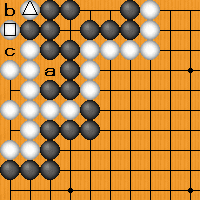
Here, is dead when considered separately (even though
  and the White stones as a whole are alive) and so point 'b' is dame:
白△は「死に石」白□は「活き石」である。したがって、bは「駄目」、cは目となる。
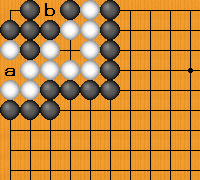
Here, the White and Black stones as a whole cannot be captured, but the single ko stones are dead and so points 'a' and 'b' are dame.
--------------------
I admit that the position is confusing. First, this position is not similar to any examples in the Japanese Rules because White's 17 stones are already alive and uncapturable and it is clear that the 3 Black stones are dead. There is nothing to "confirm" about the 17 White stones in L&D confirmation. Second, the positions in the Japanese Rules dealing with teire involve seki stones or dead stones on both sides (both situations without territory), not one side alive while the other is dead as is the case here.
Thinking about this more, I believe that the position is confusing because it is not actually a "proper" end-of-game position. I mean that additional moves would/should take place during actual game play. Specifically, Black would capture and force White to throw in, which would eventually result in White teire. So yes, White teire is required.
Backing up, the premise is that White is winning by half a point and that teire inside his territory would lose the game. So Black must force White teire. During the game (not so-called "hypothetical play"), Black would take the ko and cause White to throw in. If there is a Double Ko on the board, then White may not want to throw-in, play the Double Ko instead, and so this position may repeat and lead to No Result. After White throws in and black captures, White is winning. But White cannot just pass in this position because Black will capture the White stones. So, White must capture the ko back. White is still winning but White cannot pretend that this position is acceptable to pass because Black will just retake the ko and threaten capture the 5 White stones. White must play teire and lose a point.
Recap:
There's the question of whether White is alive, and whether the stones are seki, and the main question of whether White owes teire ('a', etc). No doubt the 3 Black stones are dead. And no doubt the 5 White stones can be captured but only if White gets to place stones such that the marked stone is no longer in ko (e.g., when there is a White stone at 'a').
Some people think that because the 3 Black stones are dead and the 22 White stones are alive, then then White is alive with territory and may take the 3 Black stones off the board.
Other people think that because the 5 White stones can be captured, that White owes teire. Otherwise the White stones will have dame and be seki without territory.
----------
My position:
I think that the 22 White stones are alive but that the 5 White stones are dead when considered separately. The intersection in the 5 White stones is dame, so those stones are seki stones, and the intersection of the 5 White stones is not territory. White owes teire.
Examples 24 and 25 show how stones are considered both as a whole and separately.
Here,
is dead when considered separately (even though and the White stones as a whole are alive) and so point 'b' is dame:白△は「死に石」白□は「活き石」である。したがって、bは「駄目」、cは目となる。
Here, the White and Black stones as a whole cannot be captured, but the single ko stones are dead and so points 'a' and 'b' are dame.
--------------------
I admit that the position is confusing. First, this position is not similar to any examples in the Japanese Rules because White's 17 stones are already alive and uncapturable and it is clear that the 3 Black stones are dead. There is nothing to "confirm" about the 17 White stones in L&D confirmation. Second, the positions in the Japanese Rules dealing with teire involve seki stones or dead stones on both sides (both situations without territory), not one side alive while the other is dead as is the case here.
Thinking about this more, I believe that the position is confusing because it is not actually a "proper" end-of-game position. I mean that additional moves would/should take place during actual game play. Specifically, Black would capture and force White to throw in, which would eventually result in White teire. So yes, White teire is required.
Backing up, the premise is that White is winning by half a point and that teire inside his territory would lose the game. So Black must force White teire. During the game (not so-called "hypothetical play"), Black would take the ko and cause White to throw in. If there is a Double Ko on the board, then White may not want to throw-in, play the Double Ko instead, and so this position may repeat and lead to No Result. After White throws in and black captures, White is winning. But White cannot just pass in this position because Black will capture the White stones. So, White must capture the ko back. White is still winning but White cannot pretend that this position is acceptable to pass because Black will just retake the ko and threaten capture the 5 White stones. White must play teire and lose a point.
-
Gérard TAILLE
- Gosei
- Posts: 1346
- Joined: Sun Aug 23, 2020 2:47 am
- Rank: 1d
- GD Posts: 0
- Has thanked: 21 times
- Been thanked: 57 times
Re: How do Japanese rules handle this?
I agree with you, white must play teire in your example.CDavis7M wrote:This board position is still kicking around and is being discussed at the OGS forums. The main question is whether White owes teire -- a move to solidify the position (e.g., at 'a'). Since this post is old I'll try to give a recap and present the positions, and explain my position. And then I'll explain what the real problem is -- this position is not a proper end-of-game board state. Black would take the ko, force White to throw in, and then force White teire. White teire is required.
Recap:
There's the question of whether White is alive, and whether the stones are seki, and the main question of whether White owes teire ('a', etc). No doubt the 3 Black stones are dead. And no doubt the 5 White stones can be captured but only if White gets to place stones such that the marked stone is no longer in ko (e.g., when there is a White stone at 'a').
Some people think that because the 3 Black stones are dead and the 22 White stones are alive, then then White is alive with territory and may take the 3 Black stones off the board.
Other people think that because the 5 White stones can be captured, that White owes teire. Otherwise the White stones will have dame and be seki without territory.
----------
My position:
I think that the 22 White stones are alive but that the 5 White stones are dead when considered separately. The intersection in the 5 White stones is dame, so those stones are seki stones, and the intersection of the 5 White stones is not territory. White owes teire.
Examples 24 and 25 show how stones are considered both as a whole and separately.
Here,
白△は「死に石」白□は「活き石」である。したがって、bは「駄目」、cは目となる。
Here, the White and Black stones as a whole cannot be captured, but the single ko stones are dead and so points 'a' and 'b' are dame.
--------------------
I admit that the position is confusing. First, this position is not similar to any examples in the Japanese Rules because White's 17 stones are already alive and uncapturable and it is clear that the 3 Black stones are dead. There is nothing to "confirm" about the 17 White stones in L&D confirmation. Second, the positions in the Japanese Rules dealing with teire involve seki stones or dead stones on both sides (both situations without territory), not one side alive while the other is dead as is the case here.
Thinking about this more, I believe that the position is confusing because it is not actually a "proper" end-of-game position. I mean that additional moves would/should take place during actual game play. Specifically, Black would capture and force White to throw in, which would eventually result in White teire. So yes, White teire is required.
Backing up, the premise is that White is winning by half a point and that teire inside his territory would lose the game. So Black must force White teire. During the game (not so-called "hypothetical play"), Black would take the ko and cause White to throw in. If there is a Double Ko on the board, then White may not want to throw-in, play the Double Ko instead, and so this position may repeat and lead to No Result. After White throws in and black captures, White is winning. But White cannot just pass in this position because Black will capture the White stones. So, White must capture the ko back. White is still winning but White cannot pretend that this position is acceptable to pass because Black will just retake the ko and threaten capture the 5 White stones. White must play teire and lose a point.
But what is your position for the following position, with the
added?-
CDavis7M
- Lives in sente
- Posts: 716
- Joined: Tue Jun 15, 2010 2:18 pm
- Rank: Shokyu
- GD Posts: 0
- Universal go server handle: CDavis7M
- Has thanked: 109 times
- Been thanked: 152 times
- Contact:
Re: How do Japanese rules handle this?
If the L&D status of the White stones were confirmed after the game is stopped: The 5 White stones are dead and their empty intersection is dame, not territory. This is because the L&D status of stones is considered as a whole and separately. As a whole with the other stones, 5 the White stones are alive. But separately, they are dead. The original 18 White stones (markedGérard TAILLE wrote:what is your position for the following position, with the
and  , I apologize for marking the wrong diagram but I can't be bothered to change it now) are easily deemed separately alive in the original position. The original 23 White stones as a whole can also be confirmed to be alive because they cannot be captured as a whole. It doesn't matter whether 5 stones can be captured and 2 new stones cannot be captured because 17 of the original stones (having 2 eyes) cannot be captured at all.
 The important thing to note is that the L&S status of the original 18 stones is not dependent on the L&D status of the 5 White stones -- the 18 stones are already deemed alive. There is nothing left to "confirm". My understanding is that new uncapturable stones
and only re-confirm the status of the 18 White stones separately and the 23 White stones as a whole, but say nothing about the separate L&D status of the 5 White stones.In situations where the L&D status is independent, I think that adding new uncapturable stones to already independently alive stones "confirms" nothing. Consider this example modified from the same diagram in the Japanese Rules:
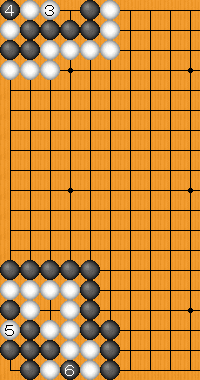
For example, if
 passes for the Double Ko (instead of passing for the Upper ko as in the actual Example) then some might think that
  also needs to pass for the Double Ko, causing a never-ending passes and retakes in the Double Ko without ever resolving the upper corner. However, consider if passes for the Double Ko and captures White in the upper corner. This lets
  retake the Double Ko leading to capture of Black in the lower corner. Even in this case, the fact that White was able to create new uncapturable stones in the lower left corner says NOTHING about the L&D status of the White stones in the upper left because the stones in the lower left were already deemed to be alive by virtue of the double ko.
I think the same reasoning applies here because the 17/18 White stones are already deemed to be alive and new uncapturable stones at
 and "confirm" nothing about the status of the 5 White stones when they are considered separately. "Confirmation" is determining the status of something unknown. There is nothing unknown about the status of the 18 stones. Therefore, the possibility of playing new stones and has no bearing on L&D "confirmation."
So the 5 White stones are dead and their empty intersection is dame, not territory.
----------
I am considering if Black tries to force White teire. At first I thought Black could, but now I see that Black cannot. If black takes the ko:
After White's throw-in, Black can retake the ko to threaten the 5 White stones, but because of
White can also retake a ko, so Black cannot capture. After the throw-in during the game, Black cannot capture the 5 White stones in L&D confirmation, but could have captured before the game-play throw-in. Black should not throw-in because otherwise White would have dame in L&D confirmation and lose territory.-
Harleqin

- Lives in sente
- Posts: 921
- Joined: Sat Mar 06, 2010 10:31 am
- Rank: German 2 dan
- GD Posts: 0
- Has thanked: 401 times
- Been thanked: 164 times
Re: How do Japanese rules handle this?
In the following:
If black captures at 'a', White will throw in at 'b', so that Black is dead in double ko. Black thus has no move here. On the other hand, White can capture at any time. So the black three stones are dead and all white stones alive. No stone needs to be added.
I think that this is not even a grey area, and that any ruleset or interpretation thereof that disagrees with this outcome is wrong.
If black captures at 'a', White will throw in at 'b', so that Black is dead in double ko. Black thus has no move here. On the other hand, White can capture at any time. So the black three stones are dead and all white stones alive. No stone needs to be added.
I think that this is not even a grey area, and that any ruleset or interpretation thereof that disagrees with this outcome is wrong.
A good system naturally covers all corner cases without further effort.
-
CDavis7M
- Lives in sente
- Posts: 716
- Joined: Tue Jun 15, 2010 2:18 pm
- Rank: Shokyu
- GD Posts: 0
- Universal go server handle: CDavis7M
- Has thanked: 109 times
- Been thanked: 152 times
- Contact:
Re: How do Japanese rules handle this?
This is why Black will not capture and induce White to throw-in. And I agree that no stones need to be added because adding a stone does not change the life and death status nor does it change the amount of territory.Harleqin wrote:In the following:
If black captures at 'a', White will throw in at 'b', so that Black is dead in double ko. Black thus has no move here. On the other hand, White can capture at any time. So the black three stones are dead and all white stones alive. No stone needs to be added.
However, the intersection with the 5 White stones is still dame, not territory. The premise of this discussion seems to be whether White must play teire and win by half a point. But actually, because there is dame, teire does not lose a point. The points are the same. It's just that White has one less point than they thought. White loses either way.
----------
Example 24:
Even if Black cannot actually capture
in the game and can always be replayed (double ko, etc.), and even if the 13 White stones including are living stones, when considered separately by itself is a dead stone and point 'b' is dame. Whereas is alive when considered separately. ----------
The 5 White stones are dead when considered separately.
Is this not consistent with how L&D status works in the Japanese Rules? Stones cannot rely on ko-threats to prove life. Here the ko threat is local, but still.
-
Harleqin
- Lives in sente
- Posts: 921
- Joined: Sat Mar 06, 2010 10:31 am
- Rank: German 2 dan
- GD Posts: 0
- Has thanked: 401 times
- Been thanked: 164 times
Re: How do Japanese rules handle this?
If the white stones are alive and the black stones dead, then there are no dame. There is no way for Black to capture the white stones, so they are alive. White can capture the black stones anytime, so they are dead. There are no dame.
A good system naturally covers all corner cases without further effort.
-
CDavis7M
- Lives in sente
- Posts: 716
- Joined: Tue Jun 15, 2010 2:18 pm
- Rank: Shokyu
- GD Posts: 0
- Universal go server handle: CDavis7M
- Has thanked: 109 times
- Been thanked: 152 times
- Contact:
Re: How do Japanese rules handle this?
I think some of the confusion comes from looking at the 5 stones first. I don't think this is how "Life & Death Confirmation" works. Considering the L&D status of the 5 stones by placing new uncapturable stones with an already independently living group is not "confirmation" affording to the definition of the word.
If you don't like dictionaries or diagrams, my main point is this: This position that can result in determining the L&D status of the 5 White stones is the same position that can result when determining the L&D status of the 1 White ko-stone. The 1 White ko-stone is alive because even though it can be captured it can create the two stones. This same position does not somehow also "confirm" the living status of the 5 White stones. There is no more uncertainty about this position and nothing left to "confirm." If the players consider the 5 White stones together with the 1 stone stone, then of course the 6 White stones are alive. But replaying the same sequence adds nothing to the players understanding of White's L&D status.
Because the 1 White stone is independently alive without the 5 White stones and without their capture or not, then the same position does not also prove that the 5 White stones are alive. Repeating the same analysis is not what "confirmation" (kakunin 確認) is.
-----------
第九条-2
対局の停止後、双方が石の死活及び地を確認し、合意することにより対局は終了する
According to Kenkuysha's J-E dictionary:
Kakunin 確認 n. confirmation; affirmation; certification; corroboration; validation.
Jisho.org gives: confirmation; verification; validation; review; check; affirmation; identification.
As for the English definitions of these words, the OED indicates that they all require some uncertainty or informality in a determination or declaration that is now being solidified, firmed, or formalized.
The players performing 死活確認 L&D Kakunin need to find all the L&D that is uncertain and solidify and formalize the status. They will of course start with the definition of 活き石 Living/Alive Stones: 相手方の着手により取られない石、又は取られても新たに相手方に取られない石を生じうる石は「活き石」という。So first, identify stones that cannot be captured and confirm their living status. Then identify stones that can be captured, but even though they can be captured, they can create new uncapturable stones. It seems many people prefer diagrams so here I go.
STEP 1
The players confirming White's L&D status look for White's stones that cannot be captured. The do not look for White's stones that can be captured yet. They can confirm that White's 17 stones cannot be captured. Not even if Black plays all of  because
  is an illegal move. Of course. This part is easy.
At this point of 死活確認, the 1 White ko-stone is not considered because it can be captured:
The 5 White stones in the corner are also not considered because they can be captured:
STEP 2
is an illegal move. Of course. This part is easy.
At this point of 死活確認, the 1 White ko-stone is not considered because it can be captured:
The 5 White stones in the corner are also not considered because they can be captured:
STEP 2
Now that the players have confirmed the uncapturable stones, they know that White's 17 stones are alive. But what about White's 1 ko-stone that can be captured? Is it alive? Can it create new uncapturable stones? Yes. is a new uncapturable stone that also makes
  uncapturable. Black does not bother with the 5 White stones because capturing them has nothing to do with whether the 1 stone can be captured and it also has nothing to do with whether the 1 capturable White stone can create a new uncapturable stone. Of course, Black also cannot just connect to ko, nor can Black play self-atari. Black captured the 1 White stone and White played and , which are then uncapturable. So the living status of the 1 White stone is confirmed.
The stones that are not part of the confirmation are half-shown. What if Black does try to capture the 5 White stones? White could throw-in or they could also play this way. Either way the 5 White stones are captured. But again, that has nothing to do with the 1 White stone which is the stone whose L&D status the players are confirming. RECAP
Let's just recap what the current agreement of the players is as to L&D status of the White stones. The 17 White stones are alive because they cannot be captured and the 1 White stone is alive because although it can be captured, it can create at least one new uncapturable stone.
STEP 3
The only remaining uncertainty is the L&D status of the 5 White stones . What is their status?
Here, Black proves that the 5 White stones are dead.
Wait, but what about this position? Don't the 2 new uncapturable stones confirm that the 5 White stones are alive?
No. This is the same position that was already considered when determining the L&D status of the 1 White stone. There is no more uncertainty about this position and nothing left to "confirm." If they players consider the 5 White stones together with the 1 stone stone then of course the 6 White stones are alive. But this adds nothing to their understanding of L&D status. The 5 White stones are still dead when considered separately.
The 5 dead White stones cannot be removed from the board because Black's 3 stones are dead.
Point is surrounded by dead stones of one player. It is not surrounded by living stones of one player. Therefore, it is not an eye 目, it is dame 駄目. Only 目, not 駄目, can be territory 地. So White does not count as territory.
If you don't like dictionaries or diagrams, my main point is this: This position that can result in determining the L&D status of the 5 White stones is the same position that can result when determining the L&D status of the 1 White ko-stone. The 1 White ko-stone is alive because even though it can be captured it can create the two
stones. This same position does not somehow also "confirm" the living status of the 5 White stones. There is no more uncertainty about this position and nothing left to "confirm." If the players consider the 5 White stones together with the 1 stone stone, then of course the 6 White stones are alive. But replaying the same sequence adds nothing to the players understanding of White's L&D status. Because the 1 White stone is independently alive without the 5 White stones and without their capture or not, then the same position does not also prove that the 5 White stones are alive. Repeating the same analysis is not what "confirmation" (kakunin 確認) is.
-----------
第九条-2
対局の停止後、双方が石の死活及び地を確認し、合意することにより対局は終了する
According to Kenkuysha's J-E dictionary:
Kakunin 確認 n. confirmation; affirmation; certification; corroboration; validation.
Jisho.org gives: confirmation; verification; validation; review; check; affirmation; identification.
As for the English definitions of these words, the OED indicates that they all require some uncertainty or informality in a determination or declaration that is now being solidified, firmed, or formalized.
The players performing 死活確認 L&D Kakunin need to find all the L&D that is uncertain and solidify and formalize the status. They will of course start with the definition of 活き石 Living/Alive Stones: 相手方の着手により取られない石、又は取られても新たに相手方に取られない石を生じうる石は「活き石」という。So first, identify stones that cannot be captured and confirm their living status. Then identify stones that can be captured, but even though they can be captured, they can create new uncapturable stones. It seems many people prefer diagrams so here I go.
STEP 1
The players confirming White's L&D status look for White's stones that cannot be captured. The do not look for White's stones that can be captured yet. They can confirm that White's 17
stones cannot be captured. Not even if Black plays all of because is an illegal move. Of course. This part is easy.
At this point of 死活確認, the 1 White ko-stone is not considered because it can be captured:
The 5 White stones in the corner are also not considered because they can be captured:
STEP 2Now that the players have confirmed the uncapturable stones, they know that White's 17 stones are alive. But what about White's 1 ko-stone that can be captured? Is it alive? Can it create new uncapturable stones? Yes.
is a new uncapturable stone that also makes uncapturable. Black does not bother with the 5 White stones because capturing them has nothing to do with whether the 1 stone can be captured and it also has nothing to do with whether the 1 capturable White stone can create a new uncapturable stone. Of course, Black also cannot just connect to ko, nor can Black play self-atari. Black captured the 1 White stone and White played and , which are then uncapturable. So the living status of the 1 White stone is confirmed. The stones that are not part of the confirmation are half-shown. What if Black does try to capture the 5 White stones? White could throw-in or they could also play this way. Either way the 5 White stones are captured. But again, that has nothing to do with the 1 White stone which is the stone whose L&D status the players are confirming. RECAP
Let's just recap what the current agreement of the players is as to L&D status of the White stones. The 17 White
stones are alive because they cannot be captured and the 1 White stone is alive because although it can be captured, it can create at least one new uncapturable stone.
STEP 3The only remaining uncertainty is the L&D status of the 5 White stones
. What is their status?
Here, Black proves that the 5 White stones are dead.
Wait, but what about this position? Don't the 2 new uncapturable stones confirm that the 5 White stones are alive?
No. This is the same position that was already considered when determining the L&D status of the 1 White stone. There is no more uncertainty about this position and nothing left to "confirm." If they players consider the 5 White stones together with the 1 stone stone then of course the 6 White stones are alive. But this adds nothing to their understanding of L&D status. The 5 White stones are still dead when considered separately. The 5 dead White stones cannot be removed from the board because Black's 3 stones are dead.
Point
is surrounded by dead stones of one player. It is not surrounded by living stones of one player. Therefore, it is not an eye 目, it is dame 駄目. Only 目, not 駄目, can be territory 地. So White does not count as territory.
Last edited by CDavis7M on Wed Dec 08, 2021 4:02 pm, edited 2 times in total.
-
CDavis7M
- Lives in sente
- Posts: 716
- Joined: Tue Jun 15, 2010 2:18 pm
- Rank: Shokyu
- GD Posts: 0
- Universal go server handle: CDavis7M
- Has thanked: 109 times
- Been thanked: 152 times
- Contact:
Re: How do Japanese rules handle this?
Black cannot capture the White stones during game-play but because Article 7-2 requires a pass before retaking a ko, the 5 White stones are capturable for purposes of Life and Death confirmation. Because the 5 White stones are capturable, they are dead because the only new uncapturable stones that can be played are stones that are only uncapturable by virtue of other stones that are independently alive and can already be deemed alive.Harleqin wrote:If the white stones are alive and the black stones dead, then there are no dame. There is no way for Black to capture the white stones, so they are alive. White can capture the black stones anytime, so they are dead. There are no dame.
As I explained above, the White stones with 2 eyes are uncapturable and the 1 White ko-stone, even though it is capturable, can create two (or three) new uncapturable stones. The 2 new uncapturable stones only prove the living status of the 1 White ko-stone. They cannot be used to prove that the 5 White stones are alive because playing those two (or three) stones only re-confirms that the 1 White ko-stone is already independently alive -- those 2 stones uncapturable stones can be played in L&D confirmation without the 5 White stones being captured at all. There is nothing being "confirmed" by doing that. Even believers of the so-called "enable" rule in one English translation should admit that it is not the capture of the 5 white stones that "enables" the 2 new uncapturable stones, it is only the capture of the 1 white ko-stone that "enables" the 2 new uncapturable stones.
It is the capture of the 1 White ko-stone that enables the 2 new uncapturable White stones
, not any capture of the 5 White stones because the 5 White stones do not have to be captured to be able to play the 2 new uncapturable stones . Only the 1 White ko-stone needs to be captured.A player cannot just add a stone to an already living group to pretend that other stones are alive. A player cannot just fill 1 point of would-be territory to pretend that a dead group is alive.
The 1 White stone is alive. The 6 White stones including the 1 White stone and the 5 White stones are alive. But the 5 White stones considered separately are dead. So the intersecting point between the 5 White stones is dame, not territory.
-
Gérard TAILLE
- Gosei
- Posts: 1346
- Joined: Sun Aug 23, 2020 2:47 am
- Rank: 1d
- GD Posts: 0
- Has thanked: 21 times
- Been thanked: 57 times
Re: How do Japanese rules handle this?
I try to understand your point but it is not that easy.CDavis7M wrote:I think some of the confusion comes from looking at the 5 stones first. I don't think this is how "Life & Death Confirmation" works. Considering the L&D status of the 5 stones by placing new uncapturable stones with an already independently living group is not "confirmation" affording to the definition of the word.
If you don't like dictionaries or diagrams, my main point is this: This position that can result in determining the L&D status of the 5 White stones is the same position that can result when determining the L&D status of the 1 White ko-stone. The 1 White ko-stone is alive because even though it can be captured it can create the two
Because the 1 White stone is independently alive without the 5 White stones and without their capture or not, then the same position does not also prove that the 5 White stones are alive. Repeating the same analysis is not what "confirmation" (kakunin 確認) is.
-----------
第九条-2
対局の停止後、双方が石の死活及び地を確認し、合意することにより対局は終了する
According to Kenkuysha's J-E dictionary:
Kakunin 確認 n. confirmation; affirmation; certification; corroboration; validation.
Jisho.org gives: confirmation; verification; validation; review; check; affirmation; identification.
As for the English definitions of these words, the OED indicates that they all require some uncertainty or informality in a determination or declaration that is now being solidified, firmed, or formalized.
The players performing 死活確認 L&D Kakunin need to find all the L&D that is uncertain and solidify and formalize the status. They will of course start with the definition of 活き石 Living/Alive Stones: 相手方の着手により取られない石、又は取られても新たに相手方に取られない石を生じうる石は「活き石」という。So first, identify stones that cannot be captured and confirm their living status. Then identify stones that can be captured, but even though they can be captured, they can create new uncapturable stones. It seems many people prefer diagrams so here I go.
STEP 1
The players confirming White's L&D status look for White's stones that cannot be captured. The do not look for White's stones that can be captured yet. They can confirm that White's 17
Now that the players have confirmed the uncapturable stones, they know that White's 17 stones are alive. But what about White's 1 ko-stone that can be captured? Is it alive? Can it create new uncapturable stones?
After step 1 you identified 17 stones uncapturable and two other capturable groups of stones. One group with only one stone and another group with 5 stones.
You begin step 2 by looking at the status of the group with only 1 stone. My question is the following : what is your analyse if you begin step 2 by looking first at the status of the group with 5 stones?
-
Harleqin
- Lives in sente
- Posts: 921
- Joined: Sat Mar 06, 2010 10:31 am
- Rank: German 2 dan
- GD Posts: 0
- Has thanked: 401 times
- Been thanked: 164 times
Re: How do Japanese rules handle this?
In my view it is quite simple: if that is the result of your interpretation of the japanese rules, then either the interpretation or the rules are wrong.
A good system naturally covers all corner cases without further effort.
-
Gérard TAILLE
- Gosei
- Posts: 1346
- Joined: Sun Aug 23, 2020 2:47 am
- Rank: 1d
- GD Posts: 0
- Has thanked: 21 times
- Been thanked: 57 times
Re: How do Japanese rules handle this?
I agree with you Harleqin, in this position I do not want white to add a move.Harleqin wrote:In my view it is quite simple: if that is the result of your interpretation of the japanese rules, then either the interpretation or the rules are wrong.
We all know that articles 7.1 and 7.2 are difficult to interpret correctly and they even seem in contradiction with the examples shown in the rule, especialy in case of double ko.
One of the main problem is the meaning of "capturable". This word appears in article 7.1 while the pass-for-ko rule appears only in article 7.2. As a consequence it is not clear if the status "capturable" has to be analysed with or without the pass-for-ko rule.
In my view if a group of stones cannot de captured in "normal" play then I consider it is alive, even if this group is capturable by using the pass-for-ko rule.
IOW I use the pass-for-ko rule only for analysing more deeply a group of capturable stones.
In the example above the groupe of 5 white stones is not capturable in "normal" play but capturable with the pass-for-ko rule. Here is the issue.