Then we are talking about different traditions. I'm talking about the one adopted later by amateurs
Well, I find it spooky to talk about something that happened in my lifetime (and yours) as a tradition, especially in a field that is already very ancient. There is something similar perhaps going in the antiques field. We have tv programmes here in which experts bemoan the trend to class objects 50 (or even 25) years old as antiques, instead of using the 100-year criterion that has long been used in their field. By that modern trend both you and I would be classed as antiques. I don't feel like one, and I very strongly suspect you don't either (maybe for simplification we'll leave getting out of bed in the morning out of it

)
But that was just scene setting. My main focus was
50 years ago most amateurs did not know that that was the wrong handicap
That would have been around the time I started go. Early on then, I came across the German system of counting grades with simple numbers, 1 down to whatever, splitting each Japanese grade in two and making no distinction between dan and kyu. I think 1-dan was 18/19 from memory.
Japanese visitors found this (and other novelties) very peculiar and would write articles in Kido and so on, describing western practices in the style of "dogs there can walk on their hindlegs." The thought police hadn't reached there yet. But even so they were a bit misguided, because they didn't take enough account of the fact that we had relatively few opponents, and so had to play lots of handicap games. They also overlooked the fact that we had few ways of getting a reliable rating, and in particular few ways of changing a rating quickly. The German system, sporadically adopted elsewhere, was an attempt to provide a workable ratings framework for Europe.
It didn't really work - for several reasons, I suppose. It was a creature of mathematicians, and not all go players were mathematicians. Most other players seemed in thrall to the Japanese system and just mimicked it, without properly realising it was not fit for purpose here perhaps, or, much more likely, if they did realise, they didn't care - "we are just weak amateurs, really" (and we
really were then!) and "it's a storm in a teacup." I certainly was in the latter don't-care camp.
Yet I believe most of us - even someone as bored by decimal points as me - still registered what the mathematicians were saying: that Black as a one-stone handicap is skewgee, and,
in addition, that the rest of the Japanese handicap scale wasn't anywhere near linear. There was even a translated book - wasn't there? - in which Ishida Yoshio played other pros at all the various handicaps, and showed the lack of linearity. We knew we were surrounded by imperfections.
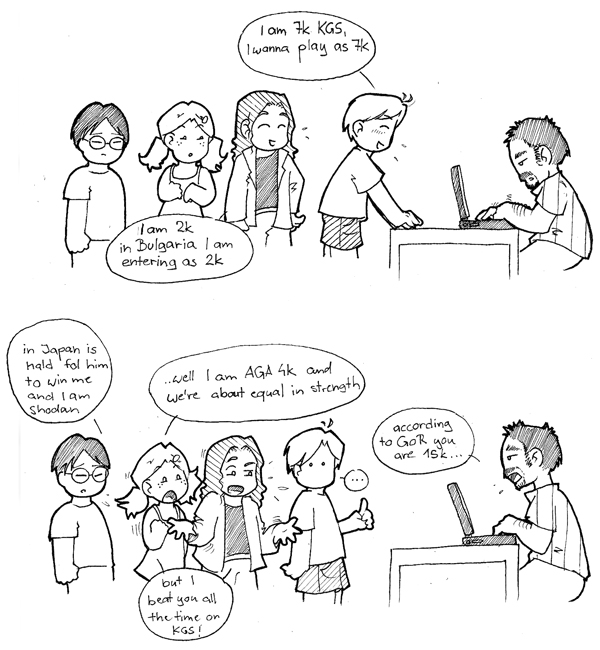
So, my contention is that "50 years ago most amateurs did not know that that was the wrong handicap" should have read "50 years ago most amateurs did not CARE that that was the wrong handicap."
I would also go further and say that is even more the case nowadays, since we can now find opponents easily and don't need to rely on a handicap system to get a rating.
That might not seem to marry with the representation of the go world currently given by L19, but I still do believe most go players in the real world are still not mathematicians and computer scientists.


 .
. .
.