How evaluate double sente moves ?

Talk about improving your game, resources you like, games you played, etc.
Gérard TAILLE
Gosei
Posts: 1346
Joined: Sun Aug 23, 2020 2:47 am
Rank: 1d
GD Posts: 0
Has thanked: 21 times
Been thanked: 57 times

Re: How evaluate double sente moves ?

Post by Gérard TAILLE »

Bill Spight wrote: Well, double sente has been controversial for at least 45 years.
Oops I am not aware of these 45 years of controversial discussion.
Maybe there is some misunderstandig on this point. Taking a real game with several subgames, my view is that subgames like the one I called "double blabla" may add some uncertainty on the result of the game. Because of that calculating acurate values for gote subgames might look irrelevant. To avoid that I would have liked to extract such positions from the set of gote but I see you do not like the idea. Considering all these positions as gote I fear that it will be more difficult for the theory to give reliable results.

Let's concentrate essentially on gote.

Can you make the same exercice and define without any ambiguity what is gote, sente or maybe unknown position as I did.

I said:
So let's call gote an area {x|y} with x > y. It is a defintion and nothing else.

Gote points have very important caracteristics: they are comparable, the evaluation (x+y)/2 allows us to tell wich gote is the best one and you can proof that by playing the gote in the order given by this evaluation you are always correct.
and you even add {x|y} + {x|y} = x + y which is nice result

What caracteristics remains with your gote defintion? Or, if you prefer, how do you reformulate such caracteristics with you gote definition?

Surely, without an unambiguous gote definition the discussion could not be very usefull.

I know my definion of gote is quite narrow but be sure I am I advance ready to take yours providing it is unambiguous Bill.
Bill Spight
Honinbo
Posts: 10905
Joined: Wed Apr 21, 2010 1:24 pm
Has thanked: 3651 times
Been thanked: 3373 times

Re: How evaluate double sente moves ?

Post by Bill Spight »

Gérard TAILLE wrote:
Bill Spight wrote: Well, double sente has been controversial for at least 45 years.
Oops I am not aware of these 45 years of controversial discussion.
Kano's Yose Jiten came out in 1974. Kano defines double sente as a place where whoever plays first, Black or White, can play with sente. In the discussion of his very first example, he recognizes that one player may be much more likely to not reply than the other. Instead of admitting that in that case the position is really a sente for the other player, he introduces a new term, hitsuzensei, meaning certainty or necessity. See previous discussion here: https://www.lifein19x19.com/viewtopic.p ... 67#p178067

The Endgame by Ogawa and Davies came out in 1976. Davies' observation about dividing the so-called double sente value by 0 tolled the mathematical death-knell for double sente, but few go pros are mathematicians.
Maybe there is some misunderstandig on this point. Taking a real game with several subgames, my view is that subgames like the one I called "double blabla" may add some uncertainty on the result of the game. Because of that calculating acurate values for gote subgames might look irrelevant. To avoid that I would have liked to extract such positions from the set of gote but I see you do not like the idea. Considering all these positions as gote I fear that it will be more difficult for the theory to give reliable results.
Remember that a gote position may be played with sente, given the global situation. Which number is more likely to get the average non-mathematical player's attention, a "2 point double sente" or a "20 point gote"? ;)
Let's concentrate essentially on gote.

Can you make the same exercice and define without any ambiguity what is gote, sente or maybe unknown position as I did.
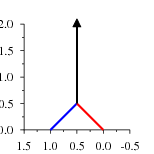
Here is a prototypical gote thermograph. (BTW, humans reason pretty well with prototypes. :))
gote 1-2.png
gote 1-2.png (2.37 KiB) Viewed 16667 times
The left and right walls are each inclined, which indicates a play or sequence of plays made with gote for each player playing first. Where they meet the black mast rises vertically, indicating that neither player will play in that game above that temperature (tax). This is how a gote thermograph looks where the left and right walls meet, whatever it may look like below that temperature.

Some thermographs for kos look similar, but the angles of the walls are different. As you know, ko thermographs can look strange. ;)

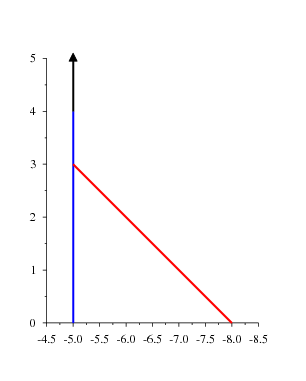
Here is a prototypical sente thermograph.
sente 3 pt.png
sente 3 pt.png (4.07 KiB) Viewed 16667 times
The left wall of the thermograph is vertical, which indicates a sequence of plays with an even number of plays by each player, starting in this case with a Black play and ending with a White play. I.e., Black played with sente. The right wall is inclined, indicating that White played with gote. Above where the walls meet the left wall rises vertically as the mast before the mast becomes black. The blue mast indicates the privilege of Black to play first with sente in that temperature range. This is how a Black sente thermograph looks where the walls meet, no matter how it looks below that temperature. A White sente thermograph, OC, has a vertical right wall and an inclined left wall.

The thermograph of a gote has a black mast, below which each wall is inclined.

The thermograph of a sente has a blue or red mast where the walls meet, depending upon whose sente it is, below which the wall of that color descends vertically while the other wall is inclined.

There are non-ko positions that are ambiguous between sente and gote, with different thermographs. We have already seen one where the mast is blue where the walls meet, but the blue wall is inclined below that while the red wall is vertical! :o
The Adkins Principle:
At some point, doesn't thinking have to go on?
— Winona Adkins

Visualize whirled peas.

Everything with love. Stay safe.
Gérard TAILLE
Gosei
Posts: 1346
Joined: Sun Aug 23, 2020 2:47 am
Rank: 1d
GD Posts: 0
Has thanked: 21 times
Been thanked: 57 times

Re: How evaluate double sente moves ?

Post by Gérard TAILLE »

Bill Spight wrote: Here is a prototypical gote thermograph. (BTW, humans reason pretty well with prototypes. :))
gote 1-2.png
The left and right walls are each inclined, which indicates a play or sequence of plays made with gote for each player playing first. Where they meet the black mast rises vertically, indicating that neither player will play in that game above that temperature (tax). This is how a gote thermograph looks where the left and right walls meet, whatever it may look like below that temperature.
OK Bill, in order to know if a area is gote I only have to look where right and left wall meets. If they meet with two inclined line it a a gote. Fine and let's proceed.

Now consider G1, G2, G3 ... gote areas with mean values (I mean the temperature where left and right wall meet) g1 >= g2 >= g3 ...
What theory tell us to help finding the best move to play?
Is it correct to say: the best play is probably a play in game G1 but, unfortunetly, be aware it is not sure at 100%.
Bill Spight
Honinbo
Posts: 10905
Joined: Wed Apr 21, 2010 1:24 pm
Has thanked: 3651 times
Been thanked: 3373 times

Re: How evaluate double sente moves ?

Post by Bill Spight »

Gérard TAILLE wrote:
Bill Spight wrote: Here is a prototypical gote thermograph. (BTW, humans reason pretty well with prototypes. :))
gote 1-2.png
The left and right walls are each inclined, which indicates a play or sequence of plays made with gote for each player playing first. Where they meet the black mast rises vertically, indicating that neither player will play in that game above that temperature (tax). This is how a gote thermograph looks where the left and right walls meet, whatever it may look like below that temperature.
OK Bill, in order to know if a area is gote I only have to look where right and left wall meets. If they meet with two inclined line it a a gote. Fine and let's proceed.

Now consider G1, G2, G3 ... gote areas with mean values (I mean the temperature where left and right wall meet) g1 >= g2 >= g3 ...
What theory tell us to help finding the best move to play?
Is it correct to say: the best play is probably a play in game G1 but, unfortunetly, be aware it is not sure at 100%.
Tax all the positions with the same amount and find the minimax results of play at that temperature. If the local temperature of G1 is greater than that of G2, then we know for a certainty that between temperatures G2 and G1 orthodox play (best play) is in G1. We can figure out the thermograph of the combined play. We are looking for best play at temperature 0, I assume.

Heuristically, OC, initial play in G1 is likely to be correct. That's why go players developed traditional go theory centuries ago. :) And that's why we usually start reading with the largest play. We also know that if all the gote are simple gote, best play is in G1. Other heuristics and theorems exist. :) For instance, in example 1) above, it was obvious that Black could make the first play with sente.

Edit: One heuristic, of which I know you are aware, is that of getting the last play before a significant temperature drop. :)

BTW, the go theory term for the temperature at which the walls meet is miai value, which is how much the gote move or reverse sente move indicated by the wall there gains.
The Adkins Principle:
At some point, doesn't thinking have to go on?
— Winona Adkins

Visualize whirled peas.

Everything with love. Stay safe.
Bill Spight
Honinbo
Posts: 10905
Joined: Wed Apr 21, 2010 1:24 pm
Has thanked: 3651 times
Been thanked: 3373 times

Re: How evaluate double sente moves ?

Post by Bill Spight »

One of those theorems is whether Black should prefer to play in

G = {g|0} or in D = {b|n||0|-w}, where b > n > 0, w > 0, and g > 0 and b, g, n, and w are all numbers.

Black should prefer to play in D
if b-n ≥ g or (b ≥ g and n+w ≥ g),
and Black should prefer to play in G
if g ≥ n+w and g ≥ b,
with the ko fight caveat.

Note that the "double sente value", n, is not relevant.

Edit for correctness.
Last edited by Bill Spight on Sat Oct 24, 2020 3:09 pm, edited 2 times in total.
The Adkins Principle:
At some point, doesn't thinking have to go on?
— Winona Adkins

Visualize whirled peas.

Everything with love. Stay safe.
Gérard TAILLE
Gosei
Posts: 1346
Joined: Sun Aug 23, 2020 2:47 am
Rank: 1d
GD Posts: 0
Has thanked: 21 times
Been thanked: 57 times

Re: How evaluate double sente moves ?

Post by Gérard TAILLE »

Bill Spight wrote:
Gérard TAILLE wrote:
Bill Spight wrote: Here is a prototypical gote thermograph. (BTW, humans reason pretty well with prototypes. :))
gote 1-2.png
The left and right walls are each inclined, which indicates a play or sequence of plays made with gote for each player playing first. Where they meet the black mast rises vertically, indicating that neither player will play in that game above that temperature (tax). This is how a gote thermograph looks where the left and right walls meet, whatever it may look like below that temperature.
OK Bill, in order to know if a area is gote I only have to look where right and left wall meets. If they meet with two inclined line it a a gote. Fine and let's proceed.

Now consider G1, G2, G3 ... gote areas with mean values (I mean the temperature where left and right wall meet) g1 >= g2 >= g3 ...
What theory tell us to help finding the best move to play?
Is it correct to say: the best play is probably a play in game G1 but, unfortunetly, be aware it is not sure at 100%.
Tax all the positions with the same amount and find the minimax results of play at that temperature. If the local temperature of G1 is greater than that of G2, then we know for a certainty that between temperatures G2 and G1 orthodox play (best play) is in G1. We can figure out the thermograph of the combined play. We are looking for best play at temperature 0, I assume.
Let's take G1 = {8|5||0} and G2 = {6|0}
G1 et G2 are incomparable and g1=3¼ g2=3
I assume each G3,G4,.. not too complex (I mean only of the forms {x|y} or {x|y||z} or {x||y|z} and the majority of them of the form {x|y})

Without having any knowledge of CGT theory I have to read all the game (not so easy is it?) in order to find the best move (in G1 or G2 if not in G3 or ...).

Now the question is : how CGT knowledge can help me?
Bill Spight wrote:Tax all the positions with the same amount
I assume I have to consider temperature between 3 and 3¼ ?
Bill Spight wrote:find the minimax results of play at that temperature
What doaes that mean? If I have to read all the game G1 + G2 + G3 ... to find the result of the game, I fear I will gain nothing in the process.
Bill Spight wrote:If the local temperature of G1 is greater than that of G2, then we know for a certainty that between temperatures G2 and G1 orthodox play (best play) is in G1
I already calculated the miai values 3 and 3¼ for G1 and G2. What do you suggest here?

Obviously I must have missed something because, for the time being, I don't see clearly what CGT knowledge brings me in the process to find the best move.
Bill Spight
Honinbo
Posts: 10905
Joined: Wed Apr 21, 2010 1:24 pm
Has thanked: 3651 times
Been thanked: 3373 times

Re: How evaluate double sente moves ?

Post by Bill Spight »

Gérard TAILLE wrote:Let's take G1 = {8|5||0} and G2 = {6|0}
G1 et G2 are incomparable and g1=3¼ g2=3
I assume each G3,G4,.. not too complex (I mean only of the forms {x|y} or {x|y||z} or {x||y|z} and the majority of them of the form {x|y})

{snip}

I already calculated the miai values 3 and 3¼ for G1 and G2. What do you suggest here?

Obviously I must have missed something because, for the time being, I don't see clearly what CGT knowledge brings me in the process to find the best move.
Since you are vague about G3 and other positions, let us take them as the environment for G1 and G2. All we need to know now is the miai value or estimated miai value of G3. Let's call it t, with t < 1½, since we know {8|5} and assume that it is relevant, and we also let the mean value of the environment be 0, for convenience. If {8|5} is not relevant, then we can replace it with its mean value, 6½.

At temperature t < 1½ the left wall of the thermograph is max(0+8-t,6-0) = 8-t. And the right wall is min(0+6,0+5+t) = min(6,5+t). When t < 1 it is 5+t, when 1 ≤ t < 1½ it is 6.

So, given what we know, when t < 1½ Black plays in G1. When 1 ≤ t < 1½ White also plays in G1, but when t < 1 White plays in G2.
The Adkins Principle:
At some point, doesn't thinking have to go on?
— Winona Adkins

Visualize whirled peas.

Everything with love. Stay safe.
Gérard TAILLE
Gosei
Posts: 1346
Joined: Sun Aug 23, 2020 2:47 am
Rank: 1d
GD Posts: 0
Has thanked: 21 times
Been thanked: 57 times

Re: How evaluate double sente moves ?

Post by Gérard TAILLE »

Bill Spight wrote:
Gérard TAILLE wrote:Let's take G1 = {8|5||0} and G2 = {6|0}
G1 et G2 are incomparable and g1=3¼ g2=3
I assume each G3,G4,.. not too complex (I mean only of the forms {x|y} or {x|y||z} or {x||y|z} and the majority of them of the form {x|y})

{snip}

I already calculated the miai values 3 and 3¼ for G1 and G2. What do you suggest here?

Obviously I must have missed something because, for the time being, I don't see clearly what CGT knowledge brings me in the process to find the best move.
Since you are vague about G3 and other positions, let us take them as the environment for G1 and G2. All we need to know now is the miai value or estimated miai value of G3. Let's call it t, with t < 1½, since we know {8|5} and assume that it is relevant, and we also let the mean value of the environment be 0, for convenience. If {8|5} is not relevant, then we can replace it with its mean value, 6½.

At temperature t < 1½ the left wall of the thermograph is max(0+8-t,6-0) = 8-t. And the right wall is min(0+6,0+5+t) = min(6,5+t). When t < 1 it is 5+t, when 1 ≤ t < 1½ it is 6.

So, given what we know, when t < 1½ Black plays in G1. When 1 ≤ t < 1½ White also plays in G1, but when t < 1 White plays in G2.
Two points Bill
1) I was assuming the miai values g1 ≥ g2 ≥ g3 were droping not too fast => g3 should be say between 2 and 3
2) My question concerns the best move. I know that an heuristic choice is quite perfect with CGT theory but I do not know if CGT theory can help me finding the real best move (OC assuming you know all the environment). If in the process you assume somewhere an ideal environment then you will only have en heuristic choice won't you?
Bill Spight
Honinbo
Posts: 10905
Joined: Wed Apr 21, 2010 1:24 pm
Has thanked: 3651 times
Been thanked: 3373 times

Re: How evaluate double sente moves ?

Post by Bill Spight »

Gérard TAILLE wrote:
Bill Spight wrote:
Gérard TAILLE wrote:Let's take G1 = {8|5||0} and G2 = {6|0}
G1 et G2 are incomparable and g1=3¼ g2=3
I assume each G3,G4,.. not too complex (I mean only of the forms {x|y} or {x|y||z} or {x||y|z} and the majority of them of the form {x|y})

{snip}

I already calculated the miai values 3 and 3¼ for G1 and G2. What do you suggest here?

Obviously I must have missed something because, for the time being, I don't see clearly what CGT knowledge brings me in the process to find the best move.
Since you are vague about G3 and other positions, let us take them as the environment for G1 and G2. All we need to know now is the miai value or estimated miai value of G3. Let's call it t, with t < 1½, since we know {8|5} and assume that it is relevant, and we also let the mean value of the environment be 0, for convenience. If {8|5} is not relevant, then we can replace it with its mean value, 6½.

At temperature t < 1½ the left wall of the thermograph is max(0+8-t,6-0) = 8-t. And the right wall is min(0+6,0+5+t) = min(6,5+t). When t < 1 it is 5+t, when 1 ≤ t < 1½ it is 6.

So, given what we know, when t < 1½ Black plays in G1. When 1 ≤ t < 1½ White also plays in G1, but when t < 1 White plays in G2.
Two points Bill
1) I was assuming the miai values g1 ≥ g2 ≥ g3 were dropping not too fast => g3 should be say between 2 and 3
2) My question concerns the best move. I know that an heuristic choice is quite perfect with CGT theory but I do not know if CGT theory can help me finding the real best move (OC assuming you know all the environment). If in the process you assume somewhere an ideal environment then you will only have en heuristic choice won't you?
If you don't want to be vague, let t = 0. But anyway, heuristics can help guide reading.

If you want 2 ≤ t < 3, then replace {8|5} with 6½ and play G1. If you are not more specific, what can be said about best play?
The Adkins Principle:
At some point, doesn't thinking have to go on?
— Winona Adkins

Visualize whirled peas.

Everything with love. Stay safe.
Gérard TAILLE
Gosei
Posts: 1346
Joined: Sun Aug 23, 2020 2:47 am
Rank: 1d
GD Posts: 0
Has thanked: 21 times
Been thanked: 57 times

Re: How evaluate double sente moves ?

Post by Gérard TAILLE »

Bill Spight wrote: If you don't want to be vague, let t = 0. But anyway, heuristics can help guide reading.

If you want 2 ≤ t < 3, then replace {8|5} with 6½ and play G1. If you are not more specific, what can be said about best play?
OK Bill let's simplify the problem and formulate it in a different way.

Let's take G1 = {8|5||0} and G2 = {6|0}
and let's assume G3,G4,.. only of the forms {x|y} (I mean only simple gote) with g1 ≥ g2 ≥ g3 ≥ g4 ...
In addition let's suppose the game black to play G1 + G2 + G3 + G4 + ... is quite close and let's suppose that the god play allows black to win the game.
Question : what is the best way to proceed in order to be sure at 100% to choose as a first black move a winning move?
Bill Spight
Honinbo
Posts: 10905
Joined: Wed Apr 21, 2010 1:24 pm
Has thanked: 3651 times
Been thanked: 3373 times

Re: How evaluate double sente moves ?

Post by Bill Spight »

Gérard TAILLE wrote:
Bill Spight wrote: If you don't want to be vague, let t = 0. But anyway, heuristics can help guide reading.

If you want 2 ≤ t < 3, then replace {8|5} with 6½ and play G1. If you are not more specific, what can be said about best play?
OK Bill let's simplify the problem and formulate it in a different way.

Let's take G1 = {8|5||0} and G2 = {6|0}
and let's assume G3,G4,.. only of the forms {x|y} (I mean only simple gote) with g1 ≥ g2 ≥ g3 ≥ g4 ...
In addition let's suppose the game black to play G1 + G2 + G3 + G4 + ... is quite close and let's suppose that the god play allows black to win the game.
Question : what is the best way to proceed in order to be sure at 100% to choose as a first black move a winning move?
OK. Without loss of generality, let Gi = {gi|-gi}. Let gi' = gi - g(i+1) + g(i+2) - ....

I. g3 ≤ 1½
A. Black to play
1. G1 first: Score1 = 6½ - 0 + 1½ - g3' = 8 - g3'
2. G2 first: Score2 = 6 - 0 + g3' = 6 + g3'
Diff = Score1 - Score2 = 2 - 2g3'
-1 ≤ Diff ≤ 2
B. White to play
1. G1 first: Score2 = 0 + 6 - g3' = 6 - g3'
1. G2 first: Score1 = 0 + 6½ - 1½ + g3' = 5 + g3'
Diff = Score2 - Score1 = -1 + 2g3' ; Both players try to maximize Diff
-1 ≤ Diff ≤ 2
II. g4 ≤ 1½ ≤ g3 ≤ 3
A. Black to play
1. G1 first: Score1 = 6½ - 0 + g3 - 1½ + g4' = 5 + g3 + g4'
2. G2 first: Score2 = 6 - 0 + g3 - g4' = 6 + g3 + g4'
Diff = -1 + 2g4'
-1 ≤ Diff ≤ 2
B. White to play
1. G1 first: Score1 = 0 + 6 - g3 + g4' = 6 - g3 + g4'
2. G2 first: Score2 = 0 + 6½ - g3 + 1½ - g4' = 8 - g3 - g4'
Diff = 2 - 2g4'
-1 ≤ Diff ≤ 2
III. g5 ≤ 1½ ≤ g4 ≤ g3 ≤ 3
A. Black first
1. G1 first: Score1 = 6½ + g3 - g4 + 1½ - g5' = 8 + g3 - g4 - g5'
2. G2 first: Score2 = 6 + g3 - g4 + g5'
Diff = 2 - 2g5'
B. White first
1. G1 first: Score1 = 6 - g3 + g4 - g5'
2. G2 first: Score1 = 5 - g3 + g4 + g5'
Diff = -1 + 2g5'
IV. g6 ≤ 1½ ≤ g5 ≤ g4 ≤ g3 ≤ 3
A. Black first
Diff = -1 + 2g6'
B. White first
Diff = 2 - 2g6'

Interesting pattern. :)

When g(2n+1) ≤ 1½ ≤ g(2n), Black to play plays in G1 when 2 ≥ 2g(2n+1)', and White to play plays in G1 when 2g(2n+1)' ≥ 1.

When g(2n) ≤ 1½ ≤ g(2n-1), Black to play plays in G1 when 2g(2n)' ≥ 1, and White to play plays in G1 when 2 ≥ 2g(2n)'.

I expect that you already knew that. :) It is part of CGT, but not thermography.
The Adkins Principle:
At some point, doesn't thinking have to go on?
— Winona Adkins

Visualize whirled peas.

Everything with love. Stay safe.
Gérard TAILLE
Gosei
Posts: 1346
Joined: Sun Aug 23, 2020 2:47 am
Rank: 1d
GD Posts: 0
Has thanked: 21 times
Been thanked: 57 times

Re: How evaluate double sente moves ?

Post by Gérard TAILLE »

Bill Spight wrote:
Gérard TAILLE wrote:
Bill Spight wrote: If you don't want to be vague, let t = 0. But anyway, heuristics can help guide reading.

If you want 2 ≤ t < 3, then replace {8|5} with 6½ and play G1. If you are not more specific, what can be said about best play?
OK Bill let's simplify the problem and formulate it in a different way.

Let's take G1 = {8|5||0} and G2 = {6|0}
and let's assume G3,G4,.. only of the forms {x|y} (I mean only simple gote) with g1 ≥ g2 ≥ g3 ≥ g4 ...
In addition let's suppose the game black to play G1 + G2 + G3 + G4 + ... is quite close and let's suppose that the god play allows black to win the game.
Question : what is the best way to proceed in order to be sure at 100% to choose as a first black move a winning move?
OK. Without loss of generality, let Gi = {gi|-gi}. Let gi' = gi - g(i+1) + g(i+2) - ....

I. g3 ≤ 1½
A. Black to play
1. G1 first: Score1 = 6½ - 0 + 1½ - g3' = 8 - g3'
2. G2 first: Score2 = 6 - 0 + g3' = 6 + g3'
Diff = Score1 - Score2 = 2 - 2g3'
-1 ≤ Diff ≤ 2
B. White to play
1. G1 first: Score2 = 0 + 6 - g3' = 6 - g3'
1. G2 first: Score1 = 0 + 6½ - 1½ + g3' = 5 + g3'
Diff = Score2 - Score1 = -1 + 2g3' ; Both players try to maximize Diff
-1 ≤ Diff ≤ 2
II. g4 ≤ 1½ ≤ g3 ≤ 3
A. Black to play
1. G1 first: Score1 = 6½ - 0 + g3 - 1½ + g4' = 5 + g3 + g4'
2. G2 first: Score2 = 6 - 0 + g3 - g4' = 6 + g3 + g4'
Diff = -1 + 2g4'
-1 ≤ Diff ≤ 2
B. White to play
1. G1 first: Score1 = 0 + 6 - g3 + g4' = 6 - g3 + g4'
2. G2 first: Score2 = 0 + 6½ - g3 + 1½ - g4' = 8 - g3 - g4'
Diff = 2 - 2g4'
-1 ≤ Diff ≤ 2
III. g5 ≤ 1½ ≤ g4 ≤ g3 ≤ 3
A. Black first
1. G1 first: Score1 = 6½ + g3 - g4 + 1½ - g5' = 8 + g3 - g4 - g5'
2. G2 first: Score2 = 6 + g3 - g4 + g5'
Diff = 2 - 2g5'
B. White first
1. G1 first: Score1 = 6 - g3 + g4 - g5'
2. G2 first: Score1 = 5 - g3 + g4 + g5'
Diff = -1 + 2g5'
IV. g6 ≤ 1½ ≤ g5 ≤ g4 ≤ g3 ≤ 3
A. Black first
Diff = -1 + 2g6'
B. White first
Diff = 2 - 2g6'

Interesting pattern. :)

When g(2n+1) ≤ 1½ ≤ g(2n), Black to play plays in G1 when 2 ≥ 2g(2n+1)', and White to play plays in G1 when 2g(2n+1)' ≥ 1.

When g(2n) ≤ 1½ ≤ g(2n-1), Black to play plays in G1 when 2g(2n)' ≥ 1, and White to play plays in G1 when 2 ≥ 2g(2n)'.

I expect that you already knew that. :) It is part of CGT, but not thermography.
Oops maybe you missed the point. The problem was not to find the best move but only to find a winning move!
My own result is far simplier:
if the score 6 + g3' allows me to win the game then my first play will be in G2 otherwise I will play in G1.
Could you verify if I am wrong?
Bill Spight
Honinbo
Posts: 10905
Joined: Wed Apr 21, 2010 1:24 pm
Has thanked: 3651 times
Been thanked: 3373 times

Re: How evaluate double sente moves ?

Post by Bill Spight »

Bill Spight wrote: If you don't want to be vague, let t = 0. But anyway, heuristics can help guide reading.

If you want 2 ≤ t < 3, then replace {8|5} with 6½ and play G1. If you are not more specific, what can be said about best play?
Gérard TAILLE wrote:
Bill Spight wrote:
Gérard TAILLE wrote:
OK Bill let's simplify the problem and formulate it in a different way.

Let's take G1 = {8|5||0} and G2 = {6|0}
and let's assume G3,G4,.. only of the forms {x|y} (I mean only simple gote) with g1 ≥ g2 ≥ g3 ≥ g4 ...
In addition let's suppose the game black to play G1 + G2 + G3 + G4 + ... is quite close and let's suppose that the god play allows black to win the game.
Question : what is the best way to proceed in order to be sure at 100% to choose as a first black move a winning move?
OK. Without loss of generality, let Gi = {gi|-gi}. Let gi' = gi - g(i+1) + g(i+2) - ....

I. g3 ≤ 1½
A. Black to play
1. G1 first: Score1 = 6½ - 0 + 1½ - g3' = 8 - g3'
2. G2 first: Score2 = 6 - 0 + g3' = 6 + g3'
Diff = Score1 - Score2 = 2 - 2g3'
-1 ≤ Diff ≤ 2
B. White to play
1. G1 first: Score2 = 0 + 6 - g3' = 6 - g3'
1. G2 first: Score1 = 0 + 6½ - 1½ + g3' = 5 + g3'
Diff = Score2 - Score1 = -1 + 2g3' ; Both players try to maximize Diff
-1 ≤ Diff ≤ 2
II. g4 ≤ 1½ ≤ g3 ≤ 3
A. Black to play
1. G1 first: Score1 = 6½ - 0 + g3 - 1½ + g4' = 5 + g3 + g4'
2. G2 first: Score2 = 6 - 0 + g3 - g4' = 6 + g3 + g4'
Diff = -1 + 2g4'
-1 ≤ Diff ≤ 2
B. White to play
1. G1 first: Score1 = 0 + 6 - g3 + g4' = 6 - g3 + g4'
2. G2 first: Score2 = 0 + 6½ - g3 + 1½ - g4' = 8 - g3 - g4'
Diff = 2 - 2g4'
-1 ≤ Diff ≤ 2
III. g5 ≤ 1½ ≤ g4 ≤ g3 ≤ 3
A. Black first
1. G1 first: Score1 = 6½ + g3 - g4 + 1½ - g5' = 8 + g3 - g4 - g5'
2. G2 first: Score2 = 6 + g3 - g4 + g5'
Diff = 2 - 2g5'
B. White first
1. G1 first: Score1 = 6 - g3 + g4 - g5'
2. G2 first: Score1 = 5 - g3 + g4 + g5'
Diff = -1 + 2g5'
IV. g6 ≤ 1½ ≤ g5 ≤ g4 ≤ g3 ≤ 3
A. Black first
Diff = -1 + 2g6'
B. White first
Diff = 2 - 2g6'

Interesting pattern. :)

When g(2n+1) ≤ 1½ ≤ g(2n), Black to play plays in G1 when 2 ≥ 2g(2n+1)', and White to play plays in G1 when 2g(2n+1)' ≥ 1.

When g(2n) ≤ 1½ ≤ g(2n-1), Black to play plays in G1 when 2g(2n)' ≥ 1, and White to play plays in G1 when 2 ≥ 2g(2n)'.

I expect that you already knew that. :) It is part of CGT, but not thermography.
Oops maybe you missed the point. The problem was not to find the best move but only to find a winning move!
My own result is far simplier:
if the score 6 + g3' allows me to win the game then my first play will be in G2 otherwise I will play in G1.
Could you verify if I am wrong?
How do you find g3'?
The Adkins Principle:
At some point, doesn't thinking have to go on?
— Winona Adkins

Visualize whirled peas.

Everything with love. Stay safe.
Gérard TAILLE
Gosei
Posts: 1346
Joined: Sun Aug 23, 2020 2:47 am
Rank: 1d
GD Posts: 0
Has thanked: 21 times
Been thanked: 57 times

Re: How evaluate double sente moves ?

Post by Gérard TAILLE »

Bill Spight wrote: How do you find g3'?
OK Bill, let's proceed.
Assume black plays G2 and white answer G1 the score of the game will be
G2 - G1 + G3 - G4 ... = 6 - 0 + g3'

Now let's assume 6+g3' allows to win.
In this case black is sure to win by playing G2 because:
1)if white answers in G1 the score 6+g3' allows black to win
2)if white answers in G3 the exchange G2 - G3 is an ideal exchange for black, it couldn't be bad, and god told us black can win this game!

Now let's assume 6+g3' is a losing result for black.
Then black cannot play G2 because nothing can prevent white answering in G1
In this case it could not harm for black to try playing first in G1

Simple isn'it?
Bill Spight
Honinbo
Posts: 10905
Joined: Wed Apr 21, 2010 1:24 pm
Has thanked: 3651 times
Been thanked: 3373 times

Re: How evaluate double sente moves ?

Post by Bill Spight »

Gérard TAILLE wrote:
Bill Spight wrote: How do you find g3'?
OK Bill, let's proceed.
Assume black plays G2 and white answer G1 the score of the game will be
G2 - G1 + G3 - G4 ... = 6 - 0 + g3'

Now let's assume 6+g3' allows to win.
In this case black is sure to win by playing G2 because:
1)if white answers in G1 the score 6+g3' allows black to win
2)if white answers in G3 the exchange G2 - G3 is an ideal exchange for black, it couldn't be bad, and god told us black can win this game!

Now let's assume 6+g3' is a losing result for black.
Then black cannot play G2 because nothing can prevent white answering in G1
In this case it could not harm for black to try playing first in G1

Simple isn'it?
What is your aspiration?

Edit: And you did not answer how you find g3'.

Edit2: It's easier to find g16' than g3'. :)
The Adkins Principle:
At some point, doesn't thinking have to go on?
— Winona Adkins

Visualize whirled peas.

Everything with love. Stay safe.
Post Reply