By the way, there seems to be several misunderstandings here. A misunderstanding of 'dame' at least, which leads to other misunderstandings.RobertJasiek wrote:For further mistakes in Japanese rulesets and their corrections, see
http://home.snafu.de/jasiek/j1989c.html
No result game without loop (in japonese rule) ?
-
CDavis7M

- Lives in sente
- Posts: 716
- Joined: Tue Jun 15, 2010 2:18 pm
- Rank: Shokyu
- GD Posts: 0
- Universal go server handle: CDavis7M
- Has thanked: 109 times
- Been thanked: 152 times
- Contact:
Re: No result game without loop (in japonese rule) ?
-
John Fairbairn
- Oza
- Posts: 3725
- Joined: Wed Apr 21, 2010 3:09 am
- Has thanked: 20 times
- Been thanked: 4739 times
Re: No result game without loop (in japonese rule) ?
Wow! I look forward to the torrent from Germany. Get the popcorn in!By the way, there seems to be several misunderstandings here. A misunderstanding of 'dame' at least, which leads to other misunderstandings.
-
CDavis7M
- Lives in sente
- Posts: 716
- Joined: Tue Jun 15, 2010 2:18 pm
- Rank: Shokyu
- GD Posts: 0
- Universal go server handle: CDavis7M
- Has thanked: 109 times
- Been thanked: 152 times
- Contact:
Re: No result game without loop (in japonese rule) ?
There's also a misunderstanding of which stones are dead and which are alive. I have no idea what rules the players are reading but https://www.nihonkiin.or.jp/match/kiyaku/ is pretty clear when it describes "黒六子" (for example) as compared "黒一子". I don't think divination from the Green Goddess is required to understand dame in seki or that territory surrounded by one player's living stones isn't dame.
----------
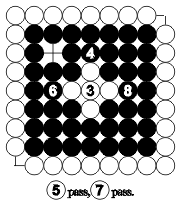
I have to wonder what Black is trying to prove here. This is not how life and death confirmation works.
----------
Is this [https://www.cs.cmu.edu/~wjh/go/rules/Japanese.html] where "enable" is coming from? I am not sure that it a perfect translation (hint: there is none when translating Japanese to English because Japanese particles do not match English words). Perhaps I'd need divination from the Green Goddess to find the right interpretation of 取られても新たに相手方に取られない石を生じうる石, but it is easy enough to see that the "enable" interpretation in "j1989c.html" is wrong. I'm not saying that "would enable" is wrong, though maybe it is misleading, just that j1989c's interpretation of "enable" and its corresponding discussion is misinterpreting the rules.
----------

----------
Shouldn't reading comprehension demand recognition of the interpretation that provides consistency?
Why pretend that the inconsistent interpretation is right just to make believe that the author is incompetent?
----------
I have to wonder what Black is trying to prove here. This is not how life and death confirmation works.
----------
Nope. This also isn't how life and death works. The example doesn't make sense under the Rules. I think the discussion of "enable" shows the culprit for the misunderstanding of the Japanese Rules.Now, for the purpose of testing for the right side's white string whether it is capturable-alive, Black needs to do both of the following: capture that particular string and prevent White from getting a permanent-stone anywhere on the board.
Is this [https://www.cs.cmu.edu/~wjh/go/rules/Japanese.html] where "enable" is coming from? I am not sure that it a perfect translation (hint: there is none when translating Japanese to English because Japanese particles do not match English words). Perhaps I'd need divination from the Green Goddess to find the right interpretation of 取られても新たに相手方に取られない石を生じうる石, but it is easy enough to see that the "enable" interpretation in "j1989c.html" is wrong. I'm not saying that "would enable" is wrong, though maybe it is misleading, just that j1989c's interpretation of "enable" and its corresponding discussion is misinterpreting the rules.
----------
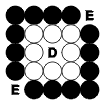
Must be kidding right? The point D is only surrounded by living stones of one player. The other player's dead stones are not part of the consideration. Maybe this misunderstanding is a result of confusion between 囲む and 交点/ 存在/取り.the empty point D is not an eye point because it is not (!) surrounded by the live stones of just one player - instead it is surrounded by dead white stones. Since D is not an eye point, it is a dame.
----------
Shouldn't reading comprehension demand recognition of the interpretation that provides consistency?
Why pretend that the inconsistent interpretation is right just to make believe that the author is incompetent?
-
Cassandra

- Gosei
- Posts: 1334
- Joined: Wed Apr 28, 2010 11:33 am
- Rank: German 1 Kyu
- GD Posts: 0
- Has thanked: 14 times
- Been thanked: 153 times
Re: No result game without loop (in japonese rule) ?
Black simply tries to find out whether his just captured single stone in the centre of the board was "alive" or "dead".CDavis7M wrote:There's also a misunderstanding of which stones are dead and which are alive. I have no idea what rules the players are reading but https://www.nihonkiin.or.jp/match/kiyaku/ is pretty clear when it describes "黒六子" (for example) as compared "黒一子". I don't think divination from the Green Goddess is required to understand dame in seki or that territory surrounded by one player's living stones isn't dame.
----------
I have to wonder what Black is trying to prove here. This is not how life and death confirmation works.
BTW, this stone is clearly "dead", as capturing it cannot "enable" anything.
J89's legal text was inconsistent from the very beginning, wasn't it? Do you want to claim that its authors were "incompetent"?----------Nope. This also isn't how life and death works. The example doesn't make sense under the Rules. I think the discussion of "enable" shows the culprit for the misunderstanding of the Japanese Rules.Now, for the purpose of testing for the right side's white string whether it is capturable-alive, Black needs to do both of the following: capture that particular string and prevent White from getting a permanent-stone anywhere on the board.
Is this [https://www.cs.cmu.edu/~wjh/go/rules/Japanese.html] where "enable" is coming from? I am not sure that it a perfect translation (hint: there is none when translating Japanese to English because Japanese particles do not match English words). Perhaps I'd need divination from the Green Goddess to find the right interpretation of 取られても新たに相手方に取られない石を生じうる石, but it is easy enough to see that the "enable" interpretation in "j1989c.html" is wrong. I'm not saying that "would enable" is wrong, though maybe it is misleading, just that j1989c's interpretation of "enable" and its corresponding discussion is misinterpreting the rules.
----------
Must be kidding right? The point D is only surrounded by living stones of one player. The other player's dead stones are not part of the consideration. Maybe this misunderstanding is a result of confusion between 囲む and 交点/ 存在/取り.the empty point D is not an eye point because it is not (!) surrounded by the live stones of just one player - instead it is surrounded by dead white stones. Since D is not an eye point, it is a dame.
----------
Shouldn't reading comprehension demand recognition of the interpretation that provides consistency?
Why pretend that the inconsistent interpretation is right just to make believe that the author is incompetent?
 Article 8, Clause 1: Empty points surrounded by the live stones of just one player are called "eye points."
 Article 8, Clause 4: Eye points surrounded by stones that are alive but not in seki are called "territory," each eye point counting as one point of territory.
 Article 10, Clause 1: After agreement that the game has ended, each player removes any opposing dead stones from his territory as is, and adds them to his prisoners.
"TERRITORY" is "EYE POINTS" (conditions apply), which is "EMPTY POINTS" (conditions apply).
Thus, "TERRITORY" cannot contain anything else but "EMPTY POINTS".
Thus, the "REMOVAL of opposing DEAD STONES" from "TERRITORY" is impossible.
The reasoning for this inconsistency is quite simple:
The definition of "TERRITORY" at a moment when the game has not yet stopped, comes much too early, and thus does not make sense at all. (The same is true for Article 7, Life & Death.)
"Territory" results from the combination of the results of L&D assessement. It cannot be derived earlier than that.
The really most difficult Go problem ever: https://igohatsuyoron120.de/index.htm
Igo Hatsuyōron #120 (really solved by KataGo)
Igo Hatsuyōron #120 (really solved by KataGo)
-
Cassandra
- Gosei
- Posts: 1334
- Joined: Wed Apr 28, 2010 11:33 am
- Rank: German 1 Kyu
- GD Posts: 0
- Has thanked: 14 times
- Been thanked: 153 times
Re: No result game without loop (in japonese rule) ?
What did J89's authors overlook?Cassandra wrote:J89's legal text was inconsistent from the very beginning, wasn't it?
"TERRITORY" is "EYE POINTS" (conditions apply), which is "EMPTY POINTS" (conditions apply).
Thus, "TERRITORY" cannot contain anything else but "EMPTY POINTS".
Thus, the "REMOVAL of opposing DEAD STONES" from "TERRITORY" is impossible.
--------------------------------
First of all, it goes without saying that
Black stones cannot surround Black stones,
because "Black stone" is the material surroundings are made of. It's a simple matter of topology.
Second, it goes without saying that
the amount of Black's territory is independent of what has been surrounded,
either empty points or dead White stones or both.
Black has eight points of territory.
Black has eight points of territory.
White's five dead stones do not add to Black's territory, but they reduce White's territory, instead.
These dead stones have a value of MINUS five points of White territory.
--------------------------------
Solution:
"Empty" in Article 8, Clause 1 must be simply deleted.
The really most difficult Go problem ever: https://igohatsuyoron120.de/index.htm
Igo Hatsuyōron #120 (really solved by KataGo)
Igo Hatsuyōron #120 (really solved by KataGo)
-
CDavis7M
- Lives in sente
- Posts: 716
- Joined: Tue Jun 15, 2010 2:18 pm
- Rank: Shokyu
- GD Posts: 0
- Universal go server handle: CDavis7M
- Has thanked: 109 times
- Been thanked: 152 times
- Contact:
Re: No result game without loop (in japonese rule) ?
My point is that there is no reason to do this under Life & Death confirmation. So I wonder if the author of "j1989c.html" misunderstands how Life & Death confirmation works.Cassandra wrote:Black simply tries to find out whether his just captured single stone in the centre of the board was "alive" or "dead".CDavis7M wrote:I have to wonder what Black is trying to prove here. This is not how life and death confirmation works.
It is questionable whether the rules describe stones having been captured as "enabling". This seems to be another point of misunderstanding.Cassandra wrote:BTW, this stone is clearly "dead", as capturing it cannot "enable" anything.
The "J98" text is NOT inconsistent. It is not me that wants to claim that it's author is incompetent. It is the author of "j1989c.html" that has claimed that the "J89" author is incompetent. But actually, the "J89" authors were competent. It is the "j1989c.html" author (and others) that cannot comprehend.Cassandra wrote:J89's legal text was inconsistent from the very beginning, wasn't it? Do you want to claim that its authors were "incompetent"?
Listen, like I already said, reading comprehension requires finding the interpretation that actually makes sense. Your interpretation of the rules is obviously incorrect because it leads to this inconsistency. It's not the text of the Japanese Rules that is the problem. Lack of reading comprehension is the problem. It's not a big deal to find an apparent inconsistency in text, but when you do find one, try to look at the context and discover the interpretation that makes everything consistent.Cassandra wrote:"TERRITORY" is "EYE POINTS" (conditions apply), which is "EMPTY POINTS" (conditions apply).
Thus, "TERRITORY" cannot contain anything else but "EMPTY POINTS".
Thus, the "REMOVAL of opposing DEAD STONES" from "TERRITORY" is impossible.
The reasoning for this inconsistency is quite simple:
The definition of "TERRITORY" at a moment when the game has not yet stopped, comes much too early, and thus does not make sense at all. (The same is true for Article 7, Life & Death.)
"Territory" results from the combination of the results of L&D assessement. It cannot be derived earlier than that.
What rules are you even reading? Of course an intersection occupied by the opponent's stone is not territory or an eye because it is not 空点. The stone is taken away and then the intersection where the stone was becomes territory. The stone can be taken away because it is "in" the territory created by the other empty points, which are eyes, which are territory. The "territory" that the dead stones are taken from are not the intersecting points that the dead stones are sitting on. The territory is the other empty points around those dead stones. This interpretation makes sense and is consistent. This is reading comprehension.
And look at the actual rule. It makes sense. 終局の合意の後、地の中の相手方の死に石はそのまま取り上げハマに加える。Look at 地の中 -- territory [possessive particle] inside, middle, among, within. This means, "among territory." The dead stones are among the other eyes that are territory. They are not sitting on territory. Obviously.
No, the solution is reading comprehension, awareness of context, and checking the source if in doubt.Cassandra wrote: White's five dead stones do not add to Black's territory, but they reduce White's territory, instead.
These dead stones have a value of MINUS five points of White territory.
--------------------------------
Solution:
"Empty" in Article 8, Clause 1 must be simply deleted.

Whites 5 stones dead and they are among 地. So they may be taken off the board as prisoners. Then those points become territory.
The Japanese Rules are consistent.
----------
The rules are not some computer procedure to be followed blindly. Think with human reasoning.
I really don't understand why some people are so determined to not understand the Japanese Rules.
-
CDavis7M
- Lives in sente
- Posts: 716
- Joined: Tue Jun 15, 2010 2:18 pm
- Rank: Shokyu
- GD Posts: 0
- Universal go server handle: CDavis7M
- Has thanked: 109 times
- Been thanked: 152 times
- Contact:
Re: No result game without loop (in japonese rule) ?
By the way, the "misunderstandings" in the other topic titled "reverse engineering" Life and Death examples are a result of similar misinterpretation issues.
For reading comprehension, if the life and death example violates your interpretation, it is the interpretation that is wrong, not the life and death example.
Why spend hours and hours creating dozens of diagrams and new terminology in an attempt to reverse engineer what the L&D examples are showing instead of first accepting that they are correct and then seeking to understand the information that the author is presenting from a different interpretation, from the context, and from the source.
For reading comprehension, if the life and death example violates your interpretation, it is the interpretation that is wrong, not the life and death example.
Why spend hours and hours creating dozens of diagrams and new terminology in an attempt to reverse engineer what the L&D examples are showing instead of first accepting that they are correct and then seeking to understand the information that the author is presenting from a different interpretation, from the context, and from the source.
-
Cassandra
- Gosei
- Posts: 1334
- Joined: Wed Apr 28, 2010 11:33 am
- Rank: German 1 Kyu
- GD Posts: 0
- Has thanked: 14 times
- Been thanked: 153 times
Re: No result game without loop (in japonese rule) ?
You simply do not want to understand that J89 were a clearly inconsistent attempt to put Japanese understanding of the game of Go into written form from the very beginning.CDavis7M wrote:By the way, the "misunderstandings" in the other topic titled "reverse engineering" Life and Death examples are a result of similar misinterpretation issues.
For reading comprehension, if the life and death example violates your interpretation, it is the interpretation that is wrong, not the life and death example.
Why spend hours and hours creating dozens of diagrams and new terminology in an attempt to reverse engineer what the L&D examples are showing instead of first accepting that they are correct and then seeking to understand the information that the author is presenting from a different interpretation, from the context, and from the source.
Simply because the authors were professionals in the game of Go, but not in writing a set of rules.
I could accept any outcome of any L&D Example, if it could be derived by the prodedures given in the legal text of the rules. But the results of several J89's L&D Examples cannot be derived with application of these procedures alone.
Therefore, either the procedures in the legal text do not make any sense, or the L&D Examples.
When putting a Go stone onto the board, these professionals were aware for sure that they had to live with the ACTUAL effect of this move when continuing their game.
It would make no sense whining about the unexpected response from the opponent, who would please be very much tied to the effects that had been thought out in private.
But this it what you do so desperately.
Reverse engineering showed what J89's authors really had in mind, but were unable to formulate on paper.
This includes
Points surrounded by the live stones of just one player are called "eye".
(current version) as what was really meant by J89's author's.
The really most difficult Go problem ever: https://igohatsuyoron120.de/index.htm
Igo Hatsuyōron #120 (really solved by KataGo)
Igo Hatsuyōron #120 (really solved by KataGo)
-
Cassandra
- Gosei
- Posts: 1334
- Joined: Wed Apr 28, 2010 11:33 am
- Rank: German 1 Kyu
- GD Posts: 0
- Has thanked: 14 times
- Been thanked: 153 times
Re: No result game without loop (in japonese rule) ?
Yes, indeed. This it what I tried to explain.CDavis7M wrote:And look at the actual rule. It makes sense. 終局の合意の後、地の中の相手方の死に石はそのまま取り上げハマに加える。Look at 地の中 -- territory [possessive particle] inside, middle, among, within. This means, "among territory." The dead stones are among the other eyes that are territory. They are not sitting on territory. Obviously.
According to J89's legal text, "territory" is "empty points" only.
Just because they "are not sitting on territory", they cannot be taken off the board ("out of territory") as they are.
But all this discussion is useless, as you do not seem to understand the core message.
Defining "territory" for a stage of the game that is earlier than the finalisation of the L&D assessement (as J89 did completely unnecessary) is nonsense.
Dead stones that are located inside opponent's alive groups that do not possess any dame, can be taken off the board as they are, being added to the alive groups owner's prisoners.
ONLY THEREAFTER, "territory" should be defined as all the empty points that are inside alive groups that do not possess any dame.
That's all, but only if it is done at the RIGHT moment.
Contrary to that, J89
-- defines "territory #1" with regard to "eye points",
-- does NOT define, but assumes in your opinion, "territory #2" for taking dead opponent's stones off the board, and
-- utilises "territory #3" and "territory #4" with regard to the calculation of the final score.
Apparently, the authors tried to complicate the matter as much as possible.
The really most difficult Go problem ever: https://igohatsuyoron120.de/index.htm
Igo Hatsuyōron #120 (really solved by KataGo)
Igo Hatsuyōron #120 (really solved by KataGo)
-
CDavis7M
- Lives in sente
- Posts: 716
- Joined: Tue Jun 15, 2010 2:18 pm
- Rank: Shokyu
- GD Posts: 0
- Universal go server handle: CDavis7M
- Has thanked: 109 times
- Been thanked: 152 times
- Contact:
Re: No result game without loop (in japonese rule) ?
You simple to not want to understand that you have misinterpreted the rules. If there are various interpretations and some create inconsistencies while other interpretations provide consistency, it should be obvious which interpretations to accept.Cassandra wrote:You simply do not want to understand that J89 were a clearly inconsistent attempt to put Japanese understanding of the game of Go into written form from the very beginning.
Simply because the authors were professionals in the game of Go, but not in writing a set of rules.
Or maybe you just do not recognize the right way to do it? The proper understanding of the Rules will be consistent with the examples. If you cannot find consistency then there is a problem in your interpretation.Cassandra wrote:I could accept any outcome of any L&D Example, if it could be derived by the prodedures given in the legal text of the rules. But the results of several J89's L&D Examples cannot be derived with application of these procedures alone. Therefore, either the procedures in the legal text do not make any sense, or the L&D Examples.
These idiomatic errors just confirm to me that the supposed problems in the Japanese Rules are actually misunderstandings.Cassandra wrote:It would make no sense whining about the unexpected response from the opponent, who would please be very much tied to the effects that had been thought out in private.
But this it what you do so desperately.
Uh.... What? The proper understanding was already formulated on paper. No reverse engineering is required. Simple reading comprehension would have sufficed. The Japanese Rules already say that points surrounded by one player's live stones are eyes. Apparently some people got confused by the dead stones. As I said above, there seems to have been confusion between 囲む and 交点/ 存在/取り.Cassandra wrote:Reverse engineering showed what J89's authors really had in mind, but were unable to formulate on paper.
This includes
Points surrounded by the live stones of just one player are called "eye".
(current version) as what was really meant by J89's author's.
Empty points that are eyes. But yes, I agree.Cassandra wrote:According to J89's legal text, "territory" is "empty points" only.
Your interpretation is wrong. First of all, the Japanese Rules are written with kanji and kana and so obviously do not say "out of territory." It's clear enough that some translation (maybe a translation of a translation) is causing the Japanese Rules to be misinterpreted. I asked several times which translation people were looking at but no one cares to respond. If you are translating it yourself then just say so.Cassandra wrote:Just because they "are not sitting on territory", they cannot be taken off the board ("out of territory") as they are.
In my reading the the Japanese Rules, they do not state that dead stones are taken "out of territory." Instead, I read the rule as stating that the stones which are taken are the dead stones among (in the company of, amid, between) territory.
My interpretation of Article 10-1 is that the 5 white stones that are dead and among territory may be taken as prisoners. Why would this interpretation not be correct?
First of all, territory is scored according to Article 10-2, which comes after the dead stones are captured as prisoners by Article 10-1, which comes after life and death is confirmed by Article 9. There is no issue in defining territory in Article 8 since territory is used for scoring which happens after L&D are confirmed. So "'Defining "territory' for a stage of the game that is earlier than the finalisation of the L&D assessement" is not nonsense because counting territory comes after the dead stones are removed.Cassandra wrote:But all this discussion is useless, as you do not seem to understand the core message. Defining "territory" for a stage of the game that is earlier than the finalisation of the L&D assessement (as J89 did completely unnecessary) is nonsense.
Dead stones that are located inside opponent's alive groups that do not possess any dame, can be taken off the board as they are, being added to the alive groups owner's prisoners.
ONLY THEREAFTER, "territory" should be defined as all the empty points that are inside alive groups that do not possess any dame.
That's all, but only if it is done at the RIGHT moment.
The Japanese Rules are so simple. Here's how they work. Once the game is stopped after 2 passes, dame are filled and reinforcing moves are played in order to assess the life and death of the stones. Once the players agree on that, eyes that are territory are identified and dead stones next to that territory can be taken as prisoners, thereby uncovering more territory. It's so simple. Once all of the prisoners are taken, they are used to fill the opponent's territory. Only after doing that is territory counted and compared.
It is not complicated. The idea of competing for territory is given as the premise of the game in Article 1. Because territory is the defining feature of Japanese Go it is no wonder that territory is defined with respect to eyes in Article 8, is used to identify prisoners in article 10-1, and then is finally counted in Article 10-2.Cassandra wrote:J89
-- defines "territory #1" with regard to "eye points",
-- does NOT define, but assumes in your opinion, "territory #2" for taking dead opponent's stones off the board, and
-- utilises "territory #3" and "territory #4" with regard to the calculation of the final score.
Apparently, the authors tried to complicate the matter as much as possible.
I think it makes sense for territory to be defined before scoring because the distinction between eyes and territory is important when identifying live stones that are seki stones, and in determining that dead stones among eyes cannot be taken as prisoners because they are not among territory.
----------
Back to the original post, it assume that the Japanese Rules have a requirement to prove that stones are dead. I see no such requirement. My reading is that that alive stones are defined and dead stones are just any stone that is not alive. Japanese Go places the burden of Life & Death on proving that stones are alive. Since the premise of the original post is that this burden cannot be met, then the stones under assessment are dead. Much of the discussion here is about whether the seemingly dead stones can be proven to be dead. That is irrelevant in my interpretation of the Japanese Rules.
-
Cassandra
- Gosei
- Posts: 1334
- Joined: Wed Apr 28, 2010 11:33 am
- Rank: German 1 Kyu
- GD Posts: 0
- Has thanked: 14 times
- Been thanked: 153 times
Re: No result game without loop (in japonese rule) ?
"Simple reading comprehension" would have told you that "空点" is "EMPTY point". And this is what is defined as being an "eye", if surrounded by alive stones of one colour.CDavis7M wrote:Simple reading comprehension would have sufficed. The Japanese Rules already say that points surrounded by one player's live stones are eyes.
However, I am glad that you want to end this fruitless discussion by agreeing that this "EMPTY" was too much.
The really most difficult Go problem ever: https://igohatsuyoron120.de/index.htm
Igo Hatsuyōron #120 (really solved by KataGo)
Igo Hatsuyōron #120 (really solved by KataGo)
-
Cassandra
- Gosei
- Posts: 1334
- Joined: Wed Apr 28, 2010 11:33 am
- Rank: German 1 Kyu
- GD Posts: 0
- Has thanked: 14 times
- Been thanked: 153 times
Re: No result game without loop (in japonese rule) ?
In J89, there are three types of stones / groups:CDavis7M wrote:Back to the original post, it assume that the Japanese Rules have a requirement to prove that stones are dead. I see no such requirement. My reading is that that alive stones are defined and dead stones are just any stone that is not alive. Japanese Go places the burden of Life & Death on proving that stones are alive. Since the premise of the original post is that this burden cannot be met, then the stones under assessment are dead. Much of the discussion here is about whether the seemingly dead stones can be proven to be dead. That is irrelevant in my interpretation of the Japanese Rules.
Stones / groups that are, or can be transformed into, a formation that includes (at least) two eyes. AKA "unconditionally alive". All other stones / groups that cannot be captured by the opponent, even if he moves first (or, if captured, "enable" something). AKA "alive in seki". All other stones / groups. AKA "dead".As a matter of course, there is no EXPLICIT requirement to prove that stones / groups are dead.
However, you will have to prove whether these stones / groups do NOT belong EITHER to "w1" OR to "w2". Very unsurprisingly,
NOT (
OR ) = (NOT ) AND (NOT ) = Therefore, being forced to exclude any of the "alive" status of stones / groups for stones / groups of type
is equivalent to proving that these stones / groups are "dead".This kind of simple mathematics will be valid also in Japan, I am very sure.
The really most difficult Go problem ever: https://igohatsuyoron120.de/index.htm
Igo Hatsuyōron #120 (really solved by KataGo)
Igo Hatsuyōron #120 (really solved by KataGo)
-
Cassandra
- Gosei
- Posts: 1334
- Joined: Wed Apr 28, 2010 11:33 am
- Rank: German 1 Kyu
- GD Posts: 0
- Has thanked: 14 times
- Been thanked: 153 times
Re: No result game without loop (in japonese rule) ?
"中" = inside, interior, middle, centreCDavis7M wrote:And look at the actual rule. It makes sense. 終局の合意の後、地の中の相手方の死に石はそのまま取り上げハマに加える。Look at 地の中 -- territory [possessive particle] inside, middle, among, within. This means, "among territory." The dead stones are among the other eyes that are territory. They are not sitting on territory. Obviously.
"中の" = within, whilst, among
Even your so much loved "among" needs a plenty / crowd, some element is being integral part of (i.e. is located "in the middle" of).
Let {A, B, C, D, E, F, G, H} be a set (of reasons, for example). Then
"A, amongst others, demonstrates XYZ."
does make sense, only if every other element of {B, C, D, E, F, G, H} ALSO demonstrates XYZ, i.e. has the same "properties" (with regard to "XYZ") as {A}.
BTW:
J89's authors utilised "有する" to describe that something is neighboured to something else.
If they really wanted the behaviour you imply, they would have chosen the wording "地を有する相手方の死に石". But they didn't!
BTW #2:
Probably you have already realised that the examples utilised in the commentary for explaining "territory" do NOT include opponent's dead stones!
In all the cases something (even something quite difficult) in NOT displayed EXPLICITLY, J89 utilises some IMPLICIT procedure / reasoning that is NOT mentioned in the legal text of the rules.
The really most difficult Go problem ever: https://igohatsuyoron120.de/index.htm
Igo Hatsuyōron #120 (really solved by KataGo)
Igo Hatsuyōron #120 (really solved by KataGo)
-
CDavis7M
- Lives in sente
- Posts: 716
- Joined: Tue Jun 15, 2010 2:18 pm
- Rank: Shokyu
- GD Posts: 0
- Universal go server handle: CDavis7M
- Has thanked: 109 times
- Been thanked: 152 times
- Contact:
Re: No result game without loop (in japonese rule) ?
There is no problem with the use of 空点 in the Japanese Rules as they are written. I think your misunderstanding comes from a misunderstanding of what 囲む means.Cassandra wrote:"Simple reading comprehension" would have told you that "空点" is "EMPTY point". And this is what is defined as being an "eye", if surrounded by alive stones of one colour.CDavis7M wrote:Simple reading comprehension would have sufficed. The Japanese Rules already say that points surrounded by one player's live stones are eyes.
However, I am glad that you want to end this fruitless discussion by agreeing that this "EMPTY" was too much.
No. The rules are clear. Show that the stones are alive, else they are dead. There is no need to prove that the stones are not alive. Pretending that there is such a requirement leads to the supposed inconsistencies in the original post.Cassandra wrote:As a matter of course, there is no EXPLICIT requirement to prove that stones / groups are dead.
However, you will have to prove whether these stones / groups do NOT belong EITHER to "w1" OR to "w2". Very unsurprisingly,
That is not the only definition of "among" in English and translating Japanese is not so easy because one statement can be said multiple ways in English. The direct translation of Japanese to English doesn't give a sense of the meaning and a meaningful translation to English might only represent some of the meaning in Japanese, or add meanings not present in Japanese.Cassandra wrote:Even your so much loved "among" needs a plenty / crowd, some element is being integral part of (i.e. is located "in the middle" of).
Good on you for reading the text. But when the rules use 有する it is describing something directly adjacent and right next to the stones (i.e., an empty adjacent point or dame of seki stones). In the case of dead stones among territory, many of those dead stones are not directly adjacent or next to the eyes that are territory. So it wouldn't make sense to use 有する. Nice try though.Cassandra wrote:BTW:
J89's authors utilised "有する" to describe that something is neighboured to something else.
If they really wanted the behaviour you imply, they would have chosen the wording "地を有する相手方の死に石". But they didn't!
Why didn't you ctrl+f? Why do that to yourself? Why discredit your other work?Cassandra wrote: BTW #2:
Probably you have already realised that the examples utilised in the commentary for explaining "territory" do NOT include opponent's dead stones!
The commentary explaining territory DOES include examples of dead stones being among territory.

Ctrl+f is so easy. White's 1 stone is dead and it is among Black's territory. Black can take the 1 White stone off the board after the game is stopped.
----------
One interpretation is consistent, while other interpretations are not. Reading comprehension is that simple.
If you just like making diagrams because that's your thing, then enjoy yourself. But don't pretend the Japanese Rules can't define territory or dame correctly.
-
Cassandra
- Gosei
- Posts: 1334
- Joined: Wed Apr 28, 2010 11:33 am
- Rank: German 1 Kyu
- GD Posts: 0
- Has thanked: 14 times
- Been thanked: 153 times
Re: No result game without loop (in japonese rule) ?
Sorry, but this diagram is from the commentaryCDavis7M wrote:The commentary explaining territory DOES include examples of dead stones being among territory.
Ctrl+f is so easy. White's 1 stone is dead and it is among Black's territory. Black can take the 1 White stone off the board after the game is stopped.
第十条-1(勝敗の決定)
which refers to "Determining the result"
NOT from the commentary
第八条(地)
which refers to "Territory". At this page you will NOT find any dead stone.
Nice try of wishful thinking.
However, those who are able to read have the advantage!
The really most difficult Go problem ever: https://igohatsuyoron120.de/index.htm
Igo Hatsuyōron #120 (really solved by KataGo)
Igo Hatsuyōron #120 (really solved by KataGo)