How do Japanese rules handle this?

For discussing go rule sets and rule theory
kvasir
Lives in sente
Posts: 1040
Joined: Sat Jul 28, 2012 12:29 am
Rank: panda 5 dan
GD Posts: 0
IGS: kvasir
Has thanked: 25 times
Been thanked: 187 times

Re: How do Japanese rules handle this?

Post by kvasir »

I pointed out in another thread that white is alive because the rule is not that stone must not be capturable but in fact the following:

Stones are said to be "alive" if they cannot be captured by the opponent, or if capturing them would enable a new stone to be played that the opponent could not capture. Stones which are not alive are said to be "dead."

This doesn't really help with J89 in general but white does have a clear argument for example because :w6: is a new stone that can't be captured.
Click Here To Show Diagram Code
[go]$$ :w4: pass for :b3:
$$ ----------------------
$$ | O . O . X 2 3 O O . O
$$ | O O O X O X O O O O O
$$ | X X X O 1 O O . O . .
$$ | X . X O O O O O . . .
$$ | . X X . . . . . . . .
$$ | X X . . . . . . . . .
$$ | . . . . . . . . . . .
$$ | . . . . . . . . . . .[/go]
Click Here To Show Diagram Code
[go]$$Bcm5
$$ ----------------------
$$ | O 3 O 1 X 2 X O O . O
$$ | O O O X 4 X O O O O O
$$ | X X X O X O O . O . .
$$ | X . X O O O O O . . .
$$ | . X X . . . . . . . .
$$ | X X . . . . . . . . .
$$ | . . . . . . . . . . .
$$ | . . . . . . . . . . .[/go]
Black has no way to avoid :w6: being played while capturing because connecting the ko doesn't let black capture.
Click Here To Show Diagram Code
[go]$$Bcm5 :w6: pass for ko
$$ ----------------------
$$ | O . O 3 X 1 X O O . O
$$ | O O O X 4 X O O O O O
$$ | X X X O X O O . O . .
$$ | X . X O O O O O . . .
$$ | . X X . . . . . . . .
$$ | X X . . . . . . . . .
$$ | . . . . . . . . . . .
$$ | . . . . . . . . . . .[/go]
However a definition of what exactly a new "enabled" stone is is not really available but J89 does use this concept to good effect to determine statuses in snapbacks. Those snapback back determinations are really key to what we know as Japanese rules. I think this position can really be thought of as a snapback shape with a ko, if black tries to take he is capturable in a ko and therefore it is not surprising that white doesn't have to add a move by the principle of "no ko in in status confirmation".
Gérard TAILLE
Gosei
Posts: 1346
Joined: Sun Aug 23, 2020 2:47 am
Rank: 1d
GD Posts: 0
Has thanked: 21 times
Been thanked: 57 times

Re: How do Japanese rules handle this?

Post by Gérard TAILLE »

kvasir wrote:I pointed out in another thread that white is alive because the rule is not that stone must not be capturable but in fact the following:

Stones are said to be "alive" if they cannot be captured by the opponent, or if capturing them would enable a new stone to be played that the opponent could not capture. Stones which are not alive are said to be "dead."

This doesn't really help with J89 in general but white does have a clear argument for example because :w6: is a new stone that can't be captured.
Click Here To Show Diagram Code
[go]$$ :w4: pass for :b3:
$$ ----------------------
$$ | O . O . X 2 3 O O . O
$$ | O O O X O X O O O O O
$$ | X X X O 1 O O . O . .
$$ | X . X O O O O O . . .
$$ | . X X . . . . . . . .
$$ | X X . . . . . . . . .
$$ | . . . . . . . . . . .
$$ | . . . . . . . . . . .[/go]
Click Here To Show Diagram Code
[go]$$Bcm5
$$ ----------------------
$$ | O 3 O 1 X 2 X O O . O
$$ | O O O X 4 X O O O O O
$$ | X X X O X O O . O . .
$$ | X . X O O O O O . . .
$$ | . X X . . . . . . . .
$$ | X X . . . . . . . . .
$$ | . . . . . . . . . . .
$$ | . . . . . . . . . . .[/go]
Black has no way to avoid :w6: being played while capturing because connecting the ko doesn't let black capture.
Click Here To Show Diagram Code
[go]$$Bcm5 :w6: pass for ko
$$ ----------------------
$$ | O . O 3 X 1 X O O . O
$$ | O O O X 4 X O O O O O
$$ | X X X O X O O . O . .
$$ | X . X O O O O O . . .
$$ | . X X . . . . . . . .
$$ | X X . . . . . . . . .
$$ | . . . . . . . . . . .
$$ | . . . . . . . . . . .[/go]
However a definition of what exactly a new "enabled" stone is is not really available but J89 does use this concept to good effect to determine statuses in snapbacks. Those snapback back determinations are really key to what we know as Japanese rules. I think this position can really be thought of as a snapback shape with a ko, if black tries to take he is capturable in a ko and therefore it is not surprising that white doesn't have to add a move by the principle of "no ko in in status confirmation".
Click Here To Show Diagram Code
[go]$$
$$ ----------------------
$$ | O . O . X a . O b . O
$$ | O O O X O X O O O O O
$$ | X X X O . O O . O . .
$$ | X . X O O O O O . . .
$$ | . X X . . . . . . . .
$$ | X X . . . . . . . . .
$$ | . . . . . . . . . . .
$$ | . . . . . . . . . . .[/go]
In L&D confirmation phase it is true that black can capture the 5 stones and it is true that white will be able to put an uncapturable stone in "a". But it is not true to say that the capture of the 5 white stones by black "enables" white to put an uncapturable stone in "a". In any case black cannot prevent white to put an uncapturable stone at "a". That means that "a" point as the same status as "b" point : black cannot prevent white to put an uncapturable stone at "a" or "b".
User avatar
CDavis7M
Lives in sente
Posts: 716
Joined: Tue Jun 15, 2010 2:18 pm
Rank: Shokyu
GD Posts: 0
Universal go server handle: CDavis7M
Has thanked: 109 times
Been thanked: 140 times
Contact:

Re: How do Japanese rules handle this?

Post by CDavis7M »

Gérard TAILLE wrote: You begin step 2 by looking at the status of the group with only 1 stone. My question is the following : what is your analyse if you begin step 2 by looking first at the status of the group with 5 stones?
It doesn't matter what order they are analyzed. If the players first attempt to determine whether the 5 stones are dead, they will quickly realize that they are determining the status of 6 stones, not 5, because the 1 ko-stone is involved. The 6 stones are alive, but is that by virtue of the 1 stone ko-stone or all 6 stones? The players will confirm the status of the 1 stone separately.

The players will realize that it is the capture of the 1 stone that actually "enables" the new uncapturable stones and that the 5 stones do not actually need to be captured at all. If the 5 stones do not actually have to be captured then they cannot be said to "enable" the new capturable stones. Of course it is just the the 1 stone alone that actually "enables" the new uncapturable stones.

When determining the status of the 1 White stone, Black does not need to attempt to capture the 5 stones because it is not their status that is being confirmed and their capture does not help black prove the status of the 1 stone.
Click Here To Show Diagram Code
[go]$$ :b3: pass, :b5: pass, :w6: above 1,
$$ ----------------------
$$ | O . O . X 4 2 O O . O-O . O . X Q . O O . O
$$ | O O O X O X O O O O O-O O O X Q . O O O O O
$$ | X X X O 1 O O . O . .-X X X O . O O . O . .
$$ | X . X O O O O O . . .-X . X O O O O O . . .
$$ | . X X . . . . . . . .-. X X . . . . . . . .
$$ | X X . . . . . . . . .-X X . . . . . . . . .[/go]
User avatar
CDavis7M
Lives in sente
Posts: 716
Joined: Tue Jun 15, 2010 2:18 pm
Rank: Shokyu
GD Posts: 0
Universal go server handle: CDavis7M
Has thanked: 109 times
Been thanked: 140 times
Contact:

Re: How do Japanese rules handle this?

Post by CDavis7M »

kvasir wrote:I pointed out in another thread that white is alive because the rule is not that stone must not be capturable but in fact the following:

Stones are said to be "alive" if they cannot be captured by the opponent, or if capturing them would enable a new stone to be played that the opponent could not capture. Stones which are not alive are said to be "dead."
Yup. We are all talking about stones that are capturable and that can so-called "enable" a new uncapturable stone. The debate is not whether there is the possibility of new uncapturable stones, but which stones are the stones that "enable" the new uncapturable stones.
kvasir wrote: However a definition of what exactly a new "enabled" stone is is not really available.
The definition of "enabled" is not available from the Japanese Rules because the Japanese Rules do not use this term. It is an unofficial interpretation of the Japanese Rules.

Stones are said to be "alive" if they cannot be captured by the opponent, or if capturing them would enable a new stone to be played that the opponent could not capture. Stones which are not alive are said to be "dead."

But if we take this guy's interpretation with "enable" and we look at the definition of "enable", it's easy to determine that it is not capturing the 5 stones that enables new uncapturable stones, it is capturing the 1 White stone that enables the new uncapturable stones. It is easy to see because the capturing of the 1 White stone enables new uncapturable stones without capturing the 5 stones. So it is the 1 white ko-stone alone that "enables" the new uncapturable stones. So the 1 stone is alive.
Click Here To Show Diagram Code
[go]$$ :b3: pass, :b5: pass, :w6: above 1,
$$ ----------------------
$$ | O . O . X 4 2 O O . O-O . O . X Q . O O . O
$$ | O O O X O X O O O O O-O O O X Q . O O O O O
$$ | X X X O 1 O O . O . .-X X X O . O O . O . .
$$ | X . X O O O O O . . .-X . X O O O O O . . .
$$ | . X X . . . . . . . .-. X X . . . . . . . .
$$ | X X . . . . . . . . .-X X . . . . . . . . .[/go]
The 1 stone can be captured and enable new uncapturable stones even if the 5 stones are not captured. The 5 stones do not enable anything. The 5 stones are dead and so they have dame.
kvasir
Lives in sente
Posts: 1040
Joined: Sat Jul 28, 2012 12:29 am
Rank: panda 5 dan
GD Posts: 0
IGS: kvasir
Has thanked: 25 times
Been thanked: 187 times

Re: How do Japanese rules handle this?

Post by kvasir »

Click Here To Show Diagram Code
[go]$$
$$ ----------------------
$$ | O . O . X a . O b . O
$$ | O O O X O X O O O O O
$$ | X X X O . O O . O . .
$$ | X . X O O O O O . . .
$$ | . X X . . . . . . . .
$$ | X X . . . . . . . . .
$$ | . . . . . . . . . . .
$$ | . . . . . . . . . . .[/go]
'b' would be part of the surrounding 'stones' also know as a group in English. Black can show that the corner can be captured, 'a' is therefore a point in an area that will after removal of stones from the board be (partially) surrounded by capturable stones and that is the difference between 'a' and 'b'.

Let's explain this further. In the following diagram the marked black stones are capturable and dead. These stones are removed from the board if and only if the surrounding stones are alive, if any of the surrounding stones are dead then these stone remain on the board (anti-seki). The marked white stones are capturable but unless they are also dead marked black stones will remain on the board. Therefore 'a' will be surrounded by either the marked black or marked white stones, in either case 'a' is (partially) surrounded by capturable stones. It is different from 'b' which is surrounded only by alive, uncapturable, white stones.
Click Here To Show Diagram Code
[go]$$
$$ ----------------------
$$ | Q . Q . Y a . O b . O
$$ | Q Q Q Y O Y O O O O O
$$ | X X X O . O O . O . .
$$ | X . X O O O O O . . .
$$ | . X X . . . . . . . .
$$ | X X . . . . . . . . .
$$ | . . . . . . . . . . .
$$ | . . . . . . . . . . .[/go]
I hope that clears up that 'a' is not same as 'b'
CDavis7M wrote:The 1 stone can be captured and enable new uncapturable stones even if the 5 stones are not captured. The 5 stones do not enable anything. The 5 stones are dead and so they have dame.
Black plays first and white is not entitle to play 'a'. Black must capture the white marked stones and defend against new stones. It doesn't matter if white could play the same stones in a different scenario. Sure there is an issue of how to understand 'enable' because it is not stated clearly in the rules text but I think this position is clear.

Claiming black need not capture the marked stones is something else. Status confirmation is not an issue if black refuses to capture the stones. It is only a question of if white can play 'new stones', stones not being new if they are part of existing 'stones'. If these rules were originally in English they would use Go terms differently and this point might be clearer, but there is no guarantee.

Anyway. 'a' is not same as 'b' because 'b' is part of existing 'stones' but 'a' would be a new 'stone' because the surrounding stones are not the same 'stones'. The surrounding stones do not have the same color or capturable status; 'a' is breaking new ground.
Gérard TAILLE
Gosei
Posts: 1346
Joined: Sun Aug 23, 2020 2:47 am
Rank: 1d
GD Posts: 0
Has thanked: 21 times
Been thanked: 57 times

Re: How do Japanese rules handle this?

Post by Gérard TAILLE »

kvasir wrote:
Click Here To Show Diagram Code
[go]$$
$$ ----------------------
$$ | O . O . X a . O b . O
$$ | O O O X O X O O O O O
$$ | X X X O . O O . O . .
$$ | X . X O O O O O . . .
$$ | . X X . . . . . . . .
$$ | X X . . . . . . . . .
$$ | . . . . . . . . . . .
$$ | . . . . . . . . . . .[/go]
'b' would be part of the surrounding 'stones' also know as a group in English. Black can show that the corner can be captured, 'a' is therefore a point in an area that will after removal of stones from the board be (partially) surrounded by capturable stones and that is the difference between 'a' and 'b'.

Let's explain this further. In the following diagram the marked black stones are capturable and dead. These stones are removed from the board if and only if the surrounding stones are alive, if any of the surrounding stones are dead then these stone remain on the board (anti-seki). The marked white stones are capturable but unless they are also dead marked black stones will remain on the board. Therefore 'a' will be surrounded by either the marked black or marked white stones, in either case 'a' is (partially) surrounded by capturable stones. It is different from 'b' which is surrounded only by alive, uncapturable, white stones.
Click Here To Show Diagram Code
[go]$$
$$ ----------------------
$$ | Q . Q . Y a . O b . O
$$ | Q Q Q Y O Y O O O O O
$$ | X X X O . O O . O . .
$$ | X . X O O O O O . . .
$$ | . X X . . . . . . . .
$$ | X X . . . . . . . . .
$$ | . . . . . . . . . . .
$$ | . . . . . . . . . . .[/go]
I hope that clears up that 'a' is not same as 'b'
CDavis7M wrote:The 1 stone can be captured and enable new uncapturable stones even if the 5 stones are not captured. The 5 stones do not enable anything. The 5 stones are dead and so they have dame.
Black plays first and white is not entitle to play 'a'. Black must capture the white marked stones and defend against new stones. It doesn't matter if white could play the same stones in a different scenario. Sure there is an issue of how to understand 'enable' because it is not stated clearly in the rules text but I think this position is clear.

Claiming black need not capture the marked stones is something else. Status confirmation is not an issue if black refuses to capture the stones. It is only a question of if white can play 'new stones', stones not being new if they are part of existing 'stones'. If these rules were originally in English they would use Go terms differently and this point might be clearer, but there is no guarantee.

Anyway. 'a' is not same as 'b' because 'b' is part of existing 'stones' but 'a' would be a new 'stone' because the surrounding stones are not the same 'stones'. The surrounding stones do not have the same color or capturable status; 'a' is breaking new ground.
Click Here To Show Diagram Code
[go]$$
$$ ----------------------
$$ | O . O . X a . O b . O
$$ | O O O X O X O O O O O
$$ | X X X O . O O . O . .
$$ | X . X O O O O O . . .
$$ | . X X . . . . . . . .
$$ | X X . . . . . . . . .
$$ | . . . . . . . . . . .
$$ | . . . . . . . . . . .[/go]
A agree that, on number of points, the point "a" and "b" are OC different.
I was talking only on a specific point : can black prevent white to put an uncapturable stone on "a"?
It seems the answer is no. In that case can you claim that the five white in the corner are alive because if black kills them then white will be enabled to put a "new" uncapturable stone at "a"? It is only in this sense that "a" and "b" are comparable. BTW you can easily replace point "b" by a point surrounded by alive white stones AND alive black stones (in seki).
User avatar
CDavis7M
Lives in sente
Posts: 716
Joined: Tue Jun 15, 2010 2:18 pm
Rank: Shokyu
GD Posts: 0
Universal go server handle: CDavis7M
Has thanked: 109 times
Been thanked: 140 times
Contact:

Re: How do Japanese rules handle this?

Post by CDavis7M »

Click Here To Show Diagram Code
[go]$$
$$ ----------------------
$$ | O . O . X a . O b . O
$$ | O O O X O X O O O O O
$$ | X X X O . O O . O . .
$$ | X . X O O O O O . . .
$$ | . X X . . . . . . . .
$$ | X X . . . . . . . . .
$$ | . . . . . . . . . . .
$$ | . . . . . . . . . . .[/go]
kvasir wrote: Anyway. 'a' is not same as 'b' because 'b' is part of existing 'stones' but 'a' would be a new 'stone' because the surrounding stones are not the same 'stones'. The surrounding stones do not have the same color or capturable status; 'a' is breaking new ground.
I'll start with your section position because it contradicts your previous position (appearing first in your original post). If you understand that 'a' is not the same as 'b' because 'b' is part of existing stones that are independently alive, then why do you not recognize that the new uncapturable stones are only alive because of the 1 single ko-stone alone, which can be deemed as alive without capturing the 5 white stones.

Arguing that the 5 stones are alive because of 1 stone that is independently alive is just like arguing that the 5 stones are alive if White can play at 'b'. Both of these arguments suffer from the same misconception.
kvasir wrote:
CDavis7M wrote:The 1 stone can be captured and enable new uncapturable stones even if the 5 stones are not captured. The 5 stones do not enable anything. The 5 stones are dead and so they have dame.
Black plays first and white is not entitle to play 'a'. Black must capture the white marked stones and defend against new stones. It doesn't matter if white could play the same stones in a different scenario. Sure there is an issue of how to understand 'enable' because it is not stated clearly in the rules text but I think this position is clear.
That's where your wrong. It DOES matter if White can play the same stones without capturing the 5 white stones and it matters because of the definition of "enable." The OED defines "enable" as give (someone) the ability or means to do something; make possible. As shown, it is the capture of the 1 White stone that makes the uncapturable stones possible to play in L&D confirmation of the White stones. We can't just pretend that words have no meaning.
kvasir wrote:Claiming black need not capture the marked stones is something else. Status confirmation is not an issue if black refuses to capture the stones. It is only a question of if white can play 'new stones', stones not being new if they are part of existing 'stones'. If these rules were originally in English they would use Go terms differently and this point might be clearer, but there is no guarantee.
There is no doubt that the 6 White stones are alive. You say "status confirmation" but not of which stones. The Japanese Rules explanations are clear that stones are considered separately and together. The status of the 6 stones must be considered but also of the 1 stone alone and the 5 stones alone. This is clear from example 24. Even though all of Whites stones are alive together, the one :wt: is dead when considered alone. So it has dame.


The 5 white stones are only alive if you consider the 6 stones together. Why is Black capturing the 1 stone if trying to decide whether the separate 5 White stones are alive? Because the life of the 5 stones depends on the life of the 1 stone. But the life of the 1 stone does not depend on the life of the 5 stones. The 1 stone is independently alive because it enables new uncapturable stones. They 5 stones are not "enabling" for L&D confirmation.
User avatar
Cassandra
Lives in sente
Posts: 1326
Joined: Wed Apr 28, 2010 11:33 am
Rank: German 1 Kyu
GD Posts: 0
Has thanked: 14 times
Been thanked: 153 times

Re: How do Japanese rules handle this?

Post by Cassandra »

You controversially discuss two conceivable sequences of status confirmation, but BOTH end with the SAME result.


Sequence #1:
Click Here To Show Diagram Code
[go]$$
$$ ----------------------
$$ | O . O . X . . O O . O
$$ | O O O X O X O O O O O
$$ | X X X O 1 O O . O . .
$$ | X . X O O O O O . . .
$$ | . X X . . . . . . . .
$$ | X X . . . . . . . . .
$$ | . . . . . . . . . . .
$$ | . . . . . . . . . . .[/go]
:b1: captures White's single stone.
Click Here To Show Diagram Code
[go]$$
$$ ----------------------
$$ | O . O . X . 2 O O . O
$$ | O O O X 3 X O O O O O
$$ | X X X O X O O . O . .
$$ | X . X O O O O O . . .
$$ | . X X . . . . . . . .
$$ | X X . . . . . . . . .
$$ | . . . . . . . . . . .
$$ | . . . . . . . . . . .[/go]
THEREAFTER, :w2: is established on the board as a stone that cannot be captured. Thus, White's captured stone is considered "alive".
:b3: connects.
White's five stones in the corner remain uncaptured, due to Black's damezumari. Thus, these stones are also considered "alive".


Sequence #2:
Click Here To Show Diagram Code
[go]$$
$$ ----------------------
$$ | O . O . X . . O O . O
$$ | O O O X O X O O O O O
$$ | X X X O 1 O O . O . .
$$ | X . X O O O O O . . .
$$ | . X X . . . . . . . .
$$ | X X . . . . . . . . .
$$ | . . . . . . . . . . .
$$ | . . . . . . . . . . .[/go]
:b1: captures White's single stone. THEREAFTER, ...
Click Here To Show Diagram Code
[go]$$
$$ ----------------------
$$ | O . O . X 2 3 O O . O
$$ | O O O X . X O O O O O
$$ | X X X O X O O . O . .
$$ | X . X O O O O O . . .
$$ | . X X . . . . . . . .
$$ | X X . . . . . . . . .
$$ | . . . . . . . . . . .
$$ | . . . . . . . . . . .[/go]
White suspects that this time (after the obvious failure in sequence #1) Black wants to attack her stones in the corner, and so gives atari with :w2:, causing damezumari temporarily.
:b3: captures, so resolving his damezumari.
Click Here To Show Diagram Code
[go]$$Bm5 :w4: pass for the upper ko
$$ ----------------------
$$ | O 3 O 1 X 2 X O O . O
$$ | O O O X . X O O O O O
$$ | X X X O X O O . O . .
$$ | X . X O O O O O . . .
$$ | . X X . . . . . . . .
$$ | X X . . . . . . . . .
$$ | . . . . . . . . . . .
$$ | . . . . . . . . . . .[/go]
:b5: gives atari in the corner.
:w6: recaptures the ko at the upper edge.
:b7: captures White's five stones in the corner.
Click Here To Show Diagram Code
[go]$$Wm8
$$ ----------------------
$$ | . X . X X O . O O . O
$$ | . . . X 1 X O O O O O
$$ | X X X O X O O . O . .
$$ | X . X O O O O O . . .
$$ | . X X . . . . . . . .
$$ | X X . . . . . . . . .
$$ | . . . . . . . . . . .
$$ | . . . . . . . . . . .[/go]
THEREAFTER, :w8: is established on the board (you will easily realise the "snap-back feature" that has been highlighted by kvasir) ...
Click Here To Show Diagram Code
[go]$$W
$$ ----------------------
$$ | . X . X X O . O O . O
$$ | . . . X O . O O O O O
$$ | X X X O . O O . O . .
$$ | X . X O O O O O . . .
$$ | . X X . . . . . . . .
$$ | X X . . . . . . . . .
$$ | . . . . . . . . . . .
$$ | . . . . . . . . . . .[/go]
... as a stone that cannot be captured. Thus, ALL of White's captured stones are considered "alive".
The really most difficult Go problem ever: https://igohatsuyoron120.de/index.htm
Igo Hatsuyōron #120 (really solved by KataGo)
User avatar
CDavis7M
Lives in sente
Posts: 716
Joined: Tue Jun 15, 2010 2:18 pm
Rank: Shokyu
GD Posts: 0
Universal go server handle: CDavis7M
Has thanked: 109 times
Been thanked: 140 times
Contact:

Re: How do Japanese rules handle this?

Post by CDavis7M »

If something is already possible, or if a previous action already makes something possible, then a later action cannot be said to "enable" that thing to be possible.
Cassandra wrote:
Click Here To Show Diagram Code
[go]$$
$$ ----------------------
$$ | O . O . X . 2 O O . O
$$ | O O O X 3 X O O O O O
$$ | X X X O X O O . O . .
$$ | X . X O O O O O . . .
$$ | . X X . . . . . . . .
$$ | X X . . . . . . . . .
$$ | . . . . . . . . . . .
$$ | . . . . . . . . . . .[/go]
THEREAFTER, :w2: is established on the board as a stone that cannot be captured. Thus, White's captured stone is considered "alive".
:b3: connects.
White's five stones in the corner remain uncaptured, due to Black's damezumari. Thus, these stones are also considered "alive".
This is wrong. White's captured stone is not deemed "alive" because the stone :w2: is not actually "enabled" (made possible) by the captured stone (previously at :b3: ). The capture does not "enable" :w2: because White could play :w2: after a Black move that does not capture the 1 White stone. Also recognize that :w2: is alive because the group with 2 eyes is uncapturable, not because the 1 White stone is capturable. Therefore, a move at :w2: does not "confirm" (determine something unknown) the L&D status of any stones.
Cassandra wrote: Sequence #2:
...
Click Here To Show Diagram Code
[go]$$
$$ ----------------------
$$ | O . O . X 2 3 O O . O
$$ | O O O X . X O O O O O
$$ | X X X O X O O . O . .
$$ | X . X O O O O O . . .
$$ | . X X . . . . . . . .
$$ | X X . . . . . . . . .
$$ | . . . . . . . . . . .
$$ | . . . . . . . . . . .[/go]
White suspects that this time (after the obvious failure in sequence #1) Black wants to attack her stones in the corner, and so gives atari with :w2:, causing damezumari temporarily.
:b3: captures, so resolving his damezumari.
I found the point you misunderstand. If the players are confirming the L&D of the 1 White stone then both White and Black have no reason to care whether the stones in the corner are attacked or captured because their capture does NOT affect the status of the 1 White stone considered by itself.

If the players were attempting to confirm the L&D of the 5 white stones, then why is Black capturing a 6th stone? So then the players are assessing 6 stones, not 5 stones. I agree, the 6 stones considered together are alive. But the Japanese Rules show that the L&D status of stones is also considered separately.

Assessing the L&D status of the 1 White stone separate from the 5 White stones in the corner, the players will see that the 1 White stone is alive. That is, the capture of the 1 White stone enables White to place new uncapturable stones even without the 5 stones being captured. Since the new uncaptured stones are already possible (already enabled) by the capture of the 1 stone, the capture of the 5 White stones is not "enabling."
Cassandra wrote: Thus, ALL of White's captured stones are considered "alive".
Wrong. The 6 White stones together are alive. The 1 White stone by itself is alive. But the 5 White stones in the corner are dead because their capture does not "enable" any uncapturable stones that were not already enabled by the capture of the 1 White stone by itself.

White has dame and loses.

----------------

The situation we are discussing is similar to Example 24: https://www.nihonkiin.or.jp/match/kiyak ... 22_25.html
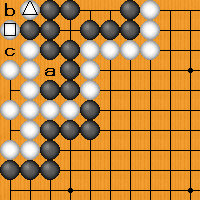
Image

Considered as a whole, the 13 White stones are alive because at least 11 of the White stones have 2 eyes.
Considering :ws: separately, it is alive because if Black captures :wt: then White can connect at 'c' and :ws: is uncapturable.
Considering :wt: separately, it is dead because it can be captured and it's capture does not "enable" any new uncapturable stones that were not already "enabled." Playing a stone at 'c' is not "enabled" by :wt: being captured. Therefore, :wt: is dead and point 'b' is dame.

Similarly, :ws: is alive and :wt: are dead. After :ws: is captured, playing stones at c and :ws: are not enabled by the 5 stones being captured, they are already enabled by :ws: being captured. So at least point 'b' is dame (as are others). In that area near with the 3 black stones, only point 'd' is territory.
Click Here To Show Diagram Code
[go]$$
$$ ----------------------
$$ | Q b Q . X c . O O . O
$$ | Q Q Q X @ X O O O O O
$$ | X X X O d O O . O . .
$$ | X . X O O O O O . . .
$$ | . X X . . . . . . . .
$$ | X X . . . . . . . . .
$$ | . . . . . . . . . . .
$$ | . . . . . . . . . . .[/go]
User avatar
Cassandra
Lives in sente
Posts: 1326
Joined: Wed Apr 28, 2010 11:33 am
Rank: German 1 Kyu
GD Posts: 0
Has thanked: 14 times
Been thanked: 153 times

Re: How do Japanese rules handle this?

Post by Cassandra »

CDavis7M wrote:If something is already possible, or if a previous action already makes something possible, then a later action cannot be said to "enable" that thing to be possible.
I think that ...
CDavis7M wrote:I found the point you misunderstand.
There is simply NO "enable" in the current Japanese original of J89.

You continue to conclude on the basis of a translation into English of which we know neither the original Japanese text nor the extent to which it faithfully reflects the content intended at the time.

The current legal text tells us that stones, which are captured in the course of status confirmation, are nevertheless considered "alive", if a "new stone" is feasible (as a matter of course after that capture), which will not become captured.
And quite naturally, the reference area is limited to the disputed area.


"New", according to Oxford Advanced Learner's Dictionary, has the meaning of "not existing before", "recently made, invented, introduced, etc."

It has NOTHING to do with something like "could come into existence in another szenario".
The really most difficult Go problem ever: https://igohatsuyoron120.de/index.htm
Igo Hatsuyōron #120 (really solved by KataGo)
kvasir
Lives in sente
Posts: 1040
Joined: Sat Jul 28, 2012 12:29 am
Rank: panda 5 dan
GD Posts: 0
IGS: kvasir
Has thanked: 25 times
Been thanked: 187 times

Re: How do Japanese rules handle this?

Post by kvasir »

Cassandra wrote:THEREAFTER, is established on the board (you will easily realise the "snap-back feature" that has been highlighted by kvasir) ...
I feel like only Cassandra understood the argument.

To the other points raised I can only try convey an opinion. The status of the triangle marked stones is alive unless black can both capture them and defend against new 'stones'. We can argue over which of the circle marked points qualify as new stones when white is able to play there, if they are all the same or different. At least I make an argument that being able to play on some of them is different from playing on unrelated intersections.

The some of the circle marked points would be on the boundary of the triangle stones after stone removal (if the triangle stones are alive) and in this case all of them allow white to live if they were played. I think the boundary argument is good, one can argue if one considers all of them to be the same (J2003 does this, or does it exclude 2 of them?) or if one emphasis that being allowed to play some of them is similar to how snapbacks are resolved is a different matter. I am trying to explain why this makes sense, not trying to make a formal system, so I choose not to be reductive.
Click Here To Show Diagram Code
[go]$$
$$ ----------------------
$$ | Q . Q . X C C O O . O
$$ | Q Q Q X W B O O O O O
$$ | X X X O C O O . O . .
$$ | X . X O O O O O . . .
$$ | . X X . . . . . . . .
$$ | X X . . . . . . . . .
$$ | . . . . . . . . . . .
$$ | . . . . . . . . . . .[/go]
To the argument that white can play there anyway or in a different way. I can only offer almost tautologies: "It is not white's turn to play." "Black is supposed to show a sequence that captures the triangle stones, not something else."

I don't know Japanese but I know that it leads to misconceptions when you try to read deeper meanings into everyday words. Most word are meant to be read in the flow of the overall text, not examined individually. In this case "would enable" is subjunctive mood and "a stone to be played" is passive voice, we already know that it should better be "stones" not "a stone" but never mind that. I think the emphasis here has to be on the condition "if capturing them" and the action in the consequence "a stone to be played" not on the subjunctive "would enable" but I think it is clear why this kind of investigation leads nowhere. An example: "if buying an airplane ticket would enable a person to travel", do we claim that "enable" has non-superfluous meaning? I think not, it is just there to comply with grammar. The subjunctive is also called the conjunctive because it connects independent and dependent sub-sentences, I think that is all there is to this sentence from the English translation. It is hard to argue with someone that says "would enable" is a meaningful phrase, but I still think that is incorrect and the connection between "if capturing" and "a stone to be played" is not being defined but instead glossed over.
Gérard TAILLE
Gosei
Posts: 1346
Joined: Sun Aug 23, 2020 2:47 am
Rank: 1d
GD Posts: 0
Has thanked: 21 times
Been thanked: 57 times

Re: How do Japanese rules handle this?

Post by Gérard TAILLE »

Surely I can understand that the following english article may not be good a good translation

1. Stones are said to be "alive" if they cannot be captured by the opponent, or if capturing them would enable a new stone to be played that the opponent could not capture. Stones which are not alive are said to be "dead."

I do not know japanese; can anybody tell us what could be a better translation?
Click Here To Show Diagram Code
[go]$$
$$ ----------------------
$$ | Q . Q . X C C C C C C C C C O . O . O |
$$ | Q Q Q X O X O O O O O O O O O O O O O |
$$ | X X X O C O O . . . . . . . . . . . . |
$$ | X . X O O O . . . . . . . . . . . . . |
$$ | . X X . . . . . . . . . . . . . . . . |
$$ | X X . . . . . . . . . . . . . . . . . |
$$ | . . . . . . . . . . . . . . . . . . . |
$$ | . . . . . . . . . . . . . . . . . . . |[/go]
In this diagram which marked intersections are related or unrelated to the status of five white marked stones in the corner?
User avatar
Cassandra
Lives in sente
Posts: 1326
Joined: Wed Apr 28, 2010 11:33 am
Rank: German 1 Kyu
GD Posts: 0
Has thanked: 14 times
Been thanked: 153 times

Re: How do Japanese rules handle this?

Post by Cassandra »

Gérard TAILLE wrote:
Click Here To Show Diagram Code
[go]$$
$$ ----------------------
$$ | Q . Q . X C C C C C C C C C O . O . O |
$$ | Q Q Q X O X O O O O O O O O O O O O O |
$$ | X X X O C O O . . . . . . . . . . . . |
$$ | X . X O O O . . . . . . . . . . . . . |
$$ | . X X . . . . . . . . . . . . . . . . |
$$ | X X . . . . . . . . . . . . . . . . . |
$$ | . . . . . . . . . . . . . . . . . . . |
$$ | . . . . . . . . . . . . . . . . . . . |[/go]
In this diagram which marked intersections are related or unrelated to the status of five white marked stones in the corner?
The points at the upper edge except for a maximum of one are irrelevant:
Click Here To Show Diagram Code
[go]$$B
$$ -----------------------
$$ | O . O . X . . . . . .
$$ | O O O X O X O O O O O
$$ | X X X O 1 O O . O . .
$$ | X . X O O O O O . . .
$$ | . X X . . . . . . . .
$$ | X X . . . . . . . . .
$$ | . . . . . . . . . . .
$$ | . . . . . . . . . . .[/go]
:b1: captures.
Click Here To Show Diagram Code
[go]$$B :w2: pass for ko
$$ -----------------------
$$ | O . O 3 X . . . . . .
$$ | O O O X . X O O O O O
$$ | X X X O X O O . O . .
$$ | X . X O O O O O . . .
$$ | . X X . . . . . . . .
$$ | X X . . . . . . . . .
$$ | . . . . . . . . . . .
$$ | . . . . . . . . . . .[/go]
:b3: gives atari at White's stones in the corner.
Click Here To Show Diagram Code
[go]$$B
$$ -----------------------
$$ | O 5 O X X . . . . . .
$$ | O O O X 4 X O O O O O
$$ | X X X O X O O . O . .
$$ | X . X O O O O O . . .
$$ | . X X . . . . . . . .
$$ | X X . . . . . . . . .
$$ | . . . . . . . . . . .
$$ | . . . . . . . . . . .[/go]
:w4: re-captures the ko / gives atari at Black's three stones at the top.
:b5: captures White's stones in the corner.
THEREAFTER ...
Click Here To Show Diagram Code
[go]$$B
$$ -----------------------
$$ | . X . X X a . . . . .
$$ | . . . X O X O O O O O
$$ | X X X O 6 O O . O . .
$$ | X . X O O O O O . . .
$$ | . X X . . . . . . . .
$$ | X X . . . . . . . . .
$$ | . . . . . . . . . . .
$$ | . . . . . . . . . . .[/go]
... :w6: connects, so establishing a permanent "new" stone.
As a matter of course, White could have captured at A, instead, to the same effect.
The really most difficult Go problem ever: https://igohatsuyoron120.de/index.htm
Igo Hatsuyōron #120 (really solved by KataGo)
kvasir
Lives in sente
Posts: 1040
Joined: Sat Jul 28, 2012 12:29 am
Rank: panda 5 dan
GD Posts: 0
IGS: kvasir
Has thanked: 25 times
Been thanked: 187 times

Re: How do Japanese rules handle this?

Post by kvasir »

Gérard TAILLE wrote:
Click Here To Show Diagram Code
[go]$$
$$ ----------------------
$$ | Q . Q . X C C C C C C C C C O . O . O |
$$ | Q Q Q X O X O O O O O O O O O O O O O |
$$ | X X X O C O O . . . . . . . . . . . . |
$$ | X . X O O O . . . . . . . . . . . . . |
$$ | . X X . . . . . . . . . . . . . . . . |
$$ | X X . . . . . . . . . . . . . . . . . |
$$ | . . . . . . . . . . . . . . . . . . . |
$$ | . . . . . . . . . . . . . . . . . . . |[/go]
In this diagram which marked intersections are related or unrelated to the status of five white marked stones in the corner?
If black captures the corner then white can play new stones on all of these points and also these two.
Click Here To Show Diagram Code
[go]$$
$$ ----------------------
$$ | Q . Q . X . . . . . . . . . O . O . O |
$$ | Q Q Q X W B O O O O O O O O O O O O O |
$$ | X X X O . O O . . . . . . . . . . . . |
$$ | X . X O O O . . . . . . . . . . . . . |
$$ | . X X . . . . . . . . . . . . . . . . |
$$ | X X . . . . . . . . . . . . . . . . . |
$$ | . . . . . . . . . . . . . . . . . . . |
$$ | . . . . . . . . . . . . . . . . . . . |[/go]
Does it really matter? These points are a superset of the points in the first position. White can still play the same points if black captures the corner as before. I don't think it matters if it is all of them or the same ones as in the first position.
Gérard TAILLE
Gosei
Posts: 1346
Joined: Sun Aug 23, 2020 2:47 am
Rank: 1d
GD Posts: 0
Has thanked: 21 times
Been thanked: 57 times

Re: How do Japanese rules handle this?

Post by Gérard TAILLE »

kvasir wrote:
Gérard TAILLE wrote:
Click Here To Show Diagram Code
[go]$$
$$ ----------------------
$$ | Q . Q . X C C C C C C C C C O . O . O |
$$ | Q Q Q X O X O O O O O O O O O O O O O |
$$ | X X X O C O O . . . . . . . . . . . . |
$$ | X . X O O O . . . . . . . . . . . . . |
$$ | . X X . . . . . . . . . . . . . . . . |
$$ | X X . . . . . . . . . . . . . . . . . |
$$ | . . . . . . . . . . . . . . . . . . . |
$$ | . . . . . . . . . . . . . . . . . . . |[/go]
In this diagram which marked intersections are related or unrelated to the status of five white marked stones in the corner?
If black captures the corner then white can play new stones on all of these points and also these two.
Click Here To Show Diagram Code
[go]$$
$$ ----------------------
$$ | Q . Q . X . . . . . . . . . O . O . O |
$$ | Q Q Q X W B O O O O O O O O O O O O O |
$$ | X X X O . O O . . . . . . . . . . . . |
$$ | X . X O O O . . . . . . . . . . . . . |
$$ | . X X . . . . . . . . . . . . . . . . |
$$ | X X . . . . . . . . . . . . . . . . . |
$$ | . . . . . . . . . . . . . . . . . . . |
$$ | . . . . . . . . . . . . . . . . . . . |[/go]
Does it really matter? These points are a superset of the points in the first position. White can still play the same points if black captures the corner as before. I don't think it matters if it is all of them or the same ones as in the first position.
In a previous post you said
kvasir wrote:
Click Here To Show Diagram Code
[go]$$
$$ ----------------------
$$ | O . O . X a . O b . O
$$ | O O O X O X O O O O O
$$ | X X X O . O O . O . .
$$ | X . X O O O O O . . .
$$ | . X X . . . . . . . .
$$ | X X . . . . . . . . .
$$ | . . . . . . . . . . .
$$ | . . . . . . . . . . .[/go]
'b' would be part of the surrounding 'stones' also know as a group in English
I agree with you that in this last diagram "a" and "b" look quite different.
The first diagram is intending to show that the frontier of the surrounding stones in the corner is not very easy to define. As a feeling I can say that the fisrt intersection or maybe the first two intersections are relevant but as far as the wording of a rule is concerned I do not know how to express this feeling for all types of positions.
That's the reason why I ask for a better translation of the original japanese 7.1 article (I understood that the word "enable" may not be a good translation of this japanese text).
Post Reply