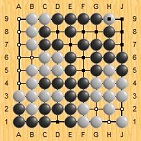
To paraphrase some things I've heard before:
Playing strange (random certain qualifies as strange) starting moves stops your opponent playing the opening by memory. ## I would say this is your key advantage, and this is a reasonably common idea
In amateur games, by pro standards many game losing mistakes are typically made on both sides.
And Kajiwara:
There are people who think that it makes little difference how they play in the opening. Ridiculous! A game is often decided in the opening.
Expanding on Kajiwara's thoughts; I think that if you are at a territorial disadvantage after the first few moves, you must struggle to catch up (which is hard/risky).
Random fuseki and other queer approaches to the go
-
cloud
- Dies in gote
- Posts: 64
- Joined: Sun May 02, 2010 9:58 pm
- Rank: AGA 4D
- GD Posts: 15
- Been thanked: 2 times
Re: Random fuseki and other queer approaches to the go
I agree that the opening is far less important than most players I have encountered (in the U.S.) think. If you look at the Korean approach to go (heavy emphasis on reading, playing faster games, playing more games as opposed to "studying"), they are on average far stronger players who improve much more rapidly. I would go as far as to say that playing random moves could actually be more useful in getting weaker players away from the bad habits of memorizing joseki, trying too hard to punish moves in the opening they see as "wrong", and seeing the whole board. I realize that a lot of players find the opening more interesting to study, but if the main goal is to further understand and improve at the game of go- then it's really not the most important thing.
-
Tooveli
- Lives with ko
- Posts: 160
- Joined: Fri Aug 20, 2010 8:14 am
- Rank: UK 3 dan
- GD Posts: 0
- Has thanked: 9 times
- Been thanked: 34 times
Re: Random fuseki and other queer approaches to the go
I've played many games on KGS with the first two moves or so on semi-random points (3rd line or higher, away from other stones). I don't think it makes any difference to the final result in blitz games. If anything, I think it's better as I become interested in the game from an earlier stage as I try to make my initial stones useful. Another advantage is the sheer number of people (at ~KGS 2D at least) that play out joseki even though their position falls apart only a few moves down the line due to a nearby 8-6 point or something. It's definitely worth trying as a good example of the proverb that memorising joseki is bad for you.
-
DrStraw
- Oza
- Posts: 2180
- Joined: Tue Apr 27, 2010 4:09 am
- Rank: AGA 5d
- GD Posts: 4312
- Online playing schedule: Every tenth February 29th from 20:00-20:01 (if time permits)
- Location: ʍoquıɐɹ ǝɥʇ ɹǝʌo 'ǝɹǝɥʍǝɯos
- Has thanked: 237 times
- Been thanked: 662 times
- Contact:
Re: Random fuseki and other queer approaches to the go
I think that the issue is that 2 dan players are really pretty weak in the opening. Even in slow games they make many mistakes but in blitz games it really doesn't matter. Try this strategy against a 5 dan and I think you will be well behind at the end the fuseki in every game.
Still officially AGA 5d but I play so irregularly these days that I am probably only 3d or 4d over the board (but hopefully still 5d in terms of knowledge, theory and the ability to contribute).
-
Liisa

- Lives with ko
- Posts: 129
- Joined: Wed Jun 16, 2010 3:30 am
- Rank: EGF 1989 KGS 2d
- GD Posts: 0
- Location: Turku, Finland
- Has thanked: 12 times
- Been thanked: 21 times
- Contact:
Re: Random fuseki and other queer approaches to the go
Actually I tried this against KGS 5 dan (about ORO 6-dan), and I won three stone random handicap game by 6 points (NZ rules was used). Then I played right away another regular handicap game with Japanese rules and I got crushed by 101.5 points. I did not have much chances during the game and I got continuously outread by white.DrStraw wrote:Try this strategy against a 5 dan and I think you will be well behind at the end the fuseki in every game.
Sample size of course is not statistically significant, but if there is much bigger difference than one stone, this should count something. So even 5-dans has some memorized patterns that are effective strategies against 4-4 handicap stones what they cannot utilize against random handicap stones.
-
Cassandra

- Gosei
- Posts: 1334
- Joined: Wed Apr 28, 2010 11:33 am
- Rank: German 1 Kyu
- GD Posts: 0
- Has thanked: 14 times
- Been thanked: 153 times
Re: Random fuseki and other queer approaches to the go
Perhaps you underestimated "standards" ?Liisa wrote:Then I played right away another regular handicap game with Japanese rules and I got crushed by 101.5 points.
The really most difficult Go problem ever: https://igohatsuyoron120.de/index.htm
Igo Hatsuyōron #120 (really solved by KataGo)
Igo Hatsuyōron #120 (really solved by KataGo)