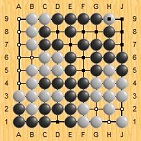
I'm going to be honest; I used to essentially not read at all. I did, you know, the subconscious sort of pattern recognition style reading that let me know how some jazz turned out.
After reading Kageyama's Lessons on the Fundamentals of Go, right near the start he nails people for not reading, and tells you to start manually/mentally reading out ladders (as a start) instead of tracing your finger/mouse across the board.
Totally worked for me. Anyway, to the point-
When you read, what's going on inside your head? I seem to flick between just a sort of pattern awareness crunching and actually visualising stones appearing in sequence. I find the visualising tougher, but I feel it's clearer, and this is what I strive to do in games.
So, howabout you ?
Reading: How do YOU do it

-
Dusk Eagle

- Gosei
- Posts: 1758
- Joined: Tue Apr 20, 2010 4:02 pm
- Rank: 4d
- GD Posts: 0
- Has thanked: 378 times
- Been thanked: 375 times
Re: Reading: How do YOU do it
I imagine the stones appearing on the board. If I know a sequence well, I can jump to the endpoint(s), but otherwise I just see one move at a time what one player can do, and then what the other can do in response. It's easy to do this sort of thing with ladders and forced moves, it takes a lot longer when there is a plethora of options at each step for both players (but it is also more beneficial).
We don't know who we are; we don't know where we are.
Each of us woke up one moment and here we were in the darkness.
We're nameless things with no memory; no knowledge of what went before,
No understanding of what is now, no knowledge of what will be.
Each of us woke up one moment and here we were in the darkness.
We're nameless things with no memory; no knowledge of what went before,
No understanding of what is now, no knowledge of what will be.
-
wms
- Lives in gote
- Posts: 450
- Joined: Tue Apr 20, 2010 4:23 pm
- GD Posts: 0
- KGS: wms
- Location: Portland, OR USA
- Has thanked: 257 times
- Been thanked: 287 times
- Contact:
Re: Reading: How do YOU do it
When I read I "see" the sequences in my head.
I enjoy reading tsumego. I don't so much enjoy reading more strategic sequences, so I don't do it so often.
I enjoy reading tsumego. I don't so much enjoy reading more strategic sequences, so I don't do it so often.
-
Phelan
- Gosei
- Posts: 1449
- Joined: Tue Apr 20, 2010 3:15 pm
- Rank: KGS 6k
- GD Posts: 892
- Has thanked: 1550 times
- Been thanked: 140 times
Re: Reading: How do YOU do it
I tend to jump too easily into pattern awareness mode, so I have to force myself to visualize moves one by one, and most importantly, to be thorough. One move you don't think of by the end of the decision tree can make a huge difference in whether you want to play it out or not. 
I find that doing whole-board ladder problems (Nakayama's are great )is a good way to train this visualization mode. It doesn't have the width of some other problems, but it has a lot of length, and forces you to keep long sequences in your mind.
I find that doing whole-board ladder problems (Nakayama's are great
)is a good way to train this visualization mode. It doesn't have the width of some other problems, but it has a lot of length, and forces you to keep long sequences in your mind.-
schultz

- Lives in gote
- Posts: 505
- Joined: Tue Apr 20, 2010 5:31 pm
- GD Posts: 0
- Location: Montana
- Has thanked: 80 times
- Been thanked: 62 times
Re: Reading: How do YOU do it
I usually try and read out move by move on the board. Having a semi photographic memory helps this, but I remember when I first started to play Go. Having done chess with it's much lower number of pieces, strict rules on movements, and small board, it was a lot easier for me to "see" the moves. This was some frustration for me when I first started playing Go. 
After some practice and plenty of games, I can definitely see variations play out in my head. At least sort of. Like Phelan mentioned, need to see all of the variations -- I don't know how many times I play some thing out only to have missed a move way down at the end of the tree that blows my move to pieces (and often, it's a response to my initial move anyway, so good on me for missing stuff...).
After some practice and plenty of games, I can definitely see variations play out in my head. At least sort of. Like Phelan mentioned, need to see all of the variations -- I don't know how many times I play some thing out only to have missed a move way down at the end of the tree that blows my move to pieces (and often, it's a response to my initial move anyway, so good on me for missing stuff...).
KGS: schultz [?].
-
unkx80
- Lives with ko
- Posts: 257
- Joined: Tue Apr 20, 2010 12:21 am
- Rank: Dan player
- GD Posts: 0
- Location: Singapore
- Has thanked: 13 times
- Been thanked: 30 times
- Contact:
Re: Reading: How do YOU do it
A mixture of pattern matching and visualizing the moves one by one. Therefore, I'm good for finding a sequence that works, but enumerating all possible sequences is a nightmare for me.
For go the stones largely static, so I do okay. In chess, I just can't visualize moving pieces.
For go the stones largely static, so I do okay. In chess, I just can't visualize moving pieces.
My homepages: http://senseis.xmp.net/?Unkx80 and http://yeefan.sg/.
-
MountainGo

- Lives with ko
- Posts: 263
- Joined: Tue Apr 20, 2010 9:23 pm
- Rank: KGS 5-kyu
- GD Posts: 60
- Location: Philadelphia, PA
- Has thanked: 32 times
- Been thanked: 10 times
- Contact:
Re: Reading: How do YOU do it
I often struggle with avoiding the compulsion to envision every possible sequence. For example, consider a tsumego situation on the edge of the board where one side could capture a stone to make a false eye. As a beginner, even after I understood why that type of move was pointless and wrong, I couldn't stop myself from picturing it over and over in my head, black, white, black, white. That sort of thing really hurt my tsumego skills, because I couldn't focus on just the moves that mattered. It's because of this idea that I'm a strong supporter in finding principles that let you avoid reading as much as possible.
But when I do have to read, I like to envision the shapes forming on the board. I don't say, "and then Black puts a stone on this coordinate." I say, "And then Black extends this chain to a 4-in-a-row shape" or what have you.
But when I do have to read, I like to envision the shapes forming on the board. I don't say, "and then Black puts a stone on this coordinate." I say, "And then Black extends this chain to a 4-in-a-row shape" or what have you.
-
schultz
- Lives in gote
- Posts: 505
- Joined: Tue Apr 20, 2010 5:31 pm
- GD Posts: 0
- Location: Montana
- Has thanked: 80 times
- Been thanked: 62 times
Re: Reading: How do YOU do it
That's a really good concept and one that I am not very good at. I very much like the suggestion, though. Guess it's some thing to add to my list of things to work on. Thanks.MountainGo wrote:I often struggle with avoiding the compulsion to envision every possible sequence. For example, consider a tsumego situation on the edge of the board where one side could capture a stone to make a false eye. As a beginner, even after I understood why that type of move was pointless and wrong, I couldn't stop myself from picturing it over and over in my head, black, white, black, white. That sort of thing really hurt my tsumego skills, because I couldn't focus on just the moves that mattered. It's because of this idea that I'm a strong supporter in finding principles that let you avoid reading as much as possible.
But when I do have to read, I like to envision the shapes forming on the board. I don't say, "and then Black puts a stone on this coordinate." I say, "And then Black extends this chain to a 4-in-a-row shape" or what have you.
KGS: schultz [?].