It has been enlightening to me to find out how people think about these problems,
One of my old problems
-
Bill Spight
- Honinbo
- Posts: 10905
- Joined: Wed Apr 21, 2010 1:24 pm
- Has thanked: 3651 times
- Been thanked: 3373 times
Re: One of my old problems
Again, many thanks to the solvers.
It has been enlightening to me to find out how people think about these problems,
Also, it is gratifying that so many feel that they are learning something about getting the last play.
I am going to pass that along to Berlekamp and Wolfe, the authors of Mathematcal Go, which is where I learned this stuff.
It has been enlightening to me to find out how people think about these problems,
The Adkins Principle:
At some point, doesn't thinking have to go on?
— Winona Adkins
Visualize whirled peas.
Everything with love. Stay safe.
At some point, doesn't thinking have to go on?
— Winona Adkins
Visualize whirled peas.
Everything with love. Stay safe.
-
walleye
- Dies with sente
- Posts: 124
- Joined: Wed Apr 28, 2010 7:56 pm
- Rank: IGS 1k
- GD Posts: 0
- Has thanked: 5 times
- Been thanked: 13 times
Re: One of my old problems
These deliberations are very interesting of course. But I'm wondering if this is the best way to improve one's endgame.
In a game, most of the time it's not necessary to compute exact values of moves. It's usually enough to find the largest place and play there, taking sente and miai into account of course. Only relative size of various plays matters.
Take a look at this elementary problem. How quickly can you decide which place is bigger, top or bottom?
I don't really want to compute the size of plays there. What I want is something like an intuitive feel for the relative size of the two places. And a good way to develop this skill is to solve hundreds or even thousands of simple yose problems where there are only two or three unsettled boundaries left and you just have to pick the largest place.
ひと目のヨセ (http://senseis.xmp.net/?YoseAtAGlance) by Cho Chikun attempts to do something like this, but it only has about a hundred problems. I need more.
In a game, most of the time it's not necessary to compute exact values of moves. It's usually enough to find the largest place and play there, taking sente and miai into account of course. Only relative size of various plays matters.
Take a look at this elementary problem. How quickly can you decide which place is bigger, top or bottom?
I don't really want to compute the size of plays there. What I want is something like an intuitive feel for the relative size of the two places. And a good way to develop this skill is to solve hundreds or even thousands of simple yose problems where there are only two or three unsettled boundaries left and you just have to pick the largest place.
ひと目のヨセ (http://senseis.xmp.net/?YoseAtAGlance) by Cho Chikun attempts to do something like this, but it only has about a hundred problems. I need more.
-
lightvector
- Lives in sente
- Posts: 759
- Joined: Sat Jun 19, 2010 10:11 pm
- Rank: maybe 2d
- GD Posts: 0
- Has thanked: 114 times
- Been thanked: 916 times
Re: One of my old problems
walleye wrote:These deliberations are very interesting of course. But I'm wondering if this is the best way to improve one's endgame.
In a game, most of the time it's not necessary to compute exact values of moves. It's usually enough to find the largest place and play there, taking sente and miai into account of course. Only relative size of various plays matters.
Take a look at this elementary problem. How quickly can you decide which place is bigger, top or bottom?
I don't really want to compute the size of plays there. What I want is something like an intuitive feel for the relative size of the two places. And a good way to develop this skill is to solve hundreds or even thousands of simple yose problems where there are only two or three unsettled boundaries left and you just have to pick the largest place.
ひと目のヨセ (http://senseis.xmp.net/?YoseAtAGlance) by Cho Chikun attempts to do something like this, but it only has about a hundred problems. I need more.
For common endgame moves, you don't need to compute. You can just know the values in advance, which isn't hard.
The top move is 1 point because it's a gote hane+connect, the bottom is just shy of 1 because it's a corridor push. So black plays the top, solved on sight (there's also a tedomari issue, but...). I don't ever actually compute the value of a complicated move during a game, unless it's a big trade or something (and then only approximately).
For me, having a few values gives a useful anchor. The following scale is roughly what I have off the top of my head, and is really useful for me in games.
1/3:
Final endgame ko
1/2:
Gote push to destroy 1 point
1/2 to 1:
Push down corridor ending in dead end (closer to 1 if longer)
1:
Sente push or push that is "eventually" sente (the corridor leads to a sente move at the end)
Gote 1st line hane-connect
Capture 1 stone and make 1 territory
Destroy 2 points
Capture2-recapture1 (this one's useful to know)
3:
1st line hane-connect sente for one side
2nd line hane-connect with gote followups
Capturing 2nd line stone with gote followups
4-5:
1st line hane-connect that can't be directly blocked by one side
Playing/blocking "typical" gote monkey jump
~4-10:
Capturing 2nd line stone with varying senteness/severity of followups
2nd line hane connect with varying senteness/severity of followups
8
Playing/blocking "typical" sente monkey jump
~11-14+
Medium to large opening moves
~14
Opening move, taking empty corner
~N/2:
Make a move that turns N potential points into dame
~N:
Save N stones
Resolve a small capturing race with N stones involved (owned by either player)
Basically, I play a lot by feel too, but having this rough scale in mind makes it a lot easier to keep everything coherent, and helps compare things like capturing stones with first line and second line moves. It's nice to instantly know that your second line hane and connect is better than saving 4 stones from capture.
-
robinz
- Lives in gote
- Posts: 414
- Joined: Thu Sep 16, 2010 3:40 am
- Rank: KGS 9k
- GD Posts: 0
- KGS: robinz
- Location: Durham, UK
- Has thanked: 95 times
- Been thanked: 15 times
Re: One of my old problems
I'm afraid to say that I've not really attempted most of these endgame problems that Bill (and others) has posted lately. And this despite me being about the 10k "target audience" - the first problem was just a bit too fiddly for me to solve at any speed, and didn't seem enough fun to want to spend time working it out
I guess I need to learn from the experts here how to evaluate the size of these plays quickly. Right now I have to read out 3 or 4 moves, then compare the two positions, before I can say "OK, so A is a 2 point gote" (or whatever).
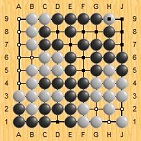

Because walleye's problem is so small, it was easy enough for me to figure out that the top was bigger than the bottom, but only because I was able to read all the way to the end of the game in both cases, to see that starting on top led to a win by one whereas starting on the bottom was jigo. But it wasn't intuitively obvious to me what the answer would be from simply looking at the position.
I'm not sure what this proves, other than that my endgame sucks
(Although, at my club I quite often get to take white in high handicap games on small board against near-beginners; and against those who don't gratuitously let their groups die, most of my wins in these situations come from bossing them about in the endgame, so I guess my endgame isn't that terrible compared to my rank. I feel I'm OK on the general principle that you shouldn't just follow your opponent around, but make sente plays of your own if they threaten something bigger than your opponent's last "sente" play does. I'm just not very good at choosing the biggest move - particularly online when I'm always in byoyomi by the endgame, and 30 seconds just doesn't seem long enough for me to decide which the biggest areas are.)
Because walleye's problem is so small, it was easy enough for me to figure out that the top was bigger than the bottom, but only because I was able to read all the way to the end of the game in both cases, to see that starting on top led to a win by one whereas starting on the bottom was jigo. But it wasn't intuitively obvious to me what the answer would be from simply looking at the position.
I'm not sure what this proves, other than that my endgame sucks
(Although, at my club I quite often get to take white in high handicap games on small board against near-beginners; and against those who don't gratuitously let their groups die, most of my wins in these situations come from bossing them about in the endgame, so I guess my endgame isn't that terrible compared to my rank. I feel I'm OK on the general principle that you shouldn't just follow your opponent around, but make sente plays of your own if they threaten something bigger than your opponent's last "sente" play does. I'm just not very good at choosing the biggest move - particularly online when I'm always in byoyomi by the endgame, and 30 seconds just doesn't seem long enough for me to decide which the biggest areas are.)
- Loons
- Gosei
- Posts: 1378
- Joined: Tue Apr 20, 2010 4:17 am
- GD Posts: 0
- Location: wHam!lton, Aotearoa
- Has thanked: 253 times
- Been thanked: 105 times
Re: One of my old problems
Considering I answered the last one correctly simply by my first pass being lucky, I will be interested in if and how I've made mistakes. I did intentionally take the last move (successfully, I believe) this time. Thanks for the fun, Bill.
My Solution and slight variations:
- Mnemonic
- Lives in gote
- Posts: 324
- Joined: Wed Aug 11, 2010 10:41 pm
- Rank: KGS 7 kyu
- GD Posts: 0
- KGS: Mnemonic, dude13
- Location: Dresden
- Has thanked: 26 times
- Been thanked: 22 times
Re: One of my old problems
@ robinz:
If you have not done the first problem go back and try it. Although I spent 40 minutes on it and never got close, the resulting discussion helped a lot. Now I still got this one wrong, but in greatly reduced time, and since several Dan players didn't read my mistake, I am not too shaken about it
What the results show is that endgame is probably the most neglected area of study and everyone sucks at it. (As a dan player I would seriously consider Bill's book suggestion. You could probably improve by a stone just by ramping up you yose skillz)
Although I remarked above that everybody sucked at endgame, I guess they suck a different levels (sounds like go
) Endgame skill is based imo 40% on reading and 60% on experience. Higher ranked players should have more of both. My formula for my handicap games is: When we enter yose black should be ahead by rank difference*5 to make it a close game.
Also, do you read while it's your opponents turn? It might not be particularly helpful in the opening, but especially in yose where the possibilities are greatly reduced, even shrubs like us should be capable of reading a few moves in advance.
If you have not done the first problem go back and try it. Although I spent 40 minutes on it and never got close, the resulting discussion helped a lot. Now I still got this one wrong, but in greatly reduced time, and since several Dan players didn't read my mistake, I am not too shaken about it
What the results show is that endgame is probably the most neglected area of study and everyone sucks at it. (As a dan player I would seriously consider Bill's book suggestion. You could probably improve by a stone just by ramping up you yose skillz)
At my club I quite often get to take white in high handicap games on small board against near-beginners; and against those who don't gratuitously let their groups die, most of my wins in these situations come from bossing them about in the endgame, so I guess my endgame isn't that terrible compared to my rank.
Although I remarked above that everybody sucked at endgame, I guess they suck a different levels (sounds like go
Also, do you read while it's your opponents turn? It might not be particularly helpful in the opening, but especially in yose where the possibilities are greatly reduced, even shrubs like us should be capable of reading a few moves in advance.
While I was teaching the game to a friend of mine, my mother from the other room:
"Cutting? Killing? Poking out eyes? What the hell are you playing?"
-
Bill Spight
- Honinbo
- Posts: 10905
- Joined: Wed Apr 21, 2010 1:24 pm
- Has thanked: 3651 times
- Been thanked: 3373 times
Re: One of my old problems
walleye wrote:Take a look at this elementary problem. How quickly can you decide which place is bigger, top or bottom?
I don't really want to compute the size of plays there. What I want is something like an intuitive feel for the relative size of the two places. And a good way to develop this skill is to solve hundreds or even thousands of simple yose problems where there are only two or three unsettled boundaries left and you just have to pick the largest place.
You can also calculate the sizes of hundreds of plays.
As for this example, my first impression is that these plays are not independent. My second is that a play here gains about 1 point. My third is that the top is surely Black's best spot, but White may have a play in the bottom.
Closer inspection reveals that a play at the top gains 1.125 points for either player.
actually gains 1.125 points, too.
gains 1.5 points in reply, for a loss to White of 0.375 points. Also, consider this variation at area scoring:
After
,
sacrifices a stone to take away the eye and set up the ko, leaving this position.Can you tell at a glance where Black should play?
The bottom is a 1 point sente for White (2 points by area scoring), while the top is a 1/3 point ko (1 1/3 points by area scoring).
Black plays the reverse sente and White takes the ko. Black has no ko threat, so the end result is this.
White wins by 1 point.
Black should fill the ko.
Black gets the last play to win the game.
Now, isn't that more fun than just saying, the top looks bigger to me?
The Adkins Principle:
At some point, doesn't thinking have to go on?
— Winona Adkins
Visualize whirled peas.
Everything with love. Stay safe.
At some point, doesn't thinking have to go on?
— Winona Adkins
Visualize whirled peas.
Everything with love. Stay safe.
-
mitsun
- Lives in gote
- Posts: 553
- Joined: Fri Apr 23, 2010 10:10 pm
- Rank: AGA 5 dan
- GD Posts: 0
- Has thanked: 61 times
- Been thanked: 250 times
Re: One of my old problems
This problem can be solved fairly simply, without reading long sequences, by noticing that it is a "corridor" problem, with a long corridor on top and a short corridor on bottom. B should simply play along the longer corridor whenever possible. If W blocks at some point, B switches to the bottom, taking the last point. By starting with a descent, B can avoid worrying about possible ko.
- Loons
- Gosei
- Posts: 1378
- Joined: Tue Apr 20, 2010 4:17 am
- GD Posts: 0
- Location: wHam!lton, Aotearoa
- Has thanked: 253 times
- Been thanked: 105 times
Re: One of my old problems
The reading in these problems is fun for me because the reading flows around a couple of locations to get a desirable result, compared to eg. L&D or tesuji protracted local sequences, with also an extra emphasis on order of moves. Sure, the specific relevance is + or - one point at the end of the game (which is an important issue occasionally) but it still is reading muscle exercise (insofaras that is a thing
).
-
Bill Spight
- Honinbo
- Posts: 10905
- Joined: Wed Apr 21, 2010 1:24 pm
- Has thanked: 3651 times
- Been thanked: 3373 times
Re: One of my old problems
The key decision in this problem is which connection to make, "a", "b", or "c". When I was learning go I realized that they were all the same size, and wondered how to tell which one was best. Sometimes there are tactical reasons for one or the other, such as life and death. But is there a general rule?
It turns out that, when ko is not a consideration, there is. One option is dominant, whatever (non-ko) plays are elsewhere on the board.
The Adkins Principle:
At some point, doesn't thinking have to go on?
— Winona Adkins
Visualize whirled peas.
Everything with love. Stay safe.
At some point, doesn't thinking have to go on?
— Winona Adkins
Visualize whirled peas.
Everything with love. Stay safe.
is correct, but
gets the last play. After
the rest is miai.
. The rest is miai.