Hi!
First of all, happy new year!
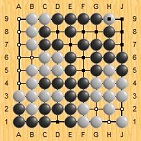
Would you say the three identical black shapes are equally spaced in each of the four quadrants?
http://bayimg.com/eALjpaadK
greetings and thanks in advance for any suggestions, Niek
question about shapes and formations
-
Dusk Eagle

- Gosei
- Posts: 1758
- Joined: Tue Apr 20, 2010 4:02 pm
- Rank: 4d
- GD Posts: 0
- Has thanked: 378 times
- Been thanked: 375 times
Re: question about shapes and formations
I don't really get the question. Is it a go question, or more of a riddle?
We don't know who we are; we don't know where we are.
Each of us woke up one moment and here we were in the darkness.
We're nameless things with no memory; no knowledge of what went before,
No understanding of what is now, no knowledge of what will be.
Each of us woke up one moment and here we were in the darkness.
We're nameless things with no memory; no knowledge of what went before,
No understanding of what is now, no knowledge of what will be.
-
Loons
- Gosei
- Posts: 1378
- Joined: Tue Apr 20, 2010 4:17 am
- GD Posts: 0
- Location: wHam!lton, Aotearoa
- Has thanked: 253 times
- Been thanked: 105 times
Re: question about shapes and formations
I would say no.
The groups' connections differ: 'A' are connected by a large knight's move, 'b' a knight's move, 'c' a diagonal move. Also the thickness/overconcentration of the stones involved.
Happy new year.
The groups' connections differ: 'A' are connected by a large knight's move, 'b' a knight's move, 'c' a diagonal move. Also the thickness/overconcentration of the stones involved.
Happy new year.
Last edited by Loons on Sun Jan 01, 2012 2:13 am, edited 2 times in total.
-
EdLee
- Honinbo
- Posts: 8859
- Joined: Sat Apr 24, 2010 6:49 pm
- GD Posts: 312
- Location: Santa Barbara, CA
- Has thanked: 349 times
- Been thanked: 2070 times
-
ez4u

- Oza
- Posts: 2419
- Joined: Wed Feb 23, 2011 10:15 pm
- Rank: Jp 6 dan
- GD Posts: 0
- KGS: ez4u
- Location: Tokyo, Japan
- Has thanked: 2355 times
- Been thanked: 1337 times
Re:
Ah, now I understand (which I did not before). Since the grid is helpful in dispelling any purely optical illusions, I guess the question comes down to whether we choose to interpret "spaced" in the original statement through any go-related filters or are content to base our answer on the purely physical arrangement. Since there is no indication one way or another in the original post, the question is purely about the person answering rather than the diagram. Anyway, I pass. (Remember Bill's dictum, "Tenuki is always an option!")EdLee wrote:He means this:

Dave Sigaty
"Short-lived are both the praiser and the praised, and rememberer and the remembered..."
- Marcus Aurelius; Meditations, VIII 21
"Short-lived are both the praiser and the praised, and rememberer and the remembered..."
- Marcus Aurelius; Meditations, VIII 21
-
dohduhdah
- Dies with sente
- Posts: 109
- Joined: Tue Oct 26, 2010 5:57 pm
- Rank: KGS 4 kyu
- GD Posts: 0
- KGS: kneh
- Has thanked: 8 times
- Been thanked: 4 times
Re: question about shapes and formations
Like EdLee indicates in the picture with marked stones, my question is more or less whether there is a way to abstract from the particular shapes of groups of connected stones when considering how they are spatially related on the go board.Dusk Eagle wrote:I don't really get the question. Is it a go question, or more of a riddle?
-
hyperpape
- Tengen
- Posts: 4382
- Joined: Thu May 06, 2010 3:24 pm
- Rank: AGA 3k
- GD Posts: 65
- OGS: Hyperpape 4k
- Location: Caldas da Rainha, Portugal
- Has thanked: 499 times
- Been thanked: 727 times
Re: question about shapes and formations
Put that way, the answer is yes. There are many ways to answer that question in the abstract. The simplest one would be to take the smallest manhattan distance between any two points of the connected stones (with some rule to avoid ties). I'm not sure whether that would be useful for anything, though.dohduhdah wrote:Like EdLee indicates in the picture with marked stones, my question is more or less whether there is a way to abstract from the particular shapes of groups of connected stones when considering how they are spatially related on the go board.Dusk Eagle wrote:I don't really get the question. Is it a go question, or more of a riddle?
If you let us know why you're asking that question and what your constraints are, we might be able to give advice on whether there's a way to do it that fits your interest.
-
dohduhdah
- Dies with sente
- Posts: 109
- Joined: Tue Oct 26, 2010 5:57 pm
- Rank: KGS 4 kyu
- GD Posts: 0
- KGS: kneh
- Has thanked: 8 times
- Been thanked: 4 times
Re: question about shapes and formations
I'm thinking about a way to store patterns in go in an optimal fashion. I'd like to program a bot that can learn from experience by accumulating knowledge (in the form of patterns it learns to recognize) based on playing many games. You can store the shape of a group of connected stones in a way that is independent of rotations, translations and reflections. Likewise it seems it must be possible to store patterns in a formation of groups on the board.hyperpape wrote:Put that way, the answer is yes. There are many ways to answer that question in the abstract. The simplest one would be to take the smallest manhattan distance between any two points of the connected stones (with some rule to avoid ties). I'm not sure whether that would be useful for anything, though.dohduhdah wrote:Like EdLee indicates in the picture with marked stones, my question is more or less whether there is a way to abstract from the particular shapes of groups of connected stones when considering how they are spatially related on the go board.Dusk Eagle wrote:I don't really get the question. Is it a go question, or more of a riddle?
If you let us know why you're asking that question and what your constraints are, we might be able to give advice on whether there's a way to do it that fits your interest.
The idea of patterns might be a bit vague. But consider the concept of atari. In a way this concept can be understood as all possible situations (*) where there is a group on the board that has only a single liberty left. As a program continues to learn, at some point it should come up with such concepts by itself and learn to distinguish them. For some concepts like 'atari' it's relatively easy and concrete, but for other concepts, like 'influence' or 'tewari' it's more fuzzy and abstract.
(*) Where a situation is understood as a configuration of stones on the board as well as a history of past states that have occurred in the particular game where this configuration occurs, which allows one to determine if a particular move is allowed or not (taking the superko rule into consideration).
-
dohduhdah
- Dies with sente
- Posts: 109
- Joined: Tue Oct 26, 2010 5:57 pm
- Rank: KGS 4 kyu
- GD Posts: 0
- KGS: kneh
- Has thanked: 8 times
- Been thanked: 4 times
Re: question about shapes and formations
I guess the easiest way to associate a location with any particular shape is to simply take the center of its bounding box as its associated location. Which means there are 1369 potential locations for shapes on a 19x19 go board.dohduhdah wrote: I'm thinking about a way to store patterns in go in an optimal fashion. I'd like to program a bot that can learn from experience by accumulating knowledge (in the form of patterns it learns to recognize) based on playing many games. You can store the shape of a group of connected stones in a way that is independent of rotations, translations and reflections. Likewise it seems it must be possible to store patterns in a formation of groups on the board.
The idea of patterns might be a bit vague. But consider the concept of atari. In a way this concept can be understood as all possible situations (*) where there is a group on the board that has only a single liberty left. As a program continues to learn, at some point it should come up with such concepts by itself and learn to distinguish them. For some concepts like 'atari' it's relatively easy and concrete, but for other concepts, like 'influence' or 'tewari' it's more fuzzy and abstract.
(*) Where a situation is understood as a configuration of stones on the board as well as a history of past states that have occurred in the particular game where this configuration occurs, which allows one to determine if a particular move is allowed or not (taking the superko rule into consideration).
http://bayimg.com/kALhbAAdm