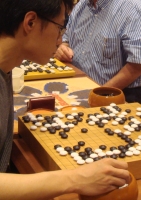
I had always thought that the word “sensei” is (mostly) used as an honorary word, appended to the name of the adressee, and also used to denote a third person as being a great/master teacher … perhaps even more as a personal statement like “s/he is _my_ teacher”.
This led to some irritation on my side when I recently read that some person is promoting their Go teaching by calling themselves “[soandso] sensei”. I would not feel the same irritation if the person would just call themselves a “Go teacher”, but this sounds to me just like somebody saying they are a “guru”, while again—for me—the word “guru” is something quite personal, I have a hard time accepting it if anybody calls somebody “_a_” guru instead of “_my_ guru”. For me, sensei/guru does not exist outside of a personal teacher/student relationship.
If you are familiar with the Japanese culture and language … what’s your opinion here? Am I wrong in assuming that calling oneself (a) “sensei” is quite some vanity? Is it widely acceptable to use “sensei” just like “teacher”? (In which case probably I myself am the vain person and should gauge down my level of moralinic acid )
TIA, and wishing you all (and everybody else) a peaceful and happy [whatever you celebrate],
Tom
“The only difference between me and a madman is that I’m not mad.” — Salvador Dalí
This is a can of worms. Very many Japanese find the use of sensei for go and shogi players odd. So much so that, around 1980 I believe, NHK instructed its games-show comperes to address players as so-and-so Meijin or so-and-so 9-dan instead of the then usual so-and-so sensei. The problem arose because the compere was invariably a low-dan, young, female go or shogi pro who, within the go or shogi world, was used to saying sensei as the players on the programme would normally be higher ranked and older. No doubt the instruction, if still in force, is breached now and then, but I'd imagine the prevalence of teeny-boppers among the top players nowadays would make the use of sensei stick in the craw of even more people.
It is a mark of respect within the go world, from the days when pupils in a go school would literally be taught by the "earlier born pupils" (the meaning of sensei), and many amateur fans, but by no means all, have latched on to this usage. But to use it within the go world of yourself is a silly solecism - or over here, a case of oriental kitsch, somewhat similar to martial artists here calling themselves sifu.
But outside the go and shogi worlds the word sensei can be used as a generic word for teacher. Since it takes the full range of plural markers (-tachi, -ra- -gata, -domo) it is clearly not meant to be exclusively personal, and since pejorative phrases such as 'demoshika sensei' (a teacher of sorts) exist, it is clearly not always meant to be a mark of esteem.
What happens when the inside and outside worlds collide? The Japanese have a wide range of structures to bypass the need to refer to someone directly while still being very polite (e.g. the o-VERB-I form as in o-kaeri desu ka - are you leaving), and there's never anything wrong with saying -san instead. Indeed, I have heard that there is a growing tendency even in ordinary schools for pupils now to refer to teachers as so-and-so san.
Even that only scratches at the surface, though. One subtle area is the juncture between name and sensei (or other title). Some (most?) people make a distinction between omitting and retaining the juncture. If you swallow up the juncture it implies the person is very famous. If you leave the (minor) juncture, it implies the person is not famous.
It's a little bit like our newspaper splash-boards. "Fred Astaire dies" tells us Fred Astaire was very famous. "Hollywood star dies" tells us he wasn't a star but you might vaguely recognise his face. In go and shogi perhaps the most famous example of this swallowed juncture was the shogi Meijin Oyama Yasuharu, who died in 1992. Even among people who didn't play shogi he was always known as OyamaMeijin (rather than Oyama Meijin). I've never heard ChoMeijin or SakataHoninbo among the populace at large, though I have sometimes heard TakagawaHoninbo. However, though again only within the go world, sensei without the juncture is often heard (if appropriate).
BTW, OyamaMeijin, whom I was fortunate enough to meet, brought shogi one distinction over go in that (as far as I know) he's the only Japanese games player to get an obit in a major UK newspaper - The Independent.
Generally in Japanese culture people don't use any honorifics/title words when referring to themselves or groups they belong to. On the other hand, there are some professions where it is expected to refer to a group of people as sensei (not just a personal teacher). For example: doctors, lawyers, politicians. Sensei can also be used as a standalone word which is probably where the confusion arises... however I believe it's still rare for people to refer to themselves in that way. More often, Japanese folk will choose a less direct description/approach.
From Wikipedia:
"Satguru (Sanskrit: सदगुरू), or sadguru, means the true guru. However the term is distinguished from other forms of gurus, such as musical instructors, scriptural teachers, parents, and so on. The satguru is a title given specifically only to an enlightened rishi/sant whose life's purpose is to guide initiated shishya along the spiritual path, the summation of which is the realization of the Self through realization of God, who is omnipresent..."
While I have the greatest respect for your knowledge (not just in Go), Bill. This bit about 'realization of God' may, I say again may, be just a bit overly confident on your part.
Dave Sigaty
"Short-lived are both the praiser and the praised, and rememberer and the remembered..."
- Marcus Aurelius; Meditations, VIII 21
Marcel Grünauer wrote:[..] In the Go world, I've never heard of someone referring to himself as "sensei". [..]
It does happen, namely in the US Go world, which is why I asked here, even their Twitter acct is named “[So-and-so] Sensei”.
Perhaps they are using the alternative version of sensei: Some Eccentric Nerd Serving Egocentric Interests.
Still officially AGA 5d but I play so irregularly these days that I am probably only 3d or 4d over the board (but hopefully still 5d in terms of knowledge, theory and the ability to contribute).
EdLee wrote:Hi Bonobo, how do you feel if people ask others to refer to themselves with the Mr. prefix ?
I feel the same about that … it just sounds stupid to me. IMO people “should” just say their names, and (usually) others would, in most situations, know how to address them.
Do you know what's the situation in German ?
Marcel already answered, but I don’t agree 100% with it:
Marcel Grünauer wrote:I'm from Vienna, Austria, so German is my native language as well. People don't refer to themselves as "Herr X" or "Frau Y".
Well, some people actually do so. I’ve lectured/taught/instructed in adult education for about ten years, and I have often heard colleagues introduce themselves to participants of courses as “Herr X” and “Frau Y” — and, interestingly, these were (IMNSHO) that kind of teachers who have (who actually ARE) an authority problem (i.e. who act in an authoritarian way and feel the need to show their place in a strict hierarchy instead of just being an authority on basis of what they know and who they are).
When I introduce myself, I say “I am [first name last name]” (more seldom “my name is …), which is who I believe I am. I am NOT “Herr Rohde”, that’s how people address me (if they don’t just call me “Tom”, which I usually prefer).
OTOH if I introduce somebody else, I might say “this is Herr/Frau XY”, but not necessarily so, I usually say “this is [first name] [last name]” since (again usually) people know how to address people appropriately for a situation. It has NEVER happened to me that people addressed me in any situationally “inappropriate” way (and no, I don’t believe that I am an awe-inspiring or frightening person).
But when they have a title ("Doktor", "Professor"), a lot of people use that when they introduce themselves and also more or less insist that others use the title.
Yeah <sigh>
Thing is, people who have achieved these titles are exactly this: entitled … to be called “Herr/Frau Professor Doctor XY”, i.e. they have a right to insist on this, but IMNSHO people who really insist (every time) are usually the same kind of jerks I have mentioned above re: “authority problem”.
Often people leave out the given name and refer to the person, both directly and indirectly, as "Herr Professor" or "Frau Doktor", for example.
Yeah, that’s how vermin (have to) treat (demi)gods, right?
BTW I can’t really recommend this habit of distinguishing between “authority” and “authoritarian behaviour” except if you want to be a PITA for authoritarian people … because this will most probably prevent any progress in hierarchical systems — except if you’re an authority. But sometimes even then.
Reminds me of this:
[..]
“You are sad,” the Knight said in an anxious tone: “Let me sing you a song to comfort you.”
“Is it very long?” Alice asked, for she had heard a good deal of poetry that day.
“It’s long,” said the Knight, “but it’s very, very beautiful. Everybody that hears me sing it — either it brings the tears to their eyes, or else —”
“Or else what?” said Alice, for the Knight had made a sudden pause.
“Or else it doesn’t, you know. The name of the song is called ‘Haddocks’ Eyes.’”
“Oh, that's the name of the song, is it?" Alice said, trying to feel interested.
“No, you don’t understand,” the Knight said, looking a little vexed. “That’s what the name is called. The name really is ‘The Aged Aged Man.’”
“Then I ought to have said ‘That’s what the song is called’?” Alice corrected herself.
“No, you oughtn’t: that’s quite another thing! The song is called ‘Ways And Means’: but that’s only what it’s called, you know!”
“Well, what is the song, then?” said Alice, who was by this time completely bewildered.
“I was coming to that,” the Knight said. “The song really is ‘A-sitting On A Gate’: and the tune’s my own invention.”
Naming
The White Knight explains a confusing nomenclature for the song.
• The song's name is calledHaddocks' Eyes
• The song's name is The Aged Aged Man
• The song is calledWays and Means
• The song isA-sitting on a Gate
The complicated terminology distinguishing between 'the song, what the song is called, the name of the song, and what the name of the song is called' entails the use–mention distinction.
“The only difference between me and a madman is that I’m not mad.” — Salvador Dalí
What came to my mind after returning to this thread (thanks, Marcel) is that there probably is some cultural difference between Austria and Germany, inasmuch as AT, to me, i.e. seen from the outside, seems to be a land of courtesy, while Germans are not exactly known for having invented politeness, modesty, and humility (this I know both from inside and outside of Germany).
</Ingrid>
Last edited by Bonobo on Mon Oct 08, 2018 6:49 pm, edited 1 time in total.
“The only difference between me and a madman is that I’m not mad.” — Salvador Dalí
I usually just introduce myself as Steve Fawthrop, or sometimes just Steve. Away from the university I would never think of adding any title. I am sure most people are not even aware that I have one. At the university I also introduce myself that way with staff and faculty, but at the start of each course I tell the students I am Dr. Steve Fawthrop, giving my full name, and expect them to address me as Dr. Fawthrop. Many of them do, but some will call me Mr. Fawthrop. I generally find that those whose parents attended college or who are in their third or fourth year will use Dr., those who are new, first generation will use Mr.
Still officially AGA 5d but I play so irregularly these days that I am probably only 3d or 4d over the board (but hopefully still 5d in terms of knowledge, theory and the ability to contribute).

 )
)