
Ah, but you don't have "nothing but single-digit coordinates". In the present system you go from 1..9 and then continue with 10..19. In the new system you would go from 9..0 and then continue with -1...-9. Either way you need a second "sign" - be it a '1' or an '-'. You simply cannot represent 19 lines with only 10 symbols, you need some kind of addition, either more symbols or more (decimal?) places.Loons wrote:@Bantari
I can't help but point out neither 12 nor 10 would be on a 19x19 board. So nothing but single-digit numbers for coordinates on normal board sizes would be an advantage.
As for you pointing out that there would be no 12, point taken.
But (almost) the same could have been said about somebody writing '9' or '3'. There is still less definition to that under new system than under old.
As I said, for computers you use the systems which are best for what they do, translating from system to system is a trivial matter in this case. I can imagine a single program could use multiple different systems to internalize the data, depending on the task at hand, and then translating from one to the other for the clarity of algorithms.I was gripped by this while writing java code to rotate boards, so. I do think it is a more elegant and symmetrical system, and go is to me a very elegant and symmetrical game. Compared to labelling one of the axis with letters a-t (except for i, most of the time) and the highest magnitude number possible. I would still put coordinates along the edges of the board, were I to make one. Hey, I should.
In your example, rotation of boards, I can see where the digints-only tengen-based system would be more efficient and much easier to code. But then - have a simple (hard-coded even) conversion matrix and you can move back-and-forth between the system in a blink. I would assume that some less trivial tasks, like reading/writing existing sgf files, could be done much easier if you used the existing system. Just to see a different example.
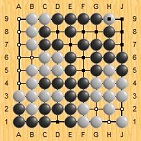


 .
.