This is off-topic, but I don't see the need to use spoiler tags unless it's a spoiler you are hiding. Hidden texts just make the thread more difficult to read imo, especially on some phone browsers.peti29 wrote: As for the other topic that apparently needs to be put into spoiler tags...
bilingualism and go strength
-
daal

- Oza
- Posts: 2508
- Joined: Wed Apr 21, 2010 1:30 am
- GD Posts: 0
- Has thanked: 1304 times
- Been thanked: 1128 times
Re: bilingualism and go strength
Patience, grasshopper.
-
wineandgolover

- Lives in sente
- Posts: 867
- Joined: Sun Jul 25, 2010 6:05 am
- GD Posts: 0
- Has thanked: 318 times
- Been thanked: 346 times
Re: bilingualism and go strength
Perhaps if you moved to China, you'd progress similarly? I'm not sure when you learned German, but I suspect total immersion had something to do with your current skill. I'd bet it was much more "work" than a few hours a day over a goban.daal wrote: It didn't take me much effort to get to the equivalent of 1d level in my second language (at age 25), and after immersing myself in it, I got to 5d without particularly working at it. I've already put much more work into go and Chinese and am still quite weak at both. I don't see much of a connection.
- Brady
-
Amelia
- Lives with ko
- Posts: 238
- Joined: Thu Feb 14, 2013 5:41 am
- Rank: 10k
- GD Posts: 0
- KGS: Soji
- DGS: Soji
- Online playing schedule: KGS usually Friday 20:00-23:00
- Has thanked: 53 times
- Been thanked: 109 times
Re: bilingualism and go strength
Most of the world's population is multilingual.peti29 wrote:I think the poll tells that most people on this forum are bilingual/multilingual.
Yes, a 1k is better than a 15k. Yes, a 15k isn't very good at go. Those are facts. And a 15k can wipe out a 25k at nine stones. That's a fact too. What is practical in constantly putting the entire 25k-10k range in one single basket?A 15k isn't very good at go. There's nothing wrong with that, it's just a fact. Some would say that a 1k isn't very good either - though it's also true that a 1k is better than a 15k.
Someone on the forum asks, "hey, I'm a beginner! I have a question..." What can I answer? He might be interested in the details of how to set up a ko or not even know why he might want to do that. But hey, where's the difference? DDK is all more or less the same rank anyway. And then that magically changes when you get to 9k, apparently.
Well, at least we're all properly humble this way.
I know people who have studied chinese for most of their life, spent years studying in chinese universities, and still end up pulling out their hair trying to read a newspaper article because a journalist got creative with the chinese writing of a western word or name. Talking a language requires a wide, wide set of skills, with some languages having a much bigger emphasis on some skills than others. And some languages are simply very, very hard to learn.I've already put much more work into go and Chinese and am still quite weak at both.
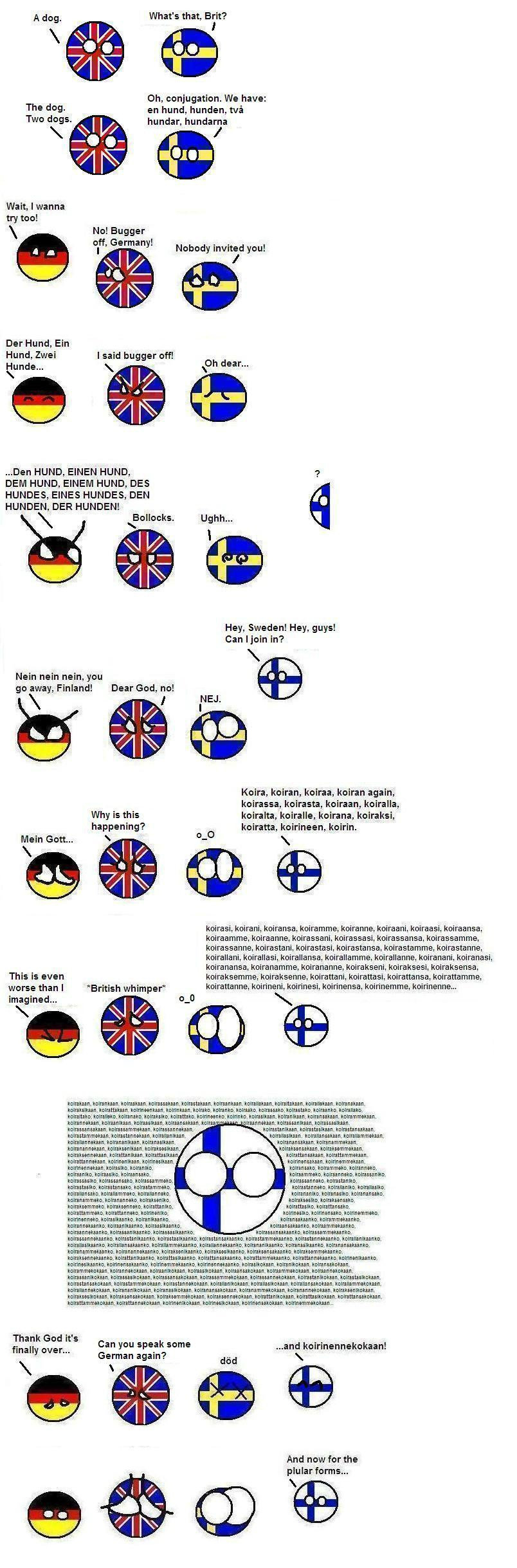
Ever tried Finnish?
-
daal
- Oza
- Posts: 2508
- Joined: Wed Apr 21, 2010 1:30 am
- GD Posts: 0
- Has thanked: 1304 times
- Been thanked: 1128 times
Re: bilingualism and go strength
That's a good point. Immersion turns everything you do into a sub-conscious workout, and without it I surely would not be so "strong" in German.wineandgolover wrote:Perhaps if you moved to China, you'd progress similarly? I'm not sure when you learned German, but I suspect total immersion had something to do with your current skill. I'd bet it was much more "work" than a few hours a day over a goban.daal wrote: It didn't take me much effort to get to the equivalent of 1d level in my second language (at age 25), and after immersing myself in it, I got to 5d without particularly working at it. I've already put much more work into go and Chinese and am still quite weak at both. I don't see much of a connection.
Nonetheless, I reached 1d in German in 6 months at age 25 before getting immersed - but German and English are linguistically not so far apart. This was a factor that contributed to my having more talent for German than for Chinese. Although I can extrapolate from the experience of learning German to other subjects, my "language talent" doesn't seem to transfer quite so well to Chinese or go. One might also point to my current age (50+) as a factor in my ability to learn, but I also recently started learning Dutch, which is closely related to two other languages I speak well, and with about a tenth of the effort, I can already communicate in Dutch much better than in Chinese.
This close relation to a skill that I learned as a child seems to be a big factor in my potential to become skillful at a new subject. Go may have some similarities to other subjects such as languages, chess, math (Geometry) or art, music, computer programming etc, but it is not so closely related - certainly not as close as Dutch and German are to each other. I don't think go is that closely related to anything.
Patience, grasshopper.
-
daal
- Oza
- Posts: 2508
- Joined: Wed Apr 21, 2010 1:30 am
- GD Posts: 0
- Has thanked: 1304 times
- Been thanked: 1128 times
Re: bilingualism and go strength
Amelia wrote: What is practical in constantly putting the entire 25k-10k range in one single basket?
It depends. If you aim to be condescending, lumping people into one category can be useful.
 But it can also be useful if ... "someone on the forum asks, 'hey, I'm a beginner! I have a question...'" Then you know that they are not looking for an advanced answer that aims over their heads.
hyvää huomenta! (Finnish is related to Hungarian, and I haven't had breakfast yet!)
Patience, grasshopper.
-
John Fairbairn
- Oza
- Posts: 3725
- Joined: Wed Apr 21, 2010 3:09 am
- Has thanked: 20 times
- Been thanked: 4739 times
Re: bilingualism and go strength
The poll seems massively skewed to me in that it specifies a range of abilities in go but a single level (bilingual/multilingual) for language.
But even for people who think of themselves as multilingual, there is a huge range of abilities. I am in daily contact with a large number of people who speak English as a second language and require it for their jobs. They function well in speaking, even in a technical world, can say almost everything that they want to say, rarely ask for anything to be repeated, and many even write reports in English and could post on this forum. But I don't regard them as bilingual.
The reason is that, unlike a native, they lack a huge amount of language-based information that a native takes for granted: understanding dialect words, child words, quotations from Shakespeare, allusions to tv series, dirty words, poetic words, nuances of similar words, and so on and so on. Even for natives there is a large range of variation, yet the dimmest native will know much more about these kinds of things than the typical fluent foreigner. Typically, when you speak to these fluent foreigners you can feel yourself limiting your speech to standard, simple English.
This applies equally in other languages. I was astonished not long ago to meet a Foreign Office expert who had studied Chinese at university and had extra total-immersion lessons (for two years I think) before being posted to China, where he lived for several years. I met him on his posting back to the UK and heard him briefing a Chinese journalist. He was totally in command of his spoken language, and being trusted to brief a journalist was something only a senior and highly competent official would be allowed to do. His job also involved reading Chinese newspapers daily, which he seemed to do fluently. None of that surprised me. What shocked me was his claim that he could not read Chinese written in traditional characters. For a person of his level of education in China that would be unthinkable. Therefore, I could not regard him as truly bilingual, brilliant though he was.
The reason for being pedantic about this, is that if we apply go grades to language, what people might regard as impressive fluency (and so might lead them to use he term "bilingual") might be no more than being a 1-dan amateur in go terms (I'd put my FO diplomat at 6-dan amateur BTW; a 9-dan would be a truly bilingual person). So if people with such language skill put the same amount of effort into go, should we simply expect them to reach something like 1-dan amateur?
But more interesting, I think, is the question whether people in the traditional go-playing countries pick up certain things about the basics of the game that we don't pick up (e.g. from messing around in school go clubs, or watching father and friends play) which produces the same sort of difference between a dim but native language speaker and a bright but non-native speaker?
Daal: FWIW while it is true that German is closer structurally to English than Chinese is, I don't think that necessarily matters. At least my experience is that westerners find Japanese and Chinese (and Arabic etc) so fascinatingly different, they are usually prepared to concentrate harder. The problems arise not so much in the structural (grammatical) differences but in the cultural differences. To give a specific example from Japanese. Structurally, the Japanese often omit the subject (or object etc). Westerners tend to put the subject in far too often when they speak, but that doesn't hinder communication much and they understand the notion of ellipsis well enough from English anyway. What they do have immense trouble with is working out what the omitted subject is in something they read or hear, and that is because they don't pick up on the non-structural (non-grammatical) clues that are scattered or implied throughout the rest of the context. In short, your problem with Chinese may possibly be down to not reading about China and the Chinese enough.
But even for people who think of themselves as multilingual, there is a huge range of abilities. I am in daily contact with a large number of people who speak English as a second language and require it for their jobs. They function well in speaking, even in a technical world, can say almost everything that they want to say, rarely ask for anything to be repeated, and many even write reports in English and could post on this forum. But I don't regard them as bilingual.
The reason is that, unlike a native, they lack a huge amount of language-based information that a native takes for granted: understanding dialect words, child words, quotations from Shakespeare, allusions to tv series, dirty words, poetic words, nuances of similar words, and so on and so on. Even for natives there is a large range of variation, yet the dimmest native will know much more about these kinds of things than the typical fluent foreigner. Typically, when you speak to these fluent foreigners you can feel yourself limiting your speech to standard, simple English.
This applies equally in other languages. I was astonished not long ago to meet a Foreign Office expert who had studied Chinese at university and had extra total-immersion lessons (for two years I think) before being posted to China, where he lived for several years. I met him on his posting back to the UK and heard him briefing a Chinese journalist. He was totally in command of his spoken language, and being trusted to brief a journalist was something only a senior and highly competent official would be allowed to do. His job also involved reading Chinese newspapers daily, which he seemed to do fluently. None of that surprised me. What shocked me was his claim that he could not read Chinese written in traditional characters. For a person of his level of education in China that would be unthinkable. Therefore, I could not regard him as truly bilingual, brilliant though he was.
The reason for being pedantic about this, is that if we apply go grades to language, what people might regard as impressive fluency (and so might lead them to use he term "bilingual") might be no more than being a 1-dan amateur in go terms (I'd put my FO diplomat at 6-dan amateur BTW; a 9-dan would be a truly bilingual person). So if people with such language skill put the same amount of effort into go, should we simply expect them to reach something like 1-dan amateur?
But more interesting, I think, is the question whether people in the traditional go-playing countries pick up certain things about the basics of the game that we don't pick up (e.g. from messing around in school go clubs, or watching father and friends play) which produces the same sort of difference between a dim but native language speaker and a bright but non-native speaker?
Daal: FWIW while it is true that German is closer structurally to English than Chinese is, I don't think that necessarily matters. At least my experience is that westerners find Japanese and Chinese (and Arabic etc) so fascinatingly different, they are usually prepared to concentrate harder. The problems arise not so much in the structural (grammatical) differences but in the cultural differences. To give a specific example from Japanese. Structurally, the Japanese often omit the subject (or object etc). Westerners tend to put the subject in far too often when they speak, but that doesn't hinder communication much and they understand the notion of ellipsis well enough from English anyway. What they do have immense trouble with is working out what the omitted subject is in something they read or hear, and that is because they don't pick up on the non-structural (non-grammatical) clues that are scattered or implied throughout the rest of the context. In short, your problem with Chinese may possibly be down to not reading about China and the Chinese enough.
-
i3ullseye
- Beginner
- Posts: 18
- Joined: Mon Feb 23, 2015 7:36 am
- GD Posts: 0
- Universal go server handle: i3ullseye
- Been thanked: 3 times
Re: bilingualism and go strength
I think maybe you are confusing cultural differences with language proficiency. UK, USA, Australia... all 3 speak English. But some references and words are VASTLY different. Does that mean that none of them can truly be considered proficient in their primary language unless they know all the slang and idioms for the other cultures? That seems to be what your breakdown suggests. When I have traveled to train, even people with almost no accent whatsoever in their English, who speak Tagalog, Spanish, Etc... whatever their other languages may be... they still don't 'get' many sports euphemisms like we use in America. "Knocked it out of the park" takes some explaining. That in no way is a reflection on their language skills, but on their cultural intelligence.
Spanish and Arabic are even more diverse, but all those who speak the various variants are certainly fluent, and can very easily get along amongst the other variants with only a few hiccoughs.
Spanish and Arabic are even more diverse, but all those who speak the various variants are certainly fluent, and can very easily get along amongst the other variants with only a few hiccoughs.
-
tentano
- Lives in gote
- Posts: 324
- Joined: Mon Dec 01, 2014 8:36 am
- Rank: kgs 4k
- GD Posts: 0
- Has thanked: 13 times
- Been thanked: 56 times
Re: bilingualism and go strength
I've noticed this before, that some Japanese lecturers were badly disappointed that some things aren't taught to western go players. There's a whole chunk of cultural depth missing in how the game is learned, and I have no real clear idea of what exactly that is.people in the traditional go-playing countries pick up certain things about the basics of the game that we don't pick up (e.g. from messing around in school go clubs, or watching father and friends play)
Of course, "aren't taught" seems full of assumptions and a bit jarring to me. Who, exactly, is this person who should have taught me? I'd like to file a complaint for dereliction of duty.
It's likely a huge barrier to mutual understanding when they refer to proper teaching, when many western players refer to how far they managed on their own.
-
Boidhre
- Oza
- Posts: 2356
- Joined: Mon Mar 05, 2012 7:15 pm
- GD Posts: 0
- Universal go server handle: Boidhre
- Location: Ireland
- Has thanked: 661 times
- Been thanked: 442 times
Re: bilingualism and go strength
I think the problem is people believe fluent means merely being able to communicate. Forgetting about accent, idiom, cadence, nuance and so on.John Fairbairn wrote:The poll seems massively skewed to me in that it specifies a range of abilities in go but a single level (bilingual/multilingual) for language.
But even for people who think of themselves as multilingual, there is a huge range of abilities. I am in daily contact with a large number of people who speak English as a second language and require it for their jobs. They function well in speaking, even in a technical world, can say almost everything that they want to say, rarely ask for anything to be repeated, and many even write reports in English and could post on this forum. But I don't regard them as bilingual.
The reason is that, unlike a native, they lack a huge amount of language-based information that a native takes for granted: understanding dialect words, child words, quotations from Shakespeare, allusions to tv series, dirty words, poetic words, nuances of similar words, and so on and so on. Even for natives there is a large range of variation, yet the dimmest native will know much more about these kinds of things than the typical fluent foreigner. Typically, when you speak to these fluent foreigners you can feel yourself limiting your speech to standard, simple English.
This applies equally in other languages. I was astonished not long ago to meet a Foreign Office expert who had studied Chinese at university and had extra total-immersion lessons (for two years I think) before being posted to China, where he lived for several years. I met him on his posting back to the UK and heard him briefing a Chinese journalist. He was totally in command of his spoken language, and being trusted to brief a journalist was something only a senior and highly competent official would be allowed to do. His job also involved reading Chinese newspapers daily, which he seemed to do fluently. None of that surprised me. What shocked me was his claim that he could not read Chinese written in traditional characters. For a person of his level of education in China that would be unthinkable. Therefore, I could not regard him as truly bilingual, brilliant though he was.
The reason for being pedantic about this, is that if we apply go grades to language, what people might regard as impressive fluency (and so might lead them to use he term "bilingual") might be no more than being a 1-dan amateur in go terms (I'd put my FO diplomat at 6-dan amateur BTW; a 9-dan would be a truly bilingual person). So if people with such language skill put the same amount of effort into go, should we simply expect them to reach something like 1-dan amateur?
But more interesting, I think, is the question whether people in the traditional go-playing countries pick up certain things about the basics of the game that we don't pick up (e.g. from messing around in school go clubs, or watching father and friends play) which produces the same sort of difference between a dim but native language speaker and a bright but non-native speaker?
Daal: FWIW while it is true that German is closer structurally to English than Chinese is, I don't think that necessarily matters. At least my experience is that westerners find Japanese and Chinese (and Arabic etc) so fascinatingly different, they are usually prepared to concentrate harder. The problems arise not so much in the structural (grammatical) differences but in the cultural differences. To give a specific example from Japanese. Structurally, the Japanese often omit the subject (or object etc). Westerners tend to put the subject in far too often when they speak, but that doesn't hinder communication much and they understand the notion of ellipsis well enough from English anyway. What they do have immense trouble with is working out what the omitted subject is in something they read or hear, and that is because they don't pick up on the non-structural (non-grammatical) clues that are scattered or implied throughout the rest of the context. In short, your problem with Chinese may possibly be down to not reading about China and the Chinese enough.
-
Uberdude
- Judan
- Posts: 6727
- Joined: Thu Nov 24, 2011 11:35 am
- Rank: UK 4 dan
- GD Posts: 0
- KGS: Uberdude 4d
- OGS: Uberdude 7d
- Location: Cambridge, UK
- Has thanked: 436 times
- Been thanked: 3720 times
Re: bilingualism and go strength
Then again there are a lot of native English people of lower social/educational class who would not count as fluent by your standards eitherJohn Fairbairn wrote:The reason is that, unlike a native, they lack a huge amount of language-based information that a native takes for granted: understanding dialect words, child words, quotations from Shakespeare, allusions to tv series, dirty words, poetic words, nuances of similar words, and so on and so on. Even for natives there is a large range of variation, yet the dimmest native will know much more about these kinds of things than the typical fluent foreigner. Typically, when you speak to these fluent foreigners you can feel yourself limiting your speech to standard, simple English.
-
gowan
- Gosei
- Posts: 1628
- Joined: Thu Apr 29, 2010 4:40 am
- Rank: senior player
- GD Posts: 1000
- Has thanked: 546 times
- Been thanked: 450 times
Re: bilingualism and go strength
I don't think there are specific criteria for skill levels like bilingual and fluent. I would say bilingual is roughly equivalent to being able to communicate in a language other than one's native language. For fluency I look to brain processing. Can the person understand the language spoken by a native speaker at speed? Is the person able to read a newspaper without having too frequently to look up words in a dictionary? Can the person speak at native speaker speed? As for vocabulary and idioms, I think we'd all fail at some words or idioms in our native languages.
I think the question posed by the OP is somewhat interesting, though vague. Few pro go players reach a level at English skill to be able to function teaching and lecturing at US Go Congress without assistance from an interpreter. I don't know about China or Korea but I think in Japan all school students (including future pros) study English every year up through high school yet it is not common for these students to reach a level to be able to communicate well in English.
I think the question posed by the OP is somewhat interesting, though vague. Few pro go players reach a level at English skill to be able to function teaching and lecturing at US Go Congress without assistance from an interpreter. I don't know about China or Korea but I think in Japan all school students (including future pros) study English every year up through high school yet it is not common for these students to reach a level to be able to communicate well in English.
-
John Fairbairn
- Oza
- Posts: 3725
- Joined: Wed Apr 21, 2010 3:09 am
- Has thanked: 20 times
- Been thanked: 4739 times
Re: bilingualism and go strength
Well we share a language, a country and a culture yet we can't seem to communicate. (a) I did not set any standards for "fluent" - I spoke about criteria for being "bilingual" and (b) I did say "Even for natives there is a large range of variation, yet the dimmest native will know much more about these kinds of things than the typical fluent foreigner", and most important (c) it's a bit naughty of you to imply I'm talking about people of lower class. Since we are alluding to allusions only a native speaker would normally pick up, allow me to remind you of Tim Nice But Dim (and the real-life version in the Fulfords).Then again there are a lot of native English people of lower social/educational class who would not count as fluent by your standards either
-
Bantari

- Gosei
- Posts: 1639
- Joined: Sun Dec 06, 2009 6:34 pm
- GD Posts: 0
- Universal go server handle: Bantari
- Location: Ponte Vedra
- Has thanked: 642 times
- Been thanked: 490 times
Re: bilingualism and go strength
Not sure I agree with that. My feeling is that what you speak of is bi-cultural rather than bi-lingual.John Fairbairn wrote:The reason is that, unlike a native, they lack a huge amount of language-based information that a native takes for granted: understanding dialect words, child words, quotations from Shakespeare, allusions to tv series, dirty words, poetic words, nuances of similar words, and so on and so on. Even for natives there is a large range of variation, yet the dimmest native will know much more about these kinds of things than the typical fluent foreigner. Typically, when you speak to these fluent foreigners you can feel yourself limiting your speech to standard, simple English.
Culture and language are tightly intertwined, but language is a skill while culture is an ocean of knowledge, experiences, behaviors, customs, etc.
According to your definition, an average native-born brit does not truly speak english because he might not understand all american idioms, slang words, or references to local tv shows. And vice versa. By the same token, if he managed to understand all that, he would be bi-lingual: speaking british and american. Extending it even further, a native californian and a native texan speak different languages. Possibly a nrthern californian and southern californian as well. There are words and phrases specific to certain families, or small groups - how does this play into what you say? It seems that at some level nobody, but absolutely nobody, truly speaks another language except the native dialect of the little tiny community they grew up in.
To me, speaking a foreign language means that you can communicate in this language to some degree. And lets make sure - there *are* different degrees to communication. Fluency means that you can communicate fluently. You can convey your thoughts and be able to understand the answer - on any subject an average native-speaker can talk about.
But unless you are born and raised in a certain region (and even then, even if you were) - you will *always* miss some cultural references and obscure slang words. Heck, I know more about some american tv shows and references to them than most of my native californian friends, and I have to remember to limit my language because of that when talking to them. I don't have this problem when speaking with my wife, although she was born and raised on another continent entirely. Why? We simply watch the same shows and laugh at the same things. Many of my friends watch different shows. But this has absolutely nothing to do with our language skills, I consider both of us bi-lingual (multi-lingual, actually), and so does anybody I ever asked.
- Bantari
______________________________________________
WARNING: This post might contain Opinions!!
______________________________________________
WARNING: This post might contain Opinions!!
-
topazg

- Tengen
- Posts: 4511
- Joined: Wed Apr 21, 2010 3:08 am
- Rank: Nebulous
- GD Posts: 918
- KGS: topazg
- Location: Chatteris, UK
- Has thanked: 1579 times
- Been thanked: 650 times
- Contact:
Re: bilingualism and go strength
Mmm, I also think the nuances of language are not necessary for fluent speech. For "native" speech, perhaps (by this I mean not necessarily the language of your home country, but the step above "fluent" that is commonly referred to as "native", of which there are a fair number of people capable of holding this level in more than one language)
-
tj86430
- Gosei
- Posts: 1348
- Joined: Wed Apr 28, 2010 12:42 am
- Rank: FGA 7k GoR 1297
- GD Posts: 0
- Location: Finland
- Has thanked: 49 times
- Been thanked: 129 times
Re: bilingualism and go strength
Any facts on that? My intuition would suggest otherwise, but I have no facts.Amelia wrote: Most of the world's population is multilingual.
Offending ad removed