Think and Grow Old

Create a study plan, track your progress and hold yourself accountable.
User avatar
Tami
Lives in gote
Posts: 558
Joined: Sat Jul 16, 2011 5:05 pm
GD Posts: 0
IGS: Reisei 1d
Online playing schedule: When I can
Location: Carlisle, England
Has thanked: 196 times
Been thanked: 342 times

Re: Think and Grow Old

Post by Tami »

Seeing the clamorous reception with which my proposal to start streaming was greeted, I have decided that perhaps I shall see if I could become a bit stronger before trying that. It's something that would be fun for me, but perhaps waiting until it would be fun for you is the best option.

I feel that I am indeed becoming stronger, although it is hard to tell whether I'm becoming stronger than I was before my hiatus, or just stronger than I was when I came back. Whichever is the case, I see that my KGS graph has generally travelled in the more pleasurable direction over the last month.

I have finished reading both Life and Death and Attack and Defence. I am finding L&D to be particularly rewarding as I am much better able to foresee which groups are going to get into trouble and therefore make suitable plans. The main gain from A&D was a new appreciation of the fact that strong go players don't just play straight-ahead, direct moves of the kind that often work so well in chess (other chess players will know what I mean: those situations where you just tie your opponent to the defence of a weak spot, relentlessly pile on the pressure, and then crack them by changing direction or sacrificing). Instead, kikashi and leaning plays, inducing moves and other methods of engineering the fight to your advantage are crucial. (This is not to say that similar techniques don't exist in chess.)

I am working through Nagahara's Strategic Concepts of Go now, and have been trying to settle on another book to provide contrast. I tried In the Beginning, but did not find it very helpful; somehow, it does not seem to address the kinds of things that arise in my game. I also tried the Nihon Kiin Tesuji dictionary, but while I enjoyed it to an extent, I began to get the feeling that it was too specialised for as weak as player as I am at present. Likewise, while I found Fujisawa's Reducing Territorial Frameworks to be quite rewarding, again I began to feel it tends to be just too advanced for me. And, as I have been working through these, a little light has been gently coming on within my mind. That is, I have become more and more aware that the most interesting parts of the books have been specific variations and examples, rather than the verbal discussions attached to them. In particular, sections such as Nagahara's chapters on aji and kikashi contain examples of joseki explained move by move, with helpful variations showing what might happen if such and such a move were omitted. What I found particularly interesting is that the concrete variations make the verbal explanations easier to understand - and not the other way around, as one might have expected. In other words, one can generalise from the specific; but past a certain level, it is almost fruitless to attempt to work out specific lines of play from general advice. This is the reason why checklists, proverbs, "thinking techniques" and what have you cannot, by themselves, take you to a high level. Indeed, if they could, then we would all be competing for the LG Cup! The secret is that there is no secret ;-)

To put it another way, you could say that, for instance, a kikashi is a forcing move that produces a response and which, furthermore, leaves behind aji for later. Armed with that, you might be able to make up your own kikashi for a certain portion of the time; but, unfortunately, you would probably also find yourself making aji keshi moves and thank-you moves and even just "pass" moves that have no effect on the opponent. In contrast, if you study known examples of kikashi (i.e., moves that are commonly accepted as such), carefully exploring the effects and variations, then you would obtain a better grasp of what a kikashi really is, and from that a better feeling for using that device properly.

Added to this insight, has been the realisation that the people who beat me simply know more about the game than I do. One of my conquerors very kindly explained to me one of my joseki errors, and showed me how to play better. It was not so much that he had a better idea of the appropriate strategy (though that was probably the case also) as that he had better tools at his disposal. So, I think the way forward is to set about acquiring more knowledge.

From my recent experience, I understand that the kind of knowledge in Reducing Territorial Frameworks and the Takao Tesuji Dictionary is too fine-grained for my level of play. It's like reading a manual on Bach's use of retrograde canon before you've acquired an understanding of chorale harmonisation. Given that the joseki examples in A&D and SCOG have proven revelatory, and given that I frequently have trouble achieving a satisfying start to a game, I've decided to work on joseki for now.

A structured approach seems helpful. While I am lucky enough still to have a good memory, I cannot just absorb things at random like a child anymore. I do own a copy of Rui Naiwei's joseki book, but it is hiding somewhere, so I've settled on the Get Strong at Joseki series, which I also happen to own. I think I shall go through the sample joseki in the first section of each volume, practise with them to get a good idea of what each moves means, and then when the dust has settled go through the problem sets. After that, I shall either give Rui Naiwei another look when it resurfaces, or use Kogo's.

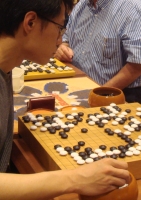
Incidentally, I must re-iterate my point about using a real board. There is no doubt about it, at least as far as I'm concerned, go patterns really do register much more strongly in the memory when physically played out. I know there are people who can learn from their computer screen or smartphone, but such devices tend to make me zone out; in contrast, the board and stones lodge in my mind.
Learn the "tea-stealing" tesuji! Cho Chikun demonstrates here:
User avatar
EdLee
Honinbo
Posts: 8859
Joined: Sat Apr 24, 2010 6:49 pm
GD Posts: 312
Location: Santa Barbara, CA
Has thanked: 349 times
Been thanked: 2070 times

Post by EdLee »

Hi Tami,

Congrats on your on-going discoveries and adventures! :)

I also find using a real set to be very helpful.
July 23, 2018 wrote:it is almost fruitless to attempt to work out specific lines of play from general advice.
... super-human Go AI epoch (2015) ...

post #12
Oct 08, 2014 wrote:I'm frustrated. Please could I have some general advice.
post #52
Oct 08, 2014 wrote:You're frustrated precisely because you are looking for general advice and heuristics. ( my wording unclear, not good )
Bill Spight
Honinbo
Posts: 10905
Joined: Wed Apr 21, 2010 1:24 pm
Has thanked: 3651 times
Been thanked: 3373 times

Re: Think and Grow Old

Post by Bill Spight »

If I may, a few comments on concepts in go.

First, your experience with playing with a real board and stones fits in with Piaget's theory. Consider the problem of verbal definition. (Not Piaget's approach, BTW.) If you look up a word in a dictionary you get a definition using other words. If you understand all the other words, fine. But if not, you can look up the words you do not understand. And if one of those definitions uses words you do not understand, you can look those up. Etc., etc. There is always the possibility that you will end up with a definition that uses words that you do not understand, but that you have already looked up. To use a dictionary you have to have words that you understand without a verbal definition, or, as in mathematics, you must have some undefined terms.

Piaget says that everyone has certain non-verbal concepts or ideas that he calls sensory-motor schemata. When I was in grade school our teachers told the kids not to count on our fingers. I think that Piaget would say that the kids were right. By counting on their fingers they were making use of their sensory-motor schemata. Later they could and would build more abstract schemata on top of their sensory-motor schemata. In go, playing with a real board and stones helps to build sensory-motor schemata. It also provides a rich experience upon which to build memories. :)

What is a concept? There is no one answer, OC, but one useful definition for game play is that a concept is a strategy. So what is a strategy? For these purposes a strategy is a situation response pair. (Obviously, strategy means something else in relation to the phrase, strategic concepts in go. ;)) For instance, a basic concept in go is that of a capture. The situation is a stone or group of stones of one color with only one dame, and the capture is filling that dame with a stone of the opposite color and removing that stone or group.

Now, one representation of that concept is the set of all stones with one dame along with the play that captures them. This representation is non-verbal, and rests upon the sensation of seeing a stone or group with one dame and the motor response of filling the dame and removing the stones. Another representation is the verbal definition. The verbal description of capture is not only concise, it allows us to capture stones in configurations that we have never seen before. Something that generalization from examples is not guaranteed to do. (OC, the concept of capture is so simple that I expect that pigeons can learn it through generalization pretty quickly. For pigeons the motor response might be pecking on the dame point in a picture.)

Many of the high level (i.e., strategic) concepts of go do not allow us to reliably apply them to novel situations. Unlike the concept of capture they are not well defined. For instance, the concept of kikashi relies upon the concepts of sente and aji, neither of which is well defined. (Actually, there is a well defined sense of sente, but one that differs from how most players understand the term. ;)) As a result, even pros may disagree about whether a play is kikashi or not, as Sakata has remarked.

Obviously, ill-defined concepts can be useful, or go players would not have developed them. And they do allow us to find good plays in novel situations. However, developing the judgement to apply them well can be a daunting challenge. :)
The Adkins Principle:
At some point, doesn't thinking have to go on?
— Winona Adkins

Visualize whirled peas.

Everything with love. Stay safe.
User avatar
EdLee
Honinbo
Posts: 8859
Joined: Sat Apr 24, 2010 6:49 pm
GD Posts: 312
Location: Santa Barbara, CA
Has thanked: 349 times
Been thanked: 2070 times

Post by EdLee »

Hi Bill,
(Actually, there is a well defined sense of sente, but one that differs from how most players understand the term. ;))
The cliffhanger worked. :study: :)
User avatar
Tami
Lives in gote
Posts: 558
Joined: Sat Jul 16, 2011 5:05 pm
GD Posts: 0
IGS: Reisei 1d
Online playing schedule: When I can
Location: Carlisle, England
Has thanked: 196 times
Been thanked: 342 times

Re: Think and Grow Old

Post by Tami »

win versus mountainshadow.sgf
(5.66 KiB) Downloaded 641 times
Perhaps I've been throwing poor old (?!) baby out with the bathwater. (It's a good job that I'm not a parent, isn't it?)

That is to say, maybe general principles are useful after all; but, paradoxically, they tend to be more useful to those who know more about specifics. What I'm driving at is hard to explain, but among other things that I have been noticing from my defeats to better players is the way that they make their stones work together. Now, I've heard that many times before, but it's from seeing it arise from my more skilled partners' joseki choices and from those occasions when they break away from other principles that I get a deeper appreciation of what that particular piece of general advice means. That is, the one who has a more comprehensive and thorough competence with individual weapons is better able to apply broader ideas.

Actually, I suppose this only equates to what I wrote in my previous post
Tami wrote:What I found particularly interesting is that the concrete variations make the verbal explanations easier to understand - and not the other way around, as one might have expected.
.

Anyway, I only the energy for the one game this evening (90 minutes of solid organ practise took quite a lot out of me earlier on), but I tried very hard to play each stone in relation to the the earlier ones that I played. Of course, my play was inaccurate and weak; but it was good enough to build up a substantial early advantage (an unusual experience for me these days). I then made a very bad mistake and found myself on the back foot for the rest of the game. But the happy thing was that despite this, I had just enough in the tank to sputter home to a 0.5 point win. My very bad mistake was, appropriately enough, a move that disrespected my earlier stones!The game, in all its grisly splendour, is here:
win versus mountainshadow.sgf
(5.66 KiB) Downloaded 641 times
It may be a simple thing, but knowing that the UR corner would resolve to an L+1 came in very handy. It's the kind of thing I would have been uncertain of before I read L&D properly. Again, knowing just that little bit more about L&D shapes and eyes is beginning to pay me back. :)

I'm not a very good player, but for the first time in many years I am experiencing a tangible feeling of growth, and that is making go more enjoyable than it has been for a very long time. So, "Yea, I say yea". (Sharpe's Rifles reference there for British TV addicts among you).

By the way, what is that definition of sente? Bill, you old tease!
Learn the "tea-stealing" tesuji! Cho Chikun demonstrates here:
User avatar
Fedya
Lives in gote
Posts: 603
Joined: Tue Apr 20, 2010 8:21 pm
Rank: 6-7k KGS
GD Posts: 0
Has thanked: 43 times
Been thanked: 139 times

Re: Think and Grow Old

Post by Fedya »

I know this is two weeks old, but what's the answer to :b1: ?
Click Here To Show Diagram Code
[go]$$B Application 1
$$ ------------------
$$ | . . . . . . . . .
$$ | . 1 O X O . . . .
$$ | . . X O . . . . .
$$ | . . X O O . . . .
$$ | . X X X O . . . .
$$ | . O X O . O . . .
$$ | . . O O . . . . .
$$ | . O . . . . . . .
$$ | . . . . . . . . .[/go]
User avatar
jlt
Gosei
Posts: 1786
Joined: Wed Dec 14, 2016 3:59 am
GD Posts: 0
Has thanked: 185 times
Been thanked: 495 times

Re: Think and Grow Old

Post by jlt »

Take the stone?
Click Here To Show Diagram Code
[go]$$B Application 1
$$ ------------------
$$ | . 3 . 2 . . . . .
$$ | 7 1 O X O . . . .
$$ | . 6 X O . . . . .
$$ | 4 . X O O . . . .
$$ | 5 X X X O . . . .
$$ | 8 O X O . O . . .
$$ | . . O O . . . . .
$$ | . O . . . . . . .
$$ | . . . . . . . . .[/go]
User avatar
EdLee
Honinbo
Posts: 8859
Joined: Sat Apr 24, 2010 6:49 pm
GD Posts: 312
Location: Santa Barbara, CA
Has thanked: 349 times
Been thanked: 2070 times

Post by EdLee »

Hi jlt:
Click Here To Show Diagram Code
[go]$$B variation
$$ ------------------
$$ | . . . 2 . . . . .
$$ | . 1 O X O . . . .
$$ | . . X O . . . . .
$$ | . . X O O . . . .
$$ | . X X X O . . . .
$$ | 3 O X O . O . . .
$$ | 4 5 O O . . . . .
$$ | . O . . . . . . .
$$ | . . X . . . . . .
$$ | . . . . . . . . .[/go]
Click Here To Show Diagram Code
[go]$$B variation
$$ -------------------
$$ | . 5 . 2 . . . . .
$$ | . 1 O X O . . . .
$$ | . 8 X O . . . . .
$$ | 6 . X O O . . . .
$$ | 7 X X X O . . . .
$$ | 3 O X O . O . . .
$$ | . 4 O O . . . . .
$$ | . O . . . . . . .
$$ | . . X . . . . . .
$$ | . . . . . . . . .[/go]
Click Here To Show Diagram Code
[go]$$B variation
$$ ------------------
$$ | . 5 . 2 . . . . .
$$ | . 1 O X O . . . .
$$ | 7 . X O . . . . .
$$ | 6 . X O O . . . .
$$ | . X X X O . . . .
$$ | 3 O X O . O . . .
$$ | . 4 O O . . . . .
$$ | . O . . . . . . .
$$ | . . X . . . . . .
$$ | . . . . . . . . .[/go]
Bill Spight
Honinbo
Posts: 10905
Joined: Wed Apr 21, 2010 1:24 pm
Has thanked: 3651 times
Been thanked: 3373 times

Re: Think and Grow Old

Post by Bill Spight »

Tami wrote:I'm not a very good player, but for the first time in many years I am experiencing a tangible feeling of growth, and that is making go more enjoyable than it has been for a very long time. So, "Yea, I say yea". (Sharpe's Rifles reference there for British TV addicts among you).
Very good. :) You may have some words of encouragement for daal. viewtopic.php?f=10&t=15922
By the way, what is that definition of sente? Bill, you old tease!
What I had in mind was the definition of sente used in evaluation. That definition is well defined. :)

I have given this some thought, and have decided to give an operational definition. Instead of relying upon verbiage, what concrete steps do we take to take to decide that a position is sente? These are steps we take to evaluate a position. :)

Here is a position. It's unfamiliar, but easy to evaluate.
Click Here To Show Diagram Code
[go]$$B
$$ ----------------------
$$ | a O . O . O . O . X .
$$ | . O X X X X X X X X .
$$ | . O 1 O . O . O . X .
$$ | . O X X X X X X X X .
$$ | b O 2 O . O . O . X .
$$ | . O X X X X X X X X .
$$ | . O 2 O 3 O . O . X .
$$ | . O X X X X X X X X .
$$ | c O 2 O 4 O . O . X .
$$ | . O X X X X X X X X .
$$ | . O 2 O 4 O 5 O . X .
$$ | . O X X X X X X X X .
$$ | . O 2 O 4 O 6 O . X .
$$ | . O X X X X X X X X .
$$ | . . . . . . . . . . .[/go]
The position to evaluate is the corridor at "a". The other corridors show positions derived in the evaluation of the same corridor, assuming certain sequences of play. The evaluations of the corridors except for "a", "b", and "c" are obvious. How do we evaluate them?

My preference is for this to be an interactive exercise, but if you just want me to continue by myself, let me know. :)
The Adkins Principle:
At some point, doesn't thinking have to go on?
— Winona Adkins

Visualize whirled peas.

Everything with love. Stay safe.
User avatar
EdLee
Honinbo
Posts: 8859
Joined: Sat Apr 24, 2010 6:49 pm
GD Posts: 312
Location: Santa Barbara, CA
Has thanked: 349 times
Been thanked: 2070 times

Post by EdLee »

Hi Bill, Thanks so much.
(a) :b1: 9 pts gote ;
(b) :b3: 6 pts gote ;
(c) :b5: 3 pts gote ;

Then, trickier: :study:
:w6: (?) pts gote ... but how to eval wrt :b5:'s 3pt gote ?
:w4: dunno how to eval wrt :b5: ...
:w2: dunno how to eval wrt :b3: & :b5: ...

( :b5: 3 pts gote; local result [0,3] ),
( :w6: local result [0,0] )... dunno how to eval :w6: :blackeye:
:w6: 3(?) pts gote.

( :b3: 6 pts gote; local result [0,6] ),
( ( :w4: + :w6: ) local result [0,0] ),
( :w4: + :w6: ) 6(?) pts gote.
Dunno how to eval :w4: by itself. :blackeye:

( :b1: 9 pts gote; local result [0,9] ),
( ( :w2: + :w4: + :w6: ) local result [0,0] ),
( :w2: + :w4: + :w6: ) 9(?) pts gote.
Still unclear how to eval :w2:, :w4:, :w6: individually. :blackeye:
Bill Spight
Honinbo
Posts: 10905
Joined: Wed Apr 21, 2010 1:24 pm
Has thanked: 3651 times
Been thanked: 3373 times

Re: Think and Grow Old

Post by Bill Spight »

Start by evaluating positions, not plays. :) The latter evaluations follow from the former.
The Adkins Principle:
At some point, doesn't thinking have to go on?
— Winona Adkins

Visualize whirled peas.

Everything with love. Stay safe.
Tryss
Lives in gote
Posts: 502
Joined: Tue May 24, 2011 1:07 pm
Rank: KGS 2k
GD Posts: 100
KGS: Tryss
Has thanked: 1 time
Been thanked: 153 times

Re: Think and Grow Old

Post by Tryss »

The game tree :

Code: Select all

.  a
. / \
+9   b
    / \
  +6   c
      / \
    +3   0

Now, let's assume that when in position c, black has half probability to play the move (ie. there's half a chance that black will have sente with this move as the biggest move). That means position c is +1.5

Position b is then +3.75, and position a is +6.375
User avatar
EdLee
Honinbo
Posts: 8859
Joined: Sat Apr 24, 2010 6:49 pm
GD Posts: 312
Location: Santa Barbara, CA
Has thanked: 349 times
Been thanked: 2070 times

Post by EdLee »

Hi Tryss, Bill, Thanks.
...assume... black has half probability to play the move...
Follow-up questions:
- Is the game tree from :black:'s POV or :white:'s, or both, or neither ? Or, it doesn't matter (why or why not?) ?
- Seems the 0.5 probability is a huge assumption ? (I'm OK with it being a magic number, just to simplify this example; I'm OK if the exact probability is not very relevant at this stage of learning... )
That means position c is +1.5
I see (3/2)==1.5, and (6+1.5)/2==3.75, and (9+3.75)/2==6.375, but
- What does the evaluation "position c == +1.5" mean ? Is there another way "In other words..." to rephrase it to explain it in another, orthogonal way ?

Thanks. :bow:
Bill Spight
Honinbo
Posts: 10905
Joined: Wed Apr 21, 2010 1:24 pm
Has thanked: 3651 times
Been thanked: 3373 times

Re: Think and Grow Old

Post by Bill Spight »

On the value of "c"
(Hidden for convenience.)
Click Here To Show Diagram Code
[go]$$B Two copies of "c"
$$ | . . . . . . . . . . .
$$ | . O X X X X X X X X .
$$ | . O O O O O . O . X .
$$ | . O X X X X X X X X .
$$ | . O O O O O . O . X .
$$ | . O X X X X X X X X .
$$ | . . . . . . . . . . .[/go]
What is the value of two copies of "c", under alternating play? The two are miai, as we know. :)

First, suppose that Black plays first.
Click Here To Show Diagram Code
[go]$$B Black first
$$ | . . . . . . . . . . .
$$ | . O X X X X X X X X .
$$ | . O O O O O 1 O . X .
$$ | . O X X X X X X X X .
$$ | . O O O O O 2 O . X .
$$ | . O X X X X X X X X .
$$ | . . . . . . . . . . .[/go]
If Black plays :b1:, White can reply with :w2: to guarantee a result of 3 pts. of territory for Black.
Click Here To Show Diagram Code
[go]$$W White first
$$ | . . . . . . . . . . .
$$ | . O X X X X X X X X .
$$ | . O O O O O 1 O . X .
$$ | . O X X X X X X X X .
$$ | . O O O O O 2 O . X .
$$ | . O X X X X X X X X .
$$ | . . . . . . . . . . .[/go]
If White plays :w1:, Black can reply with :b2: to guarantee a result of 3 pts. of territory for Black.

Since Black can guarantee at least 3 pts. for Black and White can guarantee at most 3 pts. for Black, we can regard 3 pts. for Black as the value of two copies of "c".

The average value of "c" is then 3/2 = 1½ pts. of Black territory.

You can give a probabilistic semantics to the value of 1½ pts. for Black by saying, if we do not know who will play in "c" first, the odds are 50:50 that Black will play there or that White will play there, so the expected value of "c" is 3/2. :)

That gives you the right average value, but, as the miai shows, 3/2 is not just an expected value. The error in the value of 3/2 is also 3/2. If you add two expected values, you expect the error of the value of the sum to be greater than either, i.e., that the value of two copies of "c" should be greater than 3/2. In fact, the error is 0. :)
The Adkins Principle:
At some point, doesn't thinking have to go on?
— Winona Adkins

Visualize whirled peas.

Everything with love. Stay safe.
User avatar
EdLee
Honinbo
Posts: 8859
Joined: Sat Apr 24, 2010 6:49 pm
GD Posts: 312
Location: Santa Barbara, CA
Has thanked: 349 times
Been thanked: 2070 times

Post by EdLee »

Hi Bill, Tryss,
Sorry for being dense; maybe I wasn't being clear.
Assume I'm a total beginner.
I need to start from first principles:
I don't know what the term "value of a position" means. :blackeye:

Example:
Does it make any sense to ask what's the value of this position ?
And if there's a numerical answer, does it depend on B or W,
or is it a value of this local shape as a whole ?
Thanks.
Click Here To Show Diagram Code
[go]$$
$$ |---------------
$$ | . X . X O . .
$$ | X X X X O . .
$$ | O O O O O . .
$$ | . . . . . . .[/go]
I'm probably missing a few pages of the most fundamental introduction to basic endgame theory. If SL has this 30k section, please let me know and I'll go read it. Thanks.
Post Reply