
I feel that I am indeed becoming stronger, although it is hard to tell whether I'm becoming stronger than I was before my hiatus, or just stronger than I was when I came back. Whichever is the case, I see that my KGS graph has generally travelled in the more pleasurable direction over the last month.
I have finished reading both Life and Death and Attack and Defence. I am finding L&D to be particularly rewarding as I am much better able to foresee which groups are going to get into trouble and therefore make suitable plans. The main gain from A&D was a new appreciation of the fact that strong go players don't just play straight-ahead, direct moves of the kind that often work so well in chess (other chess players will know what I mean: those situations where you just tie your opponent to the defence of a weak spot, relentlessly pile on the pressure, and then crack them by changing direction or sacrificing). Instead, kikashi and leaning plays, inducing moves and other methods of engineering the fight to your advantage are crucial. (This is not to say that similar techniques don't exist in chess.)
I am working through Nagahara's Strategic Concepts of Go now, and have been trying to settle on another book to provide contrast. I tried In the Beginning, but did not find it very helpful; somehow, it does not seem to address the kinds of things that arise in my game. I also tried the Nihon Kiin Tesuji dictionary, but while I enjoyed it to an extent, I began to get the feeling that it was too specialised for as weak as player as I am at present. Likewise, while I found Fujisawa's Reducing Territorial Frameworks to be quite rewarding, again I began to feel it tends to be just too advanced for me. And, as I have been working through these, a little light has been gently coming on within my mind. That is, I have become more and more aware that the most interesting parts of the books have been specific variations and examples, rather than the verbal discussions attached to them. In particular, sections such as Nagahara's chapters on aji and kikashi contain examples of joseki explained move by move, with helpful variations showing what might happen if such and such a move were omitted. What I found particularly interesting is that the concrete variations make the verbal explanations easier to understand - and not the other way around, as one might have expected. In other words, one can generalise from the specific; but past a certain level, it is almost fruitless to attempt to work out specific lines of play from general advice. This is the reason why checklists, proverbs, "thinking techniques" and what have you cannot, by themselves, take you to a high level. Indeed, if they could, then we would all be competing for the LG Cup! The secret is that there is no secret

To put it another way, you could say that, for instance, a kikashi is a forcing move that produces a response and which, furthermore, leaves behind aji for later. Armed with that, you might be able to make up your own kikashi for a certain portion of the time; but, unfortunately, you would probably also find yourself making aji keshi moves and thank-you moves and even just "pass" moves that have no effect on the opponent. In contrast, if you study known examples of kikashi (i.e., moves that are commonly accepted as such), carefully exploring the effects and variations, then you would obtain a better grasp of what a kikashi really is, and from that a better feeling for using that device properly.
Added to this insight, has been the realisation that the people who beat me simply know more about the game than I do. One of my conquerors very kindly explained to me one of my joseki errors, and showed me how to play better. It was not so much that he had a better idea of the appropriate strategy (though that was probably the case also) as that he had better tools at his disposal. So, I think the way forward is to set about acquiring more knowledge.
From my recent experience, I understand that the kind of knowledge in Reducing Territorial Frameworks and the Takao Tesuji Dictionary is too fine-grained for my level of play. It's like reading a manual on Bach's use of retrograde canon before you've acquired an understanding of chorale harmonisation. Given that the joseki examples in A&D and SCOG have proven revelatory, and given that I frequently have trouble achieving a satisfying start to a game, I've decided to work on joseki for now.
A structured approach seems helpful. While I am lucky enough still to have a good memory, I cannot just absorb things at random like a child anymore. I do own a copy of Rui Naiwei's joseki book, but it is hiding somewhere, so I've settled on the Get Strong at Joseki series, which I also happen to own. I think I shall go through the sample joseki in the first section of each volume, practise with them to get a good idea of what each moves means, and then when the dust has settled go through the problem sets. After that, I shall either give Rui Naiwei another look when it resurfaces, or use Kogo's.
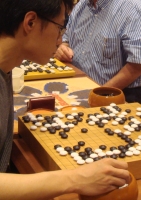
Incidentally, I must re-iterate my point about using a real board. There is no doubt about it, at least as far as I'm concerned, go patterns really do register much more strongly in the memory when physically played out. I know there are people who can learn from their computer screen or smartphone, but such devices tend to make me zone out; in contrast, the board and stones lodge in my mind.


 ?
?
 6 pts gote ;
 3 pts gote ;
 (?) pts gote ... but how to eval wrt
  dunno how to eval wrt
  dunno how to eval wrt
 's POV or
  's, or both, or neither ? Or, it doesn't matter (why or why not?) ?
 , Black can reply with
  to guarantee a result of 3 pts. of territory for Black.