OK OC for the typo you corrected!
In addition instead of
each player will recognize that the area is a good 3 points gote point you should read 4 points gote. Sorry for that.
Concerning the area on the bottom right. I know that on the diagram the gote value is g=3 but I know you have undertood that I vary this value to analyse various environment.
When I wrote
The temperature of the environment is equal to 4 and the value of our local area (against an ideal environment) is 4 points in reverse sente. I do not mean that the reverse sente gains 4 points, on average.
If mean black would be advised to play in sente before temperature drops under 4 because, as soon as the temperature drops under 4 white, by playing the reverse sente at temperature t, will gain 4-t.
Bill Spight wrote:
An ideal environment for every possible game has an infinite nember of plays. However, given a specific game or go position, there is at least one finite ideal environment. Representing a simple gote that gains g points for either side as ±g, the environment, ±4, ±3½, ±3, ±2½, ±2, ±1½, ±1, ±½ should be ideal for the top side position.
No real disagreement indeed it maybe only a problem of vocabulary. The basic reasons I said a real environment can never be ideal are the following:
- firstly when you calculate the real score with a real environment the resulting score is always a round number and cannot be something like n + t/2 for a total of say 2⅔, can it?
- secondly the environment, ±4, ±3½, ±3, ±2½, ±2, ±1½, ±1, ±½ looks quite ideal especially because when you play in this environment you gain exactly 2 points i.e. t/2 witch is fine. But as soon as the first gote point has been played, the new best gote point is ±3½, and this resulting environment cannot be also ideal with a gain of t/2.
Example of standard calculation without (?) thermography:
$$B
$$ -----------------
$$ | . . . . . . O |
$$ | X X . . . . O |
$$ | . X O O O O O |
$$ | . X X X O . . |
$$ | . . . X O O O |
$$ | . . . X X X X |
$$ | . . . . . . . |
$$ -----------------
- Click Here To Show Diagram Code
[go]$$B

$$ -----------------

$$ | . . . . . . O |

$$ | X X . . . . O |

$$ | . X O O O O O |

$$ | . X X X O . . |

$$ | . . . X O O O |

$$ | . . . X X X X |

$$ | . . . . . . . |

$$ -----------------[/go]
Imagine a good player analysing the local area in the assumption that the best gote move in the environment has a value > 4.
Because she is pretty good player she will imagine the following sequence:
Black to play:
Black begins by the sente sequence
$$B Black to play
$$ -----------------
$$ | . . 3 4 1 . O |
$$ | X X 2 5 6 . O |
$$ | . X O O O O O |
$$ | . X X X O . . |
$$ | . . . X O O O |
$$ | . . . X X X X |
$$ | . . . . . . . |
$$ -----------------
- Click Here To Show Diagram Code
[go]$$B Black to play

$$ -----------------

$$ | . . 3 4 1 . O |

$$ | X X 2 5 6 . O |

$$ | . X O O O O O |

$$ | . X X X O . . |

$$ | . . . X O O O |

$$ | . . . X X X X |

$$ | . . . . . . . |

$$ -----------------[/go]
then white continues in sente by
$$W Black to play
$$ -----------------
$$ | . 2 B 1 B . O |
$$ | X X W . W . O |
$$ | . X O O O O O |
$$ | . X X X O . . |
$$ | . . . X O O O |
$$ | . . . X X X X |
$$ | . . . . . . . |
$$ -----------------
- Click Here To Show Diagram Code
[go]$$W Black to play

$$ -----------------

$$ | . 2 B 1 B . O |

$$ | X X W . W . O |

$$ | . X O O O O O |

$$ | . X X X O . . |

$$ | . . . X O O O |

$$ | . . . X X X X |

$$ | . . . . . . . |

$$ -----------------[/go]
and finally you add the following exchange:
$$B Black to play
$$ -----------------
$$ | . B B W B 2 O |
$$ | X X W 1 W . O |
$$ | . X O O O O O |
$$ | . X X X O . . |
$$ | . . . X O O O |
$$ | . . . X X X X |
$$ | . . . . . . . |
$$ -----------------
- Click Here To Show Diagram Code
[go]$$B Black to play

$$ -----------------

$$ | . B B W B 2 O |

$$ | X X W 1 W . O |

$$ | . X O O O O O |

$$ | . X X X O . . |

$$ | . . . X O O O |

$$ | . . . X X X X |

$$ | . . . . . . . |

$$ -----------------[/go]
to reach the position
$$B Black to play
$$ -----------------
$$ | . B B . B W O |
$$ | X X W B W . O |
$$ | . X O O O O O |
$$ | . X X X O . . |
$$ | . . . X O O O |
$$ | . . . X X X X |
$$ | . . . . . . . |
$$ -----------------
- Click Here To Show Diagram Code
[go]$$B Black to play

$$ -----------------

$$ | . B B . B W O |

$$ | X X W B W . O |

$$ | . X O O O O O |

$$ | . X X X O . . |

$$ | . . . X O O O |

$$ | . . . X X X X |

$$ | . . . . . . . |

$$ -----------------[/go]
and now by a simple average calculation she counts the position as -3.
White to play is far more simple:
$$W white to play
$$ -----------------
$$ | . . . . . . O |
$$ | X X 1 . . . O |
$$ | . X O O O O O |
$$ | . X X X O . . |
$$ | . . . X O O O |
$$ | . . . X X X X |
$$ | . . . . . . . |
$$ -----------------
- Click Here To Show Diagram Code
[go]$$W white to play

$$ -----------------

$$ | . . . . . . O |

$$ | X X 1 . . . O |

$$ | . X O O O O O |

$$ | . X X X O . . |

$$ | . . . X O O O |

$$ | . . . X X X X |

$$ | . . . . . . . |

$$ -----------------[/go]
and here again by a simple average calculation she counts the position as -7.
In her mind the conclusion is simply a 4 point reverse sente for white.
But here is the point: without being aware of thermography the player has indeed made all the thermography analysis and all the calculation above can be visualised by the followng thermograph in which you can see in the bottom of the thermograph the two vertical lines corresponding to the average scores calculated effectively by the player.
Note that the wordings
reverse sente and
average used by the player implies indirectly the use of an ideal environment.
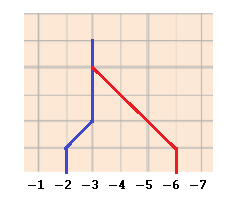
- t2.png (3.78 KiB) Viewed 30857 times
takes g0.
connects.
 as soon as temperature drops to 2⅓.
 gains 2½ I conclude
  OC, in an actual game doing more than finding the count and how much a play gains is not always useful.
 His point was that you can use thermography to find optimal play.