How do Japanese rules handle this?

For discussing go rule sets and rule theory
Post Reply
User avatar
Cassandra
Lives in sente
Posts: 1326
Joined: Wed Apr 28, 2010 11:33 am
Rank: German 1 Kyu
GD Posts: 0
Has thanked: 14 times
Been thanked: 153 times

Re: How do Japanese rules handle this?

Post by Cassandra »

Click Here To Show Diagram Code
[go]$$
$$ -------------------------
$$ | O . . O X X . . O O . O
$$ | O O O O X W X O O O O O
$$ | X X X X O 1 O O . O . .
$$ | X . X X O O O O O . . .
$$ | . X X . . . . . . . . .
$$ | X X . . . . . . . . . .
$$ | . . . . . . . . . . . .
$$ | . . . . . . . . . . . .[/go]
For proving that :wc: is alive, ...
Click Here To Show Diagram Code
[go]$$
$$ -------------------------
$$ | O . . O X X . 2 O O . O
$$ | O O O O X . X O O O O O
$$ | X X X X O X O O . O . .
$$ | X . X X O O O O O . . .
$$ | . X X . . . . . . . . .
$$ | X X . . . . . . . . . .
$$ | . . . . . . . . . . . .
$$ | . . . . . . . . . . . .[/go]
... it is sufficient to play :w2:, AFTER Black captured her single stone. White would never play there, if Black did not capture her stone before.
It seems that you overlooked this option so far.
Click Here To Show Diagram Code
[go]$$
$$ -------------------------
$$ | W . . W X X . . O O . O
$$ | W W W W X P X O O O O O
$$ | X X X X O 1 O O . O . .
$$ | X . X X O O O O O . . .
$$ | . X X . . . . . . . . .
$$ | X X . . . . . . . . . .
$$ | . . . . . . . . . . . .
$$ | . . . . . . . . . . . .[/go]
For Black's attempt to capture White's :wc: stones in the corner, it is mandatory to capture :wx: before.
Click Here To Show Diagram Code
[go]$$
$$ -------------------------
$$ | W 5 3 W X X 4 2 O O . O
$$ | W W W W X 6 X O O O O O
$$ | X X X X O X O O . O . .
$$ | X . X X O O O O O . . .
$$ | . X X . . . . . . . . .
$$ | X X . . . . . . . . . .
$$ | . . . . . . . . . . . .
$$ | . . . . . . . . . . . .[/go]
White played at :w6: AFTER her stones in the corner were captured, so her corner stones are alive.
Please note that :w6: was NOT touched by White in the process for assessing the status of her single stone seperately.

If you do not like that :w2: was played here at the same point as above (for the sake of simplicity), throw-in at :w4:, instead, and follow the well-known sequence thereafter.

Anyway, :w2: is another point than :w6:, so both proofs are INDEPENDENT of each other. I suppose that this is what you missed so far.
The really most difficult Go problem ever: https://igohatsuyoron120.de/index.htm
Igo Hatsuyōron #120 (really solved by KataGo)
User avatar
CDavis7M
Lives in sente
Posts: 716
Joined: Tue Jun 15, 2010 2:18 pm
Rank: Shokyu
GD Posts: 0
Universal go server handle: CDavis7M
Has thanked: 109 times
Been thanked: 140 times
Contact:

Re: How do Japanese rules handle this?

Post by CDavis7M »

jann wrote: Would B capturing 5 stones in the corner necessarily enable W to play a new stone under his marked ko stone? In a direct sense yes, as W cannot play a new stone there originally (thus it was only made possible in the course of the capture), and the corner cannot be captured without allowing W to play an uncapturable stone there.
There is a misunderstanding of what the word "direct" means. Direct in this context would mean "without intervening factors or intermediaries." In this example, the 1 White stone that must be captured before capturing the 5 stones is an intervening factor or intermediary. Therefore, capturing the 5 stones in the corner does not "directly" enable White to play a new stone. Instead, it is the capture of the 1 stone that directly enables White to play the uncapturable stones. This is the reason that the 5 stones are dead.

Also, the statement that the "corner cannot be captured without allowing W to play an uncapturable stone there" shows a misunderstanding. First, in this example White is NOT playing "there" because the new stones are not in the corner. Second, it is always possible in the stopped-game state of a Go game under Japanese Rules to show that stones cannot be captured without allowing the opponent to play an uncapturable stone (filling dame or territory, etc.). This is by virtue of alternating play and does not confirm L&D. This statement is unrelated to L&D confirmation.

---------------
jann wrote: Lightvector offered the following simplification of his example for the same question (ignore that reinforcement is forceable in game even vs excess W threats, suppose both pass here).
Is the marked W stone alive? Capturing it would enable W to play a new stone either under it or under his ko stone, depending on what B tries. Deciding this is still the same question as above (preparatory sacrificial capture for liberty).
Well then this is not a valid end-game position according to the Japanese Rules because it violates Article 1. This is why the Japanese Rules are sure that the players know when they need to make moves during the game and when they do not. But let's put this aside for a second and consider the position as is.
Click Here To Show Diagram Code
[go]$$
$$ | . . . . . .
$$ | X X X X X .
$$ | X O O O . .
$$ | W X X O . .
$$ | a X O O . .
$$ | X X O . . .
$$ | Q X O . . .
$$ | . O O . . .
$$ -----------[/go]
The :wc: stone is dead. The 6 black stones are dead. So point 'a' is dame. White can play teire during the game or in L&D confirmation to make :wc: alive and then make point 'a' become territory (and the black stones will become prisoners).
The :wc: stone is dead when considered separately because if :wt: is considered separately then it is independently alive while :wc: is only alive when considering the 2 stones together.
--Variation 1 shows why :wt: is independently alive. Black does not capture :wc: because it doesn't matter. Black does not try to prevent his capture because it doesn't matter if Black is captured. What matter is whether :wt: is alive when confiring the status of :wt: .
--In Variation 2, Black does capture :wc: but again, it doesn't matter when confirming the status of :wt:. The stone :wt: is alive because it can always connect back to alive stones. So it IS connected (even if loosely) to those alive stones.
--Variation 3 attempts to show why the the 1 stones :wc: is alive separately. Some might argue that :wc: is alive because :wt: can connect to the alive stones. But wait, this is exactly the same reason why :wt: is independently alive. Varition 3 does not "confirm" anything because there is nothing unknown that is being determined. The life of :wt: could already be determined. Adding a new stone to stones that are independently alive cannot show that other stones are alive. So :wc: is dead when considered separately and White has dame unless White teire.
Click Here To Show Diagram Code
[go]$$ Var.1: :w2: pass, :b3: pass, :w4: above 1, :b5: pass, :w6: connect \n Var.2: :w2: pass, :w4: above 1, :b5: connect, :w6: connect. \n Var.2: :w2: pass, :w4: above 1, :b5: connect, :w6: connect.
$$ | . . . . . .-. . . . . .--. . . . . .
$$ | X X X X X .-X X X X X .--X X X X X .
$$ | X O O O . .-X O O O . .--X O O O . .
$$ | W X X O . .-W X X O . .--W X X O . .
$$ | . X O O . .-3 X O O . .--3 X O O . .
$$ | X X O . . .-X X O . . .--X X O . . .
$$ | Q X O . . .-Q X O . . .--Q X O . . .
$$ | 1 O O . . .-1 O O . . .--1 O O . . .
$$ -----------[/go]
--------
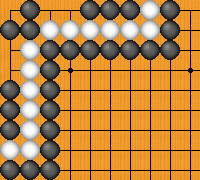
jann wrote: Any interpretation should also look at example 4, a case unlike usual snapback/nakade, where the new stones are made possible by B's first approach move, ie. not the capture itself but its necessary preparatory move already, and by the time of the capture the new stones are even played already (shown in the commentary, with a minor caveat). Locality ideas also seem poor match for the commentary examples showing the (lack of, under pass-for-ko) possible interactions between remote groups.
The thing about example 4 is that the separate groups of White stones are not alive independently. One group's life is dependent on the life of the other. When considered separately, they are both dead. One major difference in Example 4 is that the stones are seki. No one is pretending that the live stones in example 4 have territory. All of the positions we are discussing, someone is asking whether one play has territory.
Image

As for "locality," I agree that is irrelevant. My understanding of L&D "confirmation" is based on the definition of "confirmation" which requires consideration of dependencies (can status already be confirmed or is something left unknown and yet to be confirmed). The position of the new stone only matter if it is uncapturable because of other stones that can already be deemed alive separately.


----------
jann wrote: Btw, killing in these examples (not recognizing the enabled stone) could also affect capturing races. Normally a ko can provide one move in a race, but pass-for-ko can change this to two. May not be a practical problem/example (since reinforcement is forceable in game again), but suppose both passed here:
Click Here To Show Diagram Code
[go]$$
$$ | -------------------------------------
$$ | . X O . O . O a O O . W X . X . O X |
$$ | X X O O O O O O X O O X X X X O O X |
$$ | . X X X X X X X X X X O O O O O . X |
$$ | -------------------------------------[/go]
No ko threats, W is safe with territory in normal go. But B can capture the right under pass-for-ko. W needs his upcoming re-play of the marked stone recognized as enabled by B's capture of the corner, to avoid a poor ruling.
--The 22 White stones are alive because 9 of them cannot be captured at all, so 22 cannot be captured.
--The 9 White stones are alive because they have 2 eyes and cannot be captured.
--The 4 White stones are alive because the cannot be captured because if Black captures :wc: then the 4 stones can connect back. There's no question of "new" or "uncapturable." The 4 stones cannot be captured in the first place.
--The 1 :wc: stone is alive. This is because even if Black captures it, a new stone can be played at the same intersection and connect back. This is the same reason why the 1 ko-stone in "Variation B" (discussed above) is alive.
--The 8 White stones on the right are dead. Because any attempt to provide a new uncapturable stone relies on the fact that :wc: can already create a new uncapturable stones on it's own independent of the 8 White stones being captured or not.

Confirmation that :wc: is alive, separate from the capture of the 8 stones.
--In Variation 1, Black does not try to capture the 8 stones because their L&D is not being confirmed.
--In Variation 2, Black does capture the 8 stones but this does not add anything beyond Variation 1.

Trying to show that the 8 stones are alive using Variation 2 again does not "confirm" anything that is not already know. :wc: is alive but the 8 White stones are dead.
Click Here To Show Diagram Code
[go]$$ Var.1: :b3: pass, :w4: pass, :b5: pass, :w6: retake, :b7: pass, :w8: connect \n Var.2: :b3: connect, :b5: right of 4, :b7: above :b5:
$$ | -------------------------------------
$$ | . X O . O . O 2 O O 1 W X . X . O X |-. X O . O . O 2 O O 1 W X 8 X 6 O X |
$$ | X X O O O O O O X O O X X X X O O X |-X X O O O O O O X O O X X X X O O X |
$$ | . X X X X X X X X X X O O O O O . X |-. X X X X X X X X X X O O O O O 4 X |
$$ | -------------------------------------[/go]
White needs teire, in the game or in L&D confirmation.
User avatar
CDavis7M
Lives in sente
Posts: 716
Joined: Tue Jun 15, 2010 2:18 pm
Rank: Shokyu
GD Posts: 0
Universal go server handle: CDavis7M
Has thanked: 109 times
Been thanked: 140 times
Contact:

Re: How do Japanese rules handle this?

Post by CDavis7M »

Gérard TAILLE wrote: Sequence 2 proving that the group with 5 stones is alive
...and because black cannot play at "a" with :b3: white is able to play herself at "a". Then taking into account that you always considered a stone at "a" being here a new uncapturable stone then I conclude the group of 5 white stones is alive
This variation does not show that the 5 white stones are alive. It's not the case that point 'a' is always considered a new uncapturable stone, it depends on which stones are being assessed and the final position. In this position, White has simply connected stones to the group with 2 eyes. That doesn't confirm anything about L&D.

If White uses :w6: to capture two Black stones. This is the same as Variation 4 which shows the L&D of the 1 white stone considered independent of the 5 stones being captured. Because it does not matter if the 5 stones are captured, then they are not providing living status on their own, so they are dead when considered separately.

This shows that if the 1 stone is considered separate from the capture of the 5 stones, then the 1 stone is alive. It does not matter if Black can capture the 5 stones if the L&D of the stones are independent.
Click Here To Show Diagram Code
[go]$$B :w4: at "a" \n Var 4: :b3: pass, :b5: pass, :w6: at :wc:
$$ ----------------------
$$ | W 5 W 3 X a 2 . O . O-. X . X X O O . O . O-. X . X X O O . O . O-O . O . X 4 2 . O . O
$$ | W W W X O X O O O O O-. . . X . X O O O O O-. . . X 6 X O O O O O-O O O X W X O O O O O
$$ | X X X O 1 O O . O . .-X X X O X O O . O . .-X X X O X O O . O . .-X X X O 1 O O . O . .
$$ | X . X O O O O O . . .-X . X O O O O O . . .-X . X O O O O O . . .-X . X O O O O O . . .
$$ | . X X . . . . . . . .-. X X . . . . . . . .-. X X . . . . . . . .-. X X . . . . . . . .
$$ | X X . . . . . . . . .-X X . . . . . . . . .-X X . . . . . . . . .-X X . . . . . . . . .
$$ | . . . . . . . . . . .-. . . . . . . . . . .-. . . . . . . . . . .-. . . . . . . . . . .
$$ | . . . . . . . . . . .-. . . . . . . . . . .-. . . . . . . . . . .-. . . . . . . . . . .[/go]
User avatar
CDavis7M
Lives in sente
Posts: 716
Joined: Tue Jun 15, 2010 2:18 pm
Rank: Shokyu
GD Posts: 0
Universal go server handle: CDavis7M
Has thanked: 109 times
Been thanked: 140 times
Contact:

Re: How do Japanese rules handle this?

Post by CDavis7M »

kvasir wrote:Sorry, I just don't comprehend what you mean.

Are you saying that the 5 stones are alive because the 1 stone is alive or are you saying that the 5 stones are dead because the 1 stone is alive? That doesn't seem right.
I am saying that the 6 stones (including the 5 stones and the 1 stone) are alive because the 1 stone is alive. The 1 stone considered separately is alive because it is alive independent of whether the 5 stones are captured or not. The 5 stones are dead because the 1 stone is independently alive. This means that there is nothing unknown to be determined. There is nothing left to "confirm," by definition. Assessing the 5 stones does not "confirm" anything about L&D.
kvasir wrote: Words like "independent" and "dependent" convey powerful ideas but it is often not clear what that idea is. I do not for one thing understand what you mean by the 1 stone being "independent" of the 5 stones (or how to state what you meant) when the 5 stones are "dependent" on the 1 stone.
I mean that the 1 stone is independent of the 5 stones because the 1 stone is alive whether Black captures the 5 stones or not. If Black is considering the L&D status of the 1 stone separately, Black does not need to capture the 5 stones because that does not matter to the status of the 1 stone. Black's best attempt might be to connect the ko, but that doesn't work because then White can capture Black.

Confirming the status of the 5 stones necessarily involves the capture of the 1 living stone. So are 6 stones being considered or just 5? It's 6 stones. Might as well consider all the white stones including those with 2 eyes and just say White is alive because all of the stones cannot be captured. But this is not how L&D confirmation works. Any attempt to show that the 5 stones are alive depends on the 1 stone (which is independently alive) being alive. The L&D status of the 1 stone and 5 stones is not interdependent (as the stones in Example 4 of the Japanese Rules are interdependent).

This all goes back to the definition of "Confirmation" mentioned above. It is the determination of something unknown. The status of the 1 stone is known. Assessing the status of the 5 stones separately does not determine anything that is unknown so it does not "confirm" the living status of the 5 White stones. By the rules, if stones cannot be confirmed as alive, then they are dead.
kvasir wrote: I'd grant that the 1 and 5 stones are dependent (without definition) but I don't comprehend what relation you mean and why it is not symmetric, as in 1 being dependent on 5 if and only if 5 is dependent on 1. Also I don't understand what you mean by doing status confirmation for the 5+1 stones together or what that has to with if the 5 stones are alive or not.
Look at Example 4. The White stones are interdependent. One group cannot be alive without the other group being captured. Whereas in the position we are discussing, the 1 White stone can be alive without the 5 stones ever being captured.

Image
User avatar
CDavis7M
Lives in sente
Posts: 716
Joined: Tue Jun 15, 2010 2:18 pm
Rank: Shokyu
GD Posts: 0
Universal go server handle: CDavis7M
Has thanked: 109 times
Been thanked: 140 times
Contact:

Re: How do Japanese rules handle this?

Post by CDavis7M »

Cassandra wrote: For proving that :wc: is alive, ...
Click Here To Show Diagram Code
[go]$$
$$ -------------------------
$$ | O . . O X X . 2 O O . O
$$ | O O O O X . X O O O O O
$$ | X X X X O X O O . O . .
$$ | X . X X O O O O O . . .
$$ | . X X . . . . . . . . .
$$ | X X . . . . . . . . . .
$$ | . . . . . . . . . . . .
$$ | . . . . . . . . . . . .[/go]
... it is sufficient to play :w2:, AFTER Black captured her single stone. White would never play there, if Black did not capture her stone before.
It seems that you overlooked this option so far.
This does NOT show that :wc: is alive. All this shows is that the group with 2 eyes is alive. Also, this variation has been discussed.

The statement "White would never play there, if Black did not capture her stone before." only shows that alternating play is a rule of Go. It does not say anything about L&D confirmation because a player will always be able to play some uncapturable stone somewhere (eg filing dame or territory).
Cassandra wrote:
Click Here To Show Diagram Code
[go]$$
$$ -------------------------
$$ | W . . W X X . . O O . O
$$ | W W W W X P X O O O O O
$$ | X X X X O 1 O O . O . .
$$ | X . X X O O O O O . . .
$$ | . X X . . . . . . . . .
$$ | X X . . . . . . . . . .
$$ | . . . . . . . . . . . .
$$ | . . . . . . . . . . . .[/go]
For Black's attempt to capture White's :wc: stones in the corner, it is mandatory to capture :wx: before.
Oh, so if Black is considering the L&D status of the 6 stones in the corner then why is Black capturing a 7th stone? It seems like Black is considering the L&D status of the 7 stones together, not the 6 stones separately. And the 7th stone is alive independent of the 6 stones being captured. So the 6 stones are dead.
Cassandra wrote:
Click Here To Show Diagram Code
[go]$$
$$ -------------------------
$$ | W 5 3 W X X 4 2 O O . O
$$ | W W W W X 6 X O O O O O
$$ | X X X X O X O O . O . .
$$ | X . X X O O O O O . . .
$$ | . X X . . . . . . . . .
$$ | X X . . . . . . . . . .
$$ | . . . . . . . . . . . .
$$ | . . . . . . . . . . . .[/go]
White played at :w6: AFTER her stones in the corner were captured, so her corner stones are alive.
Please note that :w6: was NOT touched by White in the process for assessing the status of her single stone seperately.

If you do not like that :w2: was played here at the same point as above (for the sake of simplicity), throw-in at :w4:, instead, and follow the well-known sequence thereafter.

Anyway, :w2: is another point than :w6:, so both proofs are INDEPENDENT of each other. I suppose that this is what you missed so far.
You are mistaken because your premise regarding :w2: is incorrect. This sequence is one possible variation in showing that the 1 stone is alive. :w2: alone is insufficient to prove life. :w4: and :w6: are necessary. Black passes and does not bother to capture the corner stones because their L&D is not being considered. The 6 separate stones cannot rely on this sequence to show life because all this does is show the life of the 1 stone independent of the 6 stones.

The life of the 6 stones depends on the independent life of the 1 ko-stone. The life of the 1 stone does not depend on the life of the 6 stones. The 7 stones are alive by virtue of the 1 stone but the 6 stones are dead when considered separately.
Click Here To Show Diagram Code
[go]$$ :b3: pass, :b5: pass.
$$ -------------------------
$$ | W . . W X X 4 2 O O . O
$$ | W W W W X 6 X O O O O O
$$ | X X X X O X O O . O . .
$$ | X . X X O O O O O . . .
$$ | . X X . . . . . . . . .
$$ | X X . . . . . . . . . .
$$ | . . . . . . . . . . . .
$$ | . . . . . . . . . . . .[/go]
User avatar
Cassandra
Lives in sente
Posts: 1326
Joined: Wed Apr 28, 2010 11:33 am
Rank: German 1 Kyu
GD Posts: 0
Has thanked: 14 times
Been thanked: 153 times

Re: How do Japanese rules handle this?

Post by Cassandra »

CDavis7M wrote:
Cassandra wrote: For proving that :wc: is alive, ...
Click Here To Show Diagram Code
[go]$$
$$ -------------------------
$$ | O . . O X X . 2 O O . O
$$ | O O O O X . X O O O O O
$$ | X X X X O X O O . O . .
$$ | X . X X O O O O O . . .
$$ | . X X . . . . . . . . .
$$ | X X . . . . . . . . . .
$$ | . . . . . . . . . . . .
$$ | . . . . . . . . . . . .[/go]
... it is sufficient to play :w2:, AFTER Black captured her single stone. White would never play there, if Black did not capture her stone before.
It seems that you overlooked this option so far.
This does NOT show that :wc: is alive. All this shows is that the group with 2 eyes is alive.
:w2: is a stone that is played AFTER White's alive single stone has been captured.
Click Here To Show Diagram Code
[go]$$
$$ -------------------------
$$ | ? ? ? ? X X C C O O . O
$$ | ? ? ? ? X C C O O O O O
$$ | X X X X O C O O . O . .
$$ | X . X X O O O O O . . .
$$ | . X X . . . . . . . . .
$$ | X X . . . . . . . . . .
$$ | . . . . . . . . . . . .
$$ | . . . . . . . . . . . .[/go]
I am afraid that ALL :ec: points in the relevant area -- which could be taken by White -- can be considered being / becoming part of an already alive group of hers.

Five :ec: points are marked. I am sure that you know that at least eight stones are needed to create an independently alive group at the edge of the board.
I do not have any idea how you intend establishing ONE PERMANENT stone on the board that is INDEPENDENTLY alive on its own.

However, this does not matter at all, as e.g. L&D Example 1 clearly demonstrates.

All that J89 demands for proving "being alive" for a capturable stone is to establish a permanant stone on the board (in my opinion AFTER this capture) that would not have been played there in the case the capturable stone had not been captured.
The really most difficult Go problem ever: https://igohatsuyoron120.de/index.htm
Igo Hatsuyōron #120 (really solved by KataGo)
Gérard TAILLE
Gosei
Posts: 1346
Joined: Sun Aug 23, 2020 2:47 am
Rank: 1d
GD Posts: 0
Has thanked: 21 times
Been thanked: 57 times

Re: How do Japanese rules handle this?

Post by Gérard TAILLE »

kvasir wrote: I'll repeat that stating that the new stones could have been played anyway isn't the issue. Life and death example 1 even contradicts that claim.
Click Here To Show Diagram Code
[go]$$
$$ ----------------------
$$ | . X X O . .
$$ | O X X O . .
$$ | X O O O . .
$$ | X X X . . .
$$ | . . . . . .[/go]
Click Here To Show Diagram Code
[go]$$W
$$ ----------------------
$$ | 1 X X O . .
$$ | O X X O . .
$$ | X O O O . .
$$ | X X X . . .
$$ | . . . . . .[/go]
Click Here To Show Diagram Code
[go]$$W
$$ ----------------------
$$ | O 3 4 O . .
$$ | O 2 5 O . .
$$ | X O O O . .
$$ | X X X . . .
$$ | . . . . . .[/go]
Click Here To Show Diagram Code
[go]$$W
$$ ----------------------
$$ | 6 7 X O . .
$$ | . X O O . .
$$ | X O O O . .
$$ | X X X . . .
$$ | . . . . . .[/go]
Click Here To Show Diagram Code
[go]$$W
$$ ----------------------
$$ | X O 9 O . .
$$ | 8 X O O . .
$$ | X O O O . .
$$ | X X X . . .
$$ | . . . . . .[/go]


White can play :w7: and :w9: but life and death example 1 argues, as in the following diagrams, that white is alive because :w4: and :w6: can be played, those are the same points that white could play anyway in the previous diagram.
Click Here To Show Diagram Code
[go]$$B
$$ ----------------------
$$ | 1 X X O . .
$$ | O X X O . .
$$ | X O O O . .
$$ | X X X . . .
$$ | . . . . . .[/go]
Click Here To Show Diagram Code
[go]$$
$$ ----------------------
$$ | X X X O . .
$$ | 2 X X O . .
$$ | X O O O . .
$$ | X X X . . .
$$ | . . . . . .[/go]
Click Here To Show Diagram Code
[go]$$
$$ ----------------------
$$ | 5 4 6 O . .
$$ | O 3 . O . .
$$ | X O O O . .
$$ | X X X . . .
$$ | . . . . . .[/go]
Click Here To Show Diagram Code
[go]$$
$$ ----------------------
$$ | . X X O . .
$$ | Q X X O . .
$$ | X O O O . .
$$ | X X X . . .
$$ | . . . . . .[/go]
I presented my view on this position in the post viewtopic.php?p=267413#p267413.
I agree with the conclusion given by Jann in the following post viewtopic.php?p=267416#p267416 : in contradiction with what is said in example 1 of the rule I consider that the marked white stone is dead but as explained in the posts mentionned that does not change the final conclusion : the position is unfinished and white has to continue the game.
Gérard TAILLE
Gosei
Posts: 1346
Joined: Sun Aug 23, 2020 2:47 am
Rank: 1d
GD Posts: 0
Has thanked: 21 times
Been thanked: 57 times

Re: How do Japanese rules handle this?

Post by Gérard TAILLE »

CDavis7M wrote:
Gérard TAILLE wrote: Sequence 2 proving that the group with 5 stones is alive
...and because black cannot play at "a" with :b3: white is able to play herself at "a". Then taking into account that you always considered a stone at "a" being here a new uncapturable stone then I conclude the group of 5 white stones is alive
This variation does not show that the 5 white stones are alive. It's not the case that point 'a' is always considered a new uncapturable stone, it depends on which stones are being assessed and the final position. In this position, White has simply connected stones to the group with 2 eyes. That doesn't confirm anything about L&D.
Click Here To Show Diagram Code
[go]$$
$$ ----------------------
$$ | O . O . X a b O O . O
$$ | O O O X O X O O O O O
$$ | X X X O . O O . O . .
$$ | X . X O O O O O . . .
$$ | . X X . . . . . . . .
$$ | X X . . . . . . . . .
$$ | . . . . . . . . . . .
$$ | . . . . . . . . . . .[/go]
I think I am making some (small?) progress in understanding your view.
I agree that, when looking at the status of the five white stones, a white stone at "a" or "b" has not to be considered as a new uncapturable stone.
Now I do not understand why a white stone at "a" (or "b") could be considered as a new uncapturable stone when looking at the status of the group of 1 white stone.
For me, in any case (I mean even if it is black to play first), black cannot prevent white to put a permanent stone on "a" (or "b") => in any case, stones on "a" or b" are simply connected stones to the group with 2 eyes and not new permanent stones.

If you agree on this point then I agree (only temporarily because other arguments exist) that the group of 1 stone is alive while the group of 5 stones is dead.
kvasir
Lives in sente
Posts: 1040
Joined: Sat Jul 28, 2012 12:29 am
Rank: panda 5 dan
GD Posts: 0
IGS: kvasir
Has thanked: 25 times
Been thanked: 187 times

Re: How do Japanese rules handle this?

Post by kvasir »

Gérard TAILLE wrote:
Click Here To Show Diagram Code
[go]$$
$$ ----------------------
$$ | . X X O . .
$$ | Q X X O . .
$$ | X O O O . .
$$ | X X X . . .
$$ | . . . . . .[/go]
I presented my view on this position in the post viewtopic.php?p=267413#p267413.
I agree with the conclusion given by Jann in the following post viewtopic.php?p=267416#p267416 : in contradiction with what is said in example 1 of the rule I consider that the marked white stone is dead but as explained in the posts mentionned that does not change the final conclusion : the position is unfinished and white has to continue the game.

Now example 1 is incorrect because if it was correct it is exactly like I said, it is not necessary that the new stones couldn't have been played? It is fictitious to claim white has to continue the game and play what black dictates.
User avatar
Cassandra
Lives in sente
Posts: 1326
Joined: Wed Apr 28, 2010 11:33 am
Rank: German 1 Kyu
GD Posts: 0
Has thanked: 14 times
Been thanked: 153 times

Re: How do Japanese rules handle this?

Post by Cassandra »

Click Here To Show Diagram Code
[go]$$
$$ -------------
$$ | ? ? ? O . .
$$ | ? ? ? O . .
$$ | X O O O . .
$$ | X X X . . .
$$ | . . . . . .[/go]
The disputed area (shadowed) in the corner only includes SIX board points.
It is IMPOSSIBLE to establish a group therein that is INDEPENDENTLY alive on its own.
Click Here To Show Diagram Code
[go]$$
$$ -------------
$$ | ? ? ? O . .
$$ | Y ? ? O . .
$$ | B O O O . .
$$ | B B B . . .
$$ | . . . . . .[/go]
It should be clear that it is mandatory for any "new" permanent Black stone :bt: to be connected with Black's already alive :bc: group.
Click Here To Show Diagram Code
[go]$$
$$ -------------
$$ | Y ? ? O . .
$$ | B ? ? O . .
$$ | B O O O . .
$$ | B B B . . .
$$ | . . . . . .[/go]
... and so on ...
Click Here To Show Diagram Code
[go]$$
$$ -------------
$$ | ? ? Q W . .
$$ | ? ? ? W . .
$$ | X W W W . .
$$ | X X X . . .
$$ | . . . . . .[/go]
The same is true for any "new" permanent White stone :wt: in relation to White's already alive :wc: group.
Click Here To Show Diagram Code
[go]$$
$$ -------------
$$ | ? Q W W . .
$$ | ? ? ? W . .
$$ | X W W W . .
$$ | X X X . . .
$$ | . . . . . .[/go]
... and so on ...

The only decisive question is whether these stones would have been played if nothing had been captured before.
The answer is "NO".
The really most difficult Go problem ever: https://igohatsuyoron120.de/index.htm
Igo Hatsuyōron #120 (really solved by KataGo)
jann
Lives in gote
Posts: 445
Joined: Tue May 14, 2019 8:00 pm
GD Posts: 0
Been thanked: 37 times

Re: How do Japanese rules handle this?

Post by jann »

Here is an old example I originally posted as a test for Gérard. It also seems relevant for the enable rule and its aspiring reinventions:
Click Here To Show Diagram Code
[go]$$B
$$ +---------------+
$$ | . X . . X X X |
$$ | X X O O O O O |
$$ | . O X X X X X |
$$ | . O X O O O X |
$$ | X O X O O . X |
$$ | X O X O O O X |
$$ | X O X O O O . |
$$ +---------------+[/go]
In J89 (and Japanese-style rules in general, including Jasiek's J2003 afais) all strings are alive, seki with no territory. The traditional enable interpretation understands this (no string can be captured without enabling new uncapturable stones).

And another seki (variant of example 5) for both timing-based ideas and any non-complete enable idea:
Click Here To Show Diagram Code
[go]$$
$$ ---------------------------------
$$ | . O X X X O O O O X O O X O O |
$$ | X X O O X X X . O X . O X . O |
$$ | X X O . O O X . O X . O X . O |
$$ | O O O O . O X X O X X O X X O |
$$ ---------------------------------[/go]
These examples show why the traditional enable rule is worded as is, and works as does. It is essential for the rules to detect ANY kind of negative consequence attached to the capture in ANY kind of causal relationship. Restricting this in any way would be suicidal and almost certainly fail in some examples.

About single stone in torazu3 (kvasir and Gérard, maybe even Cassandra): it is dead under the traditional interpretation (since capturing it wouldn't enable anything), but this may be debatable under another, even less restricted interpretation. For example, it could become alive if the rule would be changed from "capturing them would enable" to "capturing them would involve" (which may be kvasir's direction), but it looks hard to find a usable algorithm for the latter due to lack of definite meaning and logical substance (and things like onesided dame).
CDavis7M wrote:...
You seem to talk about your own ideas (and not J89 anymore). This is fine, but as others pointed out you use some vague phrases without definition, which makes your ideas unverifiable (and hard to comment on). IMO this is also why you yourself don't notice their lurking contradictions. And you are wrong on example 4: both W strings are alive (separately, as L/D always works string-by-string) on enable.
kvasir
Lives in sente
Posts: 1040
Joined: Sat Jul 28, 2012 12:29 am
Rank: panda 5 dan
GD Posts: 0
IGS: kvasir
Has thanked: 25 times
Been thanked: 187 times

Re: How do Japanese rules handle this?

Post by kvasir »

jann wrote:Here is an old example I originally posted as a test for Gérard. It also seems relevant for the enable rule and its aspiring reinventions:
Well, it does need explanation why playing 'new stones' on some points counts as 'enabling' and others not. It is not reinventing anything when we discuss that the points are different.

You never explain what your "traditional" interpretation actually is. You were cited (by Gerard) as having the anti-traditional view that new stones don't count if they could have been played anyway, something that would break your second example just as it would break example 1 and 5. You completely contradict yourself in your post, first claiming the 1 stone is alive and then dead. What is up with that? Why is example 1 different from example 5, how do you justify the anti-traditional view that the 1 stone is dead in example 1 but then alive example 5? How do you determine which examples are correct and which example are wrong?

Can you give a complete list of which examples are correct in this (anti-?)traditional view that rejects parts of the original rules text as incorrect? Again, why is example 1 incorrect and why is example 5 correct?
jann
Lives in gote
Posts: 445
Joined: Tue May 14, 2019 8:00 pm
GD Posts: 0
Been thanked: 37 times

Re: How do Japanese rules handle this?

Post by jann »

kvasir wrote:You never explain what your "traditional" interpretation actually is.
I think I did above (around "the advantage of the straightforward/traditional interpretation"), but to make it clear:

"Capturing a string WOULD ENABLE" the opponent to play a new uncapturable stone if:
  • the new stone cannot be played vs resistance in the original position
    (proving that it was ENABLED or made possible in the course of the capture)
  • the string is not capturable without the new stone getting played
    (proving that capturing it WOULD indeed necessarily enable the stone)
The advantage, as mentioned above, is that both points can actually be proven/disproven by hypothetical sequences. (I doubt this is "mine" btw, it was already around decades ago iirc.)
that new stones don't count if they could have been played anyway, something that would break your second example just as it would break example 1 and 5. You completely contradict yourself in your post, first claiming the 1 stone is alive and then dead. What is up with that? Why is example 1 different from example 5, how do you justify the anti-traditional view that the 1 stone is dead in example 1 but then alive example 5?
Where did I wrote that the 1 stone is alive, could you link or quote that? Anyway, I don't think it is, IMO it is dead, and this is a minor oversight in the commentary.

But in example 5 (and its variant), even though the 1 stone is dead again, this doesn't matter much since the interesting point is the life of W rightside stones. And when those strings are analyzed, B cannot capture anything on the right without giving up the torazu3 corner completely, all intersections, and in that case there will be some new stones there that W couldn't have played originally.
User avatar
Cassandra
Lives in sente
Posts: 1326
Joined: Wed Apr 28, 2010 11:33 am
Rank: German 1 Kyu
GD Posts: 0
Has thanked: 14 times
Been thanked: 153 times

Re: How do Japanese rules handle this?

Post by Cassandra »

jann wrote:Here is an old example I originally posted as a test for Gérard. It also seems relevant for the enable rule and its aspiring reinventions:
Click Here To Show Diagram Code
[go]$$B
$$ +---------------+
$$ | . X . . X X X |
$$ | X X O O O O O |
$$ | . O X X X X X |
$$ | . O X O O O X |
$$ | X O X O O . X |
$$ | X O X O O O X |
$$ | X O X O O O . |
$$ +---------------+[/go]
In J89 (and Japanese-style rules in general, including Jasiek's J2003 afais) all strings are alive, seki with no territory. The traditional enable interpretation understands this (no string can be captured without enabling new uncapturable stones).
I doubt that this is true.
Click Here To Show Diagram Code
[go]$$B
$$ +---------------+
$$ | . X 1 2 X X X |
$$ | X X O O O O O |
$$ | . O X X X X X |
$$ | . O X O O O X |
$$ | X O X O O . X |
$$ | X O X O O O X |
$$ | X O X O O O . |
$$ +---------------+[/go]
Click Here To Show Diagram Code
[go]$$B
$$ +---------------+
$$ | . X X O . 3 . |
$$ | X X O O O O O |
$$ | . O X X X X X |
$$ | 4 O X O O O X |
$$ | X O X O O . X |
$$ | X O X O O O X |
$$ | X O X O O O . |
$$ +---------------+[/go]
Click Here To Show Diagram Code
[go]$$B
$$ +---------------+
$$ | . X X O 7 X 5 |
$$ | X X O O O O O |
$$ | 6 O X X X X X |
$$ | O O X O O O X |
$$ | . O X O O . X |
$$ | . O X O O O X |
$$ | . O X O O O . |
$$ +---------------+[/go]
Click Here To Show Diagram Code
[go]$$Wm8 :w10: pass; :w12: pass
$$ +---------------+
$$ | . X X . X X X |
$$ | X X . . . . . |
$$ | O O X X X X X |
$$ | O O X O O O X |
$$ | . O X O O 2 X |
$$ | 1 O X O O O X |
$$ | . O X O O O 4 |
$$ +---------------+[/go]
Click Here To Show Diagram Code
[go]$$Wm8 :w10: pass; :w12: pass
$$ +---------------+
$$ | . X X . X X X |
$$ | X X . . . . . |
$$ | O O X X X X X |
$$ | O O X . . . X |
$$ | . O X . . X X |
$$ | O O X . . . X |
$$ | . O X . . . X |
$$ +---------------+[/go]
No chance for White to play any additional permanent stone after her group in the lower right has been taken off the board.

+++++++++++++++++++++++++++++++++++++++++++++++++++++++++++

But there is no need to discuss this position that will never reach the game's end, as Black will capture one of White's groups at the top / the left anyway, knowing L&D Example 4 alone.
The really most difficult Go problem ever: https://igohatsuyoron120.de/index.htm
Igo Hatsuyōron #120 (really solved by KataGo)
Gérard TAILLE
Gosei
Posts: 1346
Joined: Sun Aug 23, 2020 2:47 am
Rank: 1d
GD Posts: 0
Has thanked: 21 times
Been thanked: 57 times

Re: How do Japanese rules handle this?

Post by Gérard TAILLE »

Let's take this famous 7.1 article:

1. Stones are said to be "alive" if they cannot be captured by the opponent, or if capturing them would enable a new stone to be played that the opponent could not capture. Stones which are not alive are said to be "dead."

We all know that it is quite impossible to have a common understanding of the wording "enable a new stone". Maybe the translation of the japanese text is not perfect but the result is here: nobody can claim to have the correct understanding.

In this context I would try to give you for comment MY own interpretation.
Let's assume I would like to know if a given group of white stones are alive or dead. I need first to know if these stones are capturable which seems easy to understand (but maybe not easy to prove). I need also to know if capturing them would enable a new stone to be played that the opponent could not capture. To resolve such problem I have to define clearly where are the set of intersections which are candidate to receive a new uncapturable stone.
My first idea was the following:

All intersections for which white can prove, with black to play, she can put a permanent uncapturable "stone" cannot be candidate to be a new white stone. All other intersections can be candidate to be a new white stone.

It sounded perfect for me but the word "stone" cause difficulties in the following case:
Click Here To Show Diagram Code
[go]$$
$$ -----------------
$$ | a b O . O X . .
$$ | O O O O O X . .
$$ | X X X X X X . .
$$ | . . . . . . . .
$$ | . . . . . . . .[/go]
What is the issue? I do not want to consider that a white move at "a" (or "b") create a new stone but I cannot prove that white can put on this intersection a permanent uncapturable stone because black can herself play a move at "a" and white will not be able in future to put a permanent uncapturable stone on this intersection.
How solving such issue?
My proposal is very simple: by extension, any empty intersection surrounded by permanent uncapturable stones is also considered a permanent uncapturable "stone"

With this extension my above proposal (bold text) satisfies myself.

Let's take examples:

Example 1 of the rule
Click Here To Show Diagram Code
[go]$$
$$ -------------
$$ | . X X O . .
$$ | Q X X O . .
$$ | X O O O . .
$$ | X X X . . .
$$ | . . . . . .[/go]
What is the status of the white marked stone?

To answer this question I need to identify which intersections could not be candidate being a new uncapturable stone.
Click Here To Show Diagram Code
[go]$$
$$ -------------
$$ | . B B W . .
$$ | O X B W . .
$$ | X W W W . .
$$ | X X X . . .
$$ | . . . . . .[/go]
In this exemple the circle intersections are the intersections that cannot be candidate to be a new white stone.
Black can capture the :wt: stone without allowing white to create a new uncapturable stone => the white marked stone is dead.

Example 5 of the rule
Click Here To Show Diagram Code
[go]$$
$$ -------------
$$ | . Q X X . O X . .
$$ | X X O X . O X . .
$$ | X X O X X O X . .
$$ | O O O O O X X . .
$$ | . . . . . . . . .[/go]
What is the status of the white marked stone?
Click Here To Show Diagram Code
[go]$$
$$ -------------
$$ | . O X X . O X . .
$$ | B X W X . O X . .
$$ | B B W X X O X . .
$$ | W W W W W X X . .
$$ | . . . . . . . . .[/go]
In this exemple the circle intersections are the intersections that cannot be candidate to be a new white stone.

Can black capture the marked stone without creating a new white uncapturable stone?
Click Here To Show Diagram Code
[go]$$
$$ -------------
$$ | 1 Q X X . O X . .
$$ | X X O X . O X . .
$$ | X X O X X O X . .
$$ | O O O O O X X . .
$$ | . . . . . . . . .[/go]
Click Here To Show Diagram Code
[go]$$
$$ -------------
$$ | X 2 X X . O X . .
$$ | X X O X . O X . .
$$ | X X O X X O X . .
$$ | O O O O O X X . .
$$ | . . . . . . . . .[/go]
Click Here To Show Diagram Code
[go]$$
$$ -------------
$$ | 4 O X X . O X . .
$$ | 5 3 O X . O X . .
$$ | . . O X X O X . .
$$ | O O O O O X X . .
$$ | . . . . . . . . .[/go]
Click Here To Show Diagram Code
[go]$$
$$ -------------
$$ | 7 6 X X . O X . .
$$ | X X O X . O X . .
$$ | . 8 O X X O X . .
$$ | O O O O O X X . .
$$ | . . . . . . . . .[/go]
and the position reached is the following
Click Here To Show Diagram Code
[go]$$
$$ -------------
$$ | X a X X c O X . .
$$ | X X O X . O X . .
$$ | b O O X X O X . .
$$ | O O O O O X X . .
$$ | . . . . . . . . .[/go]
and now
1) If black plays at "a" then white plays at "b" creating new uncapturable stones with the group of 3 stones in seki
2) If black plays at "c" then white plays at "b" and will be able to play then at "a" creating a new uncapturable stone.
In any case black cannot capture the initial white marked stone and avoiding the creation of a new uncapturable stone => the white :wt: marked stone is alive.

I am completly open to discuss any other interpretation of the rule based on examples.
Post Reply