How do Japanese rules handle this?

For discussing go rule sets and rule theory
Post Reply
jann
Lives in gote
Posts: 445
Joined: Tue May 14, 2019 8:00 pm
GD Posts: 0
Been thanked: 37 times

Re: How do Japanese rules handle this?

Post by jann »

Cassandra wrote:No chance for White to play any additional permanent stone after her group in the lower right has been taken off the board.
I am aware of your "new stones AFTER the capturing move" idea, but such condition doesn't exist imo, and would fail in both of these last examples (even more in the second one!).

You are interested in the L/D in the original stopped/scoring position, not L/D in a later one. And to say that a string is/was dead in the stopped position, B needs to show a sequence that captures it, starting from that position, and without enabling uncapturable stones in the process. It doesn't matter if those stones are played early or late.
Gérard TAILLE wrote:It sounded perfect for me but the word "stone" cause difficulties in the following case:
"Was it possible?" would start with W, so for this kind of trick you need something like this: :)
(Iirc this was discussed somewhere very long time ago...)
Click Here To Show Diagram Code
[go]$$
$$ -----------------
$$ | . X X O . O X . .
$$ | O O O O O O X . .
$$ | X X X X X X X . .
$$ | . . . . . . . . .
$$ | . . . . . . . . .[/go]
Gérard TAILLE wrote:
Click Here To Show Diagram Code
[go]$$
$$ -------------
$$ | . O X X . O X . .
$$ | B X W X . O X . .
$$ | B B W X X O X . .
$$ | W W W W W X X . .
$$ | . . . . . . . . .[/go]
In this exemple the circle intersections are the intersections that cannot be candidate to be a new white stone.
...
Click Here To Show Diagram Code
[go]$$
$$ -------------
$$ | X a X X c O X . .
$$ | X X O X . O X . .
$$ | b O O X X O X . .
$$ | O O O O O X X . .
$$ | . . . . . . . . .[/go]
and now
1) If black plays at "a" then white plays at "b" creating new uncapturable stones with the group of 3 stones in seki
It doesn't look clear what you meant here. Maybe that the 3 stones TURNED uncapturable now? But the rule quite firmly talks about new plays.
Last edited by jann on Sun Dec 12, 2021 1:21 pm, edited 2 times in total.
User avatar
Cassandra
Lives in sente
Posts: 1326
Joined: Wed Apr 28, 2010 11:33 am
Rank: German 1 Kyu
GD Posts: 0
Has thanked: 14 times
Been thanked: 153 times

Re: How do Japanese rules handle this?

Post by Cassandra »

Gérard TAILLE wrote:All intersections for which white can prove, with black to play, she can put a permanent uncapturable "stone" cannot be candidate to be a new white stone. All other intersections can be candidate to be a new white stone.
Click Here To Show Diagram Code
[go]$$
$$ -------------
$$ | . X O O . O
$$ | P X O . O O
$$ | X O O O O .
$$ | X X X X . .
$$ | . X . X . .
$$ | X X X X . .[/go]
:wx: is dead???
The really most difficult Go problem ever: https://igohatsuyoron120.de/index.htm
Igo Hatsuyōron #120 (really solved by KataGo)
John Fairbairn
Oza
Posts: 3724
Joined: Wed Apr 21, 2010 3:09 am
Has thanked: 20 times
Been thanked: 4672 times

Re: How do Japanese rules handle this?

Post by John Fairbairn »

Let's take this famous 7.1 article:

1. Stones are said to be "alive" if they cannot be captured by the opponent, or if capturing them would enable a new stone to be played that the opponent could not capture. Stones which are not alive are said to be "dead."

We all know that it is quite impossible to have a common understanding of the wording "enable a new stone". Maybe the translation of the japanese text is not perfect but the result is here: nobody can claim to have the correct understanding.
This obviously bugs a lot of people, so let me try to offer a translation that follows the Japanese as closely as possible in every respect - vocabulary, grammar, syntax, order or whatever. No attempt at interpretation.

It's strictly impossible, because the Japanese passive and passive potential overlap (and, as a possible point of interest many Japanese don't understand or use the passive potential in the same way that Tokyo-ites do: they make distinctions between "physically can" and "can with permission" and so on - much as native English speakers use 'may' in various conflicting ways depending on area).

I think we can ignore that, but the Japanese disinclination to distinguish between singular and plural is definite problem. To get round that, I will use the word 'stones' to mean a collection of one or more stones that can be considered connected or connectable to each other. It is not being used in any fancy mathematical way, but it is being used to refer to stones in either a singular or plural sense. Context is important. The associated diagrams in the J89 Rules show that 'stones' would often more likely be called groups in normal English, so bear that in mind.

Code: Select all

[b]NEW TRANSLATION
Article 7.1 (Dead or alive)
Stones which cannot be captured by moves of the opponent, or stones which, even if they can be captured, can newly form stones that cannot be captured by the opponent, are called 'live stones.' Stones other than live stones are called 'dead stones.'
[/b]
I don't think this will provide any solutions, but at least it only says what the Japanese says.

Although it is not relevant here, I will add a word or two on terms that have been disputed in other threads.

The Japanese rules expert Sekiguchi Harutoshi (who, incidentally, discusses all the topics being discussed here in even more detail - even throws in a bit of algebra!) says (my comments in [ ]):

An empty intersection surrounded by live stones of only one side is called a 目 [countable point].
Empty intersections other than 目 are called 駄目 [dame = non-countable points]. Live stones [here = groups] that have 駄目 are called seki stones.
The 目 of live groups other than seki stones are called 地 [territory]. One intersection of 地 is referred to as 一目 [one countable point].
Gérard TAILLE
Gosei
Posts: 1346
Joined: Sun Aug 23, 2020 2:47 am
Rank: 1d
GD Posts: 0
Has thanked: 21 times
Been thanked: 57 times

Re: How do Japanese rules handle this?

Post by Gérard TAILLE »

Cassandra wrote:
Gérard TAILLE wrote:All intersections for which white can prove, with black to play, she can put a permanent uncapturable "stone" cannot be candidate to be a new white stone. All other intersections can be candidate to be a new white stone.
Click Here To Show Diagram Code
[go]$$
$$ -------------
$$ | . X O O . O
$$ | P X O . O O
$$ | X O O O O .
$$ | X X X X . .
$$ | . X . X . .
$$ | X X X X . .[/go]
:wx: is dead???
No it is alive because I just forget to mentionned an evidence : when you look for the status of a group you assume in addition that all intersection of the group are candidate to be new uncapturable stones.
Gérard TAILLE
Gosei
Posts: 1346
Joined: Sun Aug 23, 2020 2:47 am
Rank: 1d
GD Posts: 0
Has thanked: 21 times
Been thanked: 57 times

Re: How do Japanese rules handle this?

Post by Gérard TAILLE »

jann wrote:
Gérard TAILLE wrote:It sounded perfect for me but the word "stone" cause difficulties in the following case:
"Was it possible?" would start with W, so for this kind of trick you need something like this: :)
(Iirc this was discussed somewhere very long time ago...)
Click Here To Show Diagram Code
[go]$$
$$ -----------------
$$ | . X X O . O X . .
$$ | O O O O O O X . .
$$ | X X X X X X X . .
$$ | . . . . . . . . .
$$ | . . . . . . . . .[/go]
What is your point with this position?
In any case, I mean even if black plays first (here black must pass), white will be able to first take the two black stones and then to reduce the eye to only one empty point => no intersection could be candidate to be a new white uncapturable stone.
Gérard TAILLE wrote:
Click Here To Show Diagram Code
[go]$$
$$ -------------
$$ | . O X X . O X . .
$$ | B X W X . O X . .
$$ | B B W X X O X . .
$$ | W W W W W X X . .
$$ | . . . . . . . . .[/go]
In this exemple the circle intersections are the intersections that cannot be candidate to be a new white stone.
...
Click Here To Show Diagram Code
[go]$$
$$ -------------
$$ | X a X X c O X . .
$$ | X X O X . O X . .
$$ | b O O X X O X . .
$$ | O O O O O X X . .
$$ | . . . . . . . . .[/go]
and now
1) If black plays at "a" then white plays at "b" creating new uncapturable stones with the group of 3 stones in seki
It doesn't look clear what you meant here. Maybe that the 3 stones TURNED uncapturable now? But the rule quite firmly talks about new plays.
Yes Jann, my interpretation of the rule was effectively that when stone TURNED uncapturable then a new uncapturable stones has been created even if none of the concerned stones have been effectively PLAYED. Here again it is MY interpretation of the rule without knowing what is really the intention of the original japanese text (do you know if the word "played" is explicitly mentionned in the original japanese text?)
BTW on this specific example it does not change anything because whatever the status of the one white stone group the result is a seki.
Anyway what is YOUR own interpretation? (I can easily change mine providing the new interpretation sounds clear). IOW do you agree that with your approach the group of 1 white stone is dead => seki => finally the two interpretations lead to the same result?
Could you find a position for which the two interpretations lead to two different results?
User avatar
CDavis7M
Lives in sente
Posts: 716
Joined: Tue Jun 15, 2010 2:18 pm
Rank: Shokyu
GD Posts: 0
Universal go server handle: CDavis7M
Has thanked: 109 times
Been thanked: 140 times
Contact:

Re: How do Japanese rules handle this?

Post by CDavis7M »

Cassandra wrote:
Click Here To Show Diagram Code
[go]$$
$$ -------------------------
$$ | ? ? ? ? X X C C O O . O
$$ | ? ? ? ? X C C O O O O O
$$ | X X X X O C O O . O . .
$$ | X . X X O O O O O . . .
$$ | . X X . . . . . . . . .
$$ | X X . . . . . . . . . .
$$ | . . . . . . . . . . . .
$$ | . . . . . . . . . . . .[/go]
I am afraid that ALL :ec: points in the relevant area -- which could be taken by White -- can be considered being / becoming part of an already alive group of hers.
I'm afraid that this understanding is divorced from the meaning of the term "confirmation" and it is not how L&D confirmation works in the Japanese Rules. Adding a stone to an already alive group "confirms" nothing by itself. Adding a stone to the marked points does not show anything under L&D confirmation by itself.
Cassandra wrote: I do not have any idea how you intend establishing ONE PERMANENT stone on the board that is INDEPENDENTLY alive on its own.
I know. In the main variation that's been discussed lately, the 1 ko-stone is alive because even if it is captured, Black cannot connect to prevent recapture since it can then be captured, or if Black does not connect, White can capture back and continue to capture more Black stones such that White's played stones are uncapturable. The living status of the 1 White stone is shown because it can capture black's stones to create an uncapturable shape, not simply because it can connect to an already living group.
Cassandra wrote: All that J89 demands for proving "being alive" for a capturable stone is to establish a permanant stone on the board (in my opinion AFTER this capture) that would not have been played there in the case the capturable stone had not been captured.
This is misleading, overly broad, and ultimately incorrect. This is not "all J89 demands." This is a summary of "alive stone" and definitely not a summary of the Life and Death confirmation process. Simply showing that a stones can create new uncapturable stones is not enough to show that individual separate stones are alive as shown in Example 24 and 25. The players must go through the process of confirming which stones are the cause of the living status and disconnected stones that do not contribute to the living status do not create territory on their own.

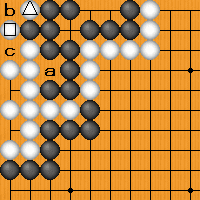
As shown in Example 24, :wt: is dead and point b is dame even though White can play a new uncapturable stone with :w2: . All :w2: does is show that :ws: is alive when considered separately, making point c territory, but it does not show that :wt: is alive. So :wt: is dead.

Your interpretation of the Rules contradicts the example in the Rules.
Click Here To Show Diagram Code
[go]$$ ----------------------
$$ | b Q X X . . X O . . .-| 1 Q X X . . X O . . .
$$ | @ X X . X X X O . . .-| O X X . X X X O . . .
$$ | c O X X O O O O . . .-| 2 O X X O O O O . . .
$$ | O O O X O . . . . . .-| O O O X O . . . . . .
$$ | . O X X O . . . . . .-| . O X X O . . . . . .
$$ | O O O O X . . . . . .-| O O O O X . . . . . .
$$ | . O X X X . . . . . .-| . O X X X . . . . . .
$$ | O O X . . . . . . . .-| O O X . . . . . . . .
$$ | X X X . . . . . . . .-| X X X . . . . . . . .[/go]
User avatar
CDavis7M
Lives in sente
Posts: 716
Joined: Tue Jun 15, 2010 2:18 pm
Rank: Shokyu
GD Posts: 0
Universal go server handle: CDavis7M
Has thanked: 109 times
Been thanked: 140 times
Contact:

Re: How do Japanese rules handle this?

Post by CDavis7M »

Gérard TAILLE wrote:I presented my view on this position in the post viewtopic.php?p=267413#p267413.
I agree with the conclusion given by Jann in the following post viewtopic.php?p=267416#p267416 : in contradiction with what is said in example 1 of the rule I consider that the marked white stone is dead but as explained in the posts mentionned that does not change the final conclusion : the position is unfinished and white has to continue the game.
Looking at those examples and the discussion, it's worth noting that dame filling and teire would occur before concluding L&D confirmation. So these positions with irregularities can be solved in L&D confirmation without continuing the game.

The player can either accept the loss of territory due to dame or fill dame and play teire to solve the issue. Here, White just plays teire in L&D confirmation and the 5 stones are alive when considered separately because they cannot be captured at all.
Click Here To Show Diagram Code
[go]$$
$$ ----------------------
$$ | O . O . X . . O O . O
$$ | O O O X O X O O O O O
$$ | X X X O W O O . O . .
$$ | X . X O O O O O . . .
$$ | . X X . . . . . . . .
$$ | X X . . . . . . . . .
$$ | . . . . . . . . . . .
$$ | . . . . . . . . . . .[/go]
User avatar
CDavis7M
Lives in sente
Posts: 716
Joined: Tue Jun 15, 2010 2:18 pm
Rank: Shokyu
GD Posts: 0
Universal go server handle: CDavis7M
Has thanked: 109 times
Been thanked: 140 times
Contact:

Re: How do Japanese rules handle this?

Post by CDavis7M »

Cassandra wrote:
Click Here To Show Diagram Code
[go]$$
$$ -------------
$$ | ? ? ? O . .
$$ | ? ? ? O . .
$$ | X O O O . .
$$ | X X X . . .
$$ | . . . . . .[/go]
The disputed area (shadowed) in the corner only includes SIX board points.
It is IMPOSSIBLE to establish a group therein that is INDEPENDENTLY alive on its own.
...
It should be clear that it is mandatory for any "new" permanent Black stone :bt: to be connected with Black's already alive :bc: group.
...
The same is true for any "new" permanent White stone :wt: in relation to White's already alive :wc: group.
Like I said in my previous response, the White and Black stones are not simply connecting to an already alive group. This is not a case where a one stone is captured and another stone is added to different group that is alive. This is a case where a stone is captured and that stone can then capture the stones that capture it. It is the ability to capture back that causes the stones to become uncapturable, and thus living.
Cassandra wrote: The only decisive question is whether these stones would have been played if nothing had been captured before.
The answer is "NO".
This interpretation contradicts Example 24. The uncapturable connecting stone would not have been played if the ko-stone had been captured before, yet the ko-stone is deemed dead.

----------

There is a difference between merely adding a stone to your already alive group and actually capturing the opponent's stones to make an uncapturable shape, even if the uncapturable shape is with your already alive stones.
kvasir
Lives in sente
Posts: 1040
Joined: Sat Jul 28, 2012 12:29 am
Rank: panda 5 dan
GD Posts: 0
IGS: kvasir
Has thanked: 25 times
Been thanked: 187 times

Re: How do Japanese rules handle this?

Post by kvasir »

John Fairbairn wrote: Article 7.1 (Dead or alive)
Stones which cannot be captured by moves of the opponent, or stones which, even if they can be captured, can newly form stones that cannot be captured by the opponent, are called 'live stones.' Stones other than live stones are called 'dead stones.'
Fantastic! It is frequently mentioned that the original doesn't contain words/phrases like "enable" and "new stones" but without a new translation it was only possible to guess what that really meant.

I also suppose it doesn't resolve what exactly is the meaning of 'newly forming stones', and that most translations (but you stated your intention) would look for a single English word to express that idea (James Davis uses 'enable' and Google translate uses 'produce'). Still, maybe it is now possible to stop debating the meaning of the phrase 'would enable'.
jann wrote:Where did I wrote that the 1 stone is alive, could you link or quote that? Anyway, I don't think it is, IMO it is dead, and this is a minor oversight in the commentary.
I think I just don't understand what you mean. I thought when you said that the following diagram was seki that this meant the marked white stone was alive, it is same in as example 5. I actually don't know what this diagram was supposed to show beyond example 5, but I may also have confused with what you said about example 4 in the same post.
Click Here To Show Diagram Code
[go]$$
$$ ---------------------------------
$$ | . P X X X O O O O X O O X O O |
$$ | B B O O X X X . O X . O X . O |
$$ | B B O . O O X . O X . O X . O |
$$ | O O O O . O X X O X X O X X O |
$$ ---------------------------------[/go]
Is it then the case that you think that the marked black stones are dead? Otherwise the marked white stone would be in black's territory. Maybe both example 1 and 5 are then wrong? It is hardly an oversight that j89 contradicted Shuwa's ruling in example 1 and it must have been given a lot of thought. This might be the only thing most people know about j89. I have no idea why you describe this as a traditional understanding of the 'enable rule'.
jann wrote:
kvasir wrote:You never explain what your "traditional" interpretation actually is.
I think I did above (around "the advantage of the straightforward/traditional interpretation"), but to make it clear:

"Capturing a string WOULD ENABLE" the opponent to play a new uncapturable stone if:
  • the new stone cannot be played vs resistance in the original position
    (proving that it was ENABLED or made possible in the course of the capture)
  • the string is not capturable without the new stone getting played
    (proving that capturing it WOULD indeed necessarily enable the stone)
Thank you for stating what you think the rule is.

I have little idea why you want to define "would enable" in this way. I don't see the word "enable" as something important or meaningful and I think John's new translation demonstrates that you could use many different words in its place. Basically, I don't understand why you don't discard this idea when it fails on example 1.
User avatar
CDavis7M
Lives in sente
Posts: 716
Joined: Tue Jun 15, 2010 2:18 pm
Rank: Shokyu
GD Posts: 0
Universal go server handle: CDavis7M
Has thanked: 109 times
Been thanked: 140 times
Contact:

Re: How do Japanese rules handle this?

Post by CDavis7M »

jann wrote:
CDavis7M wrote:...
You seem to talk about your own ideas (and not J89 anymore). This is fine, but as others pointed out you use some vague phrases without definition, which makes your ideas unverifiable (and hard to comment on). IMO this is also why you yourself don't notice their lurking contradictions. And you are wrong on example 4: both W strings are alive (separately, as L/D always works string-by-string) on enable.
If you don't bother to read my posts, then why bother to pretend you have? Disagree with my position if you want but don't make stuff up about me that's clearly not true and takes 2 seconds to check. It looks bad.

I am clearly not talking about my own ideas. And I am certainly not using vague phrases without definition. My entire position is based on definitions and I have made several posts providing definitions, some in response to you. I'll quote my previous posts and make it large. But please, don't read it. Instead, buy yourself a copy of the "advanced learned" OED.
CDavis7M wrote:I think some of the confusion comes from looking at the 5 stones first. I don't think this is how "Life & Death Confirmation" works. Considering the L&D status of the 5 stones by placing new uncapturable stones with an already independently living group is not "confirmation" affording to the definition of the word.
CDavis7M wrote:According to Kenkuysha's J-E dictionary:
Kakunin 確認 n. confirmation; affirmation; certification; corroboration; validation.
Jisho.org gives: confirmation; verification; validation; review; check; affirmation; identification.

As for the English definitions of these words, the OED indicates that they all require some uncertainty or informality in a determination or declaration that is now being solidified, firmed, or formalized.
CDavis7M wrote:The OED defines "enable" as give (someone) the ability or means to do something; make possible. As shown, it is the capture of the 1 White stone that makes the uncapturable stones possible to play in L&D confirmation of the White stones. We can't just pretend that words have no meaning.
CDavis7M wrote: My understanding of L&D "confirmation" is based on the definition of "confirmation" which requires consideration of dependencies (can status already be confirmed or is something left unknown and yet to be confirmed). The position of the new stone only matter if it is uncapturable because of other stones that can already be deemed alive separately.
CDavis7M wrote:The 1 stone considered separately is alive because it is alive independent of whether the 5 stones are captured or not. The 5 stones are dead because the 1 stone is independently alive. This means that there is nothing unknown to be determined. There is nothing left to "confirm," by definition. Assessing the 5 stones does not "confirm" anything about L&D.
CDavis7M wrote:This all goes back to the definition of "Confirmation" mentioned above. It is the determination of something unknown. The status of the 1 stone is known. Assessing the status of the 5 stones separately does not determine anything that is unknown so it does not "confirm" the living status of the 5 White stones. By the rules, if stones cannot be confirmed as alive, then they are dead.
-----
jann wrote: And you are wrong on example 4: both W strings are alive (separately, as L/D always works string-by-string) on enable.
I disagree. White's side stones are dead when considered separately but during confirmation the interdependence would be recognized. In Example 4, there is symmetry of stones such that if the 5 White stones on one side are captured then the 5 White stones on the other side cannot be captured, and vice versa. When confirming the L&D status of 5 stones separately, those stones are deemed dead. But when considering the other 5 stones, the symmetry and interdependence is recognized and the 10 stones can be deemed alive. The bottom line is that the players would recognize that the 5 stones should not be considered separately (where they are dead) but should be considered as 10 stones. Just like the players would not break a two eye group into two one-eye groups and pretend that they are dead separately. There is an interdependence in a 2 eye group just as there is an interdependence here.
User avatar
CDavis7M
Lives in sente
Posts: 716
Joined: Tue Jun 15, 2010 2:18 pm
Rank: Shokyu
GD Posts: 0
Universal go server handle: CDavis7M
Has thanked: 109 times
Been thanked: 140 times
Contact:

Re: How do Japanese rules handle this?

Post by CDavis7M »

Gérard TAILLE wrote:nobody can claim to have the correct understanding.
Actually, isn't everybody claiming to have the correct understanding? Well, here's my understanding of what L&D "confirmation" means:

If :wc: can be captured and newly form uncapturable stones :wt: without :ws: being captured. Then showing that :wc: and :ws: can be captured while only newly forming uncapturable stones :wt: again does not confirm anything beyond :wc: being alive. :ws: is extraneous. So :ws: is dead.
--------------------
John Fairbairn wrote:

Code: Select all

[b]NEW TRANSLATION
Article 7.1 (Dead or alive)
Stones which cannot be captured by moves of the opponent, or stones which, even if they can be captured, can newly form stones that cannot be captured by the opponent, are called 'live stones.' Stones other than live stones are called 'dead stones.'[/b]
I accept Fairbairn's wording of Article 7-1. It is similar to what I understood though "newly formed stones" is a new perspective. Also, my position is not necessarily based on Article 7-1. The basis of my position is Article 9-1 End-of-Game and the term 確認:

Kakunin 確認 n. confirmation; affirmation; certification; corroboration; validation.
A Japanese-language dictionary defines 確認 as involving a 争い (dispute) or 疑い (doubt, uncertainty) that is 認める(recognized, deemed) and はっきり (made clear).
The English definitions of confirmation, affirmation, certification, corroboration, and validation all require some uncertainty or informality in a determination or declaration that is now being solidified, firmed, or formalized.

Therefore any "confirmation" of Life & Death after the game is stopped must involve some uncertainty or unknown status that is being deemed or clarified, by definition. And so by definition, if some capturable stones :wc: can newly form stones :wt: that cannot be captured by the opponent regardless of whether other stones :ws: are captured, then the status of the other stones :ws: cannot be said to be "confirmed" based on the newly formed stones :wt: . Showing a variation with the same newly formed stones :wt: to pretend that the other stones :ws: are alive does not work because it does not clarify anything that was unknown -- those stones :wt: could already be newly formed and uncapturable without those stones :ws: being captured.

Again, my position does not rely on the definition of Life and Death, but on an understanding of what it means to CONFIRM Life and Death.

----------

Variations 1 and 2 show reasons why the 1 stone :wc: is alive separate from the 5 White stones :ws: in the corner. Variation 3 shows the reason why the 5 stones :ws: are dead.

Variation 1: Black does not bother to capture the 5 stones because their L&D is not being confirmed. Doing so would not "confirm" anything about the 1 stone :wc: . Only the status of the 1 stone :wc: is being confirmed. The newly formed stones :wt: are uncapturable by virtue of having captured Black's :bx: stones.
Click Here To Show Diagram Code
[go]$$ :w4: pass, :b5: pass, :b7: pass
$$ ----------------------
$$ | O . O . X 2 3 O . . O-O . O . X 8 Z O . . O-O . O . X Q M O . . O
$$ | O O O X W X O O O O O-O O O X 6 Z O O O O O-O O O X Q M O O O O O
$$ | X X X O 1 O O . O . .-X X X O Z O O . O . .-X X X O M O O . O . .
$$ | X . X O O O O O . . .-X . X O O O O O . . .-X . X O O O O O . . .
$$ | . X X . . . . . . . .-. X X . . . . . . . .-. X X . . . . . . . .
$$ | X X . . . . . . . . .-X X . . . . . . . . .-X X . . . . . . . . .
$$ | . . . . . . . . . . .-. . . . . . . . . . .-. . . . . . . . . . .
$$ | . . . . . . . . . . .-. . . . . . . . . . .-. . . . . . . . . . .[/go]
Variation 2: Similar to variation 1 except that Black happens to capture the 5 White stones. However, only the status of the 1 stone :wc: is being confirmed. The newly formed stones :wt: are uncapturable by virtue of having captured Black's :bx: stones.
Click Here To Show Diagram Code
[go]$$ :w4: pass, :b5: pass, :b7: pass
$$ ----------------------
$$ | O . O . X 2 3 O . . O-O 7 O 5 X 8 Z O . . O-. X . X X Q M O . . O
$$ | O O O X W X O O O O O-O O O X 6 Z O O O O O-. . . X Q M O O O O O
$$ | X X X O 1 O O . O . .-X X X O Z O O . O . .-X X X O M O O . O . .
$$ | X . X O O O O O . . .-X . X O O O O O . . .-X . X O O O O O . . .
$$ | . X X . . . . . . . .-. X X . . . . . . . .-. X X . . . . . . . .
$$ | X X . . . . . . . . .-X X . . . . . . . . .-X X . . . . . . . . .
$$ | . . . . . . . . . . .-. . . . . . . . . . .-. . . . . . . . . . .
$$ | . . . . . . . . . . .-. . . . . . . . . . .-. . . . . . . . . . .[/go]
Variation 3: This is the exact same as Variation 2 except that the L&D status of the 5 stones is being considered separate from the 1 stone. When considering the 5 stones separately, they can newly form stones that are uncapturable as long as the 1 stone is captured. However, these newly uncapturable stones can be newly formed by the capture of the 1 stone alone as in Variation 1. These newly formed stones are already known to be formable from the capture of the 1 stone alone. Capturing 5 stones in addition to the one stone is extraneous activity. There is nothing unknown that is being confirmed. The 5 stones cannot be confirmed as alive, so they are dead.
Click Here To Show Diagram Code
[go]$$ :w4: pass, :b5: pass, :b7: pass
$$ ----------------------
$$ | @ . @ . X 2 3 O . . O-O 7 O 5 X 8 Z O . . O-. X . X X Q M O . . O
$$ | @ @ @ X O X O O O O O-O O O X 6 Z O O O O O-. . . X Q M O O O O O
$$ | X X X O 1 O O . O . .-X X X O Z O O . O . .-X X X O M O O . O . .
$$ | X . X O O O O O . . .-X . X O O O O O . . .-X . X O O O O O . . .
$$ | . X X . . . . . . . .-. X X . . . . . . . .-. X X . . . . . . . .
$$ | X X . . . . . . . . .-X X . . . . . . . . .-X X . . . . . . . . .
$$ | . . . . . . . . . . .-. . . . . . . . . . .-. . . . . . . . . . .
$$ | . . . . . . . . . . .-. . . . . . . . . . .-. . . . . . . . . . .[/go]
----------

If :wc: can be captured and newly form uncapturable stones :wt: without :ws: being captured. Then showing that :wc: and :ws: can be captured while still newly forming uncapturable stones :wt: does not confirm anything beyond :wc: being alive. :ws: is dead.
kvasir
Lives in sente
Posts: 1040
Joined: Sat Jul 28, 2012 12:29 am
Rank: panda 5 dan
GD Posts: 0
IGS: kvasir
Has thanked: 25 times
Been thanked: 187 times

Re: How do Japanese rules handle this?

Post by kvasir »

CDavis7M wrote:Therefore any "confirmation" of Life & Death after the game is stopped must involve some uncertainty or unknown status that is being deemed or clarified, by definition. And so by definition, if some capturable stones can newly form stones that cannot be captured by the opponent regardless of whether other stones are captured, then the status of the other stones cannot be said to be "confirmed" based on the newly formed stones . Showing a variation with the same newly formed stones to pretend that the other stones are alive does not work because it does not clarify anything that was unknown -- those stones could already be newly formed and uncapturable without those stones being captured.
My dictionary says that 'confirmation' is the "the process of supporting a statement by evidence" and 'confirming' is "to state or show that (something) is true or correct". There is ofcourse no requirement that something is not already known when it is confirmed; I can confirm this.

I do not understand when you talk about first confirming the 1 stone and then the 5 stones but say that some arguments are invalid once the 1 stone has been confirmed because something is now "already known" and therefore excluded. That is, you seem to exclude the new stones because it was "already known" that they could be played. Would I be allowed to claim that the 5 stones are alive but the 1 stone is not because I confirmed the status of the 5 stones first and now it is "already known" that some new stones can be played and this won't be accepted to show that the 1 stone is alive.

You appear to discus status confirmation as a sequence of steps were it is allowed to refer back to prior steps and claim something is now "known" and has to be excluded for the remaining steps. How do you decide the order of steps? Isn't this bound to lead to arguments about the order of steps? Finally, if this was really required to reach the right conclusions in status confirmation, then would there not be an example of this in the life and death examples?

Basically, I don't think status confirmation can require us to know anything about which stones we have already addressed and which not. Such knowledge might be useful to speed up the process or simplify it but any argument that appears to depend on the order in which the status confirmation is done is very suspect. For one thing there is nothing like that in the examples.
User avatar
CDavis7M
Lives in sente
Posts: 716
Joined: Tue Jun 15, 2010 2:18 pm
Rank: Shokyu
GD Posts: 0
Universal go server handle: CDavis7M
Has thanked: 109 times
Been thanked: 140 times
Contact:

Re: How do Japanese rules handle this?

Post by CDavis7M »

kvasir wrote:My dictionary says that 'confirmation' is the "the process of supporting a statement by evidence" and 'confirming' is "to state or show that (something) is true or correct". There is ofcourse no requirement that something is not already known when it is confirmed; I can confirm this.
If something needs to be supported by evidence, how could it be that there is nothing unknown about that thing? If nothing is unknown, then why is evidence being submitted at all? What is the evidence showing except something that was unknown? And the second definition still involves something unknown. When a person "confirms" that something is true or false, they do so in a situation where it is unknown whether the person (still) considers it to be true or false. If it was already known what their statement would be, there is no reason to "confirm" it, it would be known. "Confirmation" absolutely requires something to be unknown, even if it is only a question of whether a person will state the thing same thing again.

And it's nice to talk about things that are not the rules, but what does your dictionary say about 確認? Because my dictionary defines it using 争い and 疑い.

----------
kvasir wrote:I do not understand when you talk about first confirming the 1 stone and then the 5 stones but say that some arguments are invalid once the 1 stone has been confirmed because something is now "already known" and therefore excluded. That is, you seem to exclude the new stones because it was "already known" that they could be played. Would I be allowed to claim that the 5 stones are alive but the 1 stone is not because I confirmed the status of the 5 stones first and now it is "already known" that some new stones can be played and this won't be accepted to show that the 1 stone is alive.

You appear to discus status confirmation as a sequence of steps were it is allowed to refer back to prior steps and claim something is now "known" and has to be excluded for the remaining steps. How do you decide the order of steps? Isn't this bound to lead to arguments about the order of steps?
Humans (most) do not behave like computers running an algorithm. Regardless of whether the players confirm the status of the 1 stone first or the 5 stones first, they will eventually realize that the 1 stone is alive without the 5 stones being captured at all. Gerard already asked whether order was important to my position and I explained why not: viewtopic.php?p=269860#p269860.

---------------
kvasir wrote:Finally, if this was really required to reach the right conclusions in status confirmation, then would there not be an example of this in the life and death examples?
Let me start by asking this: if it was possible for stones to be capturable but alive with territory (not dame) in L&D confirmation without there being a snapback or nakade shape, then would there not be an example of this in the Japanese Rules? Since this position has a ko and does not involve a snapback or nakade shape, then it must be the case that there is dame, right?

As to your question, I think it's silly to pretend that a group of stones is alive by adding a stone to a different group of independently alive stones. I'm not surprised that the Japanese rules didn't include an example to scold the players.

If you are looking for an example where status confirmation happens in steps and the players must determine whether a subset of the stones are alive or not, then Example 24 is the one and I've already brought it up. In explanation (1) of Ex. 24 it states that the White stones (all of them) are alive. It mentions there is an external dame to fill to get territory. In explanation (2) it considers :wt: and :ws: separately. It doesn't get into details but explains that :wt: is dead and :ws: is alive.

If the players considered :wt: , they might consider it alive since they can play an uncapturable stone at point 'c'. But after they consider the status of :ws: they will realize that it is :ws: that is alive because it cannot be captured by connecting at 'c'. If :ws: is already alive by connecting at 'c', then :wt: cannot be alive because of a play at 'c' -- that confirms nothing. It is already known that :ws: is alive.

Image

----------
kvasir wrote: Basically, I don't think status confirmation can require us to know anything about which stones we have already addressed and which not. Such knowledge might be useful to speed up the process or simplify it but any argument that appears to depend on the order in which the status confirmation is done is very suspect. For one thing there is nothing like that in the examples.
Status confirmation absolutely requires the players to know which stones have been addressed and to confirm the status of certain groups of stones first. If the players did not already confirm that the White group with 2 eyes cannot be captured, then they would not even know that the newly placed stones capturing black are uncapturable. If the nearby stones were not alive, the hoped-uncapturable stones might still die -- like in seki collapse. Stones might be in seki, but once it is known that it collapsed, one side is dead.
User avatar
Cassandra
Lives in sente
Posts: 1326
Joined: Wed Apr 28, 2010 11:33 am
Rank: German 1 Kyu
GD Posts: 0
Has thanked: 14 times
Been thanked: 153 times

Re: How do Japanese rules handle this?

Post by Cassandra »

CDavis7M wrote:Status confirmation absolutely requires the players ... to confirm the status of certain groups of stones first.
Each and every status confirmation starts with the board position at the end of "play".


"Stones which cannot be captured by moves of the opponent,"
I.e. the opponent tried / tries to capture stones, but failed / will fail.


"or stones which, even if they can be captured,"

I.e. the opponent tried / tries to capture stones, and succeeded / will succeed.


"can newly form stones that cannot be captured by the opponent,"
I.e. the opponent tried / tries to capture stones, but failed / will fail.


The number of trials is not limited!!!

But at some point, sooner or later, the opponent will realise his inability to succeed.
They will be glad and happy to have their successes noted.
The really most difficult Go problem ever: https://igohatsuyoron120.de/index.htm
Igo Hatsuyōron #120 (really solved by KataGo)
kvasir
Lives in sente
Posts: 1040
Joined: Sat Jul 28, 2012 12:29 am
Rank: panda 5 dan
GD Posts: 0
IGS: kvasir
Has thanked: 25 times
Been thanked: 187 times

Re: How do Japanese rules handle this?

Post by kvasir »

CDavis7M wrote:And it's nice to talk about things that are not the rules, but what does your dictionary say about 確認? Because my dictionary defines it using 争い and 疑い.
Common! It is 'confirming' same as in 'confirming a hotel booking', 'acknowledge' as in 'acknowledge a receipt' and so forth. It is 'life and death review' or 'life and death acknowledgment' not 'life and death conflict'.
Post Reply