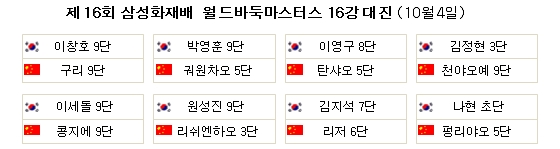
Home. Drinking a beer and thinking of youcdybeijing wrote:Where is Qiu Jun?

P.S. He lost to Wang Tao in the preliminaries

Home. Drinking a beer and thinking of youcdybeijing wrote:Where is Qiu Jun?
Far from clarifying, it seems confusing: there were >60 players from china and >110 from Korea. While I can imagine top Japanese players focusing on the more remunerative national title games, I cannot understand why other players would choose not to participate...trout wrote:To clear up some confusion among discussion;
In Samsung Cup preliminary tournament, there were 28 players from Japan participating. And only 2 players passed and joined main tournament.
This would explain it.hyperpape wrote: I am not sure if the Samsung follows the same format, but for many tournaments, the number of seeds is based on past performance. So the underrepresentation is not exactly unfair. It would still have the bad effect of making results "sticky"--if your strength is equal, but you only had two representatives because of past performance, it would take a long time for things to rebalance themselves.
If Japanese tournaments pay better than their Korean and Chinese counterparts, it's a higher opportunity cost to compete in preliminaries.iazzi wrote:Far from clarifying, it seems confusing: there were >60 players from china and >110 from Korea. While I can imagine top Japanese players focusing on the more remunerative national title games, I cannot understand why other players would choose not to participate...trout wrote:To clear up some confusion among discussion;
In Samsung Cup preliminary tournament, there were 28 players from Japan participating. And only 2 players passed and joined main tournament.
Several long technical digressions could happen here. I was simplifying, but actually I also think that what I said is technically true if you think about distributions of strength, rather than just "how strong the Japanese are".iazzi wrote: Actually, even if the japanese representative were the same level of other countries they would have less probability of winning. So they can only raise their participation ratio if they become much stronger than other countries, unless the "performance" is evaluated against the expectation (unlikely). If every game has a 50% probability of going either way the chance of a japanese passing the preliminaries was likely around 50% as well (did not do the exact calculation only an estimate). The chance of a top three is negligible. And I did not see any current or past top title holder in the preliminaries apart from O Rissei.
I agree and suspect we would have the same opinion on any specific example, but this is becoming offtopic and to have a meaningful discussion we should know the exact rules used to assign places.hyperpape wrote:Several long technical digressions could happen here. I was simplifying, but actually I also think that what I said is technically true if you think about distributions of strength, rather than just "how strong the Japanese are".
John Fairbairn wrote:Yi Ch'ang-ho had voiced concern about accepting his wild-card status



more money to top few???jswm wrote:I hope China Weiqi league extend to NE Asia Baduk/Go/Weiqi league, and cut a few commercial cups but give more money award. It will help young players and encourage top players to pay more attention into cup competitions.
League ensure dozens of players have a good life, this is your said distribute evenly. The biggest beneficiary of league is hopeful young players, league gives them enough chance to improve.Magicwand wrote:more money to top few???jswm wrote:I hope China Weiqi league extend to NE Asia Baduk/Go/Weiqi league, and cut a few commercial cups but give more money award. It will help young players and encourage top players to pay more attention into cup competitions.
that is not an answer to the problem.
more chances mean that money will be distributed evenly to more players which is better.